top 88 comments

sorted by: hot top controversial new old
[–] 80 points 1 year ago

Best math meme so far.

  • source
  • [–] 160 points 1 year ago (34 children)

    I understand why this is wrong (order of operations dictates the division happens first, so it's really 25 - 1 = 24), but why is it funny? I don't mean "This isn't funny," I think I'm just missing the joke.

  • source
  • hideshow 34 child comments
  • [–] 397 points 1 year ago* (21 children)

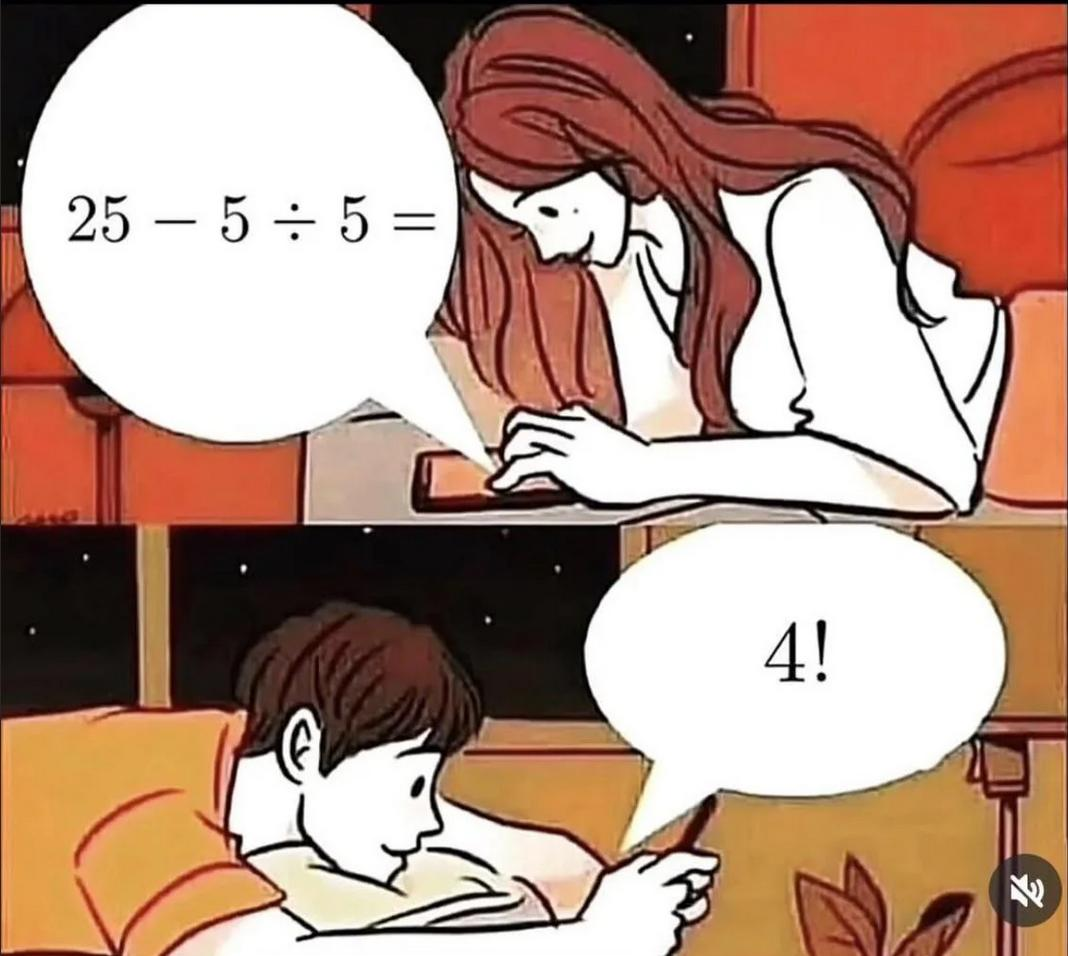
    4! Is meant to be 4 factorial. 4! = 4 x 3 x 2 x 1 = 24

  • source
  • parent
  • hideshow 21 child comments
  • [–] 42 points 1 year ago (4 children)

    And here I was thinking I was still decent at math. I got bamboozled...

  • source
  • parent
  • hideshow 4 child comments
  • [–] 12 points 1 year ago (3 children)

    Everybody forgets the factorial...

  • source
  • parent
  • hideshow 3 child comments
  • [–] 7 points 1 year ago* (13 children)

    The fuck is a "factorial"? They didn't teach me that one in high school math and I couldn't afford college.

  • source
  • parent
  • hideshow 13 child comments
  • [–] 15 points 1 year ago* (5 children)

    Factorial means n! = (n)(n-1)(n-2)... etc. down to 1, where n is a positive integer. It's used to calculate the different number of configurations of a set of elements, mainly in combinatorics.

    Like if you have four different objects and you want to know how many different configurations you can order them in, you have four choices for the first object, then three for the second, then two for the third, then one for the final slot. So the answer is 4 x 3 x 2 x 1 = 24 = 4!.

  • source
  • parent
  • hideshow 5 child comments
  • [–] 5 points 1 year ago (4 children)

    What's the point of factorials?

  • source
  • parent
  • hideshow 4 child comments
  • [–] 8 points 1 year ago

    They're used in permutations and combinations a lot. Combinations is pretty obvious based on the name. Given X things, how many ways are there to choose Y. Permutations are the same but where order matters.

    For example, if you shuffle a deck of cards properly randomly there will be 52! possible orderings (permutations).

  • source
  • parent
  • [–] 8 points 1 year ago* (last edited 1 year ago)

    the most tangible and direct application is how many different ways you can order x many items.

    eg. how many different ways can you order 3 items?

    let's say you have these 3 items: 🍏🫐🍒

    the first one can be any one of the three, so you have 3 options. that's 3 different ways to start your order. let's write that down:

    3

    now for the second one. whichever one you picked for first position will be unavailable, so you'll have 2 options this time. this is true for each first pick separately, so you multiply the possible number of first picks by the possible number of second picks:

    3 x 2

    now for the third item, since two of the three are already picked, you only have one left, which means not much to choose. you just multiply the 1:

    3 x 2 x 1

    of course multiplying by 1 doesn't change anything but as we mentioned there was no option this time, once you pick the second fruit the third is also auto-picked, so the third item doesn't add to our number.

    so the final answer seems to be:

    3 x 2 x 1 = 6

    is that true? might feel like there should be more ways but let's test it; can't be that complicated:

    1. 🍏🫐🍒
    2. 🍏🍒🫐
    3. 🫐🍏🍒
    4. 🫐🍒🍏
    5. 🍒🍏🫐
    6. 🍒🫐🍏

    here you go. you can extrapolate this logic to any number. four items would've followed the same sequence starting with 4 and have 1 less option with each pick, so 4 x 3 x 2 x 1. and that's also 4!

  • source
  • parent
  • [–] 4 points 1 year ago

    There are lots of applications, so I’ll give you three

    Factorials are used in the Taylor Series to approximate trigonometric (sine, cosine, etc) and the exponential function. This can help speed up calculations.

    In probability and statistics, if you want to find how many different ways a deck of cards can be shuffled, the answer is 52! Because the first card can be any of the 52, the second can be any of the remaining 51, and so on until the last card. Building upon this concept results in ways to model data like the binomial distribution , which is simply “how many successes will i get if i do this trial a certain number of times”. E.g. If I flip a coin 100 times, how many times will it be heads?

    In computer science, the complexity of a program is compared to functions like the factorial, exponential, quadratic, etc. to visualize it’s performance given the size of the input, n. E.g. a program of linear time complexity is denoted as O(n), and as n increases, we expect the time for the program to finish to increase linearly. For a factorial time complexity, O(n!), we expect the time to complete to increase a lot compared to O(n)

  • source
  • parent
  • [–] 2 points 1 year ago

    Makes things shorter.

    In the applications mentioned by other people, you run into calculations that would look really messy and confusing. Things like 5•4•3•2•1 can be shorted to just 5! Imagine writing the full version of 123!

  • source
  • parent
  • [–] 18 points 1 year ago (4 children)

    Im sorry your highschool curriculum failed to teach you. I learned factorals in jr highschool

  • source
  • parent
  • hideshow 4 child comments
  • [–] 4 points 1 year ago* (last edited 1 year ago) (2 children)

    4 factorial (written as 4!) is 4•3•2•1

    I think this example explains it perfectly lol

    Edit: using • instead of * to avoid markdown

  • source
  • parent
  • hideshow 2 child comments
  • [–] 4 points 1 year ago* (1 child)

    Just a small correction in case you didn't know, but your answer shows as 432*1 because Lemmy formats text wrapped by * as italic, so it thinks you want to italicize the 3. You meant to write 4*3*2*1 (written as 4\*3\*2\*1). This is because \ is an escape character that tells lemmy not to take the * as a formatting character.

  • source
  • parent
  • hideshow 1 child comment
  • [–] 5 points 1 year ago (1 child)

    You didn't learn factorials in high school?

  • source
  • parent
  • hideshow 1 child comment
  • [–] 4 points 1 year ago

    In High School education, Factorials are generally part of the curriculum, but they're one of those things you get one section on, it shows up on one test, then in common usage, you never see it again. In many schools, someone could have been out for a day, gotten two answers wrong on a test, and never have known it. Then in my school, unless you were heading on a math track, you'd hardly even touch Calculus to see it actually used anywhere.

  • source
  • parent
  • [+] -10 points 1 year ago (5 children)

    Cause math people has a weird humor?

  • source
  • parent
  • hideshow 5 child comments
  • [–] 53 points 1 year ago (4 children)
  • [–] 3 points 1 year ago (2 children)

    The exclamation point in the answer, from a math perspective, makes it 4 factorial: 4 x 3 x 2 x 1 = 24, which is the correct answer.

  • source
  • parent
  • hideshow 2 child comments
  • [+] 47 points 1 year ago (2 children)
  • [–] 131 points 1 year ago
    [–] 26 points 1 year ago

    Ok this is funny

  • source
  • [–] 24 points 1 year ago*

    This is quite possibly the best maths joke I've ever seen.

    [edit] I guess it still can't beat the 'be rational' / 'get real' one.

  • source
  • [–] 21 points 1 year ago (1 child)
  • [–] 26 points 1 year ago

    You got the wrong symbol in the headline, it should be >3

  • source
  • [–] 30 points 1 year ago (6 children)

    Comment section full of people looking for an opportunity to argue

  • source
  • hideshow 6 child comments
  • [–] 48 points 1 year ago (4 children)
  • [–] 19 points 1 year ago (3 children)

    Yes it is

    Wait, will this be the 5-minute or the half hour?

  • source
  • parent
  • hideshow 3 child comments
  • [–] 20 points 1 year ago

    Thank God this meme is muted

  • source
  • [–] 30 points 1 year ago (7 children)

    ASCII hack failure of language. Even in mathematics, ! has multiple meanings like with Boolean NOT. We need a science, math, and language reformation to remove non intuitive narcissistic names, and implied contextual meanings.

  • source
  • hideshow 7 child comments
  • [–] 20 points 1 year ago* (3 children)

    You might find Lojban interesting if you are not already aware. (I haven't tried to learn it myself, I just know it exists)

  • source
  • parent
  • hideshow 3 child comments
  • [–] 4 points 1 year ago (1 child)

    If someone wants to start a Lojban pun community, I would definitely subscribe just to learn about Lojban.

    Although, if no one posted in the community, I wouldn't be sure if it was a perfectly logical language or the community was just dead.

  • source
  • parent
  • hideshow 1 child comment
  • [–] 4 points 1 year ago* (last edited 1 year ago)

    .i la lojban cu mutce lo ka smuske tinsa .i ku'i ly. na logji prane pe'i .i loi jbopre cu piso'iroi da'asnu lo ka prane nitcu .i ru'a lo klamburi cu na'e lojbo ka'u .i jy. xebni lo malgli .iseju lo nu lojbo klamburi zbasu cu nandu ba'a jeku'i cumki

    Lojban is very semantically rigid, but not perfectly logical IMO. Lojbanists often argue about the necessity of logical perfection. I suspect that puns might not be seen as culturally Lojbanic. Lojbanists hate Anglicisms or bits of English leaking into the way they speak Lojban. Regardless, making Lojbanic puns might be difficult but it's possible.

  • source
  • parent
  • [–] 9 points 1 year ago (1 child)

    I've never seen ! used for boolean NOT in maths, just ¬. I think ! is something programming languages went for because it's easier to type. That said, screw (a, b). Is that a (coordinate) pair, an interval, an inner product, some secret fourth thing? Who knows!

  • source
  • parent
  • hideshow 1 child comment
  • [–] 7 points 1 year ago* (1 child)

    Promptly Evacuate Manure Drain And Septic

  • source
  • hideshow 1 child comment
  • [–] 2 points 1 year ago

    The answer in the comic is correct. It's just written in a way to make you as the reader think he's got it wrong for a second.

    The ! operator in mathematics indicates a function called a factorial. Four factorial, or 4! = 4 × 3 × 2 × 1 = 24. Which is the correct answer if you follow the proper order of operations.

  • source
  • parent
  • [–] 7 points 1 year ago (2 children)

    Can someone explain to me why this is funny?

  • source
  • hideshow 2 child comments
  • [–] 30 points 1 year ago (1 child)

    So with people who do order of operations incorrectly, you have 25-5 =20 and then divide it by 5 and you get 4.

    However the correct answer is 24 since you do the division first.

    Where the joke comes in is he states “4!”, which sounds like he is emphatic about the wrong answer. However an exclamation mark is “factorial” which translates to 4x3x2x1… which happens to equal the correct answer of 24.

  • source
  • parent
  • hideshow 1 child comment
  • [–] 5 points 1 year ago

    007 will never get this wrong, it's 4, 24.

  • source
  • [–] 5 points 1 year ago* (1 child)
    [–] 4 points 1 year ago

    My favourite kind of nerd.

  • source
  • [–] 3 points 1 year ago

    #DAMN YOU MATHEMATICIANS! YOU GOT ME AGAIN!!!

  • source
  • [–] 5 points 1 year ago* (last edited 1 year ago) (3 children)

    25 - ⁵/₅ = 25 - 1 = 24

    If you wrote it vertically:

    25 - 5
    ————— = 4
    5

    But once you lay it out on one line, you have to use prins to prioritize addition / subtraction:

    (25 - 5) / 5 = 20 / 5 = 4

    Some YouTube mathematicians deep-dive into this.

    ETA: Nothing goes over my head! My reflexes are too fast, I would catch it.

  • source
  • hideshow 3 child comments
  • [–] 4 points 1 year ago (2 children)
  • user has left the channel

  • source
  • [–] 1 point 1 year ago (6 children)

    I’m only going to say this once but if I’m doing a sum and you want me to do it in a specific order, use brackets. That’s what brackets are for. Don’t expect me to do things in a predetermined order because I literally can’t be bothered and I will never care enough to do that. I’m already doing a sum so don’t push it, okay bud

  • source
  • hideshow 6 child comments
  • [–] 28 points 1 year ago (3 children)

    But that's a bit like saying "If you're going to talk to me, put the adjectives before the nouns," even in Spanish where they come after. Mathematical notation is a language and it has a syntax. Sure, you can decide to ignore that syntax, or insist that people modify their use of it for you, but it's not really a reasonable expectation.

  • source
  • parent
  • hideshow 3 child comments
  • [+] -9 points 1 year ago (2 children)

    I think this is very stupid for a number of reasons. Why is there an order of operations that supersedes the direction the operations are written in? That’s at best dim witted and at worst deliberately misleading. Grog write left to right. Grog read left to right. Grog do sum left to right.

    There is absolutely no reason in the world why anybody should have to know that division comes before subtraction. That’s fucking insane, man. What is the point of writing things down if you’re only going to do them in a set order anyway? May as well have a big jumble of letters and numbers and symbols on the page at that point, like who cares. The whole point of writing things down is to express concepts. Can’t do that with any kind of nuance if you’re going to read it one way anyway, no matter how you write it down. That would be like saying you always pronounce certain letters at the start of words even if they’re in the middle. Completely nuts.

  • source
  • parent
  • hideshow 2 child comments
  • [–] 12 points 1 year ago

    If all people did was simple equations like the one in the OP, you'd probably be right, but math syntax has to deal with all kinds of equations. Your way, I can't write 3x^2–4x+5. Instead, I'd have to write ((((3x)^2)−4)x)+5. That's WAY more obnoxious. It's better to have an unambiguous syntax that covers all the cases and lets me write equations in an more simple form.

  • source
  • parent
  • [–] 1 point 1 year ago

    It's about time there was a real argument in here

  • source
  • load more comments
    view more: next ›
    5 comments in c/unexpectedfactorial@sopuli.xyz view that post