The French writer Michel Houellebecq is in the hot seat over comments he made in the French press (Front Populaire, 11/29/22; quoted in Union des Mosquées de France, 5/30/23) that could be considered incitement against the country’s Muslims, a crime in the French system.
And with the French legal system looking into him, editorialists in the United States are crying that policing his anti-Muslim bombast is a crisis for Western civilization. These pundits illustrate a double standard in the media regarding free speech.
‘Attacks and shootings in mosques’
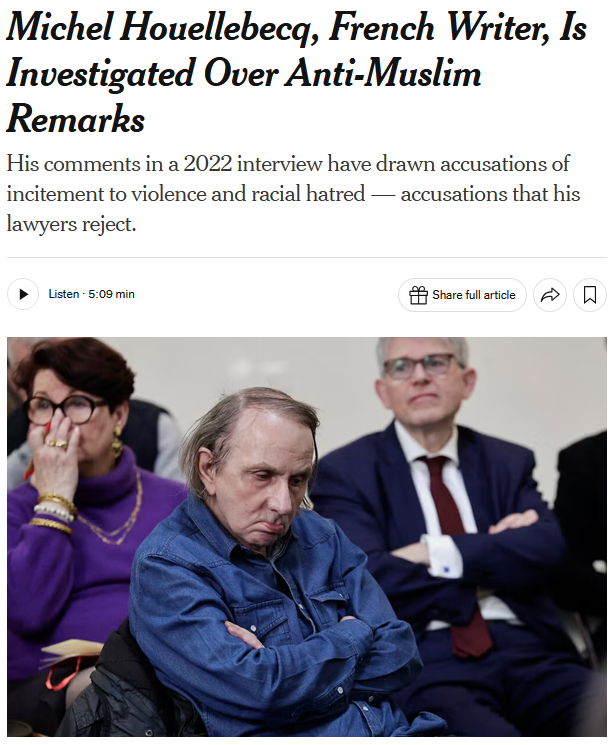
The New York Times (11/11/26) avoided quoting the parts of Michel Houellebecq’s remarks that could be construed as an incitement to violence.
The New York Times (11/11/26) summarized the current scandal:
The investigation…was prompted by remarks that Houellebecq made in an interview with the French magazine Front Populaire. He described Muslims as a threat to France’s security and said they could be subject to the kind of violence that struck Paris in 2015, with the deadly attack by Islamic State terrorists.
“I believe that the wish of the native French population, as they say, is not for Muslims to assimilate, but for them to stop stealing from and assaulting them, in short, for their violence to decrease, for them to respect the law and other people,” Houellebecq (pronounced WELL-beck) told the French philosopher Michel Onfray in the interview. “Or, another good solution, for them to leave,” Houellebecq added.
The Times again:
When Onfray raised the issue of the “great replacement” theory, a racist concept by the writer Renaud Camus that holds that white Christian Europeans are being replaced by people of color, including Muslims, Houellebecq replied, “I was very shocked that it was called a theory. It’s not a theory, it’s a fact.”
Interestingly, the Times didn’t include the part of the quote that could be considered incitement: Houellebecq told Front Populaire that if places in France “come under Islamic control, I think acts of resistance will take place.” He specified: “There will be attacks and shootings in mosques, in cafés frequented by Muslims, in short, Bataclan in reverse”—a reference to the deadly ISIS attack on the Bataclan theater in Paris in 2015. In context, it’s clear that Houellebecq thinks this would be a good thing.
‘A disgusting inversion of justice’
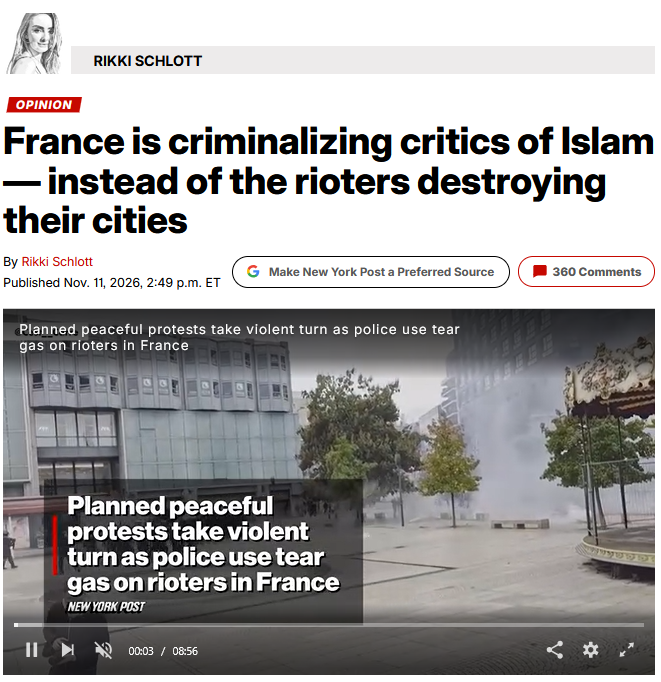
Why aren’t the French cracking down on rioters, New York Post columnist Rikki Schlott (11/11/26) asks–accompanied by video of the French using tear gas on rioters.
Right-wing editorialists are having a field day over the legal probe into the writer’s statements. At the Murdoch-owned New York Post (11/11/26), Rikki Schlott writes:
It’s a disgusting inversion of justice–and an indication that a nation being torn apart from within is more concerned with thought crimes of its citizens than the actions of hooligans intent on destroying civilization itself.
The Post’s more literate Murdoch sibling, the Wall Street Journal, ran at least two columns about this. Meghan Cox Gurdon (11/17/26) wrote:
Our own culture—by which I mean the West—is becoming so dainty about offending the intemperate that it is failing to defend the principles and values that made it free and prosperous as a civilization. Without free speech, without the free exchange of ideas, even rude ones, we will not long remain what we have been. And then we will really be in trouble.
And Dominic Green (Wall Street Journal, 11/16/26) said, Houellebecq’s “vision of the future is unpalatable,” but “shouldn’t become unsayable.” This seems like a straight-forward free speech includes offensive speech line, but it gets darker, calling the situation a “crisis of the liberal state.”
Green didn’t just defend the writer’s ability to say controversial things, but identified with his rejection of the country’s Muslims:
The French like pork, alcohol, topless beaches and provocative writers. They never wanted mass immigration or Muslim values in public life. They now feel besieged in their own country. France’s soccer team may be integrated around a common goal, but French society isn’t.
At the Atlantic (11/12/26), Thomas Chatterton Williams, who’s built a career out of the right’s ongoing moral panic against wokeness (e.g., New Yorker, 7/22/20; PBS, 4/14/23; Vanity Fair, 1/27/26), said “An assault on free speech is unfolding in France.”
These sentiments were repeated in British Tory media, like the Telegraph (11/13/26), Spectator (11/13/26) and UnHerd (11/11/26).
‘There isn’t an absolutist commitment’
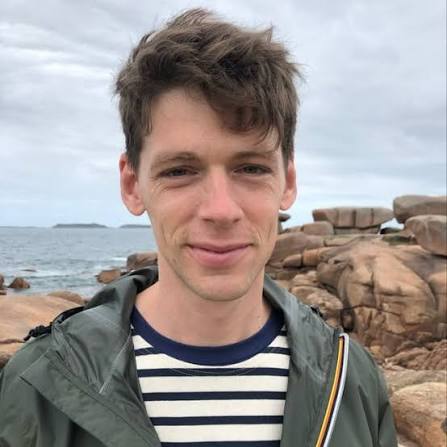
Cole Stangler: “That’s just not how the law works in France.”
In the United States, Houellebecq’s statements, as cruel and gross as they are, would be considered protected speech under the First Amendment. But he lives in France, where the relationship between free speech and hate speech is more complicated.
Cole Stangler, a Marseille-based journalist and host of What Do We Want?, told FAIR that the current situation illustrates the complex balance France strikes between protecting free expression and defending the public from extremism. Free speech “is explicitly mentioned in the Declaration of the Rights of Man and of the Citizen, which was drafted during the French Revolution and holds constitutional value today,” he said.
But Stangler added that like other European countries, France has more speech limits than the US. “There isn’t an absolutist commitment to the principle of free speech,” Stangler said:
France has more restrictive laws around defamation and laws that protect against hate speech since 1972. There are also laws that criminalize apology for terrorism and Holocaust denial.
Houellebecq is not the first French celebrity to test these limits with right-wing extremism, he added. “It seems many of his supporters disagree with the very idea of writers facing legal consequences for what they say or write,” Stangler said. “I think that can be an interesting and fair debate to have, but that’s just not how the law works in France.”
‘As long as oppression exists’
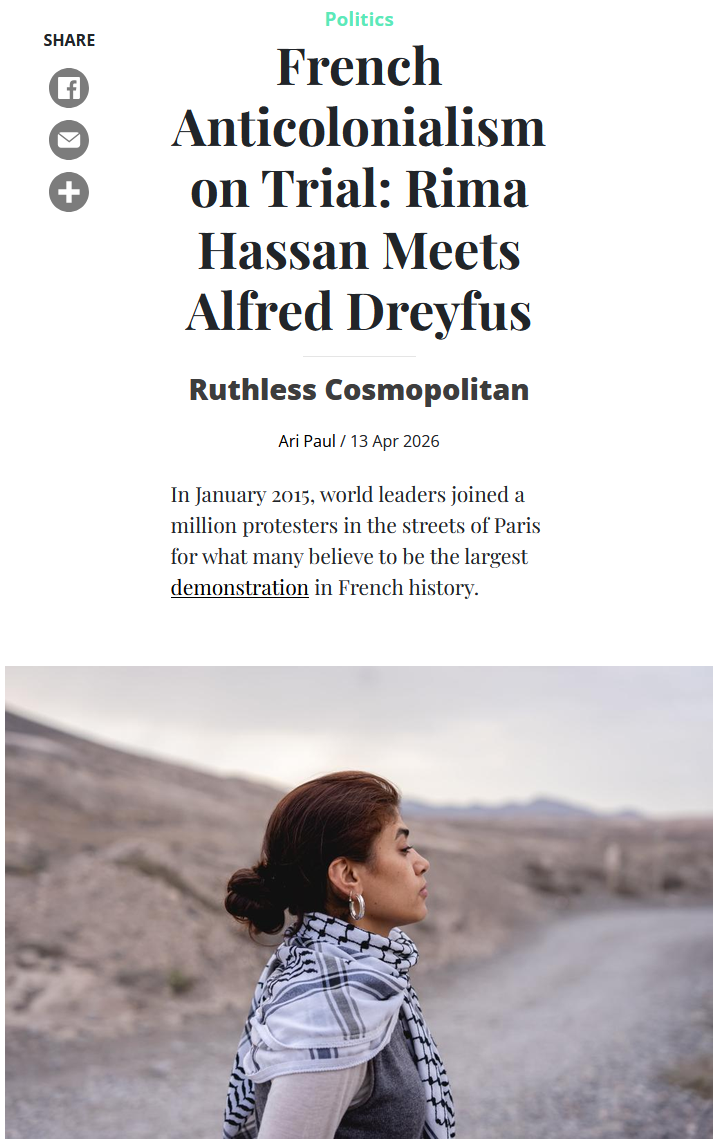
For the Battleground website (4/13/26), the prosecution of member of the European Parliament Rima Hassan shows that “the imperial embrace of free speech is not a universal ideal to be shared by all, but rather a hallmark of the metropole, deployed against colonial subjects.”
US right-wing media are eager to paint Houellebecq as the victim of a French version of liberalism that pits the feelings of Muslims against the speech rights of everyone else. But these same media were awfully quiet when the French state charged Member of European Parliament Rima Hassan, a French Palestinian, with glorification of terrorism for posting a quote on social media from Japanese Communist Kōzō Okamoto (Battleground, 4/13/26).
Okamoto, who died in Beirut this summer, took part in the 1972 attack on Lod Airport in Israel (AP, 7/23/26). The quote read: “I dedicated my youth to the Palestinian cause. As long as oppression exists, resistance will not only be a right, but a duty.”
When a Palestinian’s free speech rights are attacked by the French state after offending Zionist sensibilities, US corporate media aren’t interested in writing about France’s democratic collapse.
And France has a record of curbing freedom of speech and expression for Muslims and Palestinians. This year, “France banned a gathering of Muslims that was planned in the Paris area…due to it representing a security risk,” Reuters (4/2/26) reported, although the courts swiftly overturned the ban (BBC, 4/3/26).
The French state has also engaged in vigorous apparel policing. In 2023, Reuters (8/27/23) reported, the country announced it was banning “children from wearing the abaya, the loose-fitting, full-length robes worn by some Muslim women, in state-run schools.” Amnesty International (7/16/24) noted:
At the 2024 Olympic Games, the host country France has banned Muslim women from wearing a sports hijab or any other form of religious headgear when they compete for France. Such a ban is imposed in several sports in France, including football, basketball and volleyball, in competitions at all levels, including youth and amateur ones. The bans undermine efforts to make sports more inclusive, and mean that Muslim players and athletes who wear a hijab in France will continue to be discriminated against.
‘A threat to public order’
In 2023, right after the Hamas attack on southern Israel, AP (10/12/26) reported that
France’s interior minister…ordered local authorities to ban all pro-Palestinian demonstrations amid a rise in antisemitic acts since Hamas attacked Israel over the weekend.
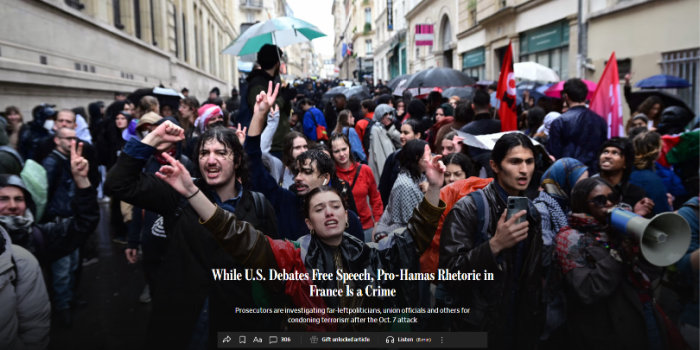
While the Wall Street Journal (5/4/24) reported on France investigating hundreds of people for “condoning terrorism” after the October 7 attacks, the Journal opinion pages (11/17/26) argued that the prosecution of Michel Houellebecq marks the “death of free speech in France.”
In fact, the Wall Street Journal (5/4/24) reported that French authorities have investigated “politicians on the far-left, union officials and hundreds of other people for allegedly condoning terrorism and inciting antisemitism” since the October 7 attack in Israel. The paper explained that “France’s limits on speech are shaped by the country’s history of antisemitism”:
France sees US-style free speech—with its broad protections against government intervention under the First Amendment—as a threat to public order that could spark racist and antisemitic violence.
The paper quoted French leftists arguing that these measures were an attack on free speech. But none of the paper’s pundits were outraged in the way that they are about the Houellebecq affair.
In other words, when antisemitism justifies a country’s limits on speech, the concept gets a down-the-middle, disinterested framing. Replace “antisemitism” with “Islamophobia,” and the media tenor changes.
Stangler highlighted the double standards:
I would say many of the free speech warriors springing to the defense of Houellebecq have seemed to miss what’s actually a much greater and far more alarming crackdown on civil liberties in France: President Emmanuel Macron and the government’s attempt to ban demonstrations after the mass protests on October 17.
The right to demonstrate is guaranteed by the Constitution—and yet Macron, the interior ministry and police prefects have sought to clamp down on people exercising this fundamental right. Fortunately, many judges have upheld this basic right in court. Maybe the Atlantic should write about that?
I guess burning trash cans and applying hate speech laws is a greater threat to Western civilization than deeply unpopular presidents trying to ban protests.
Normalized Islamophobia
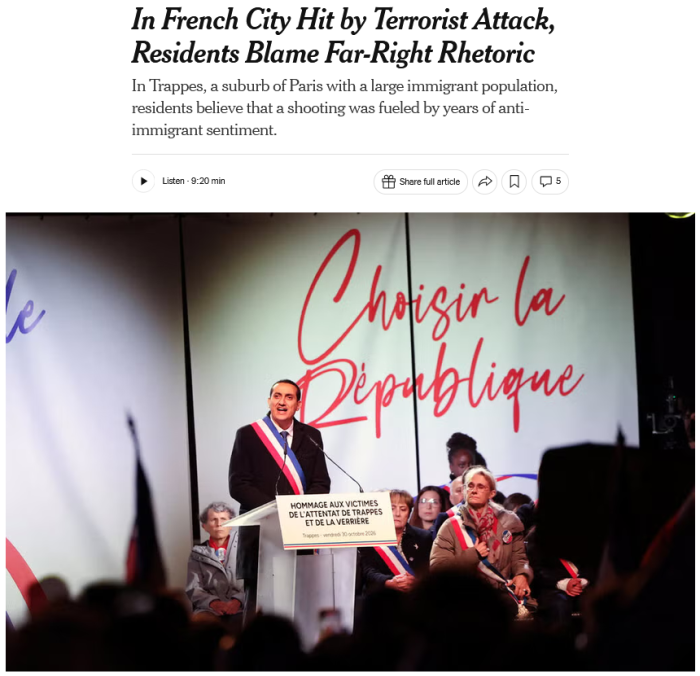
According to Trappes Mayor Ali Rabeh (New York Times, 11/6/26), a racist gunman’s hatred “was instilled in his mind by the relentless repetition of words and rhetoric that turned these minorities into targets to be eliminated.”
Many of the Houellebecq defenses don’t quite grapple with the fact that immigrant communities are on edge; the Atlantic piece (11/12/26) does a better job of grasping the context. In the town of Trappes, gunman Kévin Tessier fired at and killed a French-Congolese man and wounded five others, by his own admission specifically targeting “Black people and Arabs” (Le Monde, 10/24/26). He said he was acting “on behalf of France” (France24, 11/12/26).
The New York Times (11/6/26) reported Tessier “targeted Trappes because it was a ‘den of Islamists,’” and while he was not “affiliated with a political party, stickers mentioning the National Rally, France’s main far-right party, were found at his home.” The party “is favored to win in next year’s presidential election” and has “taken an unabashedly hostile line toward immigrants, but it was quick to distance itself from the suspect.”
That’s the key context that complicates the right-wing moral grandstanding about Houellebecq’s situation. While noting that France’s laws against hate speech haven’t curbed the effects of far-right venom, Stangler observed:
The more we learn about Kévin Tessier, the more apparent it is how much he absorbed the kind of racist, anti-immigrant, Islamophobic rhetoric that has been normalized by the media in France in recent years. The comments that Houellebecq is being investigated over are just a small piece of that larger backdrop.
Again, the Atlantic piece admits much of this, but also says that anyone who wants
to referee the boundaries of intellectual and political debate should keep in mind that tomorrow it might be used by a far-right government in ways they do not support.
As shown above, the French government under Macron is doing that to the left and immigrants today.
From FAIR via This RSS Feed.