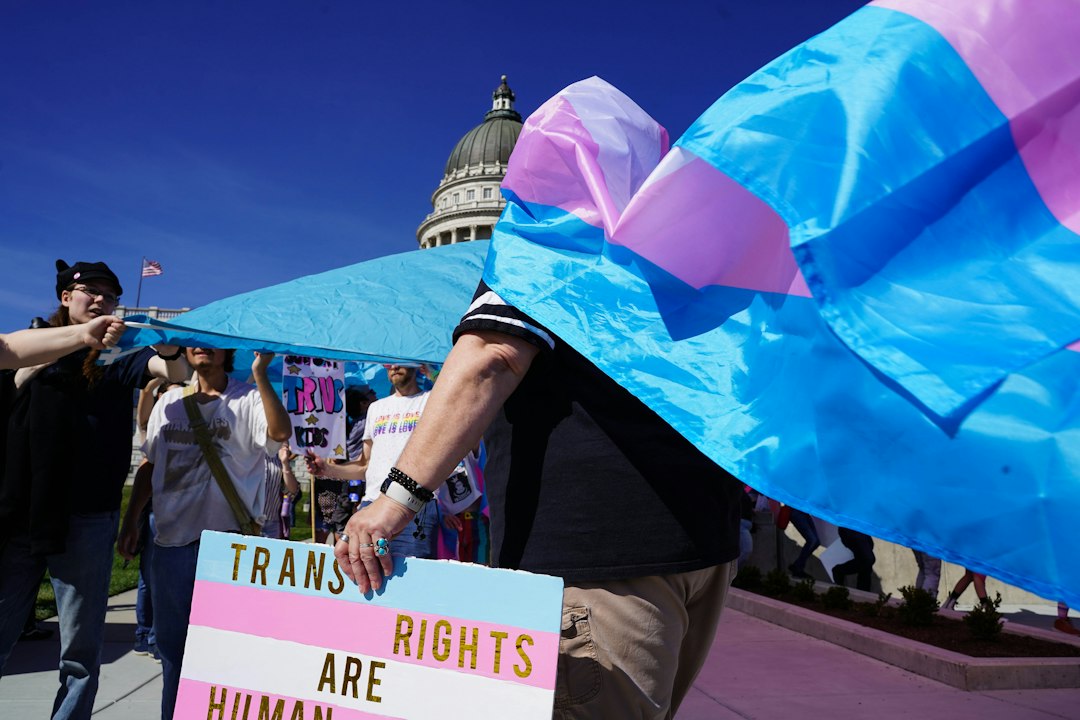
People holding transgender flag and sign at rally

Photo by yasmin peyman on Unsplash

Erin In The Morning is a reader-supported publication. To receive new posts and support my work, consider becoming a subscriber.

An investigation published in JAMA Pediatrics marksthelargest study ever examining regret rates among transgender people who transitioned as minors. What researchers found may not surprise you:

Transgender people vastly don’t regret transitioning as minors.

Published Monday,“Satisfaction, Regret, and Harm After Hormone Therapy in Youth From a Multidisciplinary Gender Clinic” sought to examine these factors among transgender and gender-diverse participants who started hormone therapy as youth. It also tracked whether demographic or clinical factors influenced outcomes.

They found that participants who received care at a single multidisciplinary clinic rarely regretted hormone replacement therapy, referenced in the study as HT or HRT. Rates of regret were only about 3%.

“Neither regret nor harm nor current HT status was associated with age at HT initiation or prepubertal gender diversity,” the study found.

Regret was also slightly higher in nonbinary patients, as opposed to binary trans men and trans women, although still low overall.

This has significant meaning for policymakers when it comes to gender-affirming care, researchers wrote. “Results provide support for existing standards of care rather than broad restrictions on youths’ access” to hormone therapy.

The exact breakdown of the study’s statistical findings and methods can be seen here:
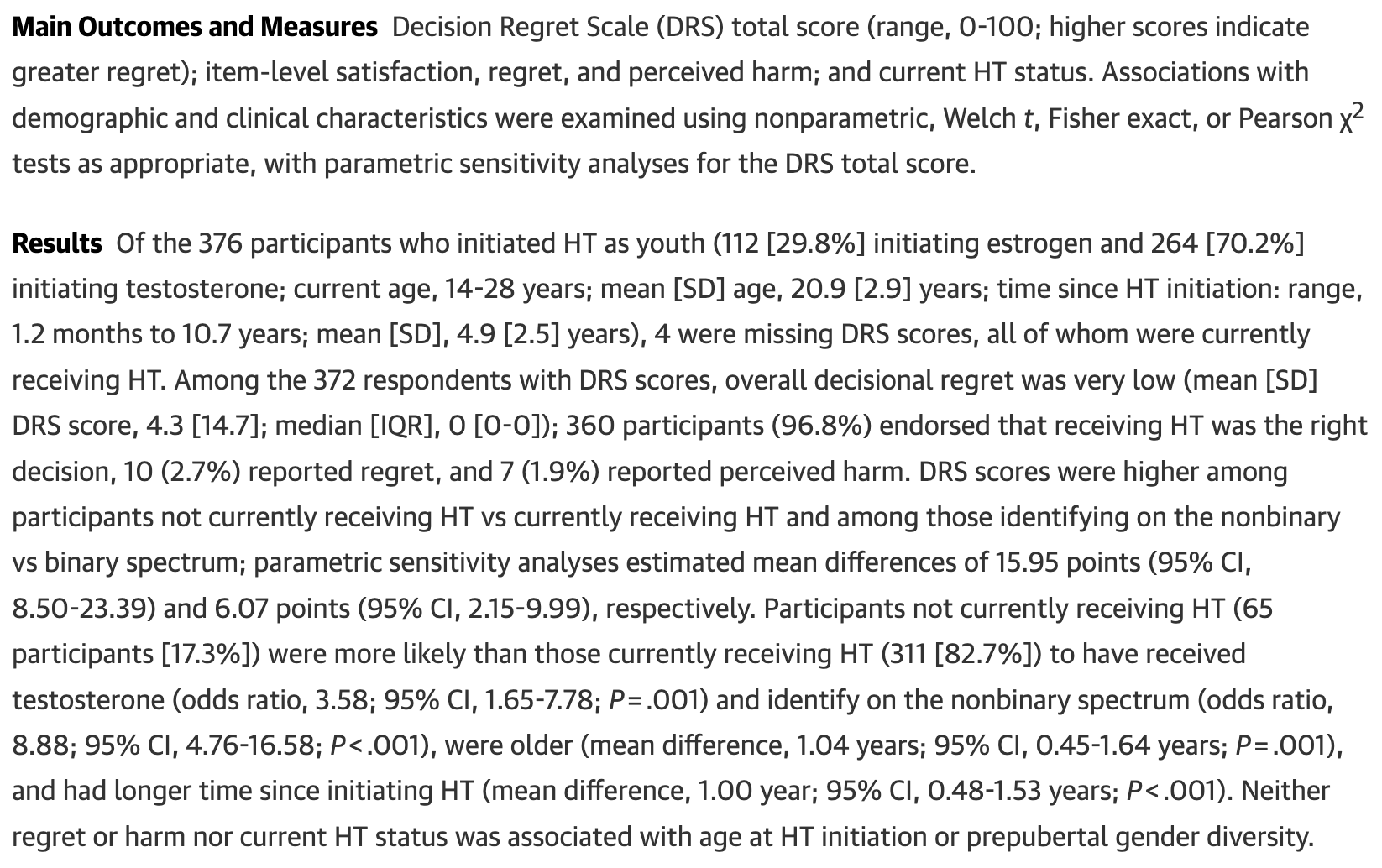
An excerpt from JAMA Pediatrics.

Of the 372 participants, nearly all said that HRT was “the right decision”; only nine disagreed. Just three people said they had not been able to make an informed choice; four cited adverse side effects (vaginal atrophy, changes in emotional state); and six said they simply no longer desired the secondary sex characteristics that HRT induced, such as breast growth or facial hair.

Respondents had been taking HRT anywhere from one month to over 10 years; the average in the study was around 5 years on HRT. In other words, anti-trans activists often push the idea that people who transition young regret it later in life, but those in this study reported high satisfaction rates for years to come.

This is notable given GOP talking points that weaponize “ex-trans” narratives that stoke fervor against trans youth and their providers. Conservative lawmakers and activists have heralded a fictitious “wave” of transition regret. But that never materialized. They’ve also pearl-clutched about doctors reportedly rushing or pressuring youth into transition. The anti-trans movement has crafted a careful narrative to argue that patients and parents have been “kept in the dark” about their own care en masse, and that gender care is a surreptitious plot to trans children for financial gain.

In reality, accessing transition care—especially as a minor—is fraught with barriers, be they legal, financial, or interpersonal (such as a young person without a supportive family).

Studies like this strengthen the academic consensus that wholesale “detransition”—where a person who medically transitions stops identifying as trans and regrets receiving gender-affirming care—is rare. For those who do stop taking hormones or regret gender-affirming care, studies find the reasons cited are more likely to be financial, such as a lack of insurance; legal, with patients losing their care when states restricted it; or, most of all, a response to transphobia and violence upon coming out.

Still, the federal government has already successfully used legal threats to compel Texas Children’s Hospital to open a “detransition clinic.”

Researchers note that the existing literature overwhelmingly supports the benefits of allowing trans and gender diverse youth to access transition care. “However, concerns about potential regret and harm have intensified, leading to widespread efforts to prevent minors from accessing HT despite standards of care continuing to support its use,” they note. “Given recent increases in external barriers to accessing HT, rates of stopping treatment are likely increasing.”

The study was approved by the institutional review board at the University of Texas Southwestern Medical Center and peer-reviewed for publication in JAMA Pediatrics—indicators of scientific quality, an important hallmark as the anti-trans academic movement spends no small sum manufacturing academic literature to support it, often without these hallmarks of rigor.

Scott Leibowitz, a child and adolescent psychiatrist who serves on the board of the World Professional Association for Transgender Health (WPATH), told The Washington Post that this study “adds to the growing evidence base that demonstrates individualized gender-affirming care can be beneficial for a young person.”

Erin In The Morning is a reader-supported publication. To receive new posts and support my work, consider becoming a subscriber.


From Erin In The Morning via This RSS Feed.

no comments (yet)

sorted by: hot top controversial new old
there doesn't seem to be anything here
23 comments in c/fediverse_vs_disinfo@lemmy.dbzer0.com view that post
[–] 38 points 2 days ago (1 child)

The fact that they had to do a huge study to refute an obvious whopper of a lie told by some asshole and repeated by fools is a perfect example of a larger truth. It's easier to spread bullshit than to clean it up. And the real kicker is that this won't change anyone's mind.

  • source
  • hideshow 1 child comment
  • [–] 18 points 2 days ago (3 children)

    I thought it mostly happened when society bullies you so much that you decide its easier to hide who you are again instead

  • source
  • hideshow 3 child comments
  • [–] 2 points 1 day ago (2 children)

    My wife has a friend who went fully FtM, then lost weight because of the testosterone and realized that they just hated their body because they were fat, not because they were trans.

    So it does happen.

  • source
  • parent
  • hideshow 2 child comments
  • [–] 3 points 1 day ago (1 child)

    I mean it does happen. But it's still far less common than just getting bullied out of transitioning.

  • source
  • parent
  • hideshow 1 child comment
  • [–] 3 points 1 day ago

    One of the earliest stories I ever read of transition was a mtf who was overweight, depressed, etc, classic neck beard. Transitioned, started taking care of their body, lost weight, made friends, went back to school, stopped presenting femme, quit the hormones, quietly detransitioned.

    No regrets, no irreversible side effects. it was what they needed at the time.

  • source
  • parent
  • [–] 15 points 1 day ago (2 children)

    Studies like this strengthen the academic consensus that wholesale “detransition”—where a person who medically transitions stops identifying as trans and regrets receiving gender-affirming care—is rare. For those who do stop taking hormones or regret gender-affirming care, studies find the reasons cited are more likely to be financial, such as a lack of insurance; legal, with patients losing their care when states restricted it; or, most of all, a response to transphobia and violence upon coming out.

  • source
  • hideshow 2 child comments
  • [–] 4 points 1 day ago (1 child)

    So not even an internal justification for their regret. It's all from external forces by the sounds of it. So it's quite possible that if they had a support network, they would not have regretted it.

  • source
  • parent
  • hideshow 1 child comment
  • [–] 13 points 2 days ago

    The actual article:
    https://pubmed.ncbi.nlm.nih.gov/43002408/

    The doi is not yet active because the JAMA Paediatric hasn't published the article yet. Here it is nonetheless:
    10.1001/jamapediatrics.2026.5185

  • source
  • [–] 20 points 2 days ago (2 children)

    Of course one of the talking points I hear about is that the younger they start the more likely people are to regret it. I kind of doubted that already, but its good to get real data on it.

  • source
  • hideshow 2 child comments
  • [–] 7 points 2 days ago

    Even if that's the case I think it would need some additional studying or math to account for survivorship bias. Many trans youth never get the chance to live long enough for us to ask them about early transition

  • source
  • parent
  • [–] 9 points 2 days ago

    Wish the ass holes that voted against gender affirming care trusted data... Instead of being ass holes

    At least there is data though, so maybe a push in the right direction can happen easier.

  • source
  • [–] 5 points 1 day ago (1 child)

    It's sad really. So many eggs (pre transition) feel fear about regret, and yet the regret rates are so low.

    I remember spending well over a year being petrified of regretting it. Years down the line? Couldnt have been a better choice. I feel so grounded in my identity now, going back to being a guy would be like being forced into undersized shoes.

  • source
  • hideshow 1 child comment
  • [–] 5 points 2 days ago (1 child)

    I wonder if studies count the cessation of HRT or transitioning from binary to nonbinary as detransitioning even tho it isn't

  • source
  • hideshow 1 child comment
  • [–] 4 points 1 day ago

    Breaking news: People know what they want to do with their own bodies better than other people do

  • source
  • [–] 12 points 2 days ago* (last edited 2 days ago) (3 children)

    It's beyond stupid that this study was even done.

    Let's play devil's advocate and say it's 90% regret.

    So fucking what? Nobody's trying to prevent people from taking out LOANS they'll regret. Or making CAREER decisions they'll regret. Or having CHILDREN they'll regret. Freedom means letting people make their decisions and live with the results. That's the whole deal.

    These assholes are only concerned about the actions they want to police - they don't give a SHIT about the well-being of the people taking those actions, and they will find any excuse.

  • source
  • hideshow 3 child comments
  • [–] 18 points 2 days ago (2 children)

    Harm reduction is a thing.
    If the study had shown a high amount of regret, it would indicate that a more restrictive screening process should be put in place, with other avenues being explored first.

  • source
  • parent
  • hideshow 2 child comments
  • [–] 0 points 1 day ago (1 child)

    Frankly I want no screening. People should be able to alter their own sex characteristics at will. I believe in a fundamental freedom of sex. Your body is your own, and the government has no rightful say in what you do with it.

  • source
  • parent
  • hideshow 1 child comment
  • [–] 2 points 1 day ago

    On the other hand, this mindset could easily lead to misclassifying necessary gender-affirming surgery as elective. I think it's worth acknowledging that some medical decisions are more necessary than others.

  • source
  • parent