post
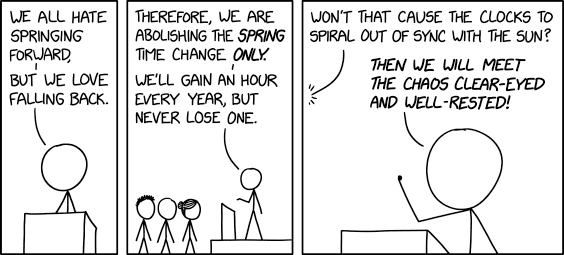
We can make up for it by skipping a leap year every 24 years
I hate to complicate things but we already skip leap years…
The Gregorian calendar, the world's most widely used civil calendar, makes a further adjustment for the small error in the Julian algorithm; this extra leap day occurs in each year that is a multiple of 4, except for years evenly divisible by 100 but not by 400. Thus 1600, 2000 and 2400 are leap years, but 1700, 1800, 1900, 2100, 2200, and 2300 are not.
That's leap days. We also skip leap minutes occasionally. I think we've only removed whole years in retrospect.
I love it when the occasional person comes through arguing that we should just get rid of time zones so it’s the same time everywhere. Always a fun discussion.
What about splitting each time zone into 60 parts, so they are in increments on 1 minute instead of one hour?
it exists already. but besides that. what numbers are assigned to what sun location is completely arbitrary and a man made convention.
if my 7:00 turns into 14:00 my job will expect me at the new 14:00
Notable context for the rest of the world: the US Congress is currently debating ending the changing of the clocks every spring and fall.
Better idea: hack the Earth’s code and do away with this annoying axial tilt thing. It’s super inconvenient.
#disable_the_wobble
How about using same time for entire globe?
I just want the sun to go down by 7 every day
You do realize changing the idea of changing the clocks to be either one hour forward or one hour backwards doesn't change the fact that the sun changes position throughout the year.
The summer will feel long and the winter will feel short no matter what. At least in the US.
You can hate it all you want but it's to account for the fact the days do actually get shorter and longer.
Take it from someone who doesn't have to change their clocks, it's way easier to deal with that way. The whole process is so gradual you barely even notice it.

all 40 comments