Why is vertical text orientation legible in East Asian languages but not with the Latin Alphabet?
(media.piefed.social)
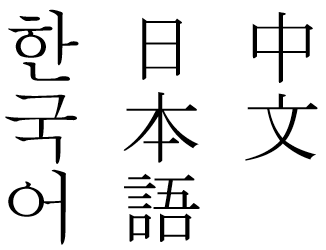
With the Latin alphabet, fluent readers don’t recognize each letter individually—they recognize words and syllables based in part on the pattern of ascenders and descenders. Arranging the characters vertically disables that mode of pattern recognition.
With East Asian writing, each character represents a word or syllable, so those units don’t get disrupted by the vertical orientation.
Many signs in English are formatted vertically. You're imagining a problem.
It works fine whether or not the letters are rotated (but that does change if it goes up-to-down or down-to-up)

I have no formal basis for this, but I imagine that it has to do with kerning, the way the letters are shaped, and us just being used to reading them in a specific format. I suspect that the format is treated as 'aesthetic' to our brains, and breaking it annoys some small part of our brains.
but doing that with Latin-based languages (like English or French) makes it look crap
Bold assumption. Who says it looks crap? Is this your "opinion" or based on a study you can share?
As for why it looks like crap, tbh it's likely just because our letters are very thin. Vertically, an l would take the same space in the line as an ー which makes absolutely no sense and makes the lines look like enshittified junk food. On the other hand, the characters in the languages you showed are squarish, which means that they look good in both orientations.
As for why it's hard to read, as someone who's learning japanese, it's likely because people are just not used to it. While I started reading R-L fairly early in my learning journey and had no problem getting used to it, I had a friend who only started reading R-L after he was already pretty much fluent in the language, and he told me that he found reading it a little tricky despite reading L-R no problem. I assume that he read words, not letters, and reading in an orientation he was not used to threw him off. On the other hand, I was still learning so I read each character individually, which was why I didn't feel much of a difference.
all 13 comments