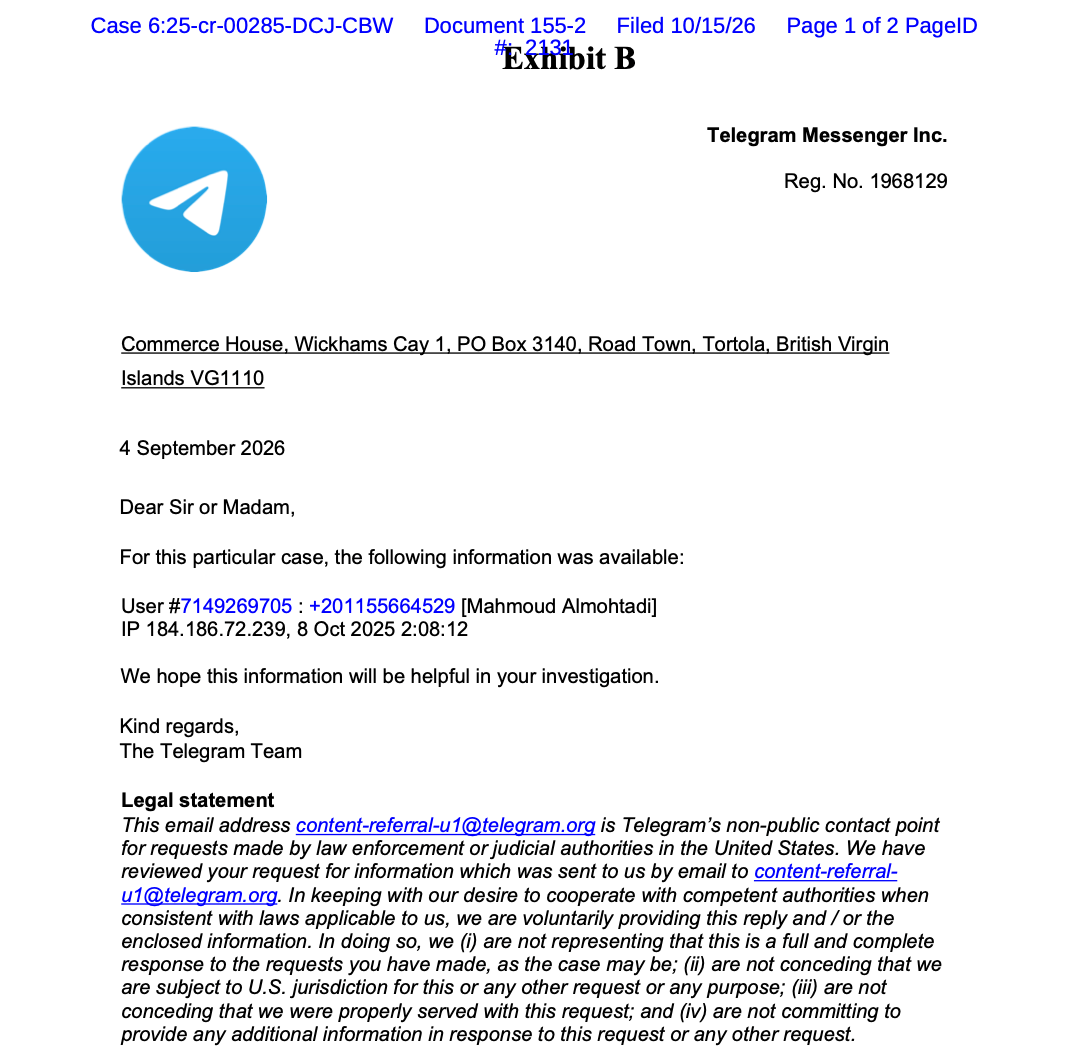
▲ 78 ▼ Here’s What Telegram Giving Data to the U.S. Government Looks Like (storage.ghost.io) submitted 3 weeks ago by beep@piefed.world to c/privacy@programming.dev 16 comments fedilink hide all child comments cross-posted from: https://piefed.world/c/private/p/1471349/heres-what-telegram-giving-data-to-the-u-s-government-looks-like Source: Legal Document. The case this document surfaced in centers around Mahmoud Amin Ya’qub Al-Muhtadi, who allegedly participated in the October 7 attacks against Israel.
[–] Turret3857@infosec.pub 26 points 3 weeks ago (3 children) thats cool I'm still not going to use a platform with a closed source back end. permalink fedilink source hideshow 3 child comments replies: [–] lena@gregtech.eu 13 points 3 weeks ago* (last edited 3 weeks ago) (2 children) From a purely opsec standpoint, it doesn't really matter whether the backend is open source or not. Either way you can't know what kind of data is being shared and whether metadata is being deleted or not. What actually matters is that the client is open source and thoroughly reviewed by independent 3rd parties. With a good messaging app, it shouldn't matter what runs on the server. And it is known that Telegram's client uses some weird in-house crypto and doesn't encrypt chats by default. This is why I'm not going to ditch Threema, even though its backend isn't open source. I think they have a solid business model, which is why I support them. I still prefer Signal though. permalink fedilink source parent hideshow 2 child comments replies: [–] GottaHaveFaith@fedia.io 10 points 3 weeks ago Yes, but open backend means you can self host permalink fedilink source parent [–] ExperimentalGuy@programming.dev 3 points 3 weeks ago Open source means you can audit how the application transfers data. Of course you can't audit parts of infrastructure and data retention, but you would be able to know if they're using an outdated dependency or if they're not using a good encryption algorithm if they're running an open source project. permalink fedilink source parent
[–] lena@gregtech.eu 13 points 3 weeks ago* (last edited 3 weeks ago) (2 children) From a purely opsec standpoint, it doesn't really matter whether the backend is open source or not. Either way you can't know what kind of data is being shared and whether metadata is being deleted or not. What actually matters is that the client is open source and thoroughly reviewed by independent 3rd parties. With a good messaging app, it shouldn't matter what runs on the server. And it is known that Telegram's client uses some weird in-house crypto and doesn't encrypt chats by default. This is why I'm not going to ditch Threema, even though its backend isn't open source. I think they have a solid business model, which is why I support them. I still prefer Signal though. permalink fedilink source parent hideshow 2 child comments replies: [–] GottaHaveFaith@fedia.io 10 points 3 weeks ago Yes, but open backend means you can self host permalink fedilink source parent [–] ExperimentalGuy@programming.dev 3 points 3 weeks ago Open source means you can audit how the application transfers data. Of course you can't audit parts of infrastructure and data retention, but you would be able to know if they're using an outdated dependency or if they're not using a good encryption algorithm if they're running an open source project. permalink fedilink source parent
[–] GottaHaveFaith@fedia.io 10 points 3 weeks ago Yes, but open backend means you can self host permalink fedilink source parent
[–] ExperimentalGuy@programming.dev 3 points 3 weeks ago Open source means you can audit how the application transfers data. Of course you can't audit parts of infrastructure and data retention, but you would be able to know if they're using an outdated dependency or if they're not using a good encryption algorithm if they're running an open source project. permalink fedilink source parent