you are viewing a single comment's thread
view the rest of the comments
[–] 75 points 1 year ago* (55 children)

Disclosure: I have been sailing the seas for years, but...

This logic does no justice to the objective financial harm being done to the creators/owners of valuable data/content/media.

The original creator/owner is at a loss when data is copied. The intent of that data is to be copied for profit. Now that the data has been copied against the creator/owners will, they do not receive the profit from that copy.

Yes yes the argument is made that the pirate would not have bought the copy anyways, but having free copies of the content available on the internet decreases the desire for people to obtain paid copies of the data. At the very least it gives people an option not to pay for the data, which is not what the creator wanted in creating it. They are entitled to fair compensation to their work.

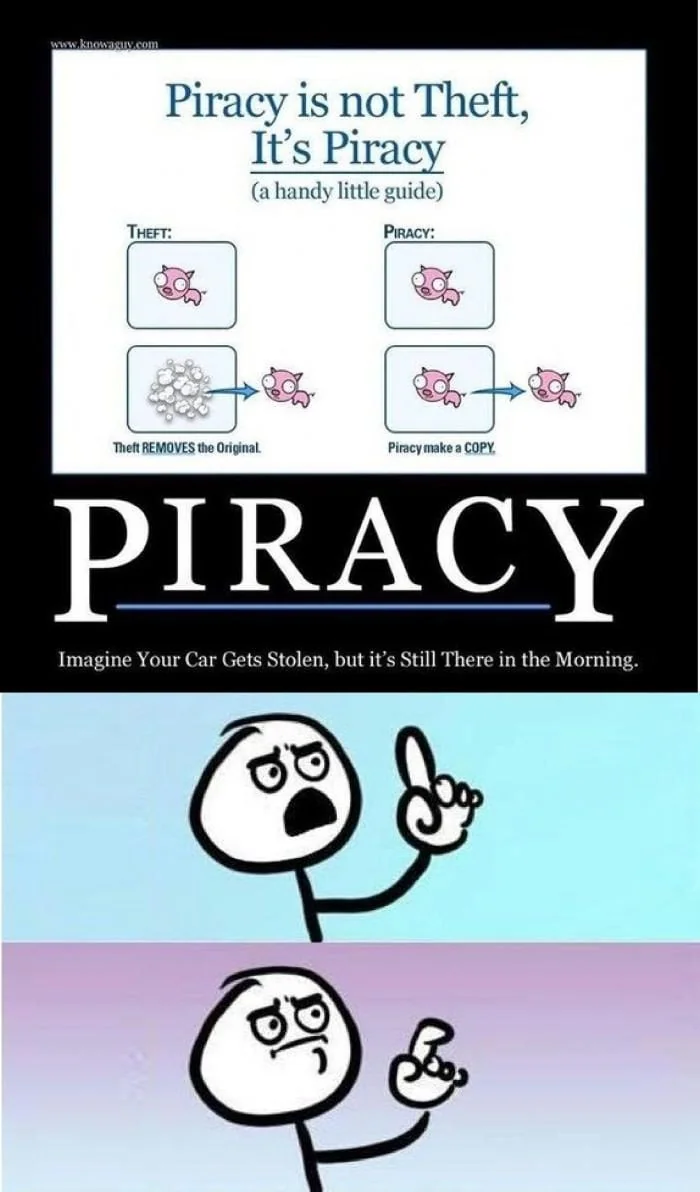
It is true that pirating is not directly theft, but it does definitely take away from the creator's/distributor's profit.

  • source
  • hideshow 55 child comments
  • [–] 55 points 1 year ago* (last edited 1 year ago) (5 children)

    Cool argument, except a huge quantity of pirated works aren't "owned" by the creator or even a group that funded it, but instead by parasitic companies that abuse capitalistic tools to actually steal value from those creators.

    I have thousands of purchased games. 3 categories here:

    1: obtained as part of a pack (humble gog etc)

    2: purchased AFTER trying out via pirate copy to know if it is my kind of thing

    3: picked up early access due to demo or general interest from being a known smaller dev/studio (hare brained for example)

    With less and less access to shareware and viable demos, piracy is often the only conduit to prevent me getting ripped off of $80 for something that looks like a shiny sports car but end up being another "buy $800 in dlc for the full story!" Ford pinto.

    Additionally, I now flat refuse to fund the likes of Denuvo, and wish that piracy actively hurt the bottom line of companies deploying that kind of anti-user shit.

  • source
  • parent
  • hideshow 5 child comments
  • [+] -6 points 1 year ago (4 children)

    I dislike investors as much as anyone but someone had to fund development. At least until we get UBI

  • source
  • parent
  • hideshow 4 child comments
  • [–] 16 points 1 year ago

    Eh, to an extent. If they are original funders, I agree. But when you have people or groups buying rights to music/movies/tv/etc to claim royalties in perpetuity, especially after the original creatives die, those people can fall into a pit of uncapped rusty rebar.

  • source
  • parent
  • [–] 11 points 1 year ago (2 children)

    or even a group that funded it

    I noted I'm ok with investors.

    I'm against parasitic groups that feed on properties and prevent money getting to the actual dev folks.

  • source
  • parent
  • hideshow 2 child comments
  • [–] 1 point 1 year ago (1 child)

    Which group would that be then?

  • source
  • parent
  • hideshow 1 child comment
  • [–] 2 points 1 year ago

    Places that buy other companies to dismantle or lay off large chunks of staff and take over IP with minimal or absent quality to show from it. Just maximize that investor dollar.

    Microsoft, Disney etc.

    The harm performed far outweighs any investment from a "toward the artists" I see come back.

  • source
  • parent
  • [–] 109 points 1 year ago* (last edited 1 year ago) (9 children)

    Devil's Advocate: Many pirates would have not paid for access to that media so to say it takes away from the creators profit isn't exactly true since one act of piracy does not equal one lost sale.

    Devil's Advocate Part II: There is s significant amount of research that supports the notion that pirates actually spend more money on media than the average person.

    I personally am an example of part II. I pirate a lot of music but I refuse to use Spotify because of how little it pays artists and I have also spent significant amounts of money buying music from artists I enjoy via Bandcamp or buying from the artist directly because I know they get a bigger cut of the profits that way.

  • source
  • parent
  • hideshow 9 child comments
  • [–] 31 points 1 year ago* (4 children)

    Ditto on Spotify. I have big love for piracy of FLAC for my personal music server, but I also have a decent rack filled with physical offerings from my favorite bands.

    My Bandcamp collection is also getting up there, since a few of my favs say they are treated well there, and it's FLAC friendly as well.

    Physical media or merch directly from the band is absolutely the way to go every time if possible.

  • source
  • parent
  • hideshow 4 child comments
  • [–] 23 points 1 year ago* (3 children)

    I'm having trouble finding a link to substantiate it, but I remember in the early 2000's a group of artists having to sue their record labels because of the lawsuits on file-sharing users. The record labels said they were doing it for the artists, but the artists had to sue the record labels to even ever see a penny from the fruits of those lawsuits. The record labels were just pocketing the money for themselves while saying it was "for the artists."

    Anyway, long story short is that kind of behavior from the recording industry made me want to give money directly to the artists and cut out these selfish middlemen who did nothing but claimed all the profits.

  • source
  • parent
  • hideshow 3 child comments
  • [–] 60 points 1 year ago (2 children)

    Ironically, piracy develops more ethical consumers

  • source
  • parent
  • hideshow 2 child comments
  • [–] 35 points 1 year ago (1 child)

    Because people don't want to pay for shit content. Let's take pirating out of the equation. If I read a book I borrowed and I really like it, I would buy. If the content was trash then I wouldn't. Same goes if I watch a movie, listen to an album, or eat a microwavable burrito at a friend's or family member's house.

  • source
  • parent
  • hideshow 1 child comment
  • [–] 6 points 1 year ago

    Before piracy there were demos and shareware, which let you see if your machine could handle the game or content and give you a vertical slice, and let you show it to friends for word of mouth advertising.

    Then, Steam put a two hour refund window with no questions asked, which helped a lot of "this crashes on start, I can't open this at all on a RTX 4090/high end PC, 15 FPS in the fog, etc".

    Developers learned from that and they began padding/gating content behind two hours of gameplay, so you wouldn't know until 3-4 hours in that the game was grindy dogshit (SCUM, Ark, Empyrion, and countless other Early Access and sometimes full release titles like NMS on launch day for example).

    So the correct thing to do, and it's what I do: Pirate the game, make sure it runs/works and is fun and there's no "gotcha" traps or hidden DLCs or other predatory mechanics involved, and THEN pay for the full title on Steam+DLCs and just continue the save.

    My Steam Account has actually already been flagged over a dozen times for this because my primary savegames are like Razor1911.sav, and so far it's still in good status because I am actually spending a couple thousand/year on content.

  • source
  • parent
  • [–] 26 points 1 year ago (2 children)

    having free copies of the content available on the internet decreases the desire for people to obtain paid copies of the data.

    According to who?

  • source
  • parent
  • hideshow 2 child comments
  • [–] 3 points 1 year ago (1 child)

    I guess herein lies the potential fallacy of my statement. Decreased desire is a Subjective observation.

    One cannot draw a direct correlation, but there is data to conclude that not having a piracy option will boost sales of data initially, at least when it comes to games. (Hence why publishers continue to use Denuvo)

    https://arstechnica.com/gaming/2024/10/the-true-cost-of-game-piracy-20-percent-of-revenue-according-to-a-new-study/

  • source
  • parent
  • hideshow 1 child comment
  • [–] 19 points 1 year ago* (last edited 1 year ago)

    Counterpoint: When Louis CK (prior to being outed as a sex pest) released one of his comedy specials on his website DRM-free for $5 he became a millionaire almost overnight.

    https://boingboing.net/2011/12/22/drm-free-experiment-makes-loui.html

    Price point matters, too.

    It also jives with early Steam Sales when Valve would cut titles like Left 4 Dead Counter Strike down to 90% off, and they would sell so many digital copies that they were actually making more money off the lower price.

    https://www.geekwire.com/2011/experiments-video-game-economics-valves-gabe-newell/

    Now we did something where we decided to look at price elasticity. Without making announcements, we varied the price of one of our products. We have Steam so we can watch user behavior in real time. That gives us a useful tool for making experiments which you can’t really do through a lot of other distribution mechanisms. What we saw was that pricing was perfectly elastic. In other words, our gross revenue would remain constant. We thought, hooray, we understand this really well. There’s no way to use price to increase or decrease the size of your business.

    But then we did this different experiment where we did a sale. The sale is a highly promoted event that has ancillary media like comic books and movies associated with it. We do a 75 percent price reduction, our Counter-Strike experience tells us that our gross revenue would remain constant. Instead what we saw was our gross revenue increased by a factor of 40. Not 40 percent, but a factor of 40. Which is completely not predicted by our previous experience with silent price variation. …

    Then we decided that all we were really doing was time-shifting revenue. We were moving sales forward from the future. Then when we analyzed that we saw two things that were very surprising. Promotions on the digital channel increased sales at retail at the same time, and increased sales after the sale was finished, which falsified the temporal shifting and channel cannibalization arguments. Essentially, your audience, the people who bought the game, were more effective than traditional promotional tools. So we tried a third-party product to see if we had some artificial home-field advantage. We saw the same pricing phenomenon. Twenty-five percent, 50 percent and 75 percent very reliably generate different increases in gross revenue.

  • source
  • parent
  • [–] 33 points 1 year ago (4 children)

    Piracy is somewhat similar to vigilantism to me. My ability to consider it a negative is directly related to how fair I consider the legitimate methods available to be.

    If similar efforts were focused on consumer protection laws as we do IP protection, I don't think pirates would have much leg to stand on, and they'd be seen in more of a negative light.

    But since consumers are regularly fucked by corporations, all I see is two sides both doing bad shit and I'm not feeling all that charitable for the faceless megacorp. I also dislike pirates who pirate from small time creators. But that's about as far as I can care given the state of things.

    We should be focusing on stronger consumer rights to truly fix the problem for all sides.

  • source
  • parent
  • hideshow 4 child comments
  • There is absolutely a connection between how shitty corporations are treating their customers with how likely those customers are likely to stop paying and start sailing.

    Netflix in its prime was the GOAT, showing a very significant decrease in piracy. We're only seeing a rise now because of the proliferation of streaming companies. No one wants to pay for 4+ streaming services.

  • source
  • parent
  • There's another comment further up about a statistic showing that people who pirate content are more likely to spend more money on content as well compared to people who don't pirate content. It seems that there's a correlation between people who pirate things and people who care about the ethical treatment of creators. Stuff like people who pirate music from Spotify and then spend money to buy the music from the band on Bandcamp.

    In that context, I have an even harder time caring about people pirating from the megacorps when they're supporting creators at the same time. That's closing in on Robin Hood style activities at that point.

  • source
  • parent
  • [–] 1 point 1 year ago

    I only started pirating movies/tv because the streaming companies were selling my info and watch history. I've mentioned it on Lemmy before, but I pay for all the subscriptions and don't use any of them, I just pirate stuff and watch through Jellyfin. (Used to use Plex, but they started selling your info/watch history as well, so they get the axe) It's not a money thing for me, it's a lack of consumer respect, and I can't stand it. If I pay for a product, don't try to squeeze every last drop of profit you can off of me by selling my activity. It's why I use a paid Android TV launcher that doesn't have ads on the homepage, and I don't let it connect to the internet. It's why I buy all my music and stream it on Symfonium, another paid app, instead of a Spotify subscription. I'm just tired of having to set up all these self-hosted services just to get big corporations off my back.

  • source
  • parent
  • [–] 9 points 1 year ago* (last edited 1 year ago)

    So a little more in depth:

    So, a little more in depth:

    Im poor as fuck. So the option isnt 'buy/pirate' its 'pirate or get nothing'. Fuck you if you think i should live without art.

    The artists generally do not recieve profit when a copy is streamed/sold. It simply is not done; their unions are too weak. This is blatant corporate propaganda.

    The entire mechanism to do that is fucked anyway, even if it were hooked up to something. I'm sorry, but i wouldnt deal with that shit show for free. Even new releases or classics have to be hunted down like cult films, and then even if i buy them, i lose them at some arbitrary later date. Music was the last thing i tried to pay on, and i just could not keep a cohesive collection together-at this point, if it's not on bandcamp, i assume the artist doesn't want money. And even bandcamp has disappeared tracks i paid for, reducing me to local backups. So fuck em.

    I'm sorry. I really would love to support art and artists, but it simply isn't possible to do that systemically within capitalism. There is no clear systemic option. Just ways to lick corporate boot and waste your fucking time.

    although

    I bet i do actually pay artists-cast crew and musicians at least-more than you do. When i dine out, rare as that is, in los angeles, i tip ~30% in cash. So i am actually supporting the arts, while you, my boot licking friend, are not. Youre supporting the corporate ghouls who feast upon them.

  • source
  • parent
  • [+] 18 points 1 year ago (5 children)
  • [–] -5 points 1 year ago* (last edited 1 year ago) (4 children)

    You have some very entitled opinions, if everyone thought like you no one would create digital media. You're free to not watch movies or listen to music but it's pretty asinine to take things without compensating the creator and claim no wrongdoing

    Edit: I assumed it would be pretty obvious I was talking about digital media that needed a budget but apparently not. Of course anyone can make digital media for free in their spare time but you'd need some kind of income to support that hobby. FOSS is the same but you need some income to survive.

  • source
  • parent
  • hideshow 4 child comments
  • [–] 8 points 1 year ago* (last edited 1 year ago) (1 child)

    People do it for clout or for love. Sure, the Hollywood blockbusters would cease being made but that might be an overall social good IMO.

    I agree with Brian Eno who describes how, if we had a universal basic income, we would see more artists creating content just for the hell of it. He also explains how there is no "genius", there is instead what he calls "scenius" where it is an entire artistic scene which breaks new ground but only one or two happen to go viral.

  • source
  • parent
  • hideshow 1 child comment
  • [–] 1 point 1 year ago

    I assumed it would be pretty obvious I was talking about digital media that needed a budget. Of course anyone can make digital media for free in their spare time but you'd need some kind of income to support that hobby. With UBI that would change

  • source
  • parent
  • load more comments (1 reply)
  • [–] 12 points 1 year ago

    Adding on to say: no. It doesn't cost the creator anything when a pirated copy is made. They potentially miss a sale, but if their item wasn't in a store where someone may have made a purchase you wouldn't call that actively harmful, right?

    In addition, most media the creators don't actually make money from the profit. Most of the time they're paid a salary, maybe with a bonus if it does particularly well. The company that owns the product takes the profit (or loss), not the actual creators.

    Also, a lot of media isn't even controlled by the same people as when it was made. For example, buying the Dune books doesn't give money to Frank Herbert. It goes to his estate.

  • source
  • parent
  • [–] 3 points 1 year ago

    This logic does no justice to the objective financial harm being done to the creators/owners of valuable data/content/media.

    "Financial harm" is a loaded term. People expected to make money and then didn't, but is that a bad thing?

    What if the US president declared that it is now a legal requirement that every American subscribe to a new paid tier of Facebook, and that declaration was rubber stamped by the lawmakers. Anybody who didn't capitulate would be doing "financial harm" to Meta, but is that really a fair way to frame that? If a bully wants your lunch money and you resist, are you doing "financial harm" to the bully?

    The way I see things, the initial copyright laws were a relatively fair trade: a 14 year monopoly on something, that could be renewed for another 14 years if the author was still alive. In exchange, everything after that term became part of the public domain. So, it would encourage people to produce writing, and the public would benefit because a reasonable amount of time later what was produced would be available to everybody at no cost. Modern copyright terms are a massive give-away to Hollywood, the record labels, etc. So, while it's true that infringing copyright does reduce the potential amount of money a copyright holder might hope to receive, morally it's closer to fighting off a bully than it is to theft.

  • source
  • parent
  • [–] 3 points 1 year ago

    it does definitely take away from the creator’s/distributor’s profit.

    Oh no! Not the distributor's profit!! Oh holy Supply Side Jesus, I pray in your name- protect the profits of the Capitalists. Take the money I worked hard for and give it to the do-nothing rich, they clearly deserve it more than me. Amen

  • source
  • parent
  • [–] 5 points 1 year ago* (8 children)

    The people who make shit normally dont get paid anyway.

  • source
  • parent
  • hideshow 8 child comments
  • [–] 3 points 1 year ago (1 child)

    They get paid. They just don't get a share of profits. They are usually paid a salary or, increasingly more commonly, are paid as a contractor.

  • source
  • parent
  • hideshow 1 child comment
  • Yeah but me streaming doesnt get them more paid, and it's a fucking pittance anyway. Ive kniwn people who couldn't really afford to live, working on projects that made ridiculous profits. Sorry, union too weak, cannot use to bludgeon me into the absolute shit show tgat is paying for media.

  • source
  • parent
  • [+] 2 points 1 year ago (5 children)
  • [–] 4 points 1 year ago (4 children)

    Not from consumption. Most of that money is for execs/investors,

  • source
  • parent
  • hideshow 4 child comments
  • [–] a comment that isn't shown here: deleted, from someone you've blocked, or on another page. view the thread from it
  • [–] 0 points 1 year ago* (1 child)

    Thats a pretty story, but completely unconnected to reality. If it worked like that, id be okay with it.

    Also, when you pay for stuff, abd like it, and want to revisit it later you usually cant. And that always makes me feel like a fool. I don't like feeling like a fool. I don't like paying to feel likeva fool. I don't like expecting a thing i like to be there then it not being there; that ruins my day. And the sheer fucking regularity of this makes. Me think it's going to keep happening.

    When you steal it, they cabt steal it from you, 'cuz they don't know you have it.

  • source
  • parent
  • hideshow 1 child comment
  • load more comments (1 reply)
  • [–] 0 points 1 year ago

    And they invested knowing that piracy was a thing and figured that into their calculations regard to the risk vs potential return. If they didn't get that right and end up with a loss, well, that's capitalism for you.

  • source
  • parent
  • load more comments (1 reply)
  • [–] 2 points 1 year ago

    The original creator/owner is at a loss when data is copied.

    No, they're not. Not earning more is not the same as losing what you already have.

    Yes yes the argument is made that the pirate would not have bought the copy anyways,

    Yet studies have shown the opposite happens.

    content available on the internet decreases the desire for people to obtain paid copies

    Does your granny know what a torrent is?

    not to pay for the data, which is not what the creatordistributor wanted in creating it.

    There, FTFY

  • source
  • parent
  • [–] 1 point 1 year ago*

    It's not my fault if somebody makes content at a loss and isn't able to recuperate their losses. It happens all the time, sucks for them. I mean that earnestly by the way, though it sounds callous -- it really does suck for them, and I feel bad for artists who can't turn a profit.

    However, I just don't agree with you that "objective harm" is done when one pirates media. If this were true, you must admit that it's equally objectively harmful to the IP holder for one to not consume media at all. I just don't see how you can square that.

  • source
  • parent
  • [+] -1 points 1 year ago* (last edited 1 year ago) (8 children)
  • [–] 6 points 1 year ago (3 children)

    Podcasters and medium to small youtubers work like that (bigger also get some money from ads, but for medium to small, Patreon is the main source of revenue). You can get their shit for free, but they would like you to give them some money after if you can.
    The scale is a bit different, but the scheme works.

  • source
  • parent
  • hideshow 3 child comments
  • [–] a comment that isn't shown here: deleted, from someone you've blocked, or on another page. view the thread from it
  • [–] 4 points 1 year ago

    Ironically, it's actually doesn't work on a small scale. It works on a medium scale, big enough to have a stable audience, not big enough to get lucrative deals from brands.
    It might not work to support a lifestyle of AAA company CEO, and it might not work at pushing out hundreds of unimaginative boring microtransaction machines, but I would say it's just a bonus

  • source
  • parent
  • load more comments (1 reply)
  • [–] 3 points 1 year ago (3 children)

    Also also, either the thing you're copying has value that arose from the effort of creating it, or it doesn't. If it's of value, then it's reasonable to expect payment for it. It's it's not of value, then you shouldn't miss not having it.

    Doesn't this contradict the whole rest of the argument? It either has value or it doesn't. It being available for free somewhere doesn't change the value. If it's not of value, then they shouldn't miss you having it.

  • source
  • parent
  • hideshow 3 child comments