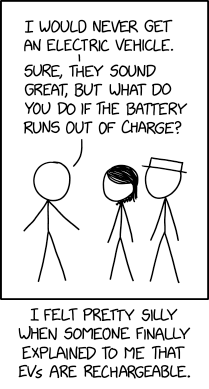
xkcd #3214: Electric Vehicles

Title text:

Now that I've finally gotten an electric vehicle, I'm never going back to an acoustic one.

Transcript:

Transcript will show once it’s been added to explainxkcd.com

Source: https://xkcd.com/3214/
explainxkcd for #3214

Now that I've finally gotten an electric vehicle, I'm never going back to an acoustic one.
you are viewing a single comment's thread
view the rest of the comments
[–] 131 points 8 months ago (95 children)

As an EV owner, I have recieved an interesting amount of reasons why people won't buy them:

  1. The autonomy is not real (so far it's been in my case and in any case, in italy, for how people drive, the declared consumptions are all fake because people here only drives by pressing the accelerator to the bottom)
  2. What if there's a blackout in the whole city and you can't charge your car? (The whole city, for a long time? I'd be worried about other stuff, but go on...)
  3. What if all the public plugs are occupied when you want to charge and you find yourself without battery to go to "ork tomorrow? (ALL OF THEM? At the same time? And why are you waiting to charge your car until it reaches 1% charge?)
  4. What if you come back from a long trip and have a 10% battery remaining and then you recieve an emergency call and have to leave immediately and you can't because the 50-60km you have in your battery are not enough to reach your destination? (I can get to a quick charge station and get 200km in 15mins or so? The world is not ending? And if it's THAT urgent then I should be calling an ambulance anyway, because I probably need one)
  5. I don't want an automatic car! I love changing my gear! (Thank fuck I got rid of the clutch and the gears... never been happier when I drive!)
  6. Ah... but the speed, the torque of a thermic sports car... (Dude, you can't afford a sports car, what the thell are you talking about? And even if I can't either and I have a pretty average EV, you should just press the accelerator of an EV to the bottom and see for yourself)
  7. But it's all about the feeling... the sound... (oh, I get it now... you want to "feel powerful" making everyone look at you and your noise making machine... yeah, I can't compete there, and I don't even want to anyway)
  8. But the electricity is made by burning fuel! (Most of it comes from green sources and, anyway, what the hell do you think your car run on? Water? Are you not very intelligent?)
  9. But the lithium comes from child labor!! (Says while casually using their iPhone, wearing clothes made in a third world country...)

After this, they usually proceed to make absurd claims like "I don't care, I just don't trust EVs.

  • source
  • hideshow 95 child comments
  • [–] 60 points 8 months ago (22 children)

    Very much similar to my own experience. The blackout is the funniest, because gas stations don't work in a blackout, while solar panels do (assuming you disconnect them from the grid).

    I would add one:

    • But I couldn't drive 1.000km without stopping (how often do you do that? It doesn't seem safe anyway....)
  • source
  • parent
  • hideshow 22 child comments
  • [–] 32 points 8 months ago (8 children)

    Oh, yeah! I forgot that one! 

    When you ask them how many times they found themselves with a thermic car doing 1000km without stopping they usually tell you: never, but what if I had to?

    Bitch, if you need to do 1000km without stopping, you should be taking a train or a plane. Driving 10-12 hours without a single stop is bad and dangerous.

  • source
  • parent
  • hideshow 8 child comments
  • [–] 13 points 8 months ago (5 children)

    This was something I realized when we drive to my wife’s parents. It’s 2,000 km each way from our house in the US to where they are in rural Quebec, Canada and we usually drive it twice a year. The charging times sound long, but even with our petrol car most of our stops end up being between 15 to 30 minutes anyways between fueling the car, taking the dog to grass, taking turns going to the toilet so the dog isn’t alone in the car, getting food and giving me a chance to eat so I’m not trying to drive and eat at the same time.

    I think the real challenge of electric range anxiety is that it still takes planning, at least in some parts of the US. There are areas on our route where it might be 100 kilometers to the next fast charger, and there’s no guarantee that all of them will be working or compatible with a car’s fastest charging speeds. We don’t really have to think about where we’ll get gasoline; there’s pretty much always a station, often several, within the next few miles. Usually if we’re waiting to stop for fuel it’s because we’re looking for the best price, looking for a place that might have decent toilets, and/or might have an appealing food option along with the gasoline. That’s all manageable in electric but might need some advanced planning, and many American drivers aren’t used to doing that kind of route planning in advance anymore.

    How many cars in Europe can drive 1,000 km without stopping anyways? The only ones I can think of offhand are large American pickup trucks intended for towing large trailers long distances. I wouldn’t expect to see them in Europe.

  • source
  • parent
  • hideshow 5 child comments
  • [–] 8 points 8 months ago (4 children)

    Any diesel can drive more than 1000 km with a full deposit. But laws forbid in some countries to drive more than 2 hours or 300 km without stopping.

  • source
  • parent
  • hideshow 4 child comments
  • [–] 3 points 8 months ago

    I remember similar guidelines being taught when I was in driver’s ed in the US, but I don’t know if there were strict laws around it. If there are laws I would guess it is a state-by-state thing.

  • source
  • parent
  • [–] a comment that isn't shown here: deleted, from someone you've blocked, or on another page. view the thread from it
  • [–] 2 points 8 months ago

    I only recently learned that in the US not every state has annual inspection requirements. In fact it’s a minority of states, only 14, and it looks like the inspection requirements have been reduced in recent years, such as some states exempting new vehicles for a certain amount of time or only requiring inspections for commercial vehicles. Both states I’ve lived in had annual inspections and I just assumed it was a thing everywhere.

  • source
  • parent
  • load more comments (2 replies)
  • load more comments (2 replies)
  • [–] a comment that isn't shown here: deleted, from someone you've blocked, or on another page. view the thread from it
  • load more comments (8 replies)
  • [–] 12 points 8 months ago (4 children)
    1. Blackout

    Eh? What if there's a gas supply issue? Can't fuel up. I've experienced this after a natural disaster disrupted gas deliveries. Lines for blocks. Days to wait.

  • source
  • parent
  • hideshow 4 child comments
  • [–] a comment that isn't shown here: deleted, from someone you've blocked, or on another page. view the thread from it
  • [–] 10 points 8 months ago (3 children)

    The problem is those days are gone, even without EVs. Between modern automatics more efficient and longer lasting, and cheap reliable CVTs (also more efficient), manual transmissions have no future. I also prefer driving a stick, and frequently complained about limited availability in the US, but technology has passed it by

  • source
  • parent
  • hideshow 3 child comments
  • load more comments (3 replies)
  • [–] 7 points 8 months ago (1 child)

    I've been there, I did manual -> hybrid -> electric.

    I did miss the stick when I was driving an hybrid. In the hybrid it felt like was I had to give away some of the control I had on the car by not being able to change gear.

    With the EV on the other hand it's totally different, the car is way more responsive, there is power the moment I press the pedal and the concept of gear disappear.

    I don't miss driving with a stick when driving an EV

  • source
  • parent
  • hideshow 1 child comment
  • [–] 10 points 8 months ago

    With point 2 you can now use a real life case. Last year the Iberian peninsula had a blackout that lasted more than a day. The combustion engine cars could not pump petrol because guess what: pumps need electricity.

  • source
  • parent
  • [–] 6 points 8 months ago (2 children)

    My argument: When I can get a decent used EV for $5k, I'll do it. Until then, I'll just get a decent used ICE car for $5K.

  • source
  • parent
  • hideshow 2 child comments
  • [–] 5 points 8 months ago*

    I always thought this was one of the reasons for an EV incentive. Encourage more people like me to buy the expensive ones sooner to develop the market, guaranteed demand for manufacturers, but that also gets us faster to the point of cheap used EVs

  • source
  • parent
  • load more comments (1 reply)
  • [–] 5 points 8 months ago

    The best argument against the blackout bit: Ukraine

    Every single used budget EV was bought up by Ukrainians when the war started. Nissan Leafs, older Hyundai Ioniqs, Renault Zoes

    Gas stations were bombed and the whole logistic chain for delivering gasoline and diesel was disrupted or prioritised for the military

    But everyone had power at least for a part of the day, so they could charge EVs.

  • source
  • parent
  • [–] 5 points 8 months ago (2 children)

    My reason: the hybrid I have is still working fine and a new car and a new car won't be in my budget for the next 10 years or so. Also iirc about 33% of the energy a typical car will ever use is spend on its production, so it's better for the environment to use a car until it breaks down.

  • source
  • parent
  • hideshow 2 child comments
  • [–] 4 points 8 months ago (2 children)

    For a lot of people it’s number 7 and I mean, that’s sad

    1 is real though, and it can be a pain

    There’s also the case where some areas are isolated and there’s no charger nearby and that can be a pain, and yea, that’s not a good spot to be in

    Finally, if you can’t charge at home, you’re not really going to save on electricity price compared to fuel, so that’s not the best purchase, and it might be a pain to charge frequently outside if you have an cheap car that charges slowly

  • source
  • parent
  • hideshow 2 child comments
  • [–] 3 points 8 months ago* (1 child)

    In the worst case scenario (very high KWh price), charging is almost the same price for the same distance. In the best case (at home) is 10x cheaper.

  • source
  • parent
  • hideshow 1 child comment
  • [–] 3 points 8 months ago

    This might actually be true, I think I misremember my calculations but I know I compared it some time ago, and realized it was way cheaper at home, and comparing the prices I pay outside and those, it might very well be the case

  • source
  • parent
  • [–] 4 points 8 months ago (5 children)

    I feel like some of those points are slightly more valid in rural areas (especially in the US, where a power pole being knocked over means that the power is out for hours) where the people making those points are more likely to have grown up. Then again if you are not in a rural point of the united states you are less likely to need a car.

  • source
  • parent
  • hideshow 5 child comments
  • [–] a comment that isn't shown here: deleted, from someone you've blocked, or on another page. view the thread from it
  • [–] 3 points 8 months ago* (2 children)

    Yeah, I meant photovoltaic with PV. At least in Europe it's gotten really cheap.

    There are mutiple ways to use the energy that is stored in electric cards. There's "Vehicle to Load" (V2L) for plugging appliances directly into the car, "Vehicle to Home" (V2H) for connecting your home to the car and "Vehicle to grid" for connecting the car to the power grid and selling the stored energy.

    "Vehicle to load" is also useful when going camping or when you need power when there's no outlet near you. You just need a car that supports it and a small adapter.

  • source
  • parent
  • hideshow 2 child comments
  • load more comments (1 reply)
  • load more comments (2 replies)
  • [–] 3 points 8 months ago

    What if everyone woke up at about the same time and plugged in their toasters to make breakfast? ARMAGEDDON.

    ICE cars grow in fields, that's just science.

    The EV battery will wear out and cost eleventy million dollars to replace, and we have to throw all the old batteries in rivers.

    EVs catch fire! no way gasoline could catch fire!

    and finally, what happens if you give up on life and want to end it all? Can't die in a sealed garage with an EV running!

  • source
  • parent
  • [–] a comment that isn't shown here: deleted, from someone you've blocked, or on another page. view the thread from it
  • [–] 3 points 8 months ago

    Depending on the car and budget: It totally is.
    At work we have a VW eUP.
    Charges at a snail pace (¼ = 60-90ish km at 2-3h).

    Yes it's fine most of the time but if we swap it between on-site visits one really has to wait or risk not coming home (and don't get me started on the landmine of charging infrastructure).

    German news about the whole infrastructure: https://youtu.be/GQ2hbLzfQ54

    TLDW: Close a contract with one provider (e.g. your supplier at home), pay tripple the amount because that charging station is from another provider. ¯\_(ツ)_/¯

  • source
  • parent
  • [–] 5 points 8 months ago* (last edited 8 months ago) (25 children)

    Here’s a financial argument. The initial purchase price is too high for me, and the depreciation of electric vehicles is also very high. Overall cost of ownership per distance driven is lower if I drive a small gasoline-powered car.

    I really don’t want it to be that way, but that’s the reality I have to deal with. Cheaper EVs are coming, but they still aren’t in my price range.

    Update: Yes they are. Needed to update my data. Used EVs aren’t expensive trash any more. Some of them are actually quite reasonable.

  • source
  • parent
  • hideshow 25 child comments
  • [–] 5 points 8 months ago (22 children)

    Must be a Europe thing. I ran the numbers in America and avoiding gas cost (vs electric cost per mile) means the car paid for itself after 30k miles. And that's ignoring that it needs no maintenance.

    I thought European gas was expensive. Is the electricity over there also really pricey?

  • source
  • parent
  • hideshow 22 child comments
  • [–] 3 points 8 months ago

    car paid for itself after 30k miles.

    I bought a used hybrid in 2020 when gas was cheap. It's already 100% paid for itself.

    People are morons and don't do the 5 year math on what a vehicle costs to run.

  • source
  • parent
  • [–] a comment that isn't shown here: deleted, from someone you've blocked, or on another page. view the thread from it
  • [–] 3 points 8 months ago (3 children)

    The economics are basically always shifting. Real world depreciation and maintenance don't always follow the model projections, and neither do actual fuel/energy price projections. Electricity service has skyrocketed in a lot of places in recent years, while gasoline prices have remained pretty low, which obviously affects the accuracy of the calculations and modeling that were done 5 years ago. Not to mention, both gasoline and electric energy pricing vary heavily between place.

    And, of course, the ever changing regulatory landscape might affect pricing and resale value, as well.

    Plus the thing with cars is that most people aren't buying the absolute bare minimum they can afford. People are willing to spend more on things: passenger and cargo space, performance, aesthetics, features/comfort, exterior dimensions that fit their own needs (for example, people who live in a city and want a car that can fit in tiny spaces), etc. For someone who is looking at total cost of ownership of something like mid tier or even luxury model, they should be comparing specific models they'd consider.

    Ultimately, people need to do the calculation for their own specific situations. Someone in the market for a minivan in Detroit is gonna have different considerations than the person looking for a pickup truck in Dallas or a luxury sedan in Los Angeles or an economy car in Honolulu.

    And as things shift, we'll likely see more people make the decisions that are right for themselves in that particular moment. Including people who want to pay more for something not directly financially beneficial to themselves, whether it's the driver who wants a manual transmission and the sounds of a revving internal combustion engine, or the person who would rather spend a little bit of extra money to do something more for climate change. Or the person who wants to boycott Elon Musk and will spend a bit more getting another non-Tesla EV.

    At this point, my next car is almost certainly an EV, but I'm not going to prematurely sell my current car to make it happen.

  • source
  • parent
  • hideshow 3 child comments
  • [–] a comment that isn't shown here: deleted, from someone you've blocked, or on another page. view the thread from it
  • [–] 2 points 8 months ago (1 child)

    I only really know the U.S. market, but our top two selling new vehicles (Ford F-150 and Chevy Silverado) have a full EV options that are similarly priced as their gasoline counterparts. They start at $10k more than the entry level gasoline trim levels, but also have options/features included that are comparable to similarly priced gasoline trim levels. And these trucks are a bit unusual in that options and features can literally more than double the price while still carrying the same model name (cheapest F-150 is $40,000 and the most expensive is about $90,000 with full options).

    Our third most popular vehicle is the Toyota RAV4, which is available as a plug in hybrid, but the plug in model doesn't sell that well. But Toyota has been slow at actually wanting to build and sell EVs. The fourth most popular, the Honda CR-V, is primarily a traditional hybrid.

    Skimming past some more pickup trucks, the seventh most popular selling car is the Tesla Y, and the most popular pure EV that isn't available as any gasoline powered variant.

    Looking at the actual EV platforms available in the US, most of the big plays from non-Tesla companies have happened in the last 5 years.

    Volkswagen was a bit earlier than most, with a few specialized models launching in 2019-2021, but they didn't really move that many units.

    The Korean manufacturers Kia and Hyundai and their shared EV platform had a bit more success with sales volume, and started with 2021 models, so that their used EVs are becoming available on the used market.

    GM's big EV platform, the BEV3 (which also powers Honda's EVs) launched with the 2023 model year, and most models started with the 2024 model year.

    Ford has their Mustang Mach-E (beginning in 2021) and F-150 Lightning (beginning in 2022), but both of those are one-off platforms while they work to develop a modular platform for building multiple models with shared electric parts.

    Skimming through the offerings by other traditional automakers, there's BMW's i series, which led to electric options for several of their models beginning in 2022, and Stellantis with a bunch of European models and a handful of American models hitting the market beginning in 2024 or so.

    Pure electric manufacturers like Rivian, Lucid, Polestar have also released some models in the U.S., mostly released in the last 5 years as well.

    So it really seems like the higher volume sales of new non-Tesla EVs picked up in the last 2-3 years, and there will be plenty of used options in the next 5 years. To me, it looks like an inflection point that can sustain EV as the default pretty soon.

  • source
  • parent
  • hideshow 1 child comment
  • load more comments (1 reply)
  • load more comments (1 reply)
  • [–] a comment that isn't shown here: deleted, from someone you've blocked, or on another page. view the thread from it
  • [–] 3 points 8 months ago (9 children)

    TCO is even better for electric. Near zero maintenance. The depreciation is real, but only if you plan to sell it at it's half life. If you plan to hold it a long time, depreciation evens out.

    My EV is ten years old and cost $30k. It's paid for itself twice over in just gas. More if I factor in the zero maintenance (not totally zero. I changed the tires a few times and had to replace a trunk component). The resale on it is about $8k lower than an equivalent ICE. But for me, the EV was a good deal.

    I'd definitely recommend getting a used one though. I bought mine new, and that makes the numbers worse.

  • source
  • parent
  • hideshow 9 child comments
  • [–] 3 points 8 months ago (4 children)

    The depreciation is real

    It’s not though, or it is currently. It wasn’t too many years ago that teslas kept their value more than any other car. I’d argue this is a temporary market condition that is only valid for decisions now but is not predictably valid

  • source
  • parent
  • hideshow 4 child comments
  • [–] 2 points 8 months ago (3 children)

    I lean the other way. I think Tesla valuation was artificially hyped and manipulated. The car's valuation was luxury priced and tied to Elons personality. And that tanked. So I personally don't think that was normal or ever coming back.

    I think the current conditions are also abnormal, with EV becoming political and a horse running amok in the white house.

    The normal depreciation is probably in the middle. But when are things ever normal anymore?

  • source
  • parent
  • hideshow 3 child comments
  • [–] 2 points 8 months ago (2 children)

    Yeah normal seems to have taken a vacation

    In either case it’s all tied to supply and demand. When teslas kept their value it was because huge growth they couldn’t keep up with. Now their value used is horrible but a big part of that is demand dropped, so they can make too many.

    And yes it is not a good thing that in both cases too much was driven by a personality.

    Personally I’m annoyed because teslas still are the most compelling EV available to me, but they always had the shadow of over-hype and now they’re toxic

  • source
  • parent
  • hideshow 2 child comments
  • [–] a comment that isn't shown here: deleted, from someone you've blocked, or on another page. view the thread from it
  • [–] 2 points 8 months ago

    I’m pretty sure maintenance still is a bottleneck. I did have to get warranty work done and the wait was significantly longer than I’ve waited for warranty work on traditional cars. I haven’t read much about it in the last year or though, so who knows.

    But do you even have to goto Tesla? Certainly the drivetrain and any software is highly proprietary but it also rarely needs attention. The shop I use for inspections claims they can do wear items like tires, brakes, suspension

    Body work on the other hand is probably a nightmare. Actually it’s a nightmare for traditional vehicles and can only be longer for Tesla based on lack of parts inventory

  • source
  • parent
  • load more comments (1 reply)
  • [–] a comment that isn't shown here: deleted, from someone you've blocked, or on another page. view the thread from it
  • [–] 2 points 8 months ago (2 children)

    temperatures hovering around +5…-15 °C

    We’ve just come off a cold streak like this and I have to say it was no big deal.

    Obviously I don’t know of there are long term effects on the battery but

    • most/all EVs have active thermal management now so will maintain a healthy temperate while in use
    • my decision point on technology maturity was when they started using heat pumps rather than resistive heat. That’s still too rare but makes a huge impact on cold weather range
  • source
  • parent
  • hideshow 2 child comments
  • [–] a comment that isn't shown here: deleted, from someone you've blocked, or on another page. view the thread from it
  • [–] 2 points 8 months ago

    The most hopeful part about those other chemistries is we already have nmc demonstrated to last beyond the average life expectancy of a vehicle…. And most of those newer chemistries should last significantly longer

  • source
  • parent
  • load more comments (1 reply)
  • load more comments (1 reply)
  • [–] 3 points 8 months ago (3 children)

    It depends where you live. We have cheap gas and I live in an area with one of the more expensive prices for electricity (and there are worse), but “filling up” at home is much cheaper than “filling up” my ice car.

    However

    • yes, we only have expensive EVs here. You can make up an extra $5k of purchase price with money saved on operations, but $10k or more is much harder
    • trip chargers are already in a race for exploitation, profit seeking. Except for Tesla, prices are high, maintenance is low, and they compete for trapping customers more than attracting them
    • since EVs became political we are currently off balance between supply and demand, so used cars are over supplied and lost much value. The quickly changing technology just makes it worse
  • source
  • parent
  • hideshow 3 child comments
  • [–] a comment that isn't shown here: deleted, from someone you've blocked, or on another page. view the thread from it
  • [–] 3 points 8 months ago

    Yes, I’ve argued that too. While there is the factor of fast changing technology, I think used EVs are a great buy right now.

    I’m not in the market for an additional car although I’ve actually been tempted anyway …. I have two college kids sharing my old Subaru and it would prevent a lot of fights if I had another old vehicle for them

    Then again my older kid just applied for a summer job with like 90 miles each way commute so may not be appropriate for limited or unknown range

  • source
  • parent
  • load more comments (2 replies)
  • load more comments (3 replies)
  • load more comments (2 replies)
  • load more comments (9 replies)