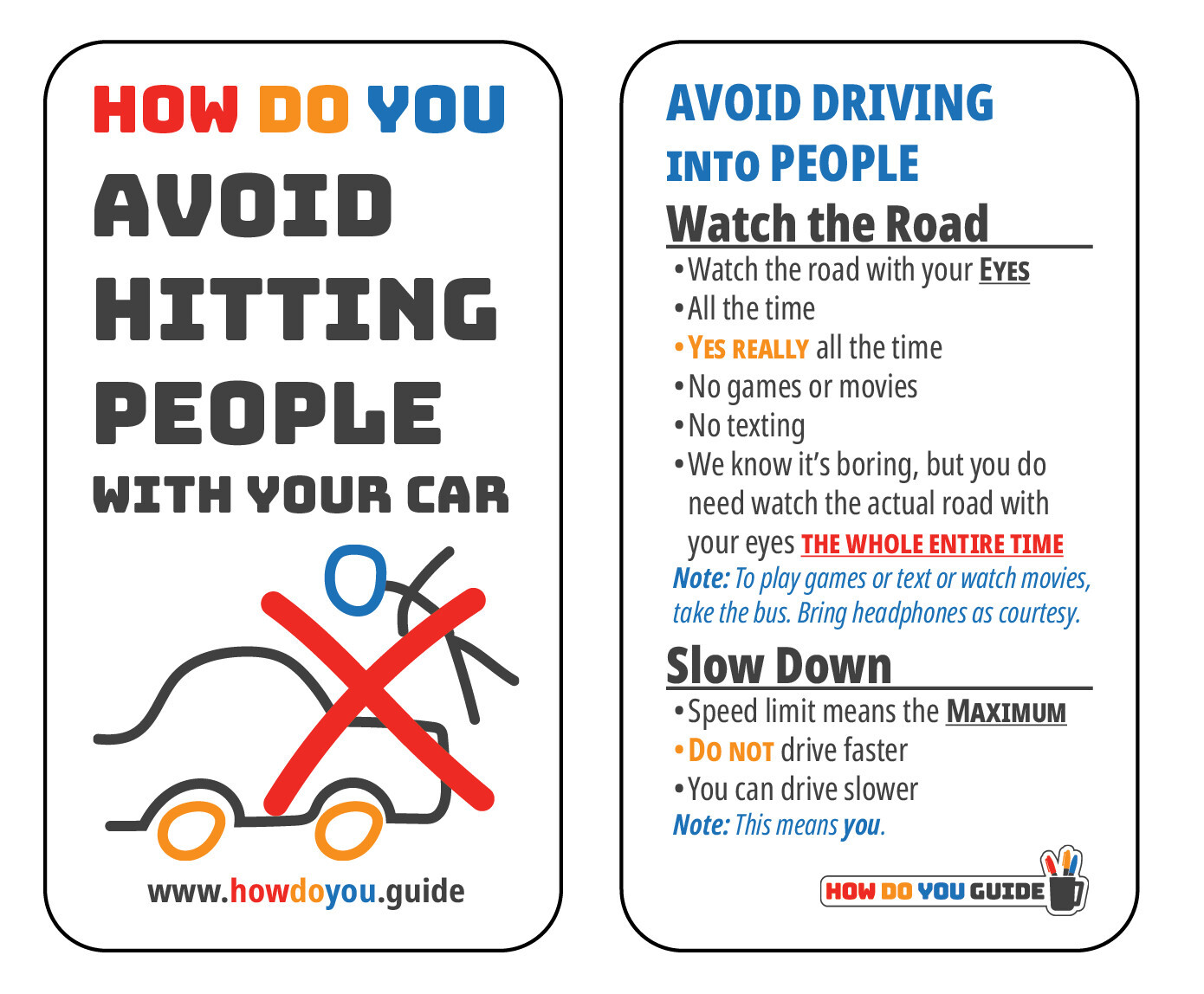
“ How Do You Avoid Hitting People With Your Car" pocket guide. Instructs readers to Watch the Road and Slow Down. Further text humorously insists that watching the road and slowing down are indeed important.
you are viewing a single comment's thread
view the rest of the comments
[–] 34 points 1 year ago* (13 children)

Carpooling is just taking a short bus (non-derogatory and second-meaning not intended).

  • source
  • parent
  • hideshow 13 child comments
  • [+] -7 points 1 year ago* (11 children)

    Except it's a "bus" that stops at your start and destination instead of several blocks away, and takes a fraction of the time to make the trip

  • source
  • parent
  • hideshow 11 child comments
  • [–] 5 points 1 year ago (3 children)

    Its a good thing that busses and trains don't take you directly to your destination.

  • source
  • parent
  • hideshow 3 child comments
  • [–] -1 points 1 year ago (2 children)

    Yes, because it's terrible to get somethwete in a timely manner, especially people unable to walk moderate distances.

  • source
  • parent
  • hideshow 2 child comments
  • [–] 7 points 1 year ago*

    Its terrible because it is geometrically impossible for a form of transit to simultaneously have high capacity and to carry people directly to their destination.

    Cars average an occupancy of about 1.5, while trains routinely carry hundreds of people. A bit of thought about the implications of everyone arriving directly at their destination should reveal why the average occupancy of such a transit mode can never be much higher than 1.5. This is something that many many advocates of PRT (personal rapid transit) systems fail to understand.

    By the way, a pedestrian oriented space can be made to accommodate people that have difficulty walking, but it is virtually impossible to make a city safe and accessible for people with difficulty seeing if the expectation is that everyone is driving a car to their destination.

  • source
  • parent
  • load more comments (1 reply)
  • [–] 5 points 1 year ago (6 children)

    Depends on the design of the area. For rural areas, that's gonna be the case (although we could make buses go to specific houses by request and buses for disabled people already do this). But I've been places where the buses stop everywhere and have designated routes, so getting to a car means walking at least half a mile each way and often having to drive further, possibly in traffic the buses avoid.

  • source
  • parent
  • hideshow 6 child comments
  • [+] -6 points 1 year ago (5 children)

    Where have you found that buses stop only in front of your start and destination, and nowhere else? How do buses prevent cars from dropping off or picking up people at a curb? Where are parking structures significantly further away than bus stops?

  • source
  • parent
  • hideshow 5 child comments
  • [–] 5 points 1 year ago (4 children)

    I didn't mean only stop at destination. Just that the pickup and dropoff are basically the destination, while parking is in some distance lot or garage. The entire routes are bus-only. Cars aren't allowed on the street at all.

  • source
  • parent
  • hideshow 4 child comments
  • [–] -3 points 1 year ago (3 children)

    Right, so an urban area that actually has full transit coverage wouldn't have that problem. Sadly, that isn't relevant to the vast majority of the planet.

  • source
  • parent
  • hideshow 3 child comments
  • [–] 4 points 1 year ago* (2 children)

    Its not possible for the majority of uninhabited land on the planet, but its possible for the majority of people globally that live in urban areas.

  • source
  • parent
  • hideshow 2 child comments
  • [–] -1 points 1 year ago (1 child)

    To clarify, I was specifically referring to urban environments across the globe.

  • source
  • parent
  • hideshow 1 child comment
  • [–] 2 points 1 year ago

    Its possible for every urban area everywhere across the globe, because the laws of geometry are the same across the entire globe.

    In many cities in many countries the conscious choice was made to destroy transit infrastructure and radically alter the urban fabric to accommodate cars (and in so doing hamper every other form of transportation). But nothing about this has anything at all to do with the city's location, and its not an accident that public transportation just 'happens' to be better in some places than in others.

  • source
  • parent