KNBR (AM 680) Antennas, Redwood City, CA, 2024.All the pixels, none of the sports, news, or weather, at flickr.com/photos/mattblaze/54#photography
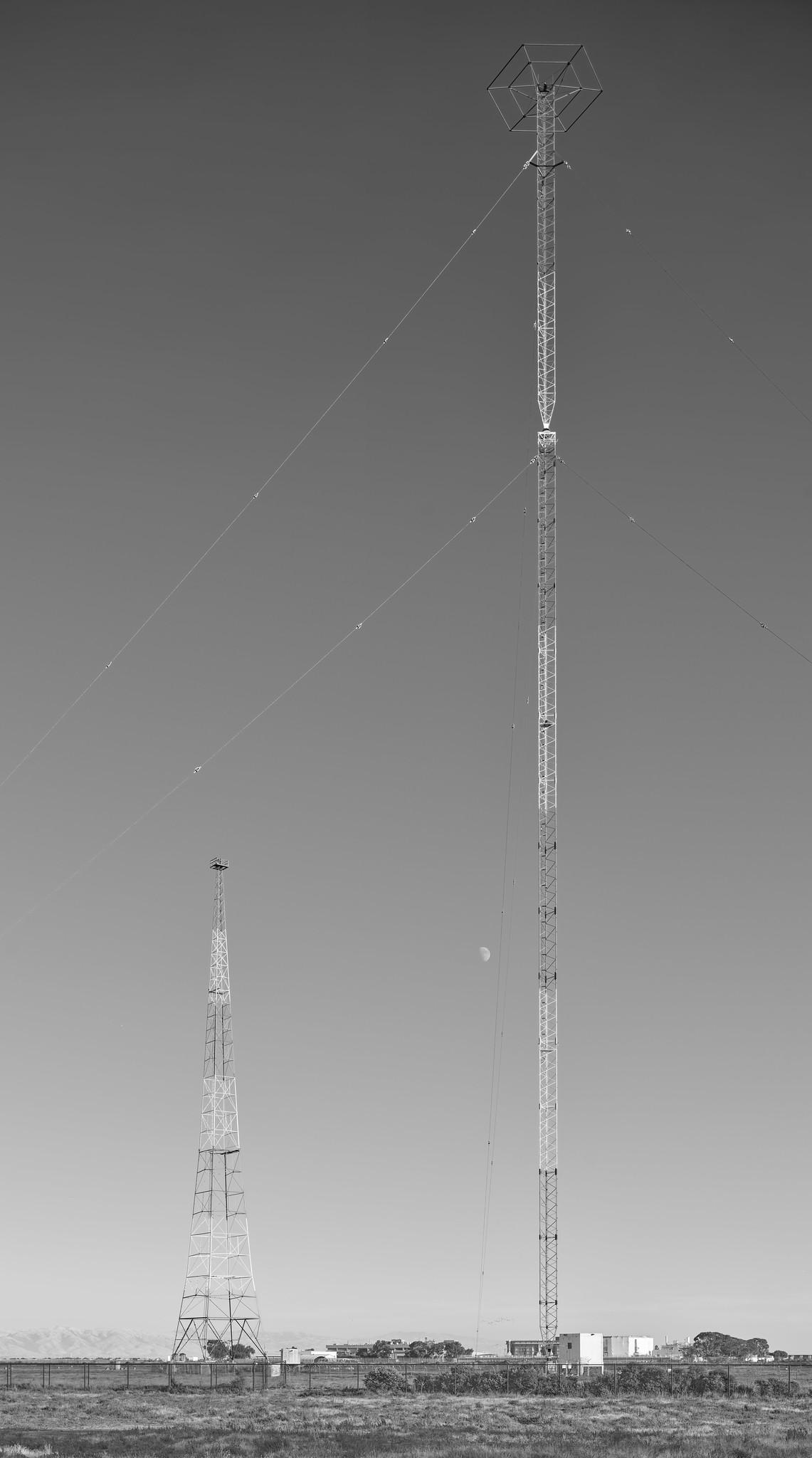
Two radio antenna masts in a field. The taller mast, on the right, is a guyed tower with a hexagonal structure at the top. The shorter mast on the left, toward the background, is freestanding.
you are viewing a single comment's thread
view the rest of the comments
[–] [S] 1 point 1 year ago (16 children)

The taller tower (550 feet) at right is the main KNBR antenna, built in 1949. It employs an unusual "pseudo-Franklin" design; it's actually an array of two antennas stacked atop one another. The 400 foot lower section is insulated from the ground. The upper 150 foot section is insulated from the lower section. The large (50 foot) diameter "capacitance hat" at the top (reminiscent of the Parachute Jump at Coney Island) electrically lengthens the top section, saving 250 feet of additional height.

  • source
  • parent
  • hideshow 16 child comments
  • [–] 1 point 1 year ago (1 child)

    @mattblaze Radio and Photography technical expertise and explanations in one thread - what's not to love!A quick google indicates that the wavelength of 680kHz is approximately 440m.I was half expecting the antenna lengths to be an even fraction of a wavelength, but came up with 5/18ths for the lower section and 5/54 for the upper section before the effect of the hat.

  • source
  • parent
  • hideshow 1 child comment
  • [–] [S] 1 point 1 year ago

    @BernardSheppard Yeah, MW wave antennas are almost never an exact standard size that might be used at higher frequencies (like 1/4 or 5/8 wave), especially because stations sometimes change frequencies. So everything is tuned.By the way, it's common for lower frequency antennas to be specified in degrees of a full wave. So this antenna is a total of 137º at 680 KHz (but electrically longer, because of the top hat).

  • source
  • parent
  • [–] [S] 1 point 1 year ago (12 children)

    This distinctive stacked dual antenna arrangement is used to lower the radiation angle of the antenna, concentrating transmitted power to the "ground wave" and reducing energy that would otherwise be sent upward into the sky.The smaller (300 foot) freestanding mast in the background left is not in current use. It can be used as an emergency spare antenna for KNBR during maintenance of the taller main antenna.

  • source
  • parent
  • hideshow 12 child comments
  • [–] [S] 1 point 1 year ago (11 children)

    The antenna field is in the final approach and takeoff flightpath for SFO airport's runways 28L/R (and 10L/R), and so the site has special markings to warn pilots of a collision hazard. In addition to the usual tower lights and red/white paint, 3-dimensional "HAZ" warnings were installed around the field. These are easily visible in areal photos; see, e.g., earth.google.com/web/@37.54712

  • source
  • parent
  • hideshow 11 child comments
  • [–] [S] 1 point 1 year ago (10 children)

    Note, important safety tip: you can get closer to this tower without clearly trespassing or jumping fences than most other 50KW broadcast antennas I've encountered. I measured a field strength of over 80V/m a bit outside the tower fence, which is an incredibly strong signal (though still within OSHA limits at the frequency involved).Resist any temptation to jump the fence and climb the (energized) tower. You'd be electrocuted as soon as you touched it.

  • source
  • parent
  • hideshow 10 child comments
  • [–] [S] 1 point 1 year ago (7 children)

    AM broadcast is a technically interesting and somewhat endangered medium. The low frequencies mean that signals routinely travel well beyond their local coverage areas, especially overnight in winter. So there's a bit of mystery in tuning around the dial late at night; you never know what you might pick up.Sadly, industry consolidation and the growth of higher bandwidth media (FM, satellite, podcasts) has greatly reduced the variety and local focus of programming. But it somehow hangs on.

  • source
  • parent
  • hideshow 7 child comments
  • [–] 1 point 1 year ago

    @mattblaze With modern modulation techniques, I'd think you could get some pretty decent bandwidth even at those frequencies for long-distance data comms. Wouldn't be AM anymore, but...

  • source
  • parent
  • [–] 1 point 1 year ago

    @mattblaze I had a Mickey Mouse transistor radio as a kid that I'd keep under the pillow to listen to at night -- something of a feat, since it was about an inch and a half thick. Mostly I listened to WIP-AM (which was music then) and KYW (still news after all these years), but I would tune around seeing what I could find. One night I was surprised to hear a Chicago Blackhawks game -- being broadcast from Chicago without a repeater! Overcast nights for the win.

  • source
  • parent
  • [–] [S] 1 point 1 year ago (4 children)

    The rapid decline in recent years of local content on the mediumwave bands has considerably reduced the romantic mystery of tuning around and seeing what you find. It's mostly now a sterile mix of mass-produced, syndicated right wing talk, sports, and so on. But there are still a handful of stubbornly local stations producing their own programming.

  • source
  • parent
  • hideshow 4 child comments
  • [–] 1 point 1 year ago

    @mattblaze I secretly love when the power goes out (not for too long though) so I can get out a portable radio and DX on the shortwave and medium wave bands. No matter the content, get a thrill from hearing a signal from a far-away place.

  • source
  • parent
  • [–] 1 point 1 year ago

    @mattblaze It wasn't unusual at all to hear the midnight baseball rebroadcasts of Giants games on KNBR up here in Portland. A clear channel meant something in those days.Thank you for advising people to stay away from the tower. There really isn't a "safe" place to be on a transmitter site unless you are part of a crew and following strict protocols. (Full disclosure: I've worked on transmitter sites and know a whole lot more about specific dangers than an average person.)

  • source
  • parent