1


Chinese-made panels on rooftops across the world are changing the facts of life for big utilities.

2
3
4


I have an old laptop that I'd like to get rid of. I've repurposed its SSD and RAM. It has an HDD on it, but it's so old, that it probably shouldn't be used anymore. A screw doesn't fit properly, so the chassis is a bit bumpy on one corner. But it works just fine. (Has an 8th gen i7 in it.)

I already have home-servers etc., so I just want to get rid of it. What's the most ethical way of doing it?

I'm currently living somewhere in southern USA, if that's relevant.

5


Happy 2026! The Eco-Libre project published our 2025 Annual Report for last year.
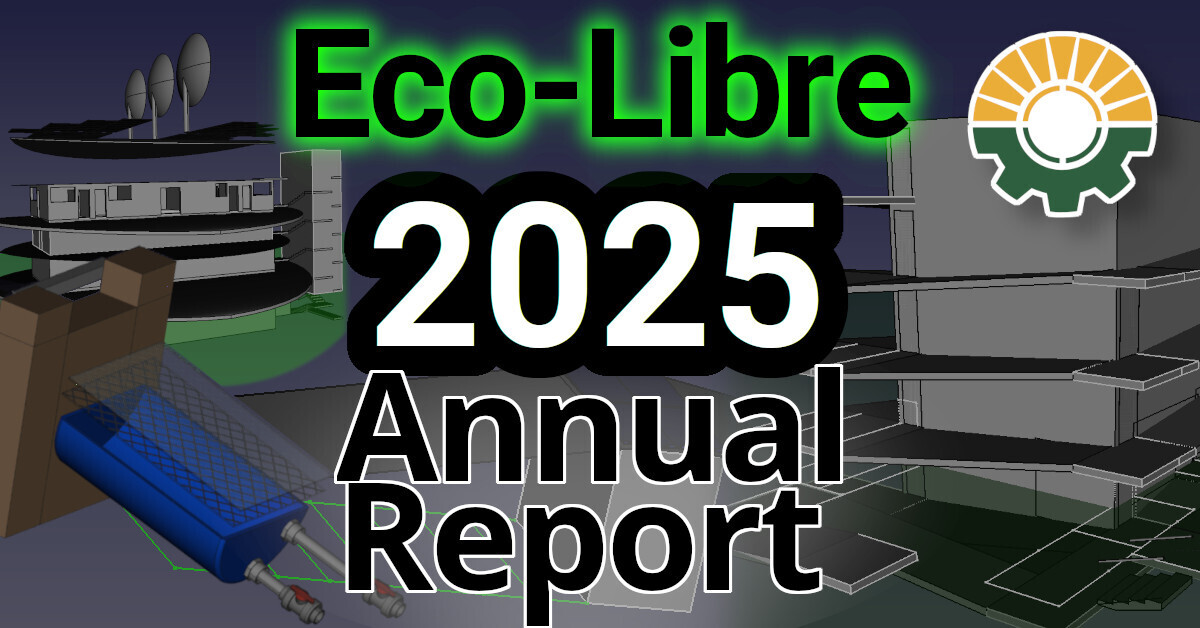
Eco-Libre 2025 Annual Report

Eco-Libre is a volunteer-run project that designs libre technology for sustainable communities.

Eco-Libre's mission is to research, develop, document, teach, build, and distribute open-source technology that sustainably enfranchises communities' human rights.

We aim to provide clear documentation to build low-cost machines, tools, and infrastructure for people all over the world who wish to live in sustainable communities with others.

Executive Summary

  • Continuing search for land in Ecuador
  • New Eco-Libre Logo
  • First Release of Life-Line Project
  • Two Prototypes of Life-Line Project

Read the full report here.

Contribute to Eco-Libre

If you'd like to help Eco-Libre reach our mission to enfranchise sustainable communities' human rights with libre tech, please contact us to get involved :)

Join Us
eco-libre.org/join

Cheers,
The Eco-Libre Team
https://www.eco-libre.org/

6


Though it's in a crowd funding stage, this looked fascinating as a Sustainable piece of tech.

7
8


We’re happy to announce the release of the Eco-Libre Life-Line version 2025.10.
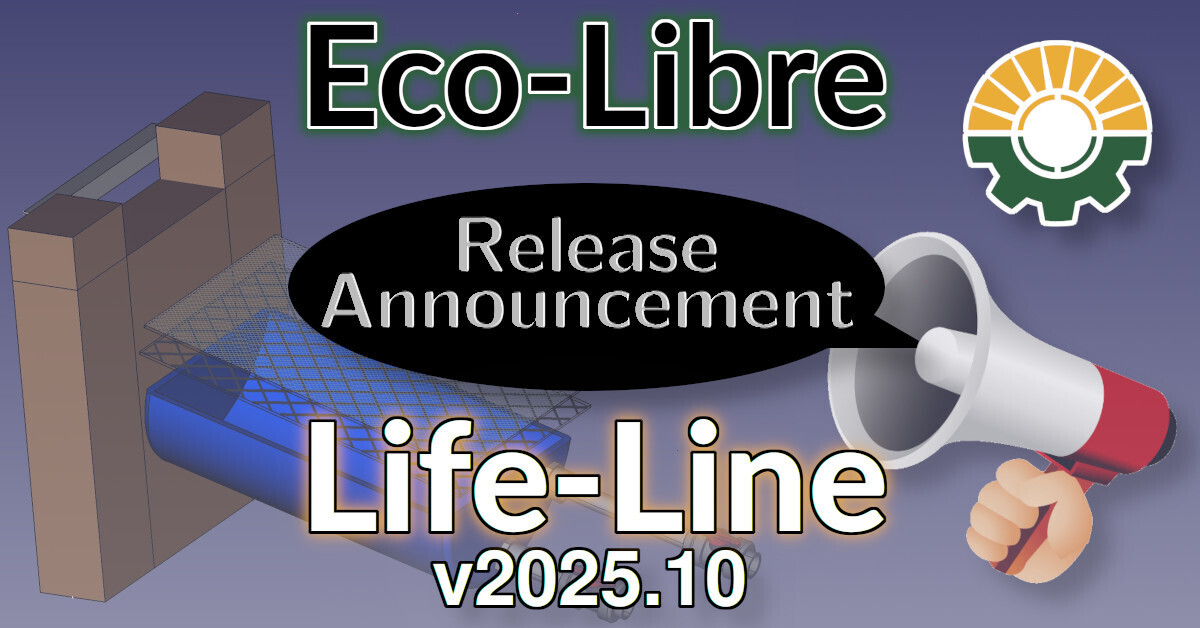
Eco-Libre Life-Line v2025.10 Release Announcement

Who is Eco-Libre?

Eco-Libre is a volunteer-run project that designs libre technology for sustainable communities.

Eco-Libre's mission is to research, develop, document, teach, build, and distribute open-source technology that sustainably enfranchises communities' human rights.

We aim to provide clear documentation to build low-cost machines, tools, and infrastructure for people all over the world who wish to live in sustainable communities with others.

Contribute to Eco-Libre

If you'd like to help Eco-Libre reach our mission to enfranchise sustainable communities' human rights with libre tech, please contact us to get involved :)

Join Us
eco-libre.org/join

Cheers,
The Eco-Libre Team
https://www.eco-libre.org/

9
10


cross-posted from: https://lemmy.world/post/34131035

This is re solar, which is sustainable energy, so I'm cross-posting this here.

I asked Claude 4 opus (thinking) re sunlight hitting a solar cell. Per Claude, the infrared wavelengths near the visible light wavelengths are the most efficient. But a big part of the sunlight is visible light, so a big part of the electrical energy from a solar cell is from visible light.

Also, per Claude, "When light strikes an n-type monocrystalline silicon solar cell, photons must have sufficient energy to promote electrons from the valence band to the conduction band across silicon's bandgap. Silicon has a bandgap energy of approximately 1.12 electron volts (eV) at room temperature, which corresponds to a wavelength of about 1107 nanometers. This means photons with wavelengths longer than 1107 nm (energy less than 1.12 eV) cannot generate electron-hole pairs in silicon and pass through the material without contributing to electrical current. The relationship between photon energy and wavelength follows the equation E = hc/λ, where E is energy, h is Planck's constant, c is the speed of light, and λ is wavelength. Using this relationship, we can understand how different portions of the solar spectrum interact with silicon. Infrared radiation spans wavelengths from about 700 nm to 1 mm, with energies ranging from approximately 1.77 eV down to 0.001 eV. Only the near-infrared portion up to about 1107 nm can be absorbed by silicon. Photons in the 700-1107 nm range have energies between 1.77 and 1.12 eV, making them ideal for silicon solar cells as they have just enough energy to create electron-hole pairs with minimal excess energy lost as heat. Visible light extends from 400 to 700 nm, corresponding to energies of 3.1 to 1.77 eV. All visible photons have more than enough energy to overcome silicon's bandgap. However, the excess energy above 1.12 eV is largely wasted through thermalization, where hot carriers quickly lose their extra energy as heat. This fundamental thermalization loss limits the theoretical efficiency of single-junction silicon cells. Ultraviolet light, with wavelengths below 400 nm, carries energies above 3.1 eV. While UV photons are readily absorbed by silicon, their high excess energy results in significant thermalization losses. Additionally, UV photons are often absorbed very near the surface of the cell, where recombination rates are typically higher, further reducing their contribution to the cell's output current. The high surface recombination and thermalization losses make UV photons particularly inefficient for silicon solar cells despite their high energy."

I know re llm hallucination so I googled. I verified the energy formula and silicon's energy gap.

Has Claude been right?

11


cross-posted from: https://lemmy.sdf.org/post/36402193

The knee-jerk answer when an app pushes designed obsolescence by advancing the min Android API required is always “for security reasons…” It’s never substantiated. It’s always an off-the-cuff snap answer, and usually it does not even come from the developers. It comes from those loyal to the app and those who perhaps like being forced to chase the shiny with new phone upgrades.

Banks, for example, don’t even make excuses. They can just neglect to be mindful of the problem and let people assume that some critical security vuln emerged that directly impacts their app.

But do they immediately cut-off access attempts on the server-side that come from older apps? No. They lick their finger and stick it in the air, and say: feels like time for a new version.

It’s bullshit. And the pushover masses just accept the ongoing excuse that the platform version must have become compromised to some significant threat -- without realising that the newer version bears more of the worst kinds of bugs: unknown bugs, which cannot be controlled for.

Banks don’t have to explain it because countless boot-licking customers will just play along. After all, these are people willing to dance for Google and feed Google their data in the first place.

But what about FOSS projects? When a FOSS project advances the API version, they are not part of the shitty capitalist regime of being as non-transparent as possible for business reasons. A FOSS project /could/ be transparent and say: we are advancing from version X to Y because vuln Z is directly relevant to our app and we cannot change our app in a way that counters the vuln.

The blame-culture side-effect of capitalism

Security analysis is not free. For banks and their suppliers, it is cheaper to bump up the AOS API than it is to investigate whether it is really necessary.

It parallels the pharmacutical industry, where it would cost more to test meds for an accurate date of expiry. So they don’t bother.. they just set an excessively safe very early expiration date.

Android version pushing is ultimately a consequence of capitalist blame-culture. Managers within an organisation simply do not want to be blamed for anything because it’s bad for their personal profit. Shedding responsibility is the name of the game. And outsourcing is the strategy. They just need to be able to point the blame away from themselves if something goes wrong.

Blindly chasing the bleeding-edge latest versions of software is actually security-ignorant¹ but upper management does not know any better. In the event of a compromise, managers know they can simply shrug and say “we used the latest versions” knowing that upper managers, shareholders, and customers are largely deceived into believing “the latest is the greatest”.

¹ Well informed infosec folks know that it’s better to deal with the devil you know (known bugs) than it is to blindly take a new unproven version that is rich in unknown bugs. Most people are ignorant about this.

Research needed

I speak from general principles in the infosec discipline, but AFAIK there is no concrete research specifically in the context of the onslaught of premature obsolescence by Android app developers. It would be useful to have some direct research on this, because e-waste is a problem and credible science is a precursor to action.