1


Compared with looser undergarments, for instance, tighter options were linked to 18 percent higher odds of producing less semen.

Tight undies were also linked to 12 percent higher odds of having fewer motile sperm, 48 percent higher odds of having fewer normally shaped sperm, and 108 percent higher odds of having more sperm with DNA fragmentation or damage.

In a secondary analysis, researchers also found that erectile dysfunction and premature ejaculation were more prevalent in the tight underwear group.

"In conclusion, tight underwear was associated with poorer semen quality and a higher prevalence of erectile dysfunction and premature ejaculation," the authors write, led by urologist Xue-Chun Hu from the University of Science and Technology of China (USTC).

2
3
4


Dogs are constantly passing gas. So why don’t cats seem to?

5
6
7


Learn more about a new species of brittle star found beside a 9.5-million-year-old whale carcass in Denmark.

8
9
10
11
12
13
14
15


cross-posted from: https://lemmus.org/post/26646894

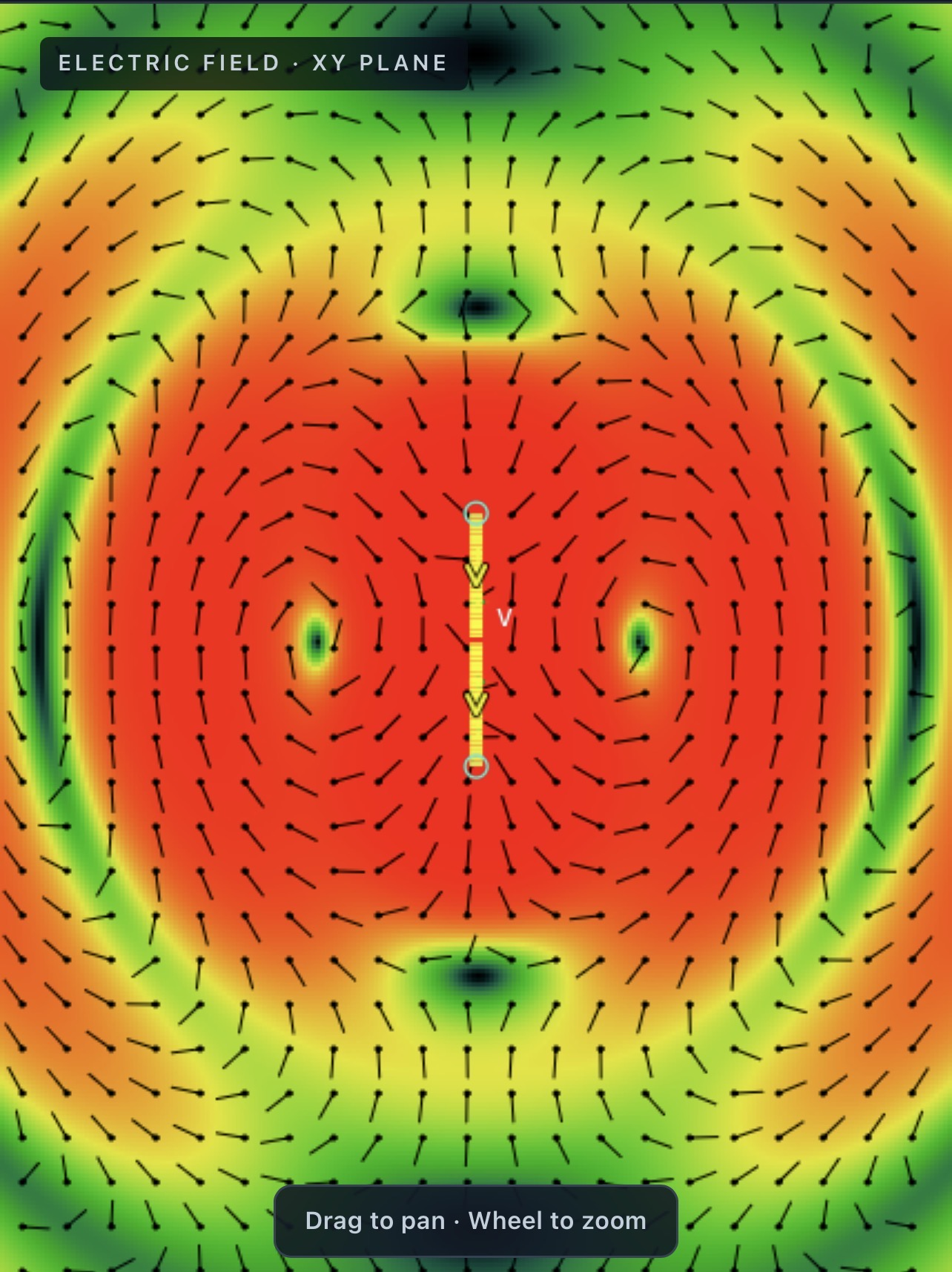
a website to help students visualize the electromagnetic field

I’ve been building this simulator as a side project aimed to help students understand and visualize electromagnetic phenomena such as radiation, near field effects, polarization, wave interference and diffraction.

You can:

  • place multiple, diffrent radiation sources and set their parameters (geometery, amplitude, phase and more)
  • place perefect wire conductors, PEC plane and poke slots in the plane to create diffraction patterns
  • observe the electric field, magnetic field, energy flow field, energy density or radiation pattern
  • zoom in and out and translate the canvas
  • change the simulation resolution, frequency and propogation speed and some other parameters

I hope someone might find it useful and I’d love to hear what people think :)

What do you think I should add?

Live:
https://www.antennasim.com/

GitHub:

https://github.com/rotemTsafrir/antenna_sim

16
17
18
19
20


Quark–gluon plasma (QGP) is an unusual state of matter that appears under tremendous pressure and heat. At temperatures exceeding 100,000 times those at the Sun's center, particles such as protons and neutrons can no longer maintain their normal structure. Instead, they break apart into quarks and the gluons that ordinarily bind them together.

Physicists believe that this was the state of matter throughout the universe during the first millionths of a second after the Big Bang. Nearly 14 billion years later, researchers can briefly recreate these extraordinary conditions by smashing atomic nuclei together at extremely high energies inside the LHC.

21
22
23
24


An account of how nineteenth-century studies aiming to find a biological basis for human races were dismantled by good scientific practices — although their effects are still felt today.

OG Link: https://www.nature.com/articles/d41586-026-03507-z

25
view more: next ›