1
posts
2
3
The military uses a Manitoba park for survival training. Some are worried about the wildfire risk
(thenarwhal.ca)
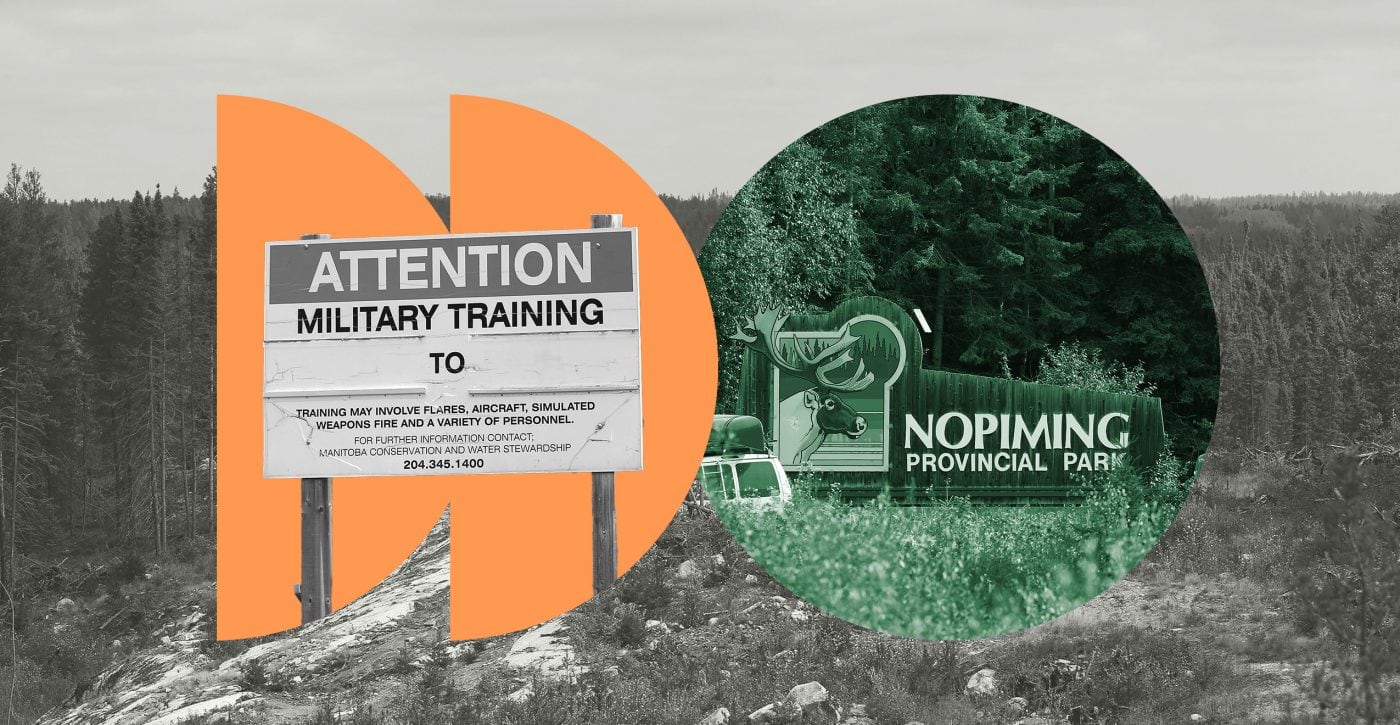
Photo illustration: Shawn Parkinson / The Narwhal. Photos: Shannon VanRaes / The Narwhal
It’s been more than a year since Pat Popp and her husband fled their home in Nopiming Provincial Park to escape an encroaching wildfire, but it’s a day she thinks about often.
Popp recalls seeing distant flames from the window of her property on Bird Lake when she went to bed on May 12, 2025. An evacuation order was issued the next morning.
“They had to water down the highway to get us out of here and then we were evacuated for five weeks,” Popp said over the phone.
Much of Nopiming — a sprawling boreal forest and recreational area 175 kilometres northeast of Winnipeg — burned in the wildfire, which was sparked by lightning and spread to nearly 4,000 square kilometres by the time it was finally deemed extinguished last December.
Today, charred fir trees dominate the landscape around Bird Lake, where the Popps have lived full time since 2017 and where Pat’s husband, Russ, has had a cottage since 1966. Popp said she feels traumatized by how close they came to losing everything. Those anxieties were reignited last month when she noticed military training had resumed in the woods near her home.
The Canadian Forces School of Survival and Aeromedical Training has been operating in Nopiming Provincial Park since the mid-1990s under a memorandum of agreement between the military and Manitoba government.
Now, in the wake of the wildfire, park residents and a local wilderness advocate are calling for the relocation of the long-running survival training program to protect the damaged forest and its inhabitants — humans and animals alike.
Military uses provincial park for survival training
The Manitoba government markets Nopiming, which means “entrance to the wilderness” in Anishinaabemowin, as a destination for “nature-oriented recreational opportunities such as canoeing, hiking and mountain biking in a largely undisturbed environment.” But the park has also long allowed both mining exploration and military activities with the provincial park.
The agreement that allows the military to use the park was last reviewed in 2021, and dictates where and under what conditions military activities are permitted in the park, Capt. Ken Jacobson, a public affairs officer with CFB Winnipeg, said in an emailed response to questions from The Narwhal/Free Press.
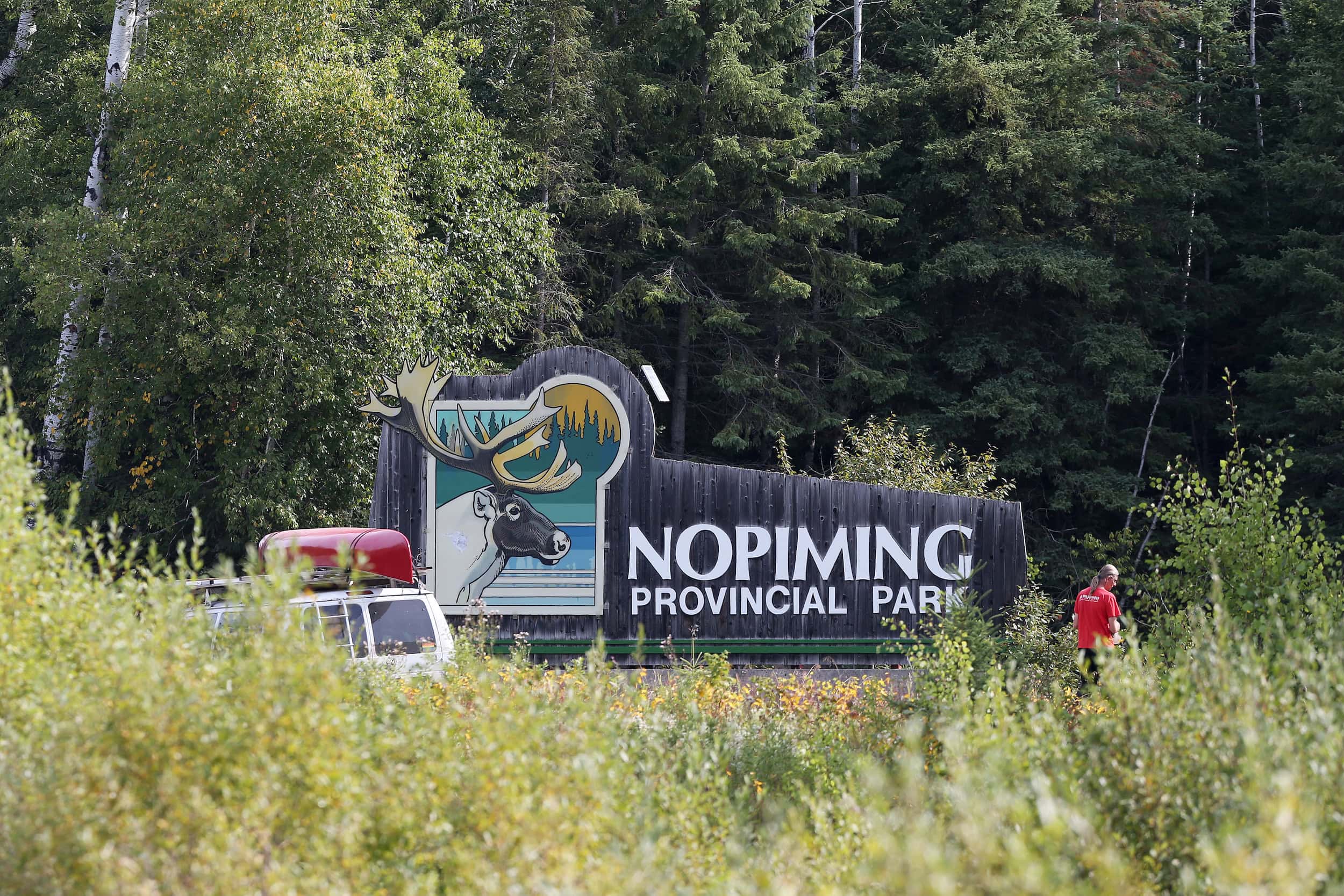
Nopiming Provincial Park is one of few protected areas that allow military training inside their boundaries. According to CFB Winnipeg, the exercises are carried out under an agreement that dictates where and when they may occur. Photo: Shannon VanRaes / The Narwhal
The school trains Air Force members how to survive in remote wilderness environments following a plane crash or emergency situation; as well as how to evade, resist and escape enemy capture.
“Training focuses on survival fundamentals such as shelter construction, firemaking, signalling, water procurement and food acquisition. The program does not involve combat training,” Jacobson said.
The school is based at a former summer camp on Springer Lake — a body of water north of Bird Lake near Provincial Road 314. Students and staff were evacuated during the 2025 fire and most of the facilities were destroyed. The base is currently outfitted with tents and temporary storage units. So far, none of the permanent structures have been rebuilt.
The program returned to Nopiming in October 2025 through consultation and permits approved by Manitoba Parks, Jacobson said, adding modifications have been made to reduce the natural resources used by trainees in the field, such as limiting the number of trees required to build a shelter.
Timber is allowed to be harvested for personal use in designated areas of Crown land and Manitoba provincial parks with a permit. The agreement between the province and military includes a provision that allows trees to be cut down during the survival training, according to the provincial spokesperson.
Students may also fish and hunt small animals in accordance with provincial regulations during the training exercises, Jacobson said, but are not allowed to harvest large game.
The agreement between the military and province only allows campfire training to occur from April to May and September to October unless prior notice is given and pending local fire restrictions, a provincial spokesperson said in an emailed statement.
Residents concerned about military firemaking in a park recently ravaged by wildfire
The military confirmed training activities are being conducted this fall south of the Bird Lake cottage development in an area untouched by the fire.
The firemaking and close proximity are what worry Pat Popp most.
“They are so close to my home. I mean, we’ve been worried about this for years: these fires that they start and can so easily get out of control,” she said. “It’s just so stressful knowing that this much of the park is gone and now they’re pushing them into this small area.”
In 2021, Popp wrote a letter to the province expressing her concerns about the potential wildfire risk associated with the military survival exercises, which involve making open fires in makeshift camps outside of designated pits.
In a response letter reviewed by The Narwhal/Free Press, then deputy minister of conservation and climate, Jan Forster, said parks staff had engaged with Department of National Defence staff “to strengthen communications, and to ensure training activities are restricted during times of high to extreme fire danger.”
While the fire danger was extreme in northern parts of the province, the risk remained low in most of southern Manitoba this year due to wetter conditions.
The school is required to have firefighting equipment on hand during training demonstrations, and instructors are responsible for confirming campsite fires have been properly extinguished before departing a site, the provincial spokesperson said.
A 2025 wildfire evacuee and resident of nearby Flanders Lake, who asked not to be named, shared similar concerns about military trainees making open fires near Nopiming’s residential area and described the practice as a preventable risk — particularly in a forested region where much of the ground is covered by peatlands, which can harbour smouldering fires for months. The permanent park resident hadn’t noticed any signage related to military training in the area this fall and said it’s unsettling to see uniformed Canadian Forces members arriving in the neighbourhood unannounced.
‘Now that the park is burnt, the area needs peace’: advocate
Eric Reder, senior Manitoba campaigner with the Wilderness Committee, said his organization has been pushing the province to decommission and remove the military training facility at Springer Lake since at least 2014. He believes the issue is more pressing following last year’s wildfire.
“Military training can happen somewhere, but this isn’t the place for it,” Reder said over the phone while driving up to Nopiming last month. “And now that the park is burnt, the area needs peace.”
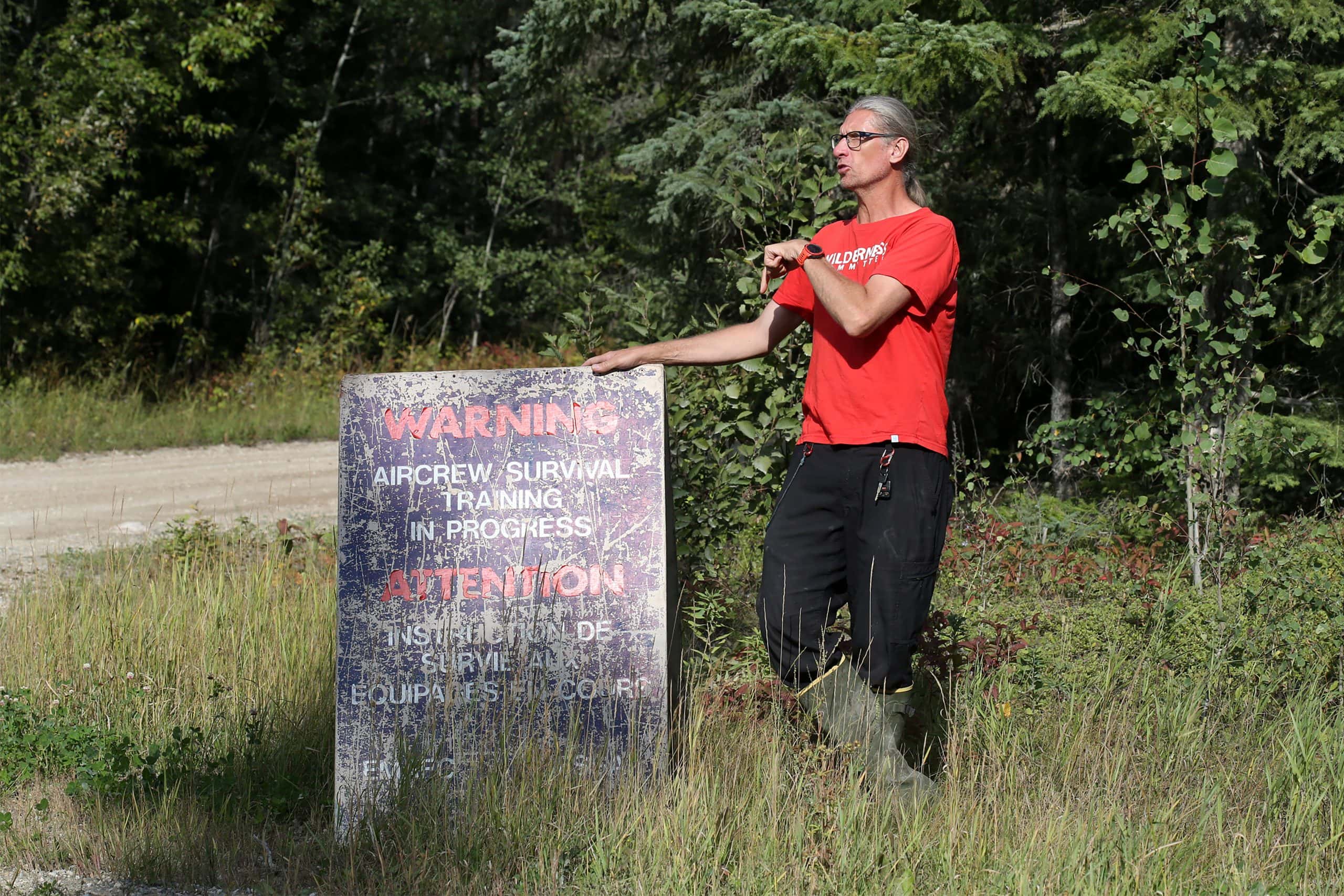
A recent report calls for a moratorium on “disruptive” military exercises in Nopiming Provincial Park. “That’s not what parks are for,” says climate campaigner Eric Reder. Photo: Shannon VanRaes / The Narwhal
In a report released earlier this year, the committee recommended a moratorium on industrial activity and “disruptive military training exercises” to allow the park’s vegetation and wildlife — including its threatened boreal woodland caribou herd — to recover.
Over the years, Reder has documented remnants of temporary campgrounds in the bush and gouges in trails left by the tracks of an all-terrain vehicle used by the school.
“It’s way too invasive for an area that is a sensitive ecosystem. It’s important wilderness, but it’s also a park, right?” Reder said of the military training. “That’s not what parks are for.”
Popp also worries about the impact on flora and fauna, adding she’s seen a large military plane flying over the area frequently this fall.
“It’s so vulnerable at this point,” she said of the forest. “It’ll take decades to regenerate, it won’t happen in my lifetime.”
The province said there are no plans to end the military training agreement.
The military and province are developing a tree-replacement initiative and looking at other forest regeneration options. “This work reflects a shared commitment to responsible environmental stewardship and the continued preservation of the park’s natural environment,” Jacobson said.
Eva has been reporting on environmental issues in Manitoba since joining The Narwhal in 2026. Her role is part of a partnership with the Winnipeg Free Press.
The Narwhal’s reporters are telling environment stories you won’t read about anywhere else. Stay in the loop by signing up for our free weekly dose of independent journalism.
From The Narwhal | News on Climate Change, Environmental Issues in Canada via This RSS Feed.
4
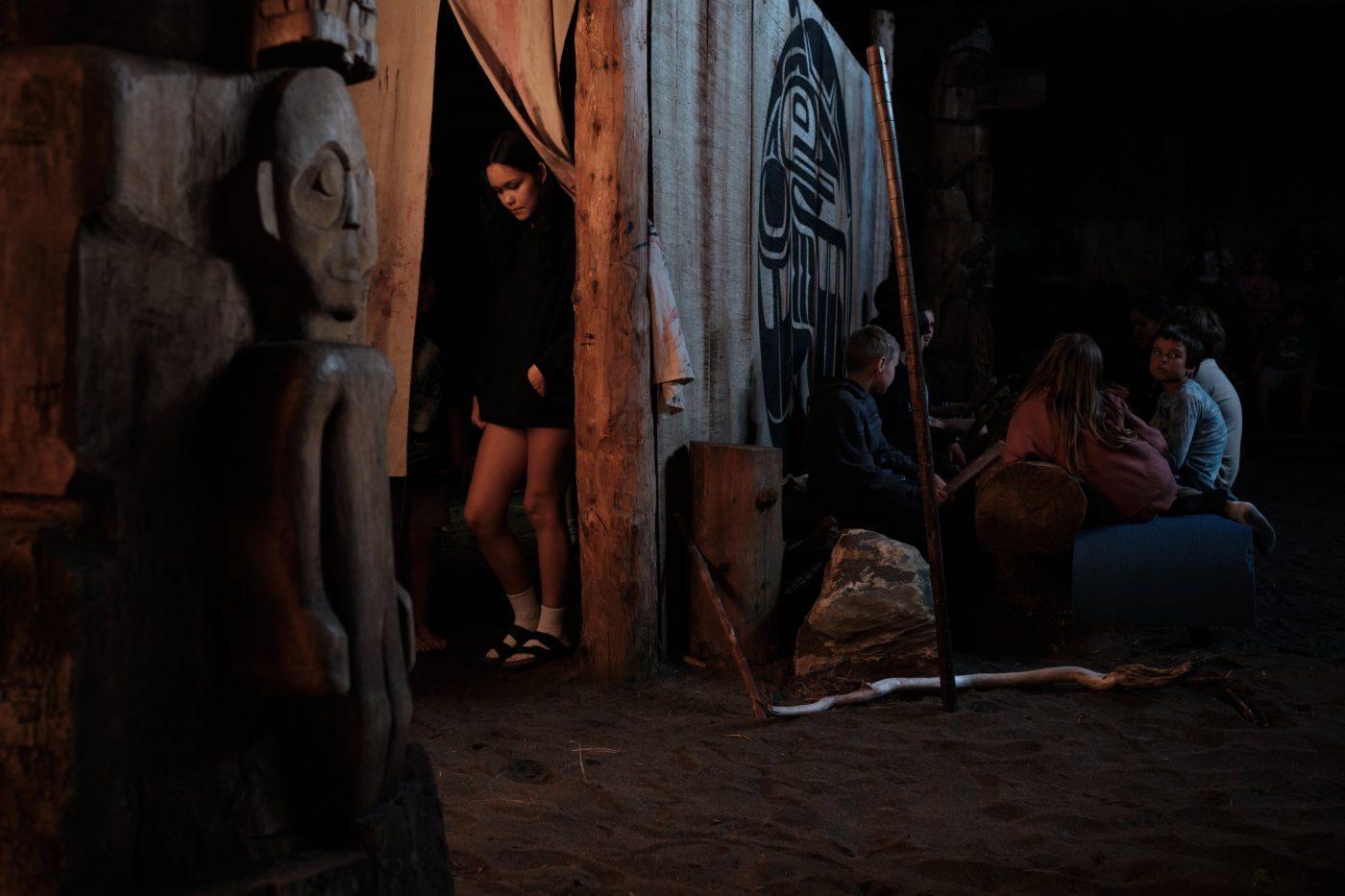
As smoke rises from the fire at the centre of a Haíɫzaqv Big House raised two decades ago on a beach crowded with cedar, the song begins.
The dancers emerge and circle the floor, their feet tracing stories in the sand. Drummers seated at the log drum hold the beat and their voices carry the song. Around the room, from among all the people here to witness the ceremony, women stand. Swaying like kelp in tidal currents, their movements and hand gestures mirror those of the dancers, protecting them.
Leading this ceremony, dancing life into the walls and the world around, are children. This is Kvai, a place where Haíɫzaqv kids come to connect with song and story, language and ceremony. Received by the lands and waters, this is their lineage, their inheritance.
Standing next to the log drum, leaning on the talking stick, Thomas Dixon extends a welcome.
“The name of this Big House is λáλix̌sístala,” he says. “λáλix̌sístala in our language translates to ‘complete the circle’ — and the circle we’re referring to is the circle of knowledge, because of the amount of knowledge that gets passed on here, from generation to generation.”
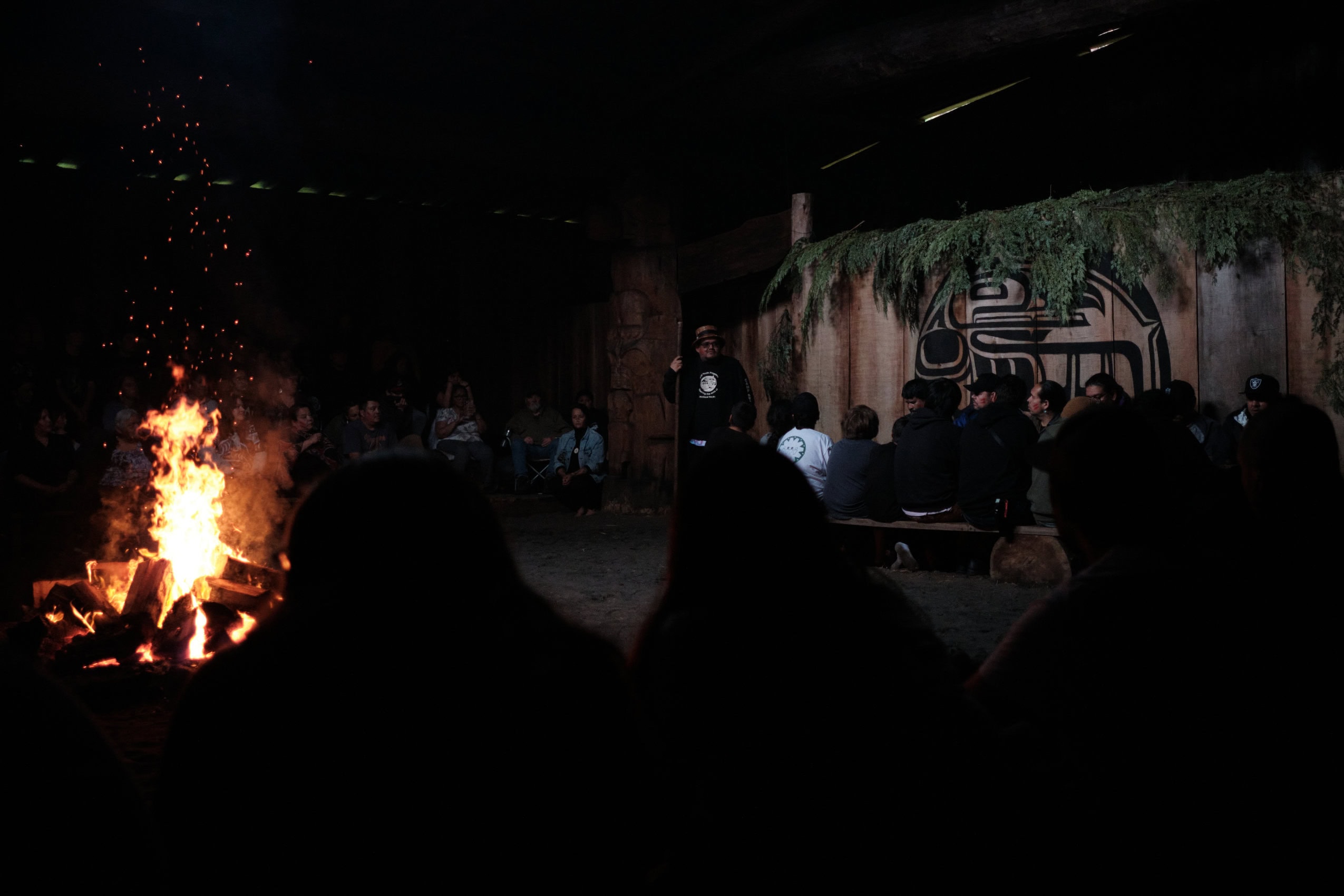
Inside the λáλix̌sístala Big House, cultural leader Thomas Dixon welcomes young people to Kvai, a camp for Haíɫzaqv youth.
Like many of his peers, Dixon came here as a youth and learned from the land and from the stories. Now, as a cultural leader, he’s passing on the teachings he received, completing the circle.
“These songs and dances are very sacred,” he says, asking guests not to share photos or videos on social media. “When we were given permission to teach these songs and dances, we promised the Chiefs and Elders we wouldn’t put it out publicly like that.”
He pauses. In the space between his words, the snapping of the fire.
“W̓álas ǧiáxsix̌a,” he says, sitting down at the log. The drumming begins.
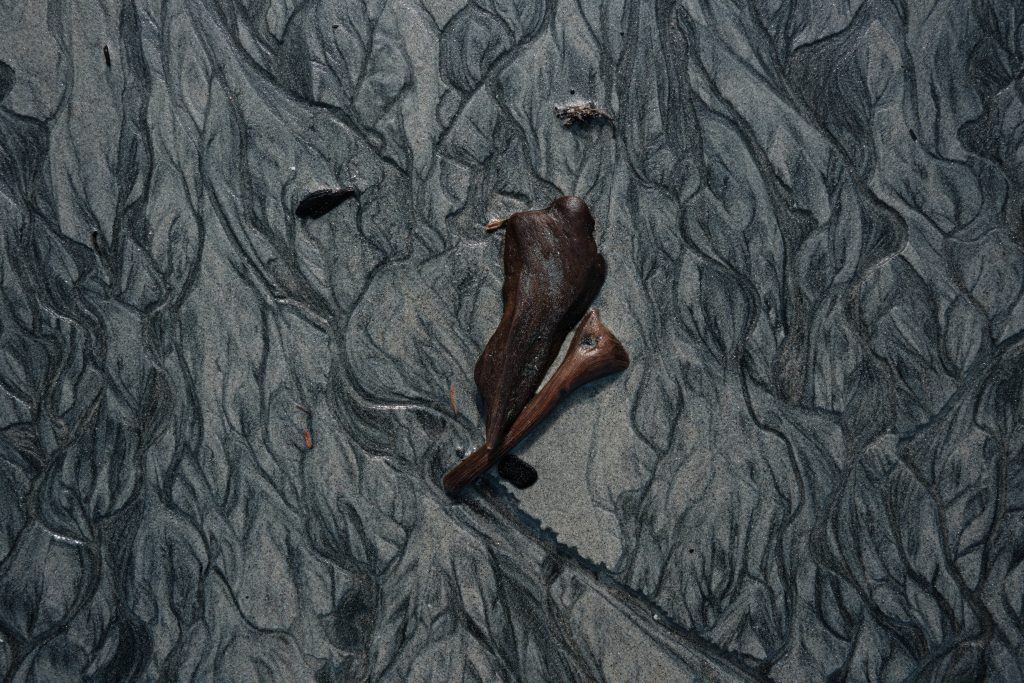
In 2008, Opaskwayak Cree scholar Shawn Wilson said: “When listeners know where the storyteller is coming from and how the story fits into the storyteller’s life, it makes the absorption of the knowledge that much easier.”
These are not my stories — but I am part of it because I was there. ’Cúagilákv Jess Housty invited me, extending the welcome to my seven-year-old daughter. I was invited to witness, given permission to share a story of this place and what it means to many Haíɫzaqv. This place also holds deep meaning for Wuìk̓inux̌v people and the watershed is an area of shared importance. Gently warned about past harms done by well-meaning journalists, I am walking lightly, honouring the trust.
I listen to my recordings while I write: the sound of the waves, ravens squawking, an eagle chittering. A light wind.
Inside, a couple of teenagers add logs to the flames, sending a burst of sparks through the hole in the roof. Outside, a grizzly bear walks the beach with her cubs under sheets of rain while salmon jump from the bay, their silver backs glistening against a grey ocean.
Dixon stands, again holding the talking stick, and speaks in Haíɫzaqvḷa: “Yáu sásṃ, sas húmíɫṇƛa?”
As one, the kids respond with an affirming ‘mm-hmm.’
“I want to explain what I just asked the kids,” he says. “I asked the kids: ‘Sas húmíɫṇƛa?’ — ‘Did you hear me?’ [Are you listening?] I asked them that because I want to make sure that they’re listening before we tell the story. At every practice, after every dance, I would ask them that before I tell them the story. I would tell the story behind each dance so the stories get told over and over and over again and hopefully it gets embedded in their heads.”
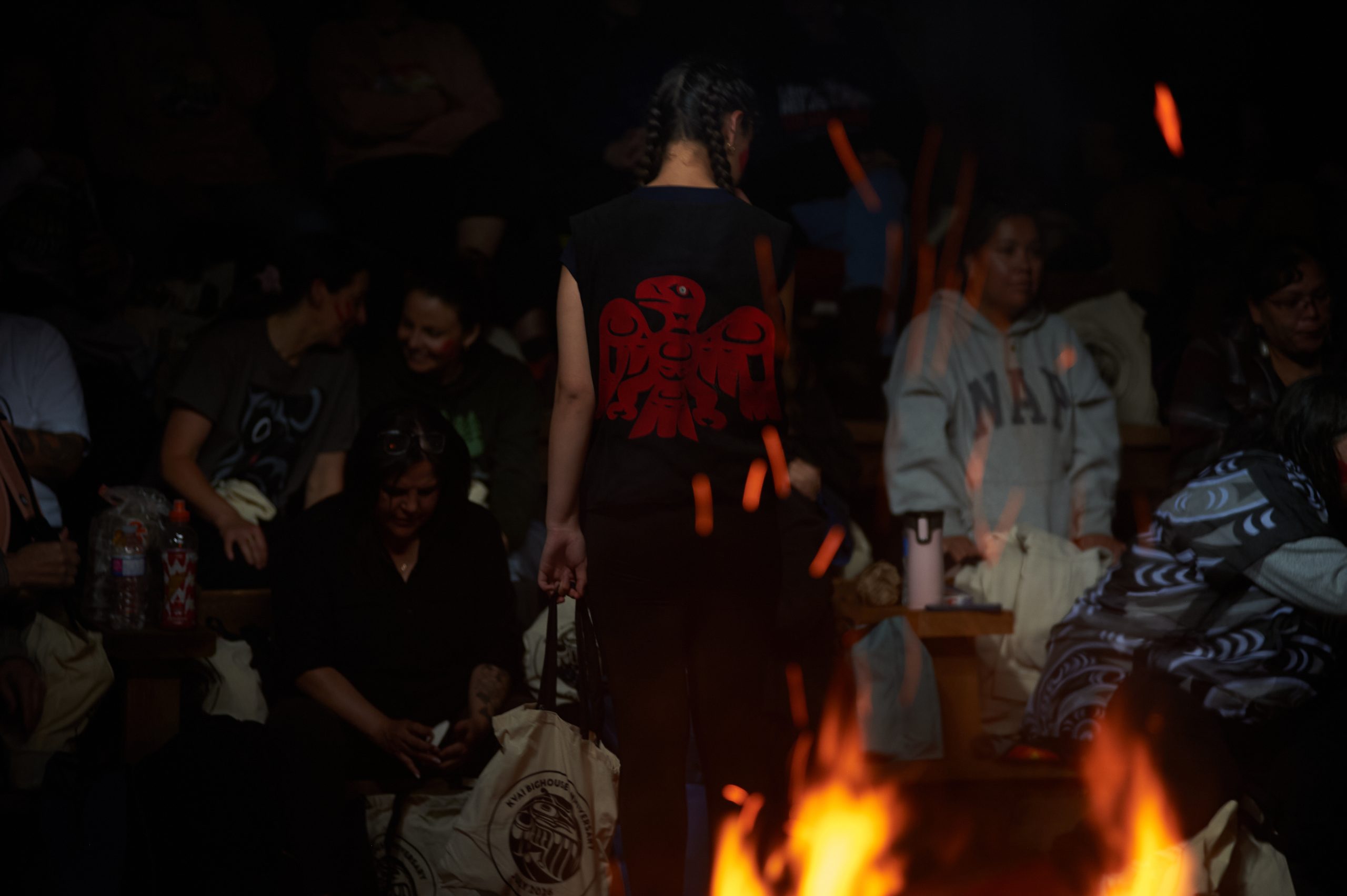
“This was an old teaching we got from Thistalalh Ed Martin, when he was our camp Elder out here,” he continues. “When I was a camper, that’s what he used to say to us. So when I say, ‘Sas húmíɫṇƛa?’ you guys can say ‘mm-hmm,’ to make sure you are all paying attention.”
The sounds of the rain and the fire are one and the song begins again.

Haíɫzaqv have always been here, caring for w̓áxv:w̓uísax̌v. W̓áxv:w̓uísax̌v is the land, ocean, submerged land, surface water, groundwater, subsurface and air space as defined by the boundaries of the five tribes which make up the Haíɫzaqv Nation: Ẁúyalitx̌v, ’Qvúqvay̓áitx̌v, W̓u̓íƛ̓itx̌v, Y̓ísdáitx̌v and X̌íx̌ís. On colonial maps, Haíɫzaqv w̓áxv:w̓uísax̌v is on B.C.’s central coast.
As affirmed by the nation’s constitution, ratified in 2025, the “relationship of the Haíɫzaqv people to the w̓áxv:w̓uí sax̌v is ancient, sacred and complex,” and the nation’s “ancient rights, inherent jurisdiction and responsibility for the w̓áxv:w̓uí sax̌v, which have never been surrendered, flow from our relationship to it.”
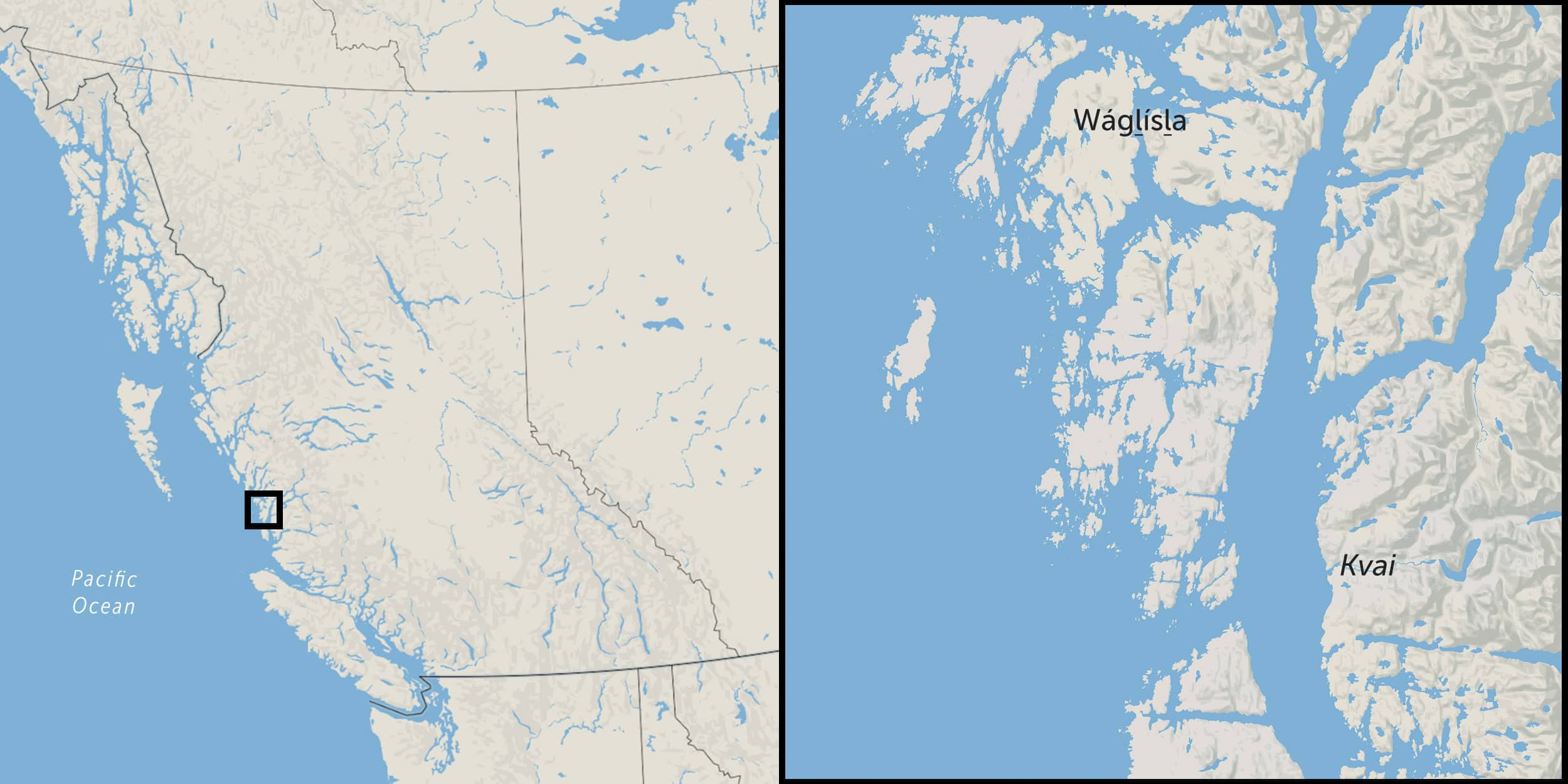
Map: Shawn Parkinson / The Narwhal
The sun rises every morning, even when it can’t be seen in all the clouds. The moon completes its cycles, waning and waxing, inexorably tugging our bodies and the waters we come from. The seasons shift like slow stretching tides, bringing herring and salmon and berries.
These are the places where the stories are from, the stories that get told over and over and over again. Story, song, ceremony, place: same thing, different forms. Sas húmíɫṇƛa?
Ten years after λáλix̌sístala was raised, a tugboat called the Nathan E. Stewart ran aground near the village of Q’vúqvai in Gale Passage. Eight hours later, it sank, spilling more than 100,000 litres of diesel and other pollutants into Haíɫzaqv waters.
Everything is connected, of course, and all the threads matter — but this is not a story about the legacy of pollution and trauma, of diesel spills and shipping lanes. This is a story of knowledge, ceremony and the future of stewardship. This is a story about λáλix̌sístala.
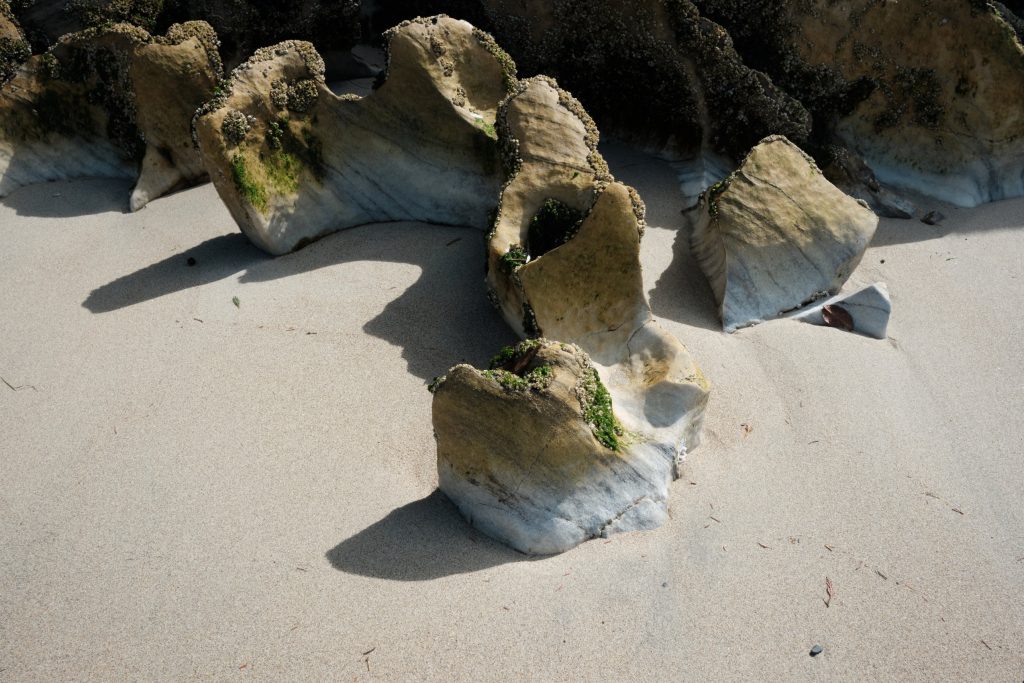
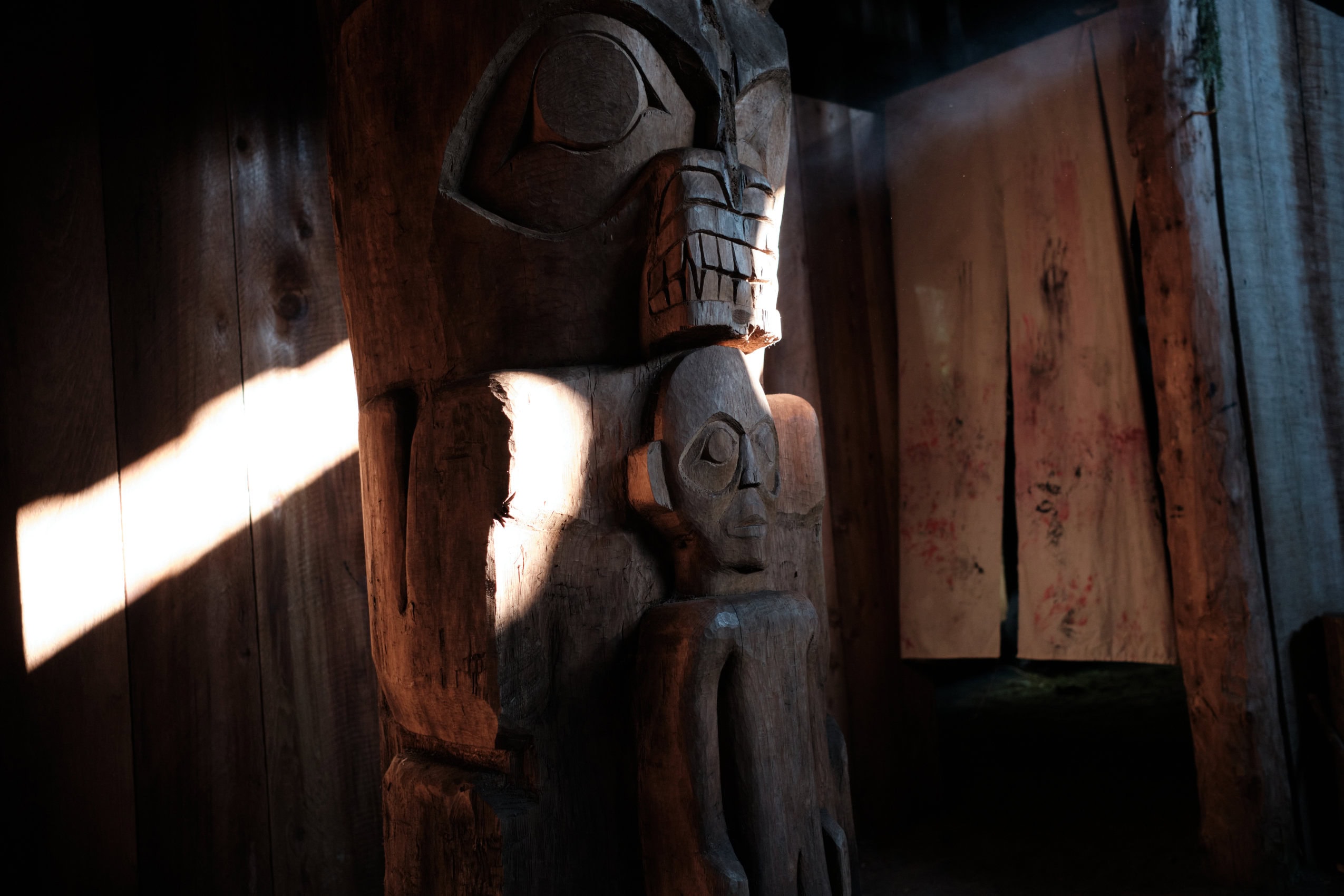
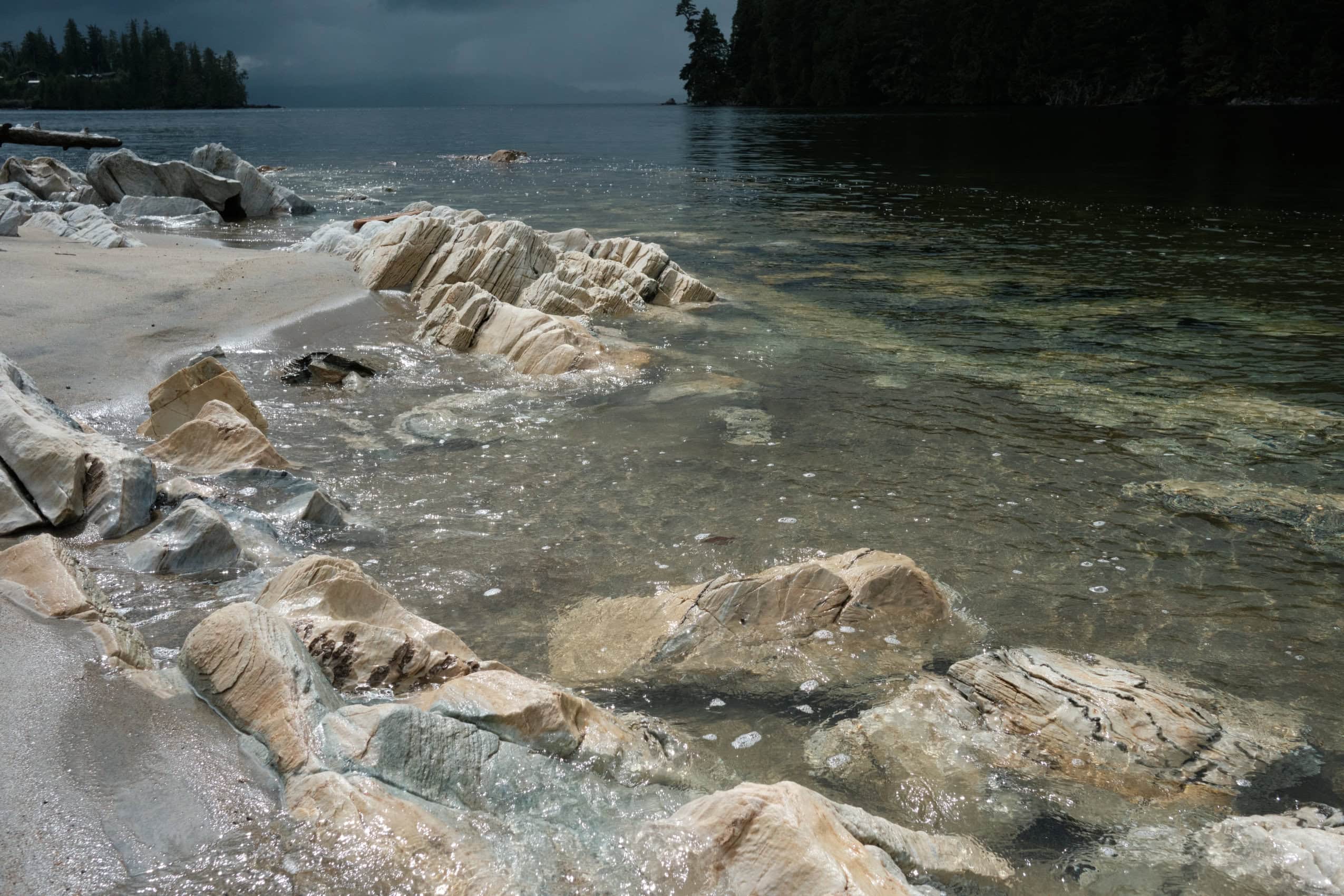
Haíɫzaqv story, song and ceremony are inextricably linked to the nation’s territory.
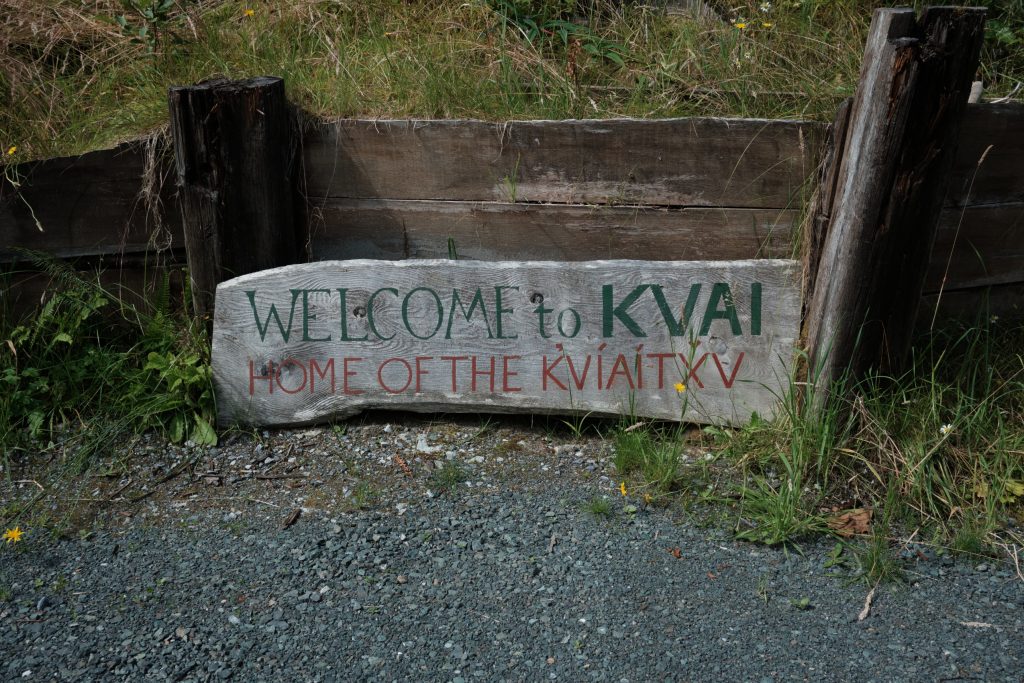
Kvai, sometimes spelled Koeye, is pronounced kway.
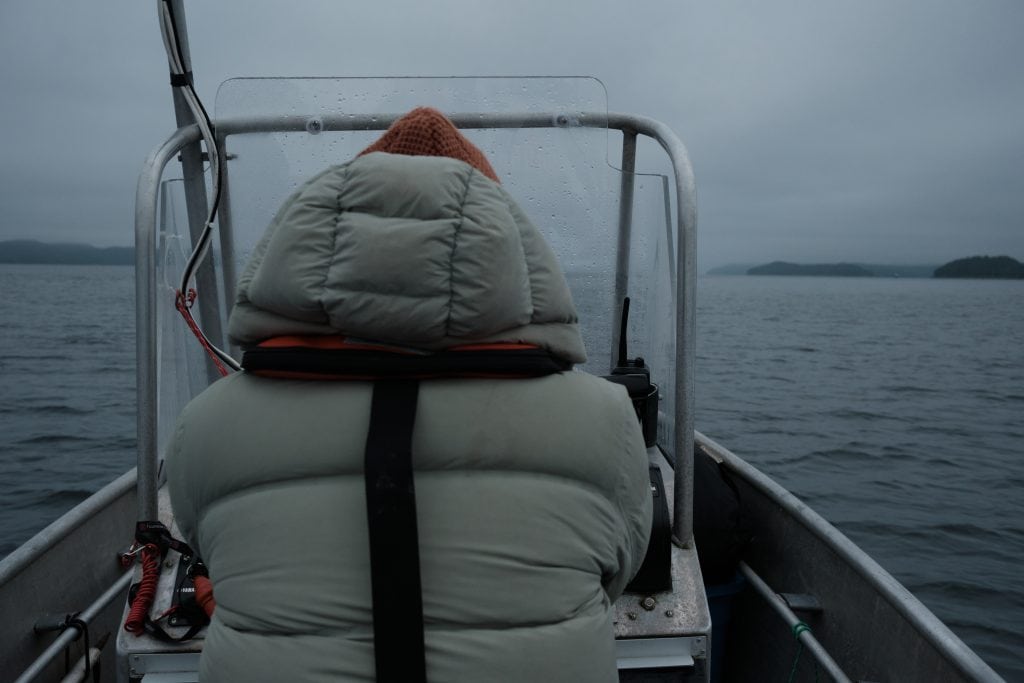
Depending on the boat and weather, it takes around an hour-and-a-half to two hours to get here from Wágḷísḷa (Bella Bella, B.C.)
On the way down, you might see whales — humpbacks or orcas, probably — and in the summer you’ll likely see fishing boats, a smattering of pleasure craft of various types and sizes, maybe a coast guard vessel and perhaps a BC Ferries vessel on its regular run between Port Hardy and Prince Rupert.
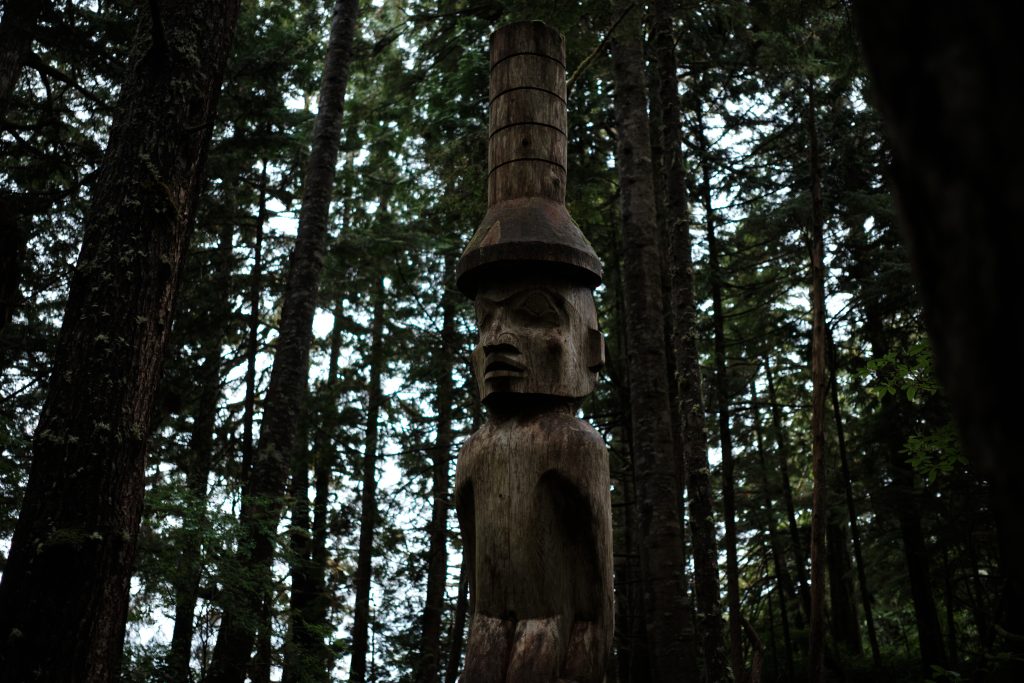
When you get here, you’ll see a flash of white sand against the dark green of the coastal rainforest. λáλix̌sístala will greet you as you enter the bay. Atop a bluff, you’ll see the lodge and other buildings, tucked into the trees. It’s welcoming, protective.
Before all this, the Kvai watershed was home to several Haíɫzaqv villages and fishing sites. For thousands of years, this place was a vital part of culture, ceremony, harvesting and stewardship. Then came the colonizers.
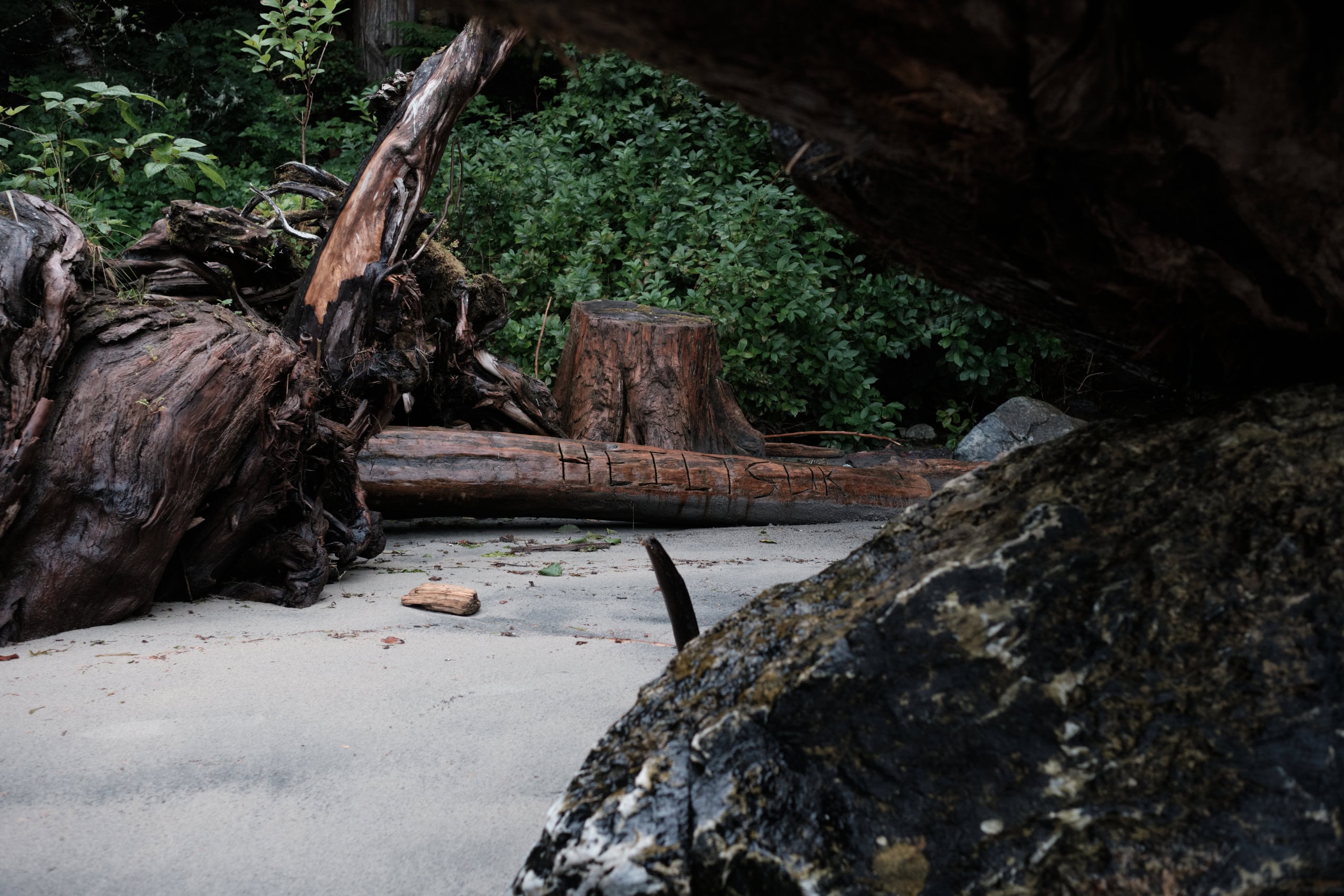
In 1884, the federal government amended the Indian Act to prohibit Potlatches: “Every Indian or other person who engages in or assists in celebrating the Indian festival known as the ‘Potlatch’ or in the Indian dance ‘tamananawas’ is guilty of a misdemeanor, and shall be liable to imprisonment,” the amendment stated.
Gilbert M. Sproat, a Scottish-born businessman and government agent at the time, described the Potlatch ceremony to then-prime minister John A. MacDonald as “the parent of numerous vices which eat out the heart of the [native] people.”
Israel Wood Powell, the provincial government’s first superintendent of Indian Affairs, went further, advocating for the federal government to “adopt every practicable means to put a stop to the custom.” Powell went on to champion and oversee the residential “school” system in B.C., forcibly removing Indigenous children from their homes, cultures and languages. (Powell’s name continues to be used in geographic place names, including the community of Powell River. Tla’amin Nation leadership has been petitioning to have the name changed for several years.)
MacDonald agreed with Sproat and Powell and their contemporaries.
“The great aim of our legislation has been to do away with the tribal system and assimilate the Indian people in all respects … as speedily as they are fit to change,” he said in 1887.
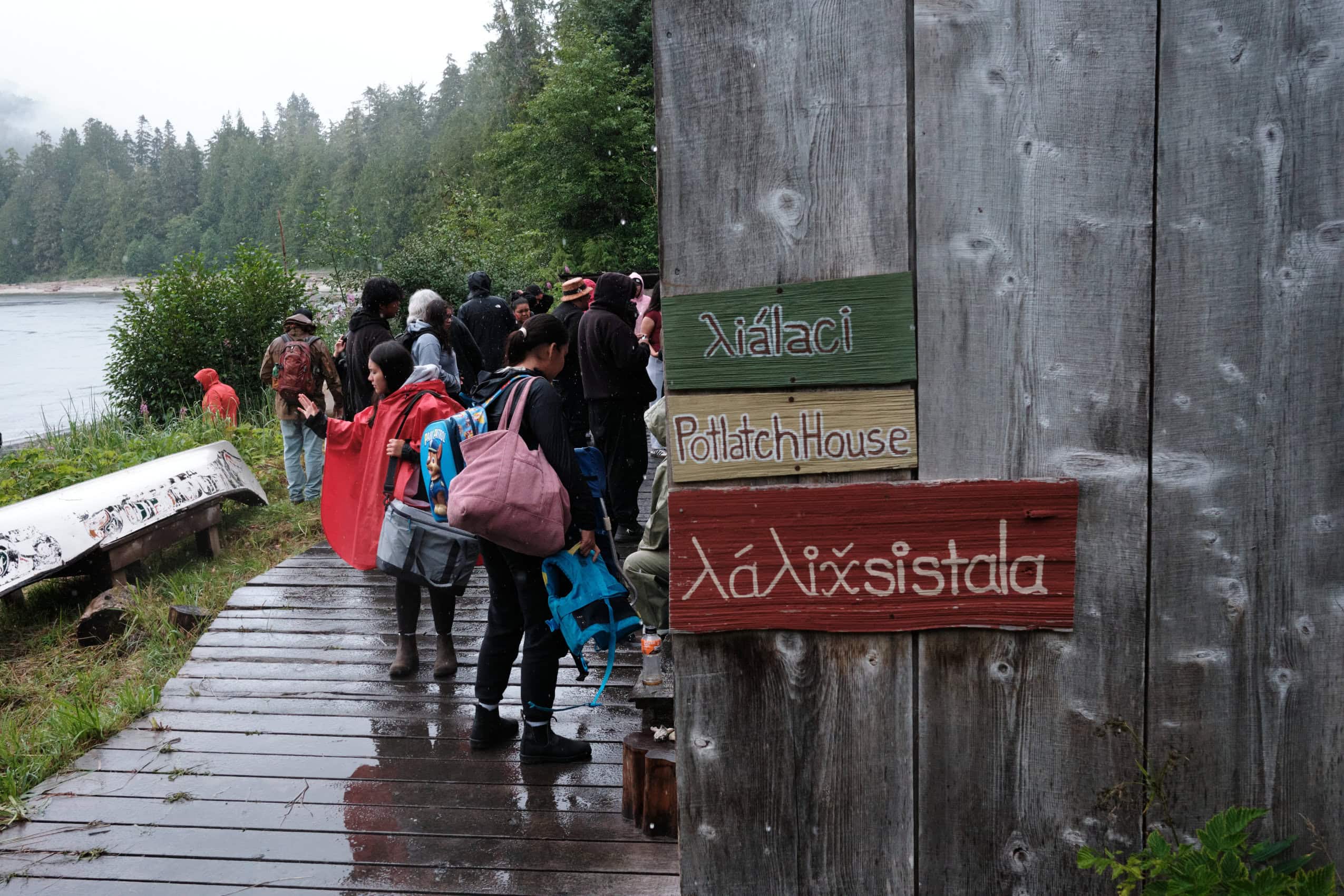
Colonial persecution of Haíɫzaqv traditions did great damage and inflicted much violence, but ultimately failed to achieve its goal of assimilating the nation. More than a century after the last remaining λiác̓ilacx̌i (Big House) was destroyed, the nation raised a new one.
In the years that followed, widespread persecution of any expression of Indigeneity or ceremony was severe, sanctioned and often enforced by government agents, including the newly formed federal police force that is now the RCMP. Around this time, with the nation’s communities already devastated by the spread of smallpox, including attempts to exterminate entire communities with disease-ridden blankets, the only remaining Haíɫzaqv λiác̓ilacx̌i (Big House) was destroyed, likely by missionaries.
More than a century would pass before the next was built.
λáλix̌sístala was the first, raised on the beach at Kvai in 2006. Next came Gvakva’aus Haíɫzaqv, the larger λiác̓ilacx̌i raised in Wágḷísḷa in 2019. Last year, Haíɫzaqv ratified its new constitution and celebrated with a Potlatch in that space.
The importance of the Potlatch cannot be overstated. In Potlatch, songs and dances breathe life into the world. Within them are stories that span generations, past, present and future, and speak of place, lineage, spirit and so much more. These stories, as they are shared in all their shapes and forms, preserve the circle of knowledge.
In Indigenous Storywork, Sto:lo scholar Q’um Q’um Xiiem Jo-ann Archibald said that “storytellers not only learned stories from master storytellers but also by being connected to land” and explained how “stories can become a teacher, and … we can live life through stories.” She also said the oral tradition challenges the listener to “make meaning and gain understanding from the storyteller/teacher’s words and stories, which is an empowering process.”
Remember: “The stories get told over and over and over again and hopefully it gets embedded in their heads.”
In coming together, at places like Kvai, or in the Big House in Wágḷísḷa, or anywhere else where knowledge is passed on through story, time takes on a new shape, layers and threads where there is no beginning and no end, just a continuous unfolding. As Haida and Tlingit artist Robert Davidson said in Potlatch as Pedagogy, we are “all connected to the past by a thin thread. And when we come together as a group, then these threads form quite a thick rope.”
In Haíɫzaqvḷa: m̓ṇukvs w̓úwax̌di; one mind, one heart.
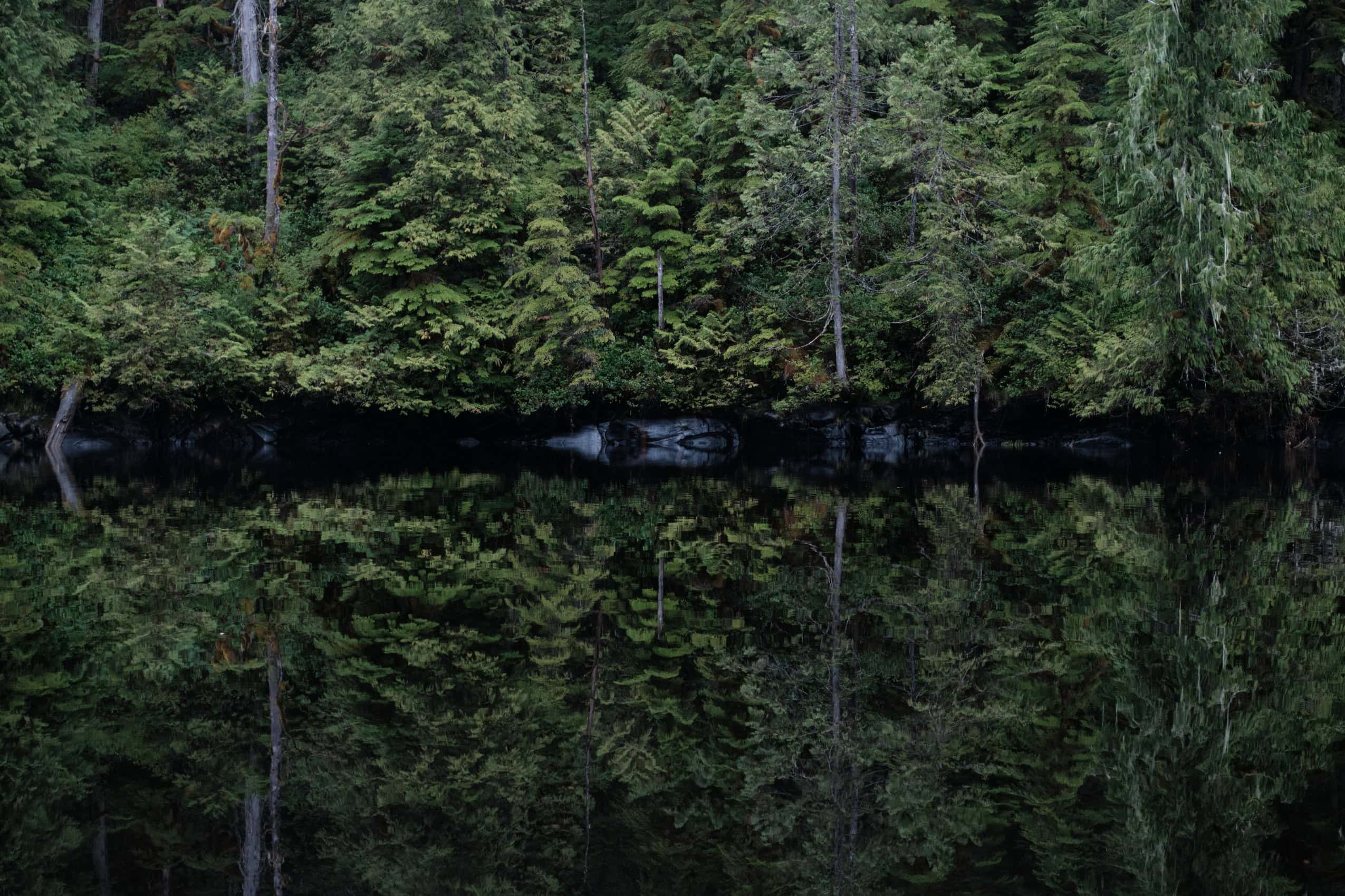
The river feels eternal, its banks renewed time and time and time again. The beach is washed by the tides and the rain. The old spruce tree absorbs a cloud of swallows; their symphony of chirps dying abruptly, swallowed by the endless riffling river. Sas húmíɫṇƛa? (Are you listening?)
From ‘Cúagilákv’s newest collection of poems:
Cup sea water in your hands.
Bring it gently above the highest tide line.
Wait for the precious sun;
wait in your posture of petition
for the gift of salt.
When you have enough
to make a little mountain on your palm,
pinch it between your fingers
and use it to spell the words
closest to your heart.
Lick your fingers clean
and know that the ocean
is the holder, now,
of your prayers.

After ceremony, and after all the guests have been gifted the salmon and seaweed the kids harvested and processed, most community members head back to Bella Bella on a handful of boats and the kids move their things into λáλix̌sístala to sleep. For some, it’s their final night here before returning home. Others will be back next week, and maybe again the week after that.
Singing and drumming and practicing dances, cooking hot dogs on the fire, the big kids guide the little ones and there’s a comfortable, controlled chaos to it all. A few of the boys swim in the ocean, laughing and splashing as the rain continues falling and the sun slowly dips down to the western horizon behind the clouds.
Before λáλix̌sístala and before all the infrastructure that exists today, kids camped on the beach in a handful of tents from Canadian Tire. ’Cúagilákv was once one of those kids, and today they’re a camp leader.
“I had some moments this summer around the celebration where I would be talking to campers about what my experience was like as a camper in the first years of camp, when it was tents on the beach and on feast day we literally used to rake a flat spot on the beach to light a fire and dance around the fire, and they were just like, ‘What dark times are you from?’ ”
’Cúagilákv laughs, their eyes twinkling.
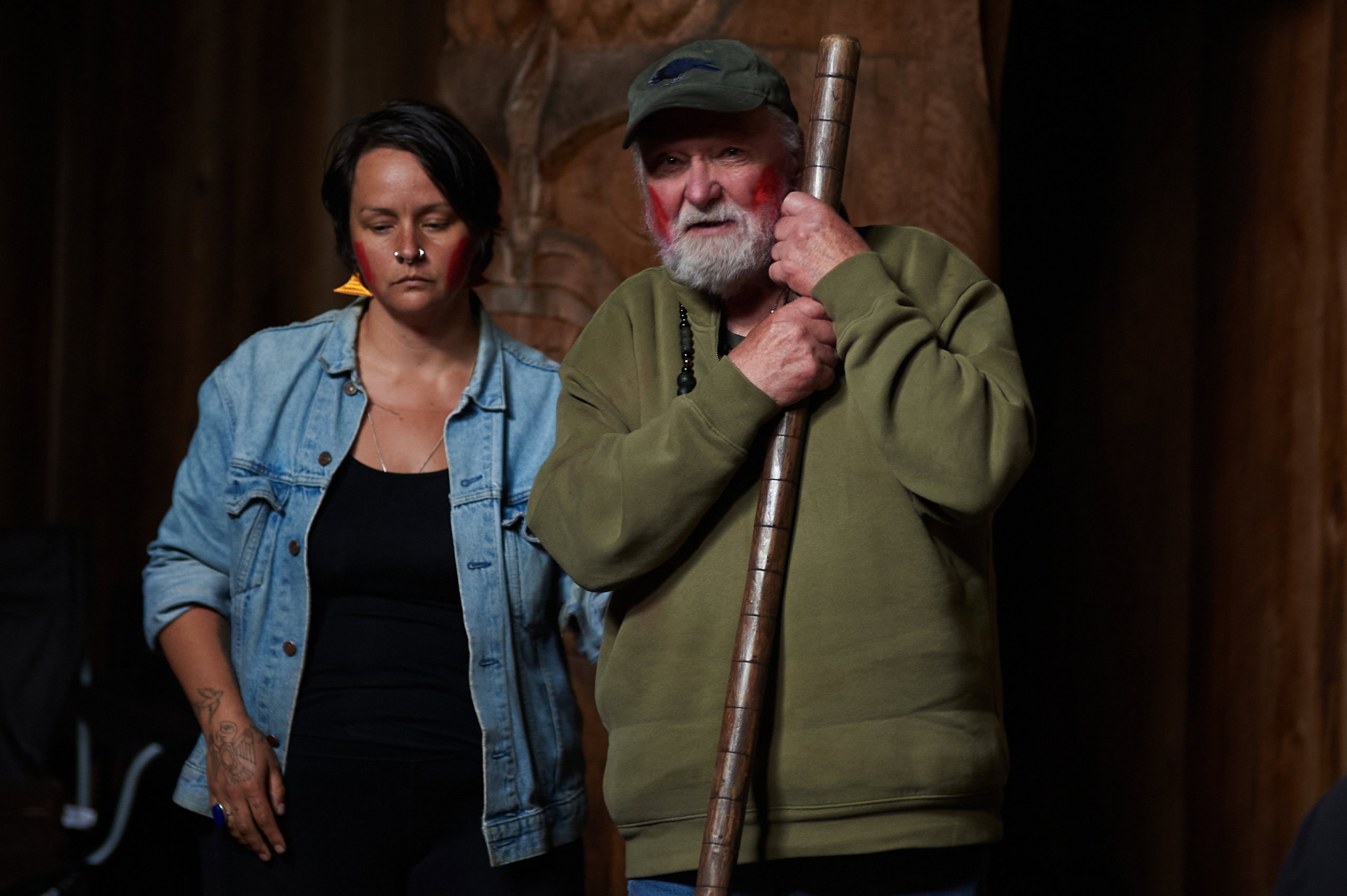
‘Cúagilákv Jess Housty (left) is the executive director of Kvai, a position they took on after their dad, Larry Jorgensen (right), stepped back from his leadership role.
During the more recent chapters of colonization, the site where the current lodge, cabins, garden and other infrastructure sits was once logged and later sold to settlers who built a sport fishing lodge there. Haíɫzaqv leaders stood firm in upholding their sovereign rights and established the youth science and culture camp, first on the beach and later buying back the land in 2001.
Those original buildings were burned in an arson fire in 2011. With the insurance money, the organization bought a sawmill, rebuilding everything from the ground up. Working with timbers harvested on the land, milled by Haíɫzaqv workers, they created a beautiful new lodge and cabins.
“It’s really cool that kids who attend camp today don’t ever remember not having a Big House down there,” ’Cúagilákv says. “They don’t remember a time when there wasn’t a lodge providing safety and support and hosting their families. They don’t remember a time when there weren’t comfortable cabins to sleep in. They just totally take for granted that that’s always been there and it will always be there — and I love it.”
Central to all this safety and support is Qqs.
Qqs (pronounced kucks) is the non-profit organization that oversees programs including the youth science and culture camps at Kvai, as well as a variety of programming in Haíɫzaqv communities in support of health, culture, food security and more. ’Cúagilákv is the executive director, a position they took on after their dad, Larry Jorgensen, stepped back from his leadership role. Qqs means ‘eyes’ in Haíɫzaqvḷa.
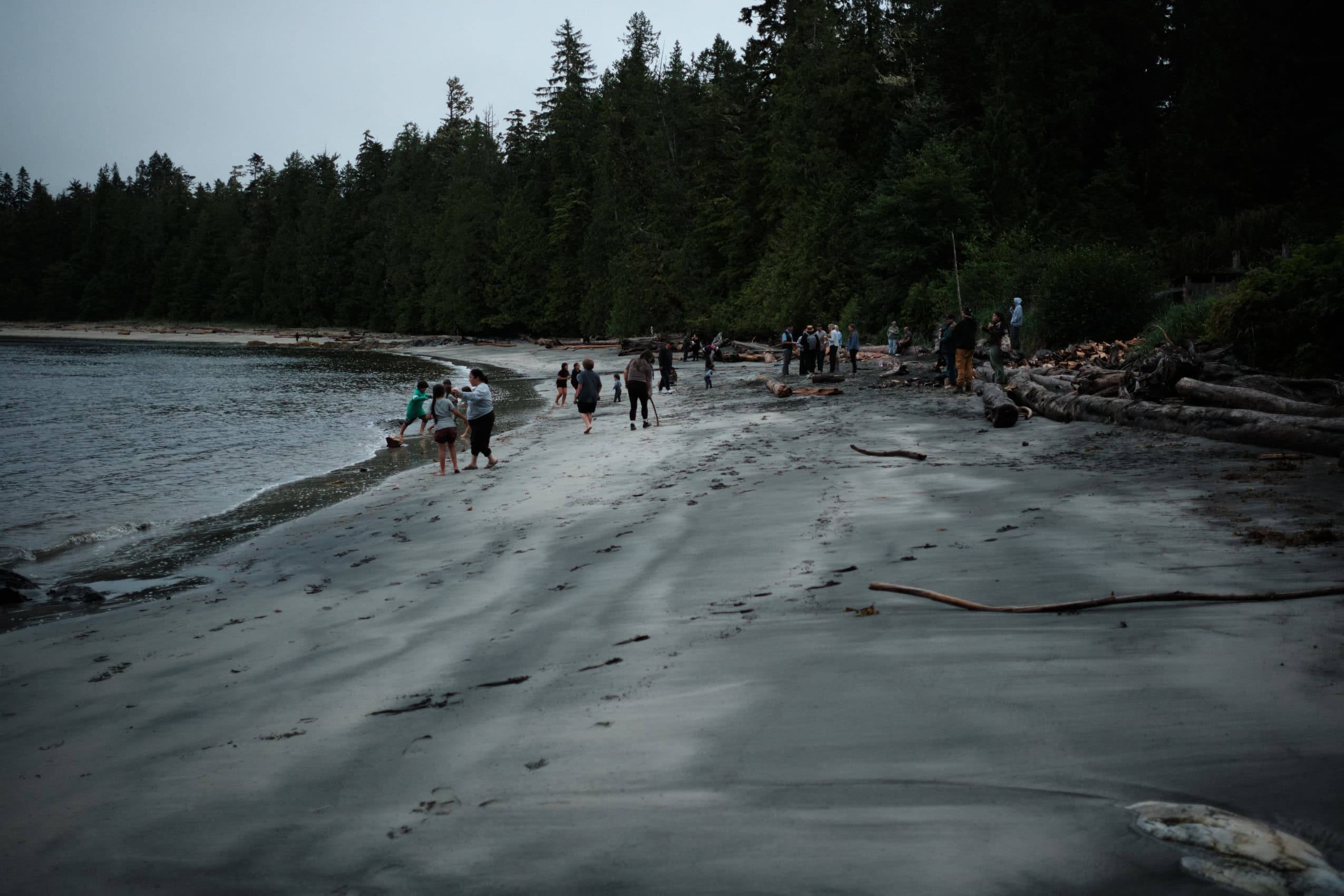
A few decades ago, Haíɫzaqv youth camped on the beach when they attended the science and culture camp at Kvai. Today, there is a lodge and cabins on-site to give safety and comfort.
Keeping the camp running isn’t always easy, nor is it cheap. Transport alone is a huge expense: running boats back and forth accounts for about a third of the entire annual budget. For eight weeks every summer, Kvai is home to kids, youth and staff, with groups of anywhere from 15 to 30 people rotating in and out weekly. Some kids come for multiple weeks, others just for one. A lot of the staff are youth themselves, former campers who are stepping into leadership roles or getting experience and earning a wage in their first jobs, cooking and cleaning or otherwise supporting the programs. At the end of each week is feast day, when the kids are responsible for leading the ceremonies in front of community members who come down for the day.
“Programs like this are beautiful, but the reality of running them in a remote location is that certain aspects are astronomically more expensive and complicated,” ’Cúagilákv says.
Yet, somehow, for the past 28 years, Haíɫzaqv youth have gathered here every summer to learn from the land. When I ask some of the staff how long they’ve been coming out to Kvai, most say their connections thread through their whole lives. It’s as if they’ve always been here.
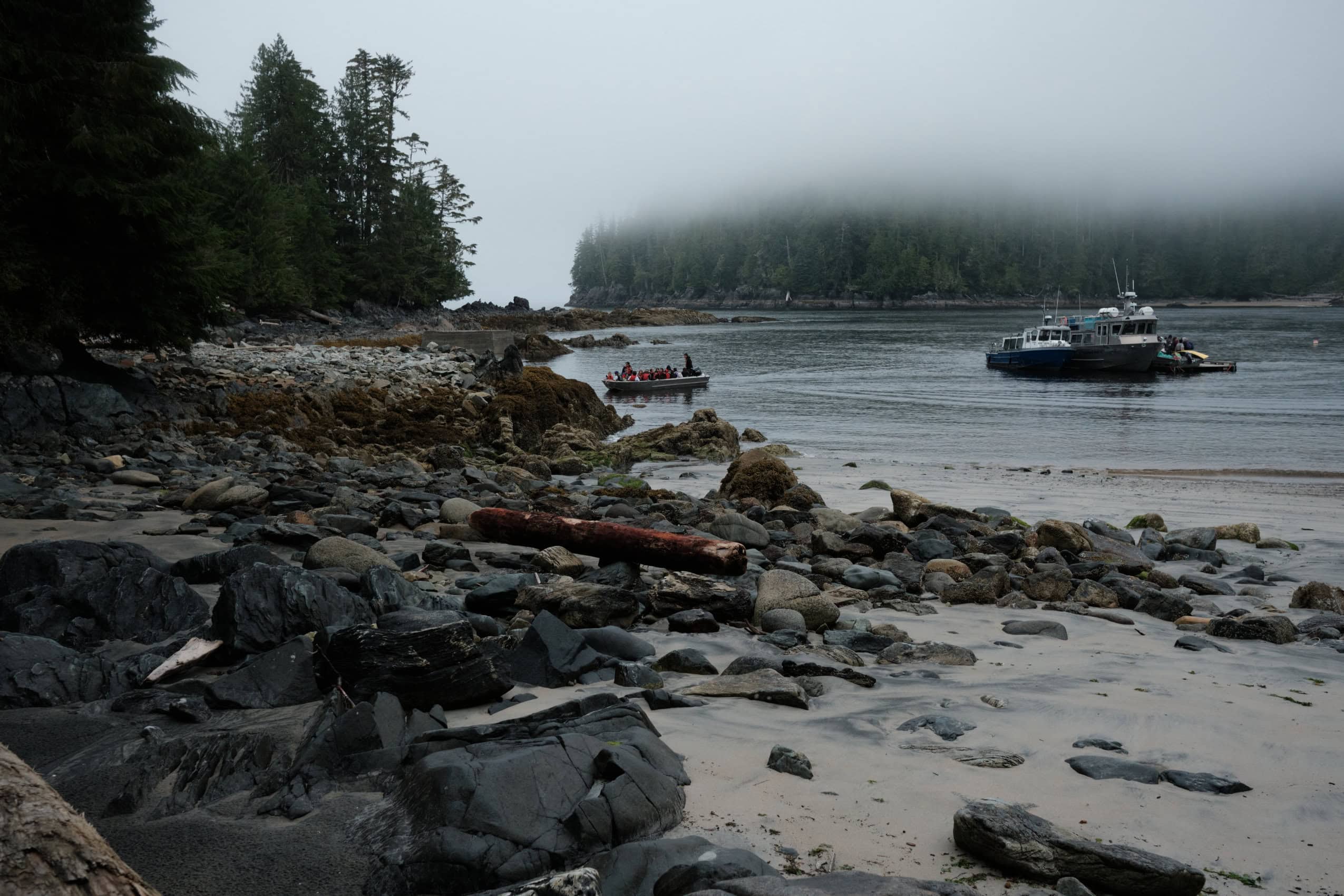
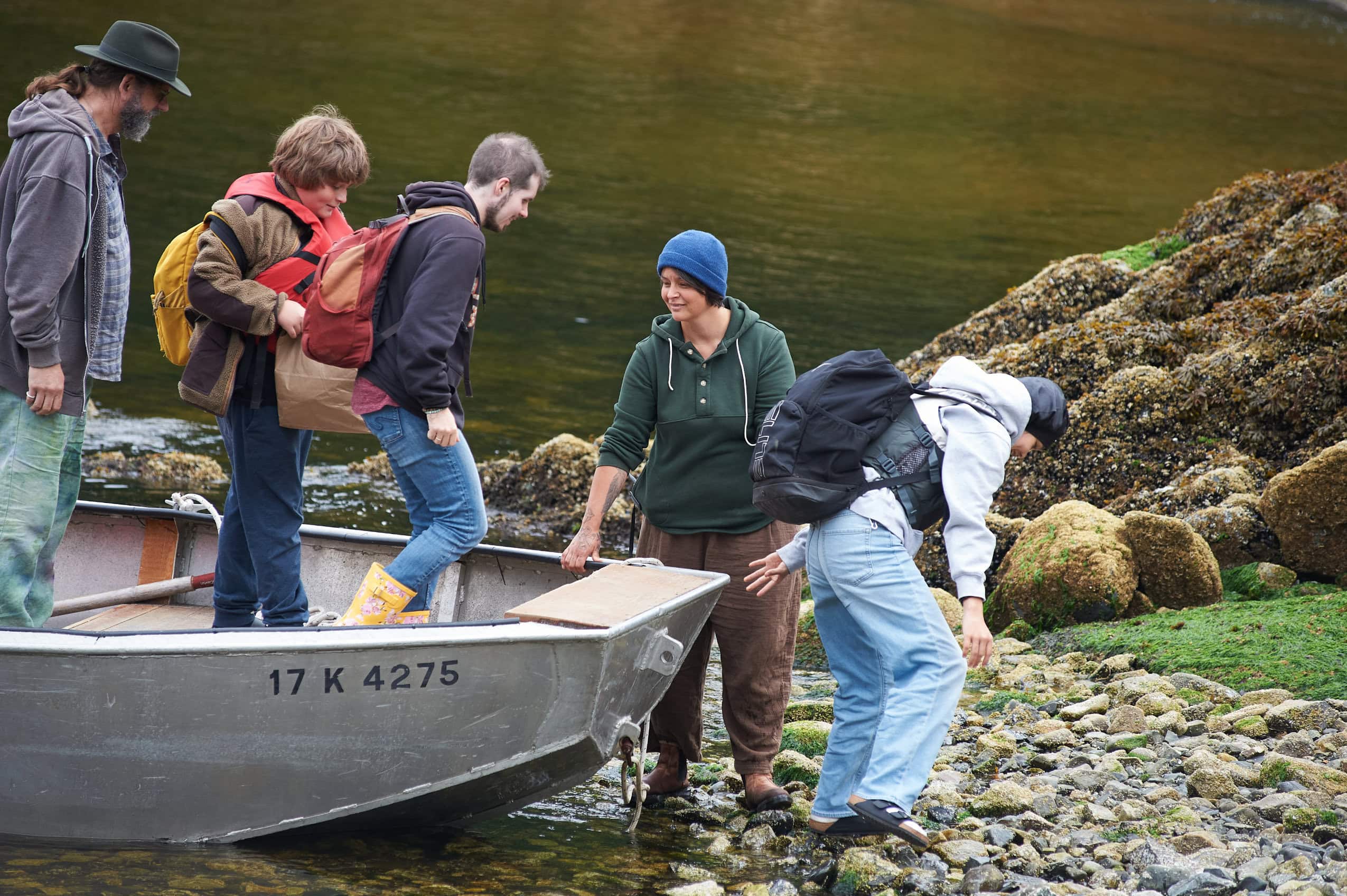
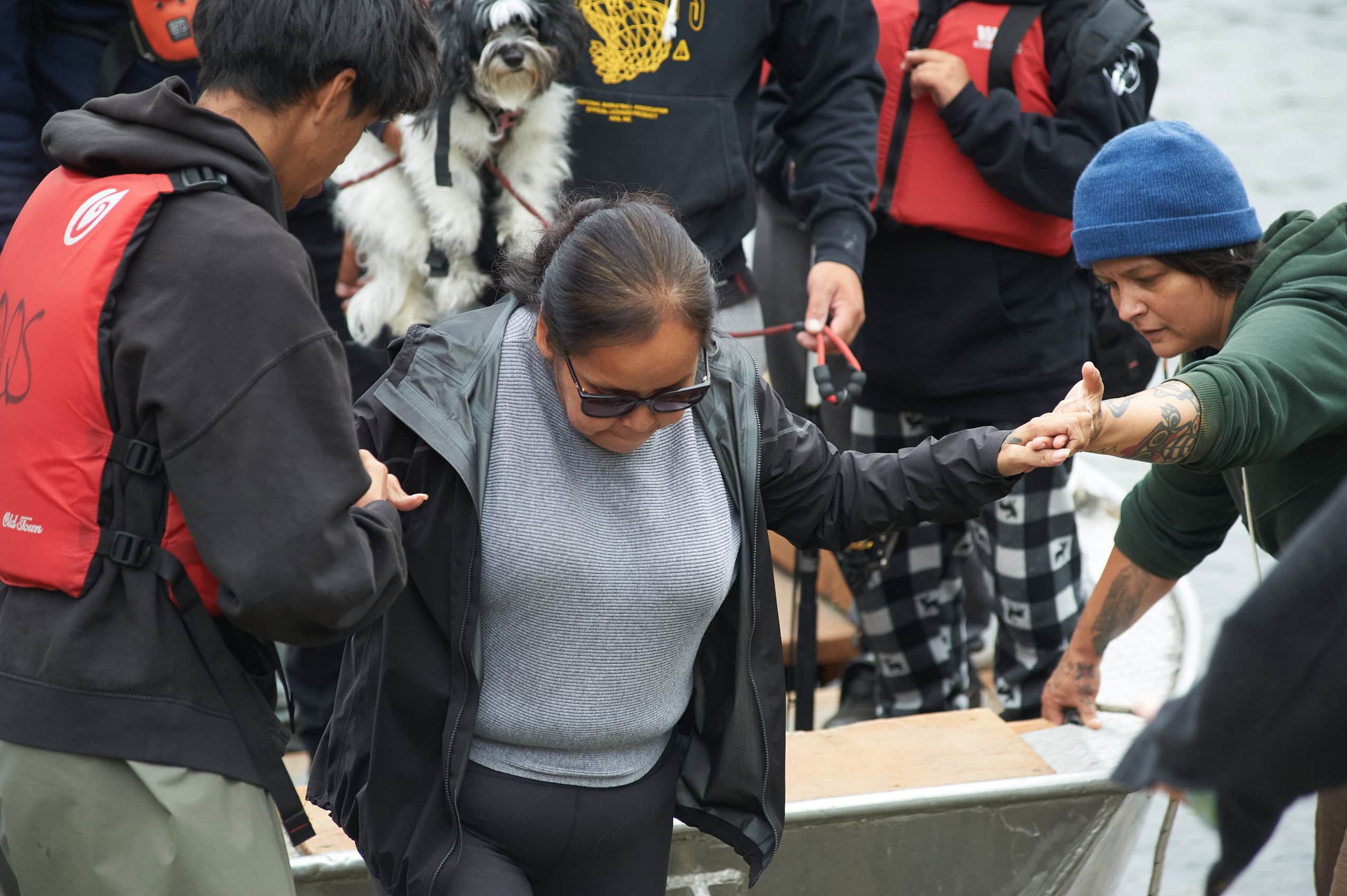
Kvai is reached by boat from Wágḷísḷa (Bella Bella, B.C.), a journey that takes more than an hour.
Allie, a staff member, puts it simply: “Since I was a baby. I grew up out here.”
“I think back to that really early wisdom that guided the creation of Qqs and it was this idea that people protect what they love,” ’Cúagilákv says. “So you want to teach them to love themselves, so they’re protecting themselves. You want to teach them to love each other and their community, so there’s a strong, cohesive community mind. You want to teach them to love the land and the waters so that they are standing up as stewards. And you want to teach them to love language and culture, so they are stewarding that as well.”
“I mean, it’s stupidly simple, but I really believe it is the most important thing we do.”
Both ‘Cúagilákv and their brother Dúqva̓ísḷa William Housty now have their own kids among the campers. Faye, William’s wife, is one of the camp leaders, and his teenager is also on staff. Across the fire one night, Faye tells me their youngest, George, listened to the songs while in the womb. William is there singing and drumming with the kids in the Big House on feast day.
“I think one of the really beautiful things about having done this work for as long as we have, is that we can see what Kvai kids do when they grow up,” ’Cúagilákv says. “Stewardship is a really obvious one.”
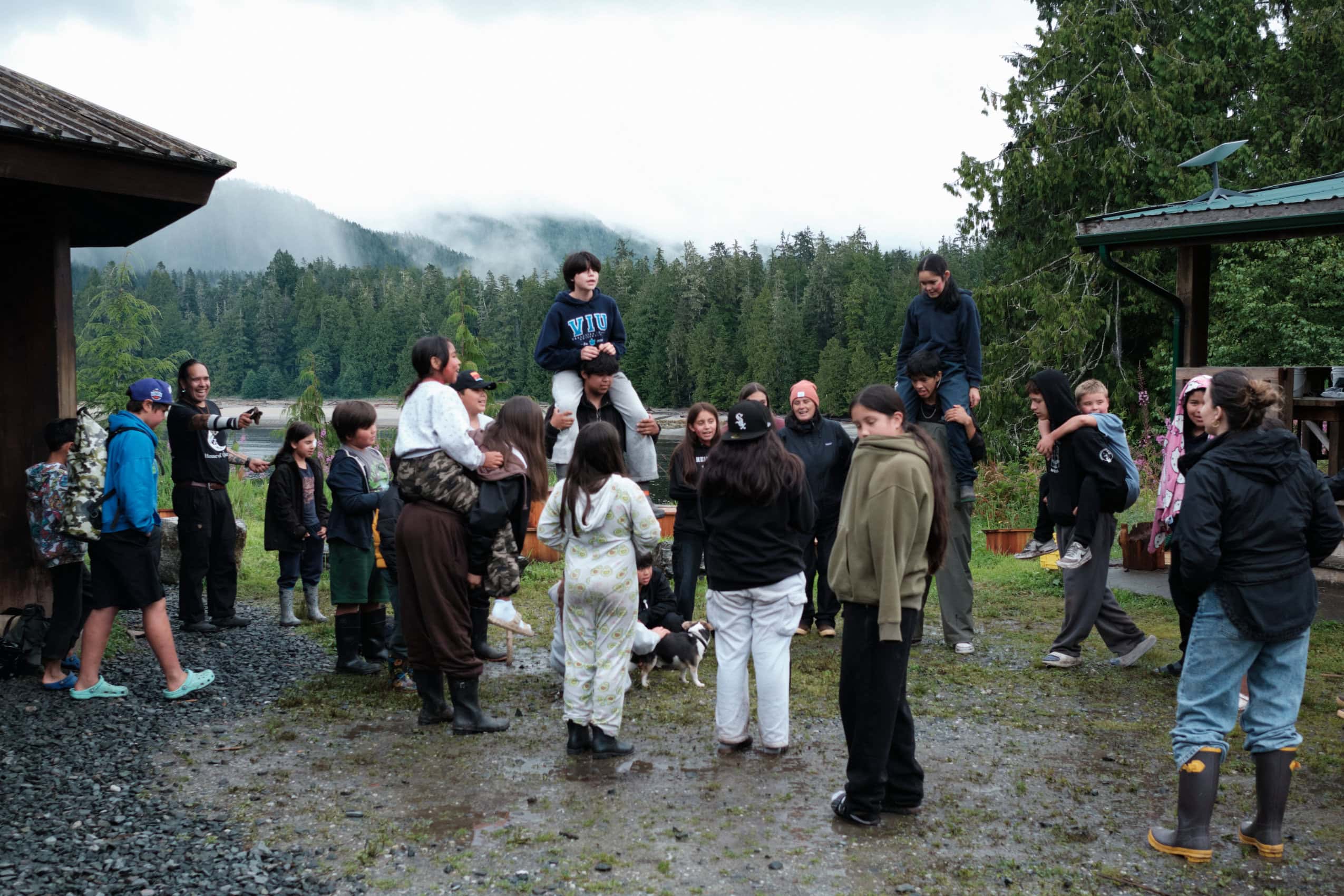
Generations of Haíɫzaqv youth have attended camp at Kvai. Today, many of the camp leaders have their own memories of formative experiences there.
William was one of the earliest camp leaders and is now director of the nation’s stewardship department, which manages policy and planning in support of ecosystem health, jurisdiction and protection of Haíɫzaqv lands, waters and resources. Gíƛa Elroy White was similarly an early leader out at Kvai and is now the department’s in-house archaeologist.
“Many of the Guardian Watchmen and people who work at all levels in that office were Kvai campers or Kvai staff at one point over the years,” ’Cúagilákv says. “By no means would we ever take all the credit for that — they are extraordinary in their own right and we’re really lucky that we got to support them for portions of that formative time in their lives.”
For Louisa Housty-Jones, Kvai not only shaped her — it saved her life.
“I was the victim of domestic violence,” she tells me. When she was around nineteen, drinking heavily and spiraling from the trauma of an abusive relationship, Larry took her down to Kvai and left her there, alone. “Larry had this vision of helping our young people in their healing journeys through the land, guiding them to finding their identity.”
At first, she was angry with him. Slowly, yielding to the lands and waters, her anger subsided. This was before λáλix̌sístala and the current trail which links the lodge to the beach. Somewhere near where the Big House now stands she found a rock to sit at.
“Every day, rain or shine, I would make it a daily thing to go and sit on that rock,” she says. “I wailed, I cried, I screamed — I did a lot of healing at that rock. And then I would go in the ocean and I did that pretty much every day.”
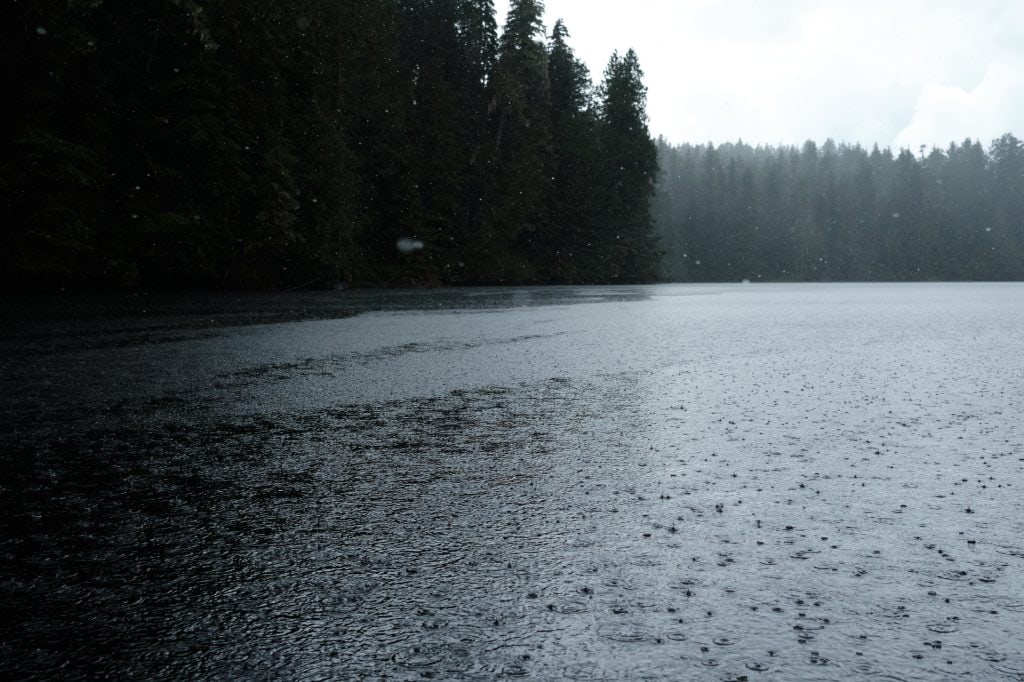
The Kvai watershed is a place of healing and connection.
Among the many roles she now holds, Louisa works with the W̓úm̓aqs du M̓ṇúyaqs, the council of high-ranking Matriarchs and Knowledge Keepers, supporting “their responsibility to pass on knowledge, teachings and wisdom from one generation to the next.”
“We are Haíɫzaqv women. We are as strong as cedar trees,” the M̓ṇúyaqs affirm in the Heiltsuk Women’s Declaration. “We are the mothers who give birth to nations. We are the mothers who bring future generations into being. We are the lifeblood of our people.”
When she was alone at Kvai, Louisa once heard women singing the Haíɫzaqv songs. And near her rock, she kept hearing a lady crying. It scared her: it was fall, cold, and there was no one else out there. A couple of months later, back in Bella Bella, she told her grandmother the story.
“She grabbed my hand and she said: ‘That lady crying was you. That was you, your spirit.’ Everything just totally came together. It’s what our Elders talk about. It was the way she explained it to me, that it was a part of me that was leaving, that was fighting not to leave.”
She started taking the canoe out in the bay, to harvest crabs, and up the river. It was there she found the most peace, she says.
“There’s so much healing in our land.”
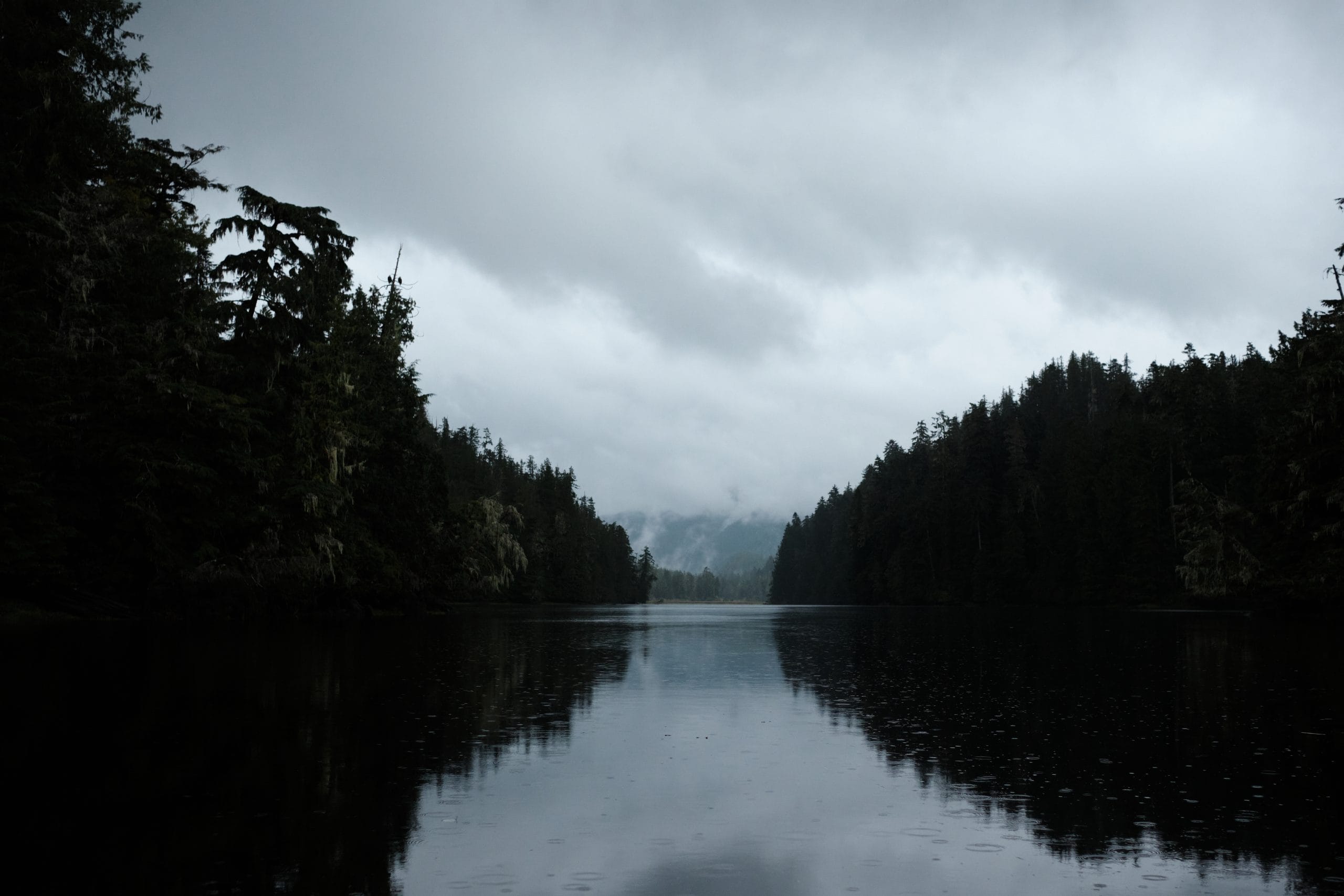
After the kids leave and staff head back to Wágḷísḷa for the weekend, it’s quiet and the bears come back. The sand is white and golden and the story of their morning walk along the beach is fresh and new, even as it reflects one that has been told here for thousands of years. Little birds dart around the shallow waves that lap at the shore. A few gulls congregate by the kelp and barnacle encrusted rocks.
The river is tea-coloured, rich with tannins. A flotilla of canoes leans against an old cedar tree. In the deep stillness away from the beach, the land opens to receive you. The light plays on the waters, creeks tumble from the forest. Later, the tide is so high it stretches into the tangle of trees that line the long beaches. In the mornings, the clouds sit so low it’s hard to tell where the fog ends and the ocean begins.
’Cúagilákv skims the little boat expertly along the water. In the hum of the engine, the slap of the waves and the cool salt spray, their words are offerings.
When I was small,I loved the stories of people who—with unhurried gestures—lifted the edges of the seaand walked into other worlds.Of course water is a portal,the pathway between usand some magnificent other spacebeyond our imagining.What else could we expectof a substance that,even in this heavy world,lets us float?
In his living room overlooking the bay at Wágḷísḷa, ‘Nusi Ian Reid, a Haíɫzaqv artist and carver, puts a book of oral histories on the table.
Gusgai’in William Beynon, a hereditary chief whose mixed lineage includes Nisga’a, Ts’msyen and the Allied Tribes of Lax Kw’alaams, spent decades listening to and carefully recording oral histories, starting in 1914 and continuing until the 1950s. His great-granddaughter, Samantha Beynon, recently wrote a children’s book about Potlatches based on his work.
These stories, ‘Nusi says, and all the stories we haven’t lost are part of the fabric of everything that matters.
‘Nusi shares old stories about the animals and people and new stories about the times we’re living in. He talks about Pops, Ed Martin, about mosquitoes and grizzlies. He talks about being on the water, being away from community and coming home, carving poles, receiving his chief name. He explains how the songs and dances the kids learn at Kvai are connected to stewardship because they come from specific places and lineage. Those places and lineages belong to the children and the kids belong to the stories. They are held through time, shared on a continuum.
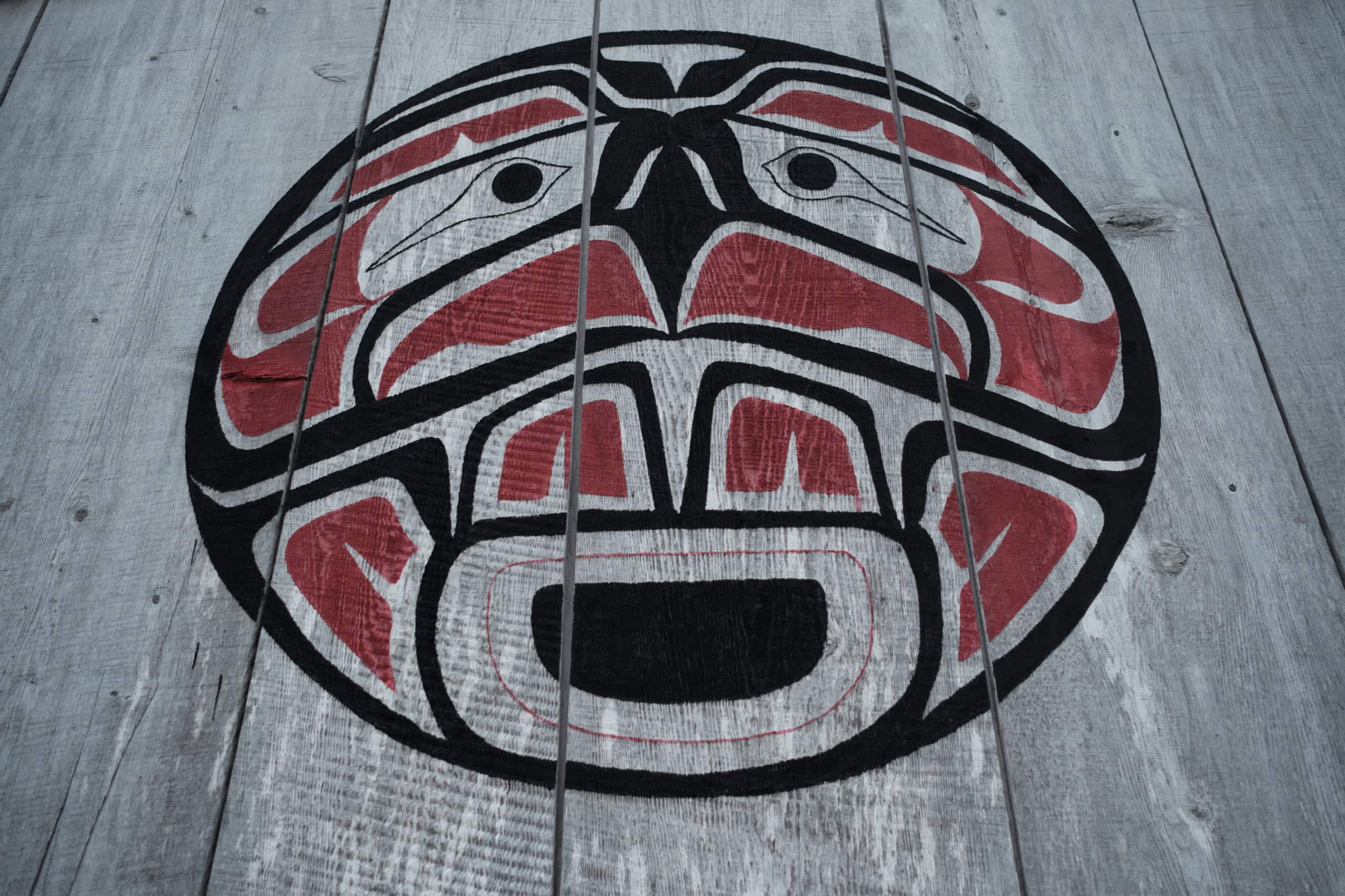
More than a hundred years ago, as the federal government prohibited Potlatches and set about taking up the lands, Haíɫzaqv Chief Bob Anderson spoke of that continuum:
“The government have not bought any land from us so far as we know and we are simply lending this land to the government. We own it all. We will never change our minds in that respect, and after we are dead our children will still hold on to the same ideas.” Anderson’s words, spoken to representatives of the colonial government in 1913, form part of the preamble of Q̓áikasas Ǧvi̓ḷás: The great laws of the Haíɫzaqv. “It does not matter how long the government takes to determine this question, we will remain the same in our ideas about this matter … We consider that the government is stealing that land from us, and we also understand that it is unlawful for the government to take this land.”
A moment stretches and becomes endless, unfurling like a spring fiddlehead. The stories are a presence. Through time, an echo: “… Our children will still hold on to the same ideas.”
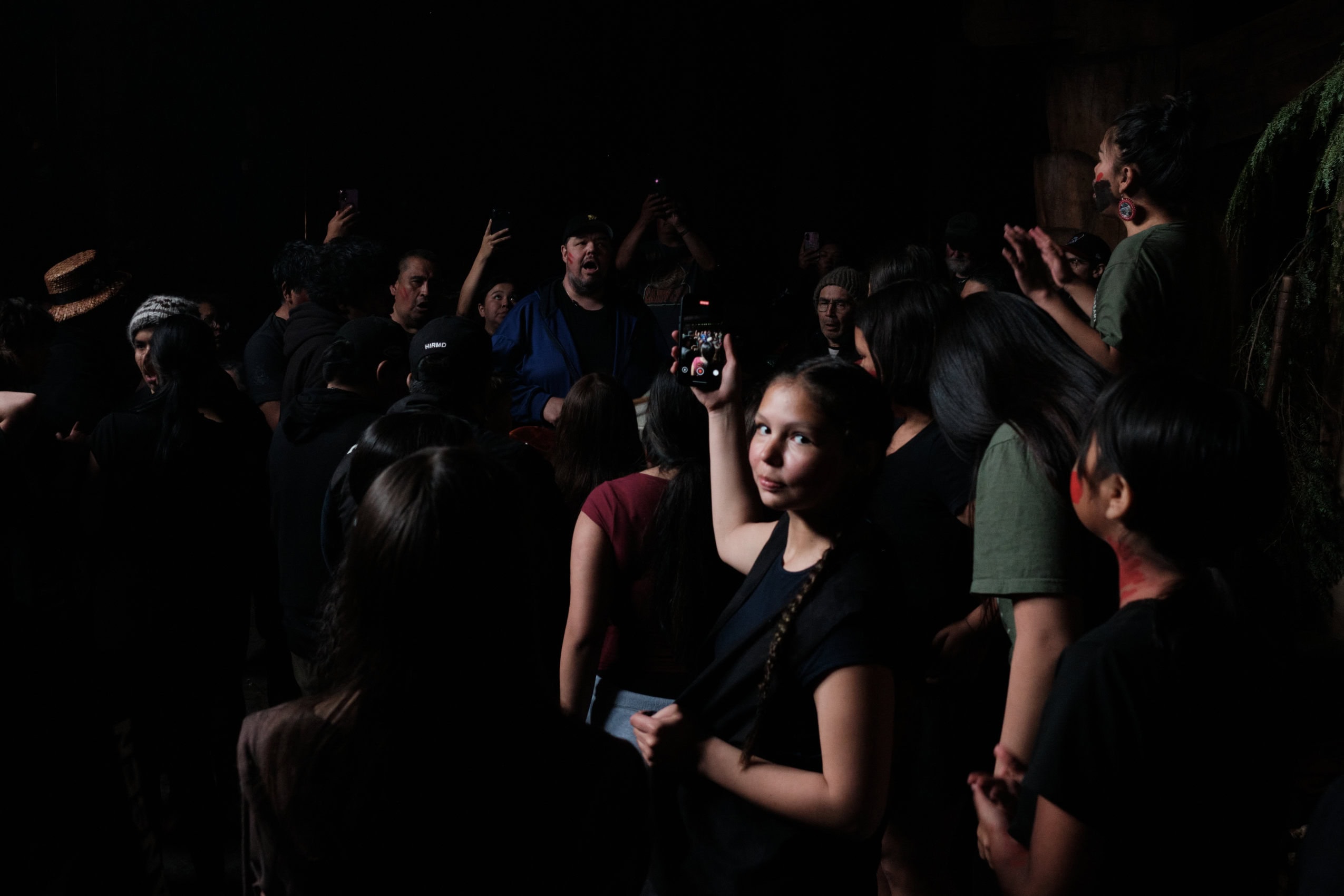
Stella Caruso records a video of drumming and singing led by Dúqva̓ísḷa William Housty.
And through time, I’m in λáλix̌sístala, listening. Above the crackling of the fire and the murmur of twin babies, ƛ̓istalaɫ Maria Martin’s voice rings out:
“Kvai has become the place where our children, youth and community come for wellness, healing, guidance and, most importantly, learning our Haíɫzaqv culture,” she says. ƛ̓istalaɫ is one of Ed Martin’s daughters. “This Great House has been here for 20 years and that’s what we are here to acknowledge and celebrate today. It strengthens our identity and gives us much hope for our future generations. Our children that have been here are the strongest and the greatest little leaders on the ground. This is exactly what my late dad envisioned. … This place was our dad’s home.”
“I am proud to have watched our children and youth grow confidence, respect and pride,” ƛ̓istalaɫ continues. “They have learned not only our songs, dances and our protocols, but also kindness and what it means to listen and be accountable — and they will become strong leaders for our nation.”
“We continue to find healing here. We remember who we are here.”
The twins are brought onto the floor and danced around the fire in the arms of their relatives.
Sas húmíɫṇƛa?
In reporting this story, Matt Simmons leaned into participatory, community-driven storytelling as part of a decolonized approach to journalism. He wrote about why this is important in a story you can read here.
none
The Narwhal’s reporters are telling environment stories you won’t read about anywhere else. Stay in the loop by signing up for our free weekly dose of independent journalism.
From The Narwhal | News on Climate Change, Environmental Issues in Canada via This RSS Feed.
5
The federal budget talks big about solving the cost-of-living crisis—but caters mostly to corporate priorities
The post Mark Carney’s new budget prioritizes corporate profits above all else appeared first on The Breach.
From The Breach via This RSS Feed.
6
7
8
One of the largest Indigenous-led LNG projects in Canada faces pushback from other First Nations
(thenarwhal.ca)

Photo: Ethan Cairns / The Canadian Press
On October 30, leaders from Canada and the European Union gathered in Montreal and agreed to study exporting liquefied natural gas to Europe. That same day, the head of a US$23-billion project to ship Western Canadian gas from Quebec’s North Shore was on a ferry crossing the St. Lawrence River.
“Europe needs gas. If it doesn’t come from the East Coast, it will come from the West,” Yves Crits, chief executive of Kino Aski LNG, told The Narwhal in what he said was his first media interview. West Coast liquefied natural gas, or LNG, bound for Europe will cross the congested Panama Canal, he noted, unless it can find a shorter route through Quebec.
Crits was returning from Baie-Comeau, about 400 kilometres downriver from Quebec City, where he had been meeting with local communities about the proposal and the pipeline that would be connected to it. “We’re in the information phase,” he said. “We want to develop the project with the community.”
But Kino Aski’s planning seems to be further along than that. A presentation the company prepared for the federal government months ago, obtained by The Narwhal, already mapped three possible pipeline routes: through Atikamekw territory, farther north toward Cree lands or along the path of GNL Québec’s defunct pipeline proposal. The presentation also proposed launching environmental studies and the regulatory process by mid-October, a target that has come and gone.
When The Narwhal asked about the pipeline routes in the presentation, Crits said they were rough corridors drawn without accounting for environmental constraints. A new route developed more recently does, he said — though he noted it did not yet take into account the input of Indigenous communities and will be adjusted through further talks.
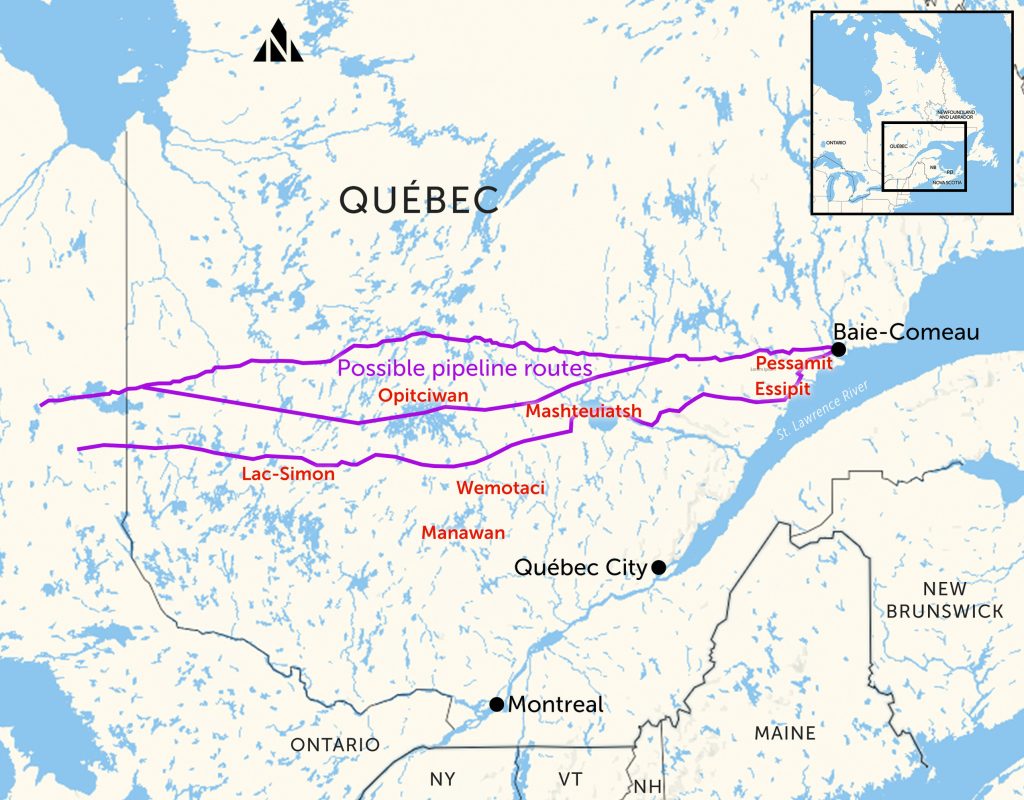
A presentation Kino Aski prepared for the federal government months ago, obtained by The Narwhal, mapped three possible pipeline routes: through Atikamekw territory, farther north toward Cree lands or along the path of GNL Québec’s defunct pipeline proposal. Pipeline route information: presentation Kino Aski prepared for the federal government. Map: Shawn Parkinson / The Narwhal
The project would pipe mostly fracked gas from Western Canada through roughly 1,000 kilometres of new pipeline to Baie-Comeau, where floating facilities would liquefy up to 15 million tonnes a year. That would make it one of the largest LNG export projects in the country, larger than B.C.’s Ksi Lisims LNG (12 million tonnes a year), Cedar LNG (about three million) and Woodfibre LNG (about two million). Kino Aski is pitching itself as “low carbon,” saying it plans to build wind turbines across the province to sell energy to Hydro-Québec, which it says would offset its energy use. No regulatory process has begun for Kino Aski LNG.
Yet Ottawa is already pitching the project to investors. A federal prospectus prepared for the Canada Investment Summit, hosted by Prime Minister Mark Carney in Toronto in September, promoted Kino Aski’s “ultra-low-emission LNG” and invited investors to take an equity stake.
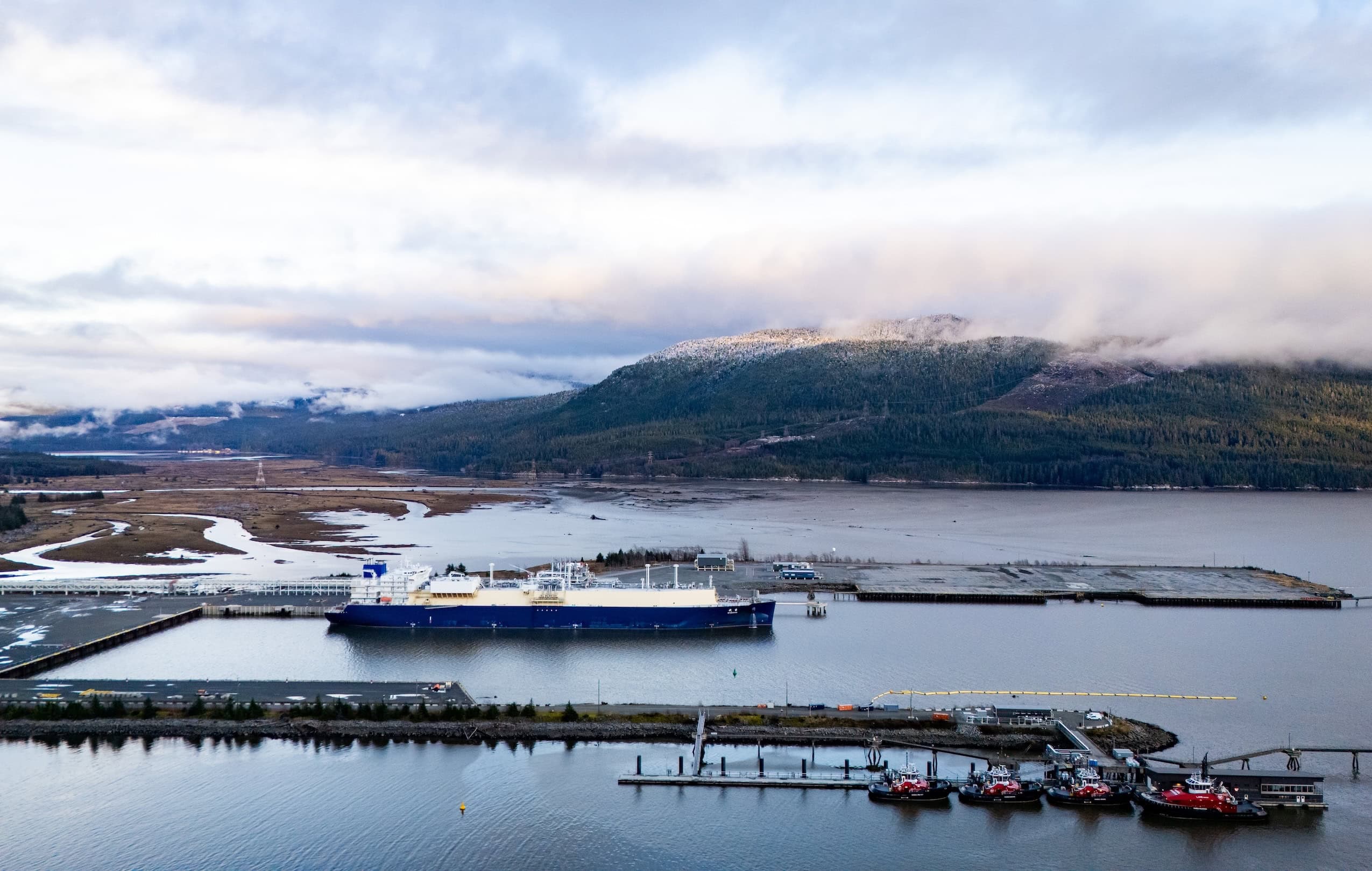
Kino Aski would be one of the largest LNG export projects in the country, even eclipsing the roughly 14 million tonnes exported annually from LNG Canada located in Kitimat, B.C., seen here. Photo: Ethan Cairns / The Canadian Press
In response to The Narwhal’s questions, Natural Resources Canada said inclusion in summit materials “does not constitute government approval, endorsement or a determination regarding a project’s viability.”
Still, that doesn’t sit well with Lucien Wabanonik, Chief of the Anishnabe Nation of Lac Simon, whose territory lies along one of the proposed pipeline routes. “It’s a mistake to sell something without having the consent or approval of our communities or our neighbours,” he said in an interview conducted in French.
Every nation along pipeline route has been invited to be a founding shareholder: energy executive
The Baie-Comeau LNG project first surfaced as a secretive proposal from Norwegian company Marinvest Energy, which had a non-disclosure agreement with Ottawa, as The Narwhal reported in March. Crits said Marinvest then approached the Atikamekw Nation, the territorial government for three Atikamekw nations: Wemotaci, Opticiwan and the most populous, Manawan, where Crits, a Belgian energy executive, has worked with the community for about a decade. Relaunched in August and marketed as “First Nations-led,” the project is now majority-controlled by the Atikamekw Nation Council, with Marinvest as a minority partner.
Two Marinvest executives, Greg Cano and Harald Vartdal, remain on the board of the joint venture, Kino Aski LNG Inc., according to Quebec’s business registry. But Crits indicated the Norwegian company’s stake will be diluted in upcoming fundraising rounds. “The Marinvest project is dead,” he said. “We’re going with an Indigenous philosophy.” So far, the Atikamekw Nation has been an eager partner. The nation responded to a request from The Narwhal but was not able to make someone available for an interview before publication time.
“Kino Aski LNG represents a unique opportunity to demonstrate that our communities can be leading economic partners while protecting our lands, our values and our future,” Atikamekw Grand Chief Constant Awashish said in an August statement. Awashish was reelected in September with 70 per cent voter support.
But other nations along the route in Quebec say the Atikamekw Nation doesn’t speak for them. Asked whether Atikamekw’s endorsement changed his view, Wabanonik answered: “Not at all. The objective is still the protection of our land.”
In an October statement, the Innu First Nations of Essipit, Mashteuiatsh and Pessamit said, in French, that they had neither consented to the project nor given Kino Aski a mandate to “speak on their behalf,” and called for a pause. Essipit did not respond to a request for an interview by publication time. Crits said Kino Aski has met with Innu leaders several times, and that they “are not against the project” but want more information.
The Innu have been here before. In 2015, Mashteuiatsh, Essipit and Pessamit signed a collaboration agreement with GNL Québec, which proposed a similar terminal in the Saguenay region. In 2021, the nations walked away, citing their opposition to fracked gas — fracking uses large volumes of water and is known to cause earthquakes and significant emissions — and the company’s failure to show its LNG would replace dirtier fuels. Quebec and Ottawa rejected the project in 2021 and 2022, citing emissions, impacts on Innu communities and risks to belugas. Lac Simon was opposed then, too. “At the time, the community was completely against this kind of project because of its impact on the land, the water, the air and the climate,” Chief Wabanonik said in an interview.
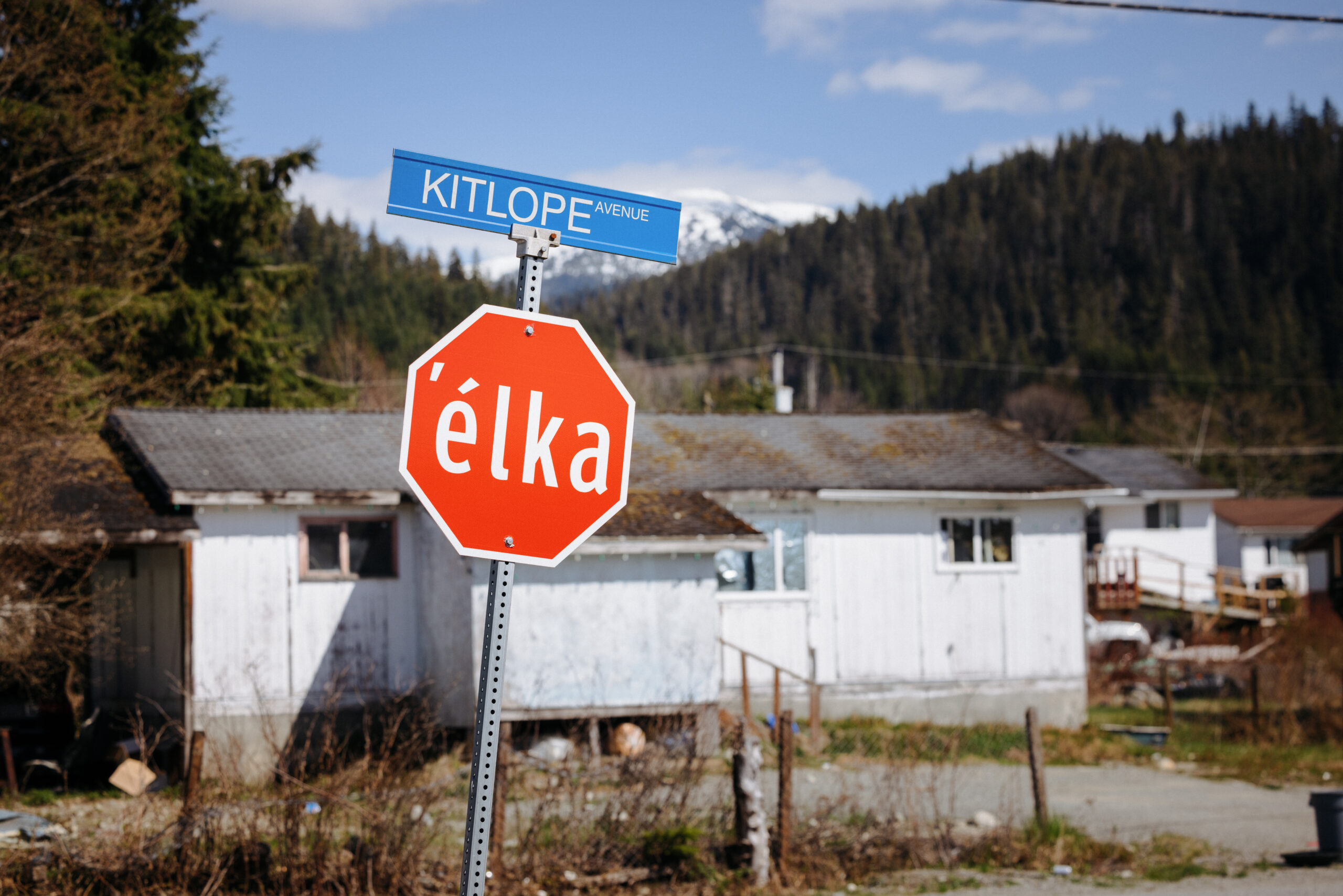
The project is being modelled after other Indigenous-majority-owned projects such as the Haisla Nation’s Cedar LNG, though Kino Aski still has not received the “go-ahead” from all neighbouring nations. Photo: Marty Clemens / The Narwhal
Crits rejects the comparison to the GNL Québec terminal, saying communities have been involved from the beginning this time and that, unlike the Saguenay site, Baie-Comeau lies east of the belugas’ main summer range. But LNG carriers are among the largest ships on the ocean, and 15 million tonnes of LNG a year would mean hundreds of tanker trips through waters used by other whales.
The CEO said Kino Aski is offering the Innu nations a stake — and that every nation along the proposed route has been invited to become a founding shareholder. That would mean benefits agreements, jobs and contracts, modelled on Western Canadian projects such as the Haisla Nation’s Cedar LNG. The company’s presentation to Ottawa calls this offer “economic reconciliation” and estimates the project would pay $8 billion in dividends to its shareholders over its first 10 to 12 years of operation.
But that model depends on the neighbouring nations saying yes. Wabanonik called the offer “the carrot at the end of the stick.”
“It’s not the financial aspect that interests us,” he said. At a recent community assembly, families whose lands lie along the route called the project unacceptable, Chief Wabanonik said.
Kino Aski is ‘a major project for Canada’: CEO
Despite the scale of the proposal running through its territory, Lac Simon learned of the project through the news and had to approach the developer for information, Wabanonik said. That’s not what Ottawa says should come first. Indigenous Peoples need “good information” early and should help co-develop projects, Rob Van Walleghem, general counsel and vice-president of Indigenous affairs at the Major Projects office, told members of Parliament on the House of Commons environment committee on Oct. 27. When asked about Lac Simon learning about Kino Aski through the news, the CEO said Kino Aski did not communicate earlier because it did not have much to say, and noted the Atikamek election kept the nation busy.
Natural Resources Canada’s spokesperson Miriam Galipeau said Kino Aski has not entered any federal review process or been referred to the Major Projects Office, and that Indigenous consultation would be part of any federal review. Crits said the project is by nature “a major project for Canada,” for Quebec and for Indigenous communities in the East, and that the company intends to seek referral to the office “at some point.”
Once the route is set, Crits said, “it will be up to the communities to make their decisions.” Asked whether Kino Aski would proceed without approval from every nation whose territory could be affected, he didn’t answer. But nothing in federal law guarantees First Nations that final say. In 2025, the Carney government passed the Building Canada Act, which paves the way to fast-track projects deemed in “the national interest,” a concept that has yet to be defined. It requires affected Indigenous communities to be consulted — but not that they consent. Bill C-39, now before Parliament, would go further, letting Ottawa designate entire “regions of national interest” and consolidating Indigenous consultation.
The question of consent also runs through the Atikamekw nation, where some members have asked whether Wemotaci, Opitciwan and Manawan were consulted before the Grand Chief endorsed the project. Along with the territorial government, each community has its own band council and Christian Awashish, a former Chief of Opitciwan (no relation to the Grand Chief), said in August the pipeline “will not happen.” Awashish did not respond to a request for an interview by publication time. In an August Facebook post, he called for more transparency, arguing the territorial council can’t commit community lands — in Opitciwan’s case, he wrote, only the band holds constitutionally recognized Aboriginal Title.
Corporate records reviewed by The Narwhal show Kino Aski Inc. is controlled through a sovereign fund the territorial council created in March, with the three band council chiefs on its board. Kino Aski Inc.’s own board has just two members: Constant Awashish and Yves Crits.
Kino Aski hopes to capitalize on changing geopolitics and its ‘low carbon’ approach
As it pushes the Baie-Comeau project under the new structure, Kino Aski is banking on a shift in public opinion. In 2021, the Quebec government rejected another LNG project, GNL Québec, after widespread opposition. But in December 2025, 67 per cent of Quebec respondents said they supported Marinvest’s LNG project, according to an Ipsos poll commissioned by the Montreal Economic Institute. The think tank, which receives part of its funding from the oil and gas industry, concluded that social acceptability is now there.
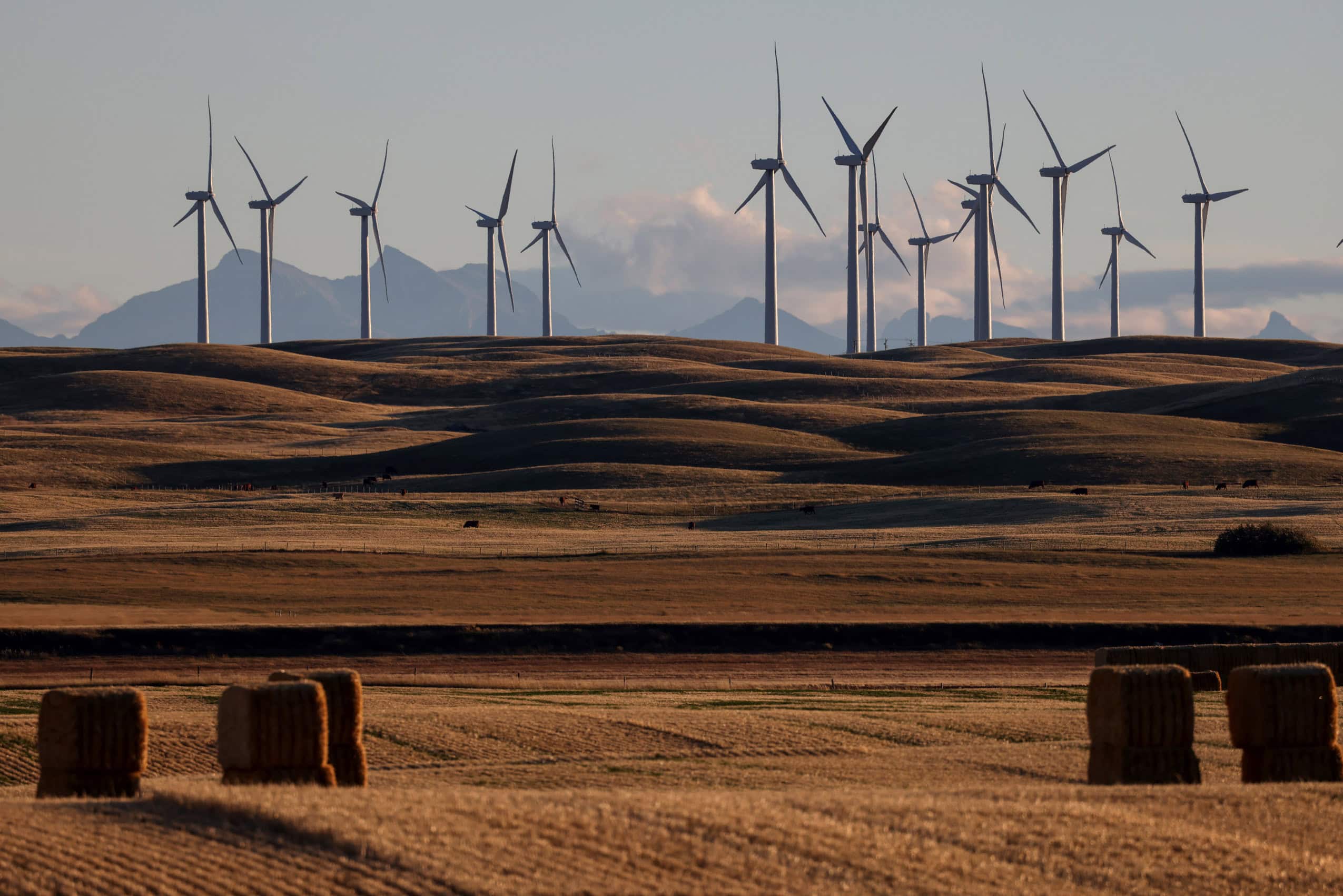
While the United States and Qatar burn gas to prepare their LNG, Kino Aski is marketing its “low carbon” approach that will use power from wind farms and Hydro-Québec. Photo: Leah Hennel / The Narwhal
“The geopolitical context has completely changed,” Crits said. Kino Aski’s presentation to Ottawa argues that Europe will need new suppliers: Norway’s production is expected to decline, and Russian gas is to be banned by the end of 2027. The new Canada-EU commitment to studying LNG exports pledges to consider both sides’ climate goals, which could make Europe’s long-term appetite uncertain: the European Union’s top diplomat told The Narwhal in February that Europe will “give priority to clean energy sources,” amid a global LNG glut.
Kino Aski markets its LNG as “low carbon,” and its presentation to Ottawa set a goal of carbon neutrality. Up to a third as much energy as is exported is used to prepare gas for shipping: first, compressing gas through a pipeline, then chilling it to -162 C and liquefying it, according to the document. In the United States and Qatar, that energy usually comes from burning gas, which is largely made up of methane, a potent greenhouse gas. Kino Aski would use Hydro-Québec power instead, offset by new wind farms. But its carbon-neutral claims cover only processing, not methane escaping from tankers — or the emissions from burning the gas in Europe.
For Wabanonik, those larger impacts are exactly the problem. Lac Simon’s concerns go beyond its own territory, to the cumulative effects of development on land, water, air and the climate, he said. “It’s false to believe that only First Nations will live with these impacts,” he said. “It’s society in general.”
The Narwhal’s reporters are telling environment stories you won’t read about anywhere else. Stay in the loop by signing up for our free weekly dose of independent journalism.
From The Narwhal | News on Climate Change, Environmental Issues in Canada via This RSS Feed.
9
Docs shed light on Alberta regulator’s decision to transfer more wells to struggling MAGA Energy
(thenarwhal.ca)
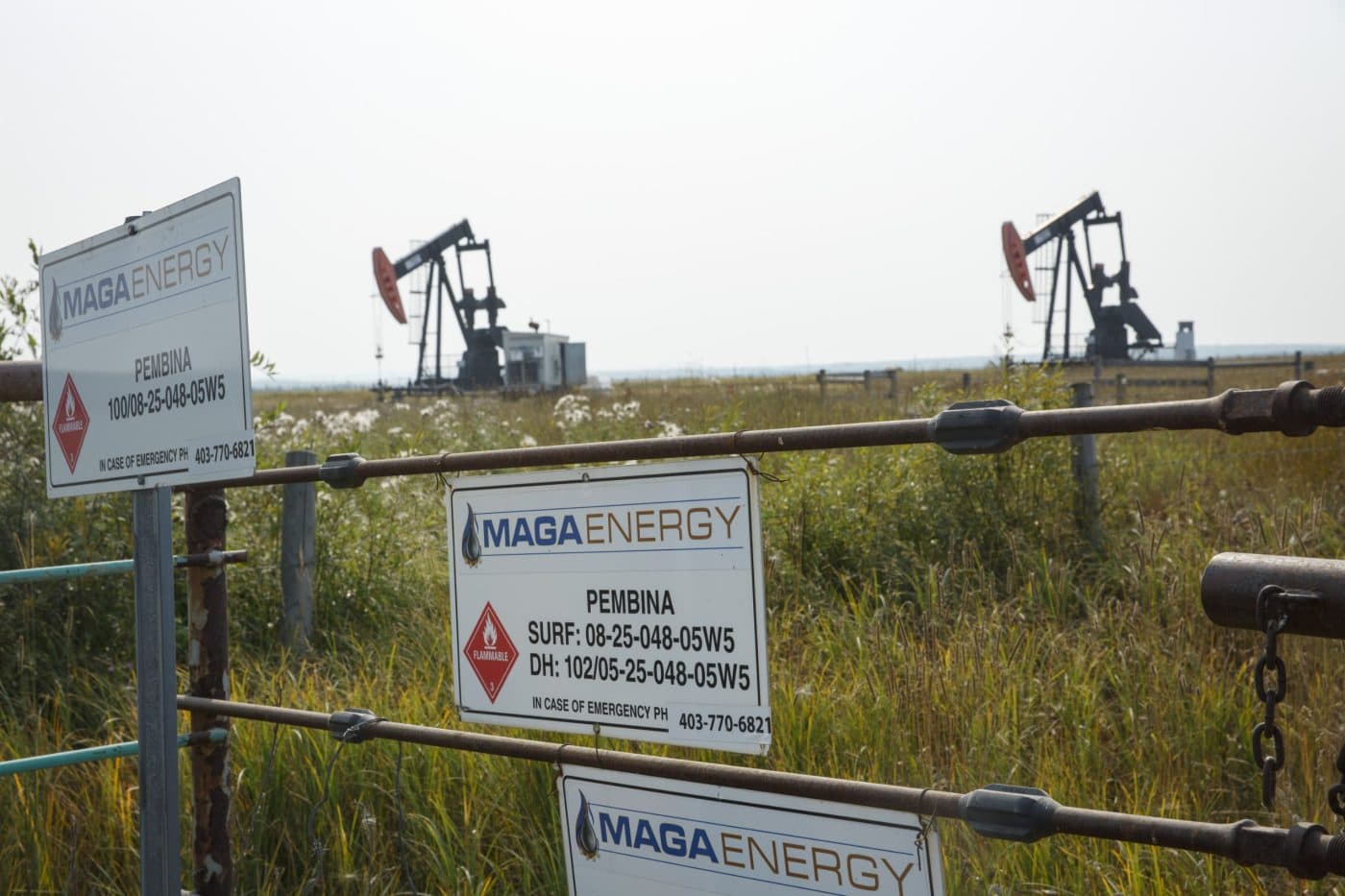
Photo: Isabella Falsetti / The Narwhal
Documents obtained by The Narwhal offer new insights into what went on behind the scenes at the Alberta Energy Regulator when it transferred 170 oil and gas wells and related facilities to beleaguered oil and gas company MAGA Energy in 2024.
The documents, obtained through an access to information request, reveal a flurry of correspondence between the regulator and the company. MAGA, which said it was facing “severe hardship,” proposed the transfer as a “solution” to its financial woes.
“We believe this will further enhance our financial position and contribute positively to our stakeholders,” the company wrote in May 2024 as part of its pitch.
The deal was ultimately approved, apparently without the regulator independently verifying some of the evidence submitted by the company to move the deal forward, according to The Narwhal’s review of the documents.
Records show MAGA Energy submitted payment plans with three municipalities to cover taxes owed by the company to the regulator in June 2024. In Alberta, oil and gas companies are not allowed to obtain new licences if they owe more than $20,000 in back taxes.
Past reporting by The Narwhal showed the company owed in excess of $200,000 to Sturgeon County alone, and that it violated a repayment agreement with the county four months before submitting it to the regulator as proof of compliance.
The tax arrears, however, were just one symptom of a company in freefall. In October, just weeks after approving the transfer, the regulator said it had completed an analysis of the company’s finances and concluded “MAGA was at risk of not meeting its end-of-life obligations.”
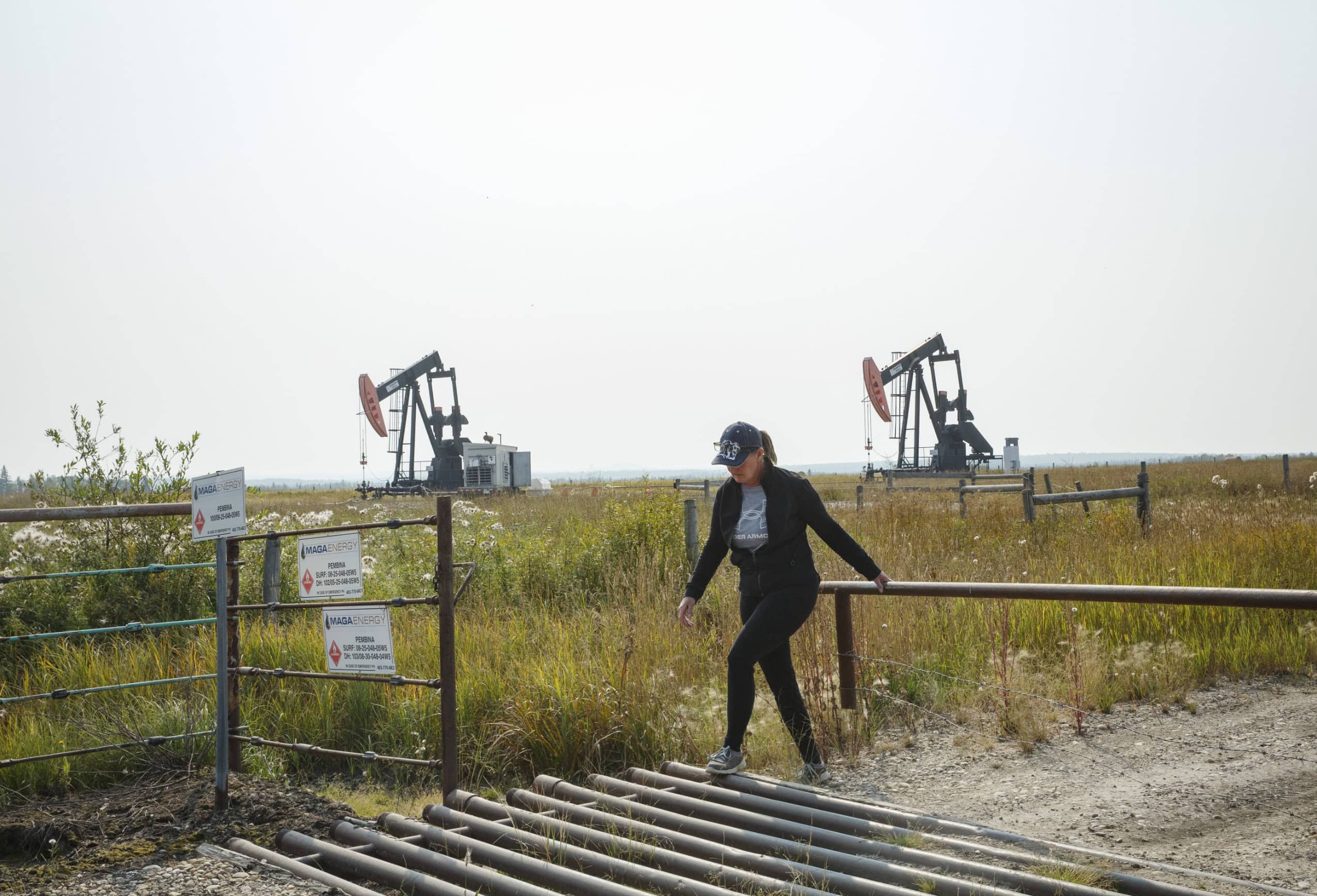
Jennifer Stephenson is one of many Alberta landowners who MAGA Energy failed to pay lease payments to. She says the Alberta Energy Regulator “dropped the ball” when it approved MAGA’s expansion. Photo: Isabella Falsetti / The Narwhal
The regulator said it performed a holistic assessment prior to approving the transfer. It’s unclear what, if anything, changed in the month after it was approved.
Eighteen months later, with mounting regulatory violations and mounting debts, the regulator ordered MAGA to cease operations.
It has left landowners with MAGA sites on their property frustrated.
“The Alberta Energy Regulator dropped the ball,” Jennifer Stephenson, who has four wells on her property near Drayton Valley, Alta., said. “What are they going to do to fix it? Where’s their accountability?”
‘The agreement was already breached’
The regulator touts its “holistic assessment” of oil and gas companies as a critical element in analyzing licence transfers.
And with hundreds of millions in unpaid taxes from oil and gas companies across the province, it’s also required to block transfers when that $20,000 threshold is met.
On June 11, 2024, the documents show the regulator informed MAGA that it was in violation of those tax requirements and that it needed to submit proof of payment, or proof of a certified payment plan within a week or the transfer would be rejected.
That same day, Mark Ross, MAGA’s then-vice-president of operations, responded.
“Proof of active and approved property tax payment plans for the three counties, Westlock, Sturgeon and Parkland are attached,” he wrote.
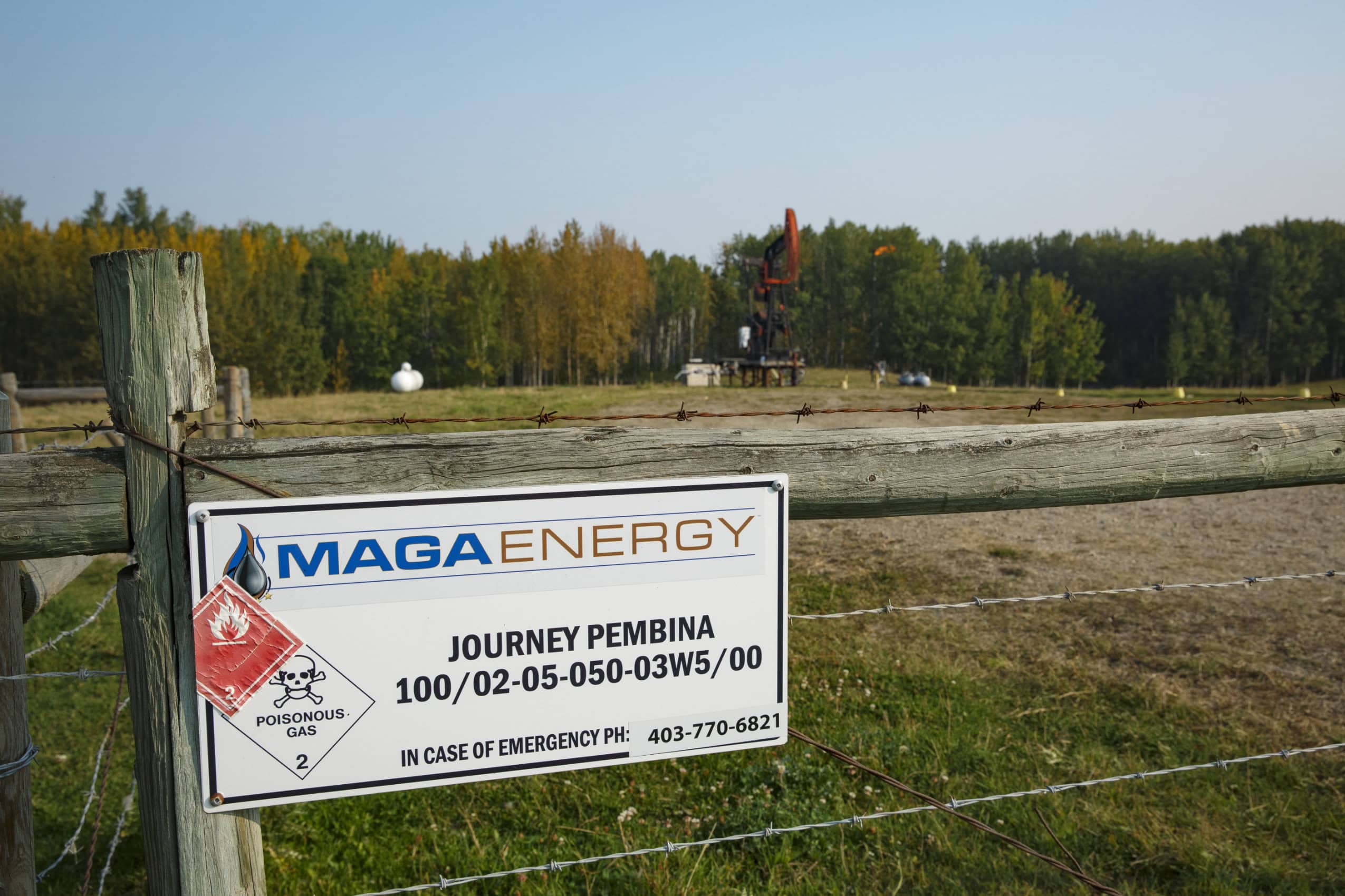
MAGA Energy submitted tax arrears payment plans to the Alberta Energy Regulator as part of its application to take over additional oil and gas wells in 2024. The application was approved — even though MAGA had already failed to honour at least one of those payment plans. Photo: Isabella Falsetti / The Narwhal
Sturgeon County inked its payment plan with MAGA in October 2023 in an attempt to recoup unpaid taxes. But the county confirmed to The Narwhal that MAGA violated that agreement in February 2024 after making seven payments.
“If this agreement was submitted as proof of compliance in June 2024, the agreement was already breached as of February 2024 and was reported to [the Alberta Energy Regulator] in March 2024,” Josephine Mah, the communications manager for Sturgeon County, said in an email.
Municipalities do not report directly to the regulator, but submit information to the Ministry of Municipal Affairs, which then provides regular updates to the regulator.
Tony Kulbisky, the chief administrative officer for Westlock County, which also had a tax agreement with MAGA, said the company was in compliance at the time of the transfer, but defaulted in February 2025.
Parkland County, the third municipality in question, said it could not confirm any details, citing Albera’s access to information laws. Parkland County also provided a letter of support for the transfer to the regulator in June 2024.
“MAGA is an active business in Parkland County where most of its assets are predominantly located, accounting for 90 per cent of their operations and productions,” Jeff Dyck, then the county’s chief administrative officer, wrote. “The resumption of its stranded production is essential for MAGA’s success.”
By email, the regulator told The Narwhal there was “no evidence provided during the application review showing any of the payment plans … were in default,” when asked about the Sturgeon agreement, which the county said it alerted the regulator about. The regulator said it does not maintain a database on unpaid municipal taxes.
“Municipalities work directly with the ministry of municipal affairs to report up-to-date information on outstanding arrears.”
When asked how often it confirms the tax agreements submitted by companies, the regulator said it “requires listed licencees to provide the required evidence upon every application for a new well or well licence transfer.”
The regulator refused to clarify how it accesses tax information, how regularly and where that information is stored.
Jack Alarie, the press secretary for the minister of municipal affairs, did not directly answer questions emailed by The Narwhal, but did provide a statement.
“Municipal Affairs collects property tax arrears information from municipalities and provides regular updates to the Alberta Energy Regulator,” he wrote. “Sturgeon County’s March 2024 report on MAGA Energy Operations Ltd. was included in the next update to the [regulator], following the department’s standard process.”
Alarie did not answer questions about when that update was provided to the regulator.
Emails to MAGA’s management team, including Ross and chief financial officer, Patrick Amantea, were not acknowledged. It’s unclear if all of the company’s executives are still employed at MAGA.
Pleas and hand-delivered cheques
MAGA’s implosion started in October 2023, when another company — Tidewater — shut down a gas processing plant near Acheson, Alta., that was critical to MAGA’s operations. Without it, the company resorted to flaring off gas and cutting production. A graph provided to the regulator by Ross shows MAGA’s production fell off a cliff shortly after the plant was shut down. It never recovered.
That calamity was a central part of the company’s pitch to the regulator. If it could just take over these new sites, it said, it could make more money and find its footing.In a presentation prepared for the regulator, Ross argued the plan would ensure “MAGA’s financial sustainability” and its ability to pay taxes, lease payments to landowners and royalties to government, as well as paying its mandated fees to the regulator and the Orphan Well Association, which oversees cleanup of sites with no viable owner.
The signs of the company’s dire situation were clear.
During the evaluation of the transfer request, documents show MAGA was also forced to pay outstanding administrative fees and mandatory Orphan Well Association levies to the regulator or its application would be rejected. The company had set up a payment plan for those fees but failed to make its first payment on time, the documents show.The company’s then-chief financial officer, Patrick Amantea, hand delivered a cheque for those fees to the tune of $235,617 on the last possible day for payment.
The company was also delinquent on its mandatory spending for well cleanup and had significantly more inactive wells than active wells in its inventory: 73 per cent, compared to an industry average of 38 per cent, according to the documents.

When MAGA Energy filed its application with the Alberta Energy Regulator, 73 per cent of its wells were inactive — almost double the industry average. Photo: Isabella Falsetti / The Narwhal
Further, the regulator later said the company was informed in January 2024, eight months before the transfer was approved, that MAGA’s compliance rate from field inspections was significantly lower than the industry average of 75 per cent.
It’s unclear what MAGA’s rate was, but at the end of 2024, the regulator noted the compliance rate had only declined, hitting a low of 37 per cent.
Despite those signs of distress, and the pleas by the company to approve the transfer as a last-ditch attempt at survival, the approval process continued.
In late August 2024, the regulator issued a conditional approval of the transfer of 170 wells and related facilities to MAGA Energy — with the caveat that the company first pay a security deposit of almost $5.5 million. MAGA objected, arguing it should not have to pay the deposit for several reasons, including its claims that data on its reserves had been misinterpreted and that the sum would be “prejudicial given the already reduced cash flow as a result of Tidewater’s decision” to close its gas plant.
Less than two weeks later, the regulator issued a revised approval of the transfer, with no security deposit required.
When asked why the requirement for security was rescinded, the regulator said it wasn’t required, “based on the holistic assessment of the application.”
The regulator also said correspondence from MAGA outlining its financial strain was not considered in the review process.“Financial capability alone is not a factor to determine licence transfer decisions,” reads the email, signed AER Media. “The Alberta Energy Regulator has no control over what licencees share verbally compared to the financial data that is considered in a licence transfer review.”
The regulator refused to answer what changed between the assessment conducted during the review period and the assessment conducted one month later, which determined MAGA was at risk of not meeting its end-of-life obligations.
An issue bigger than one company
Just months after the transfer, MAGA Energy stopped paying some landowners to lease property on their land for its newly licensed wells and facilities. In one instance, it pleaded for patience from a landowner, saying the company was in “survival mode over the last 14 months.”
It was not the only company struggling to meet its obligations even as it continued to operate.
In Alberta, the government will cover costs owed to landowners if an oil and gas company stops paying its leases. In 2025-26, the province paid out $48.4 million to cover unpaid leases, a steep rise from $29.8 million in the previous year.
Previous reporting by The Narwhal showed the government doled out almost $150 million to cover leases from oil and gas companies in the province between 2010 and 2024. The government only recovered $1.4 million from oil and gas companies in that same time — less than one per cent.
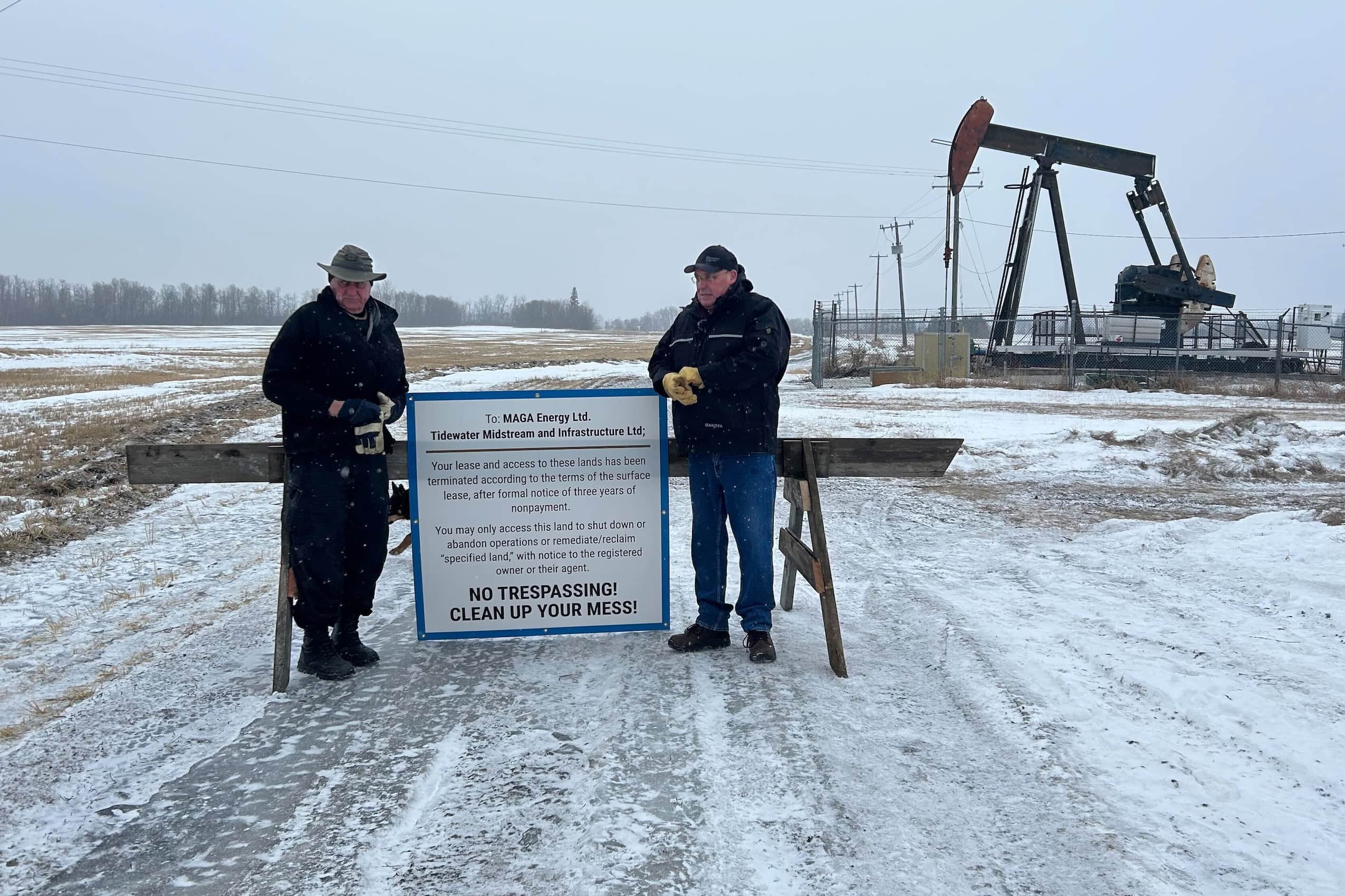
In March, an Edmonton-area landowner set up a blockade to protest MAGA Energy’s failure to make lease payments. Photo: Jack Farrell / The Canadian Press
Stephenson, whose property sits about an hour west of Edmonton, was one of the landowners left in the lurch who had to apply for compensation.
“It took over a year through the government to get my money,” she said, adding she’s frustrated taxpayers foot the bill.
“We’re all paying. You’re paying me,” she said.
The Rural Municipalities of Alberta, an umbrella organization representing municipalities across the province, estimated in 2025 that companies owed more than $254 million in unpaid taxes and municipalities have written off an additional $200 million, money that will never be recovered.
The organization says $100 million of the remaining taxes are owed by 201 companies that are still operating.
Earlier this year, the organization collaborated with the province to draft a report with recommendations to address the ongoing issue of unpaid taxes, including clearer processes and more stringent requirements for transferring oil and gas licenses.
The government has not yet implemented changes in response to that report, but Alarie said the government has accepted the recommendations, “including more detailed reporting from municipalities to support the [regulator’s] oversight.”
MAGA Energy has until September 2027 to safely seal its oil and gas sites.
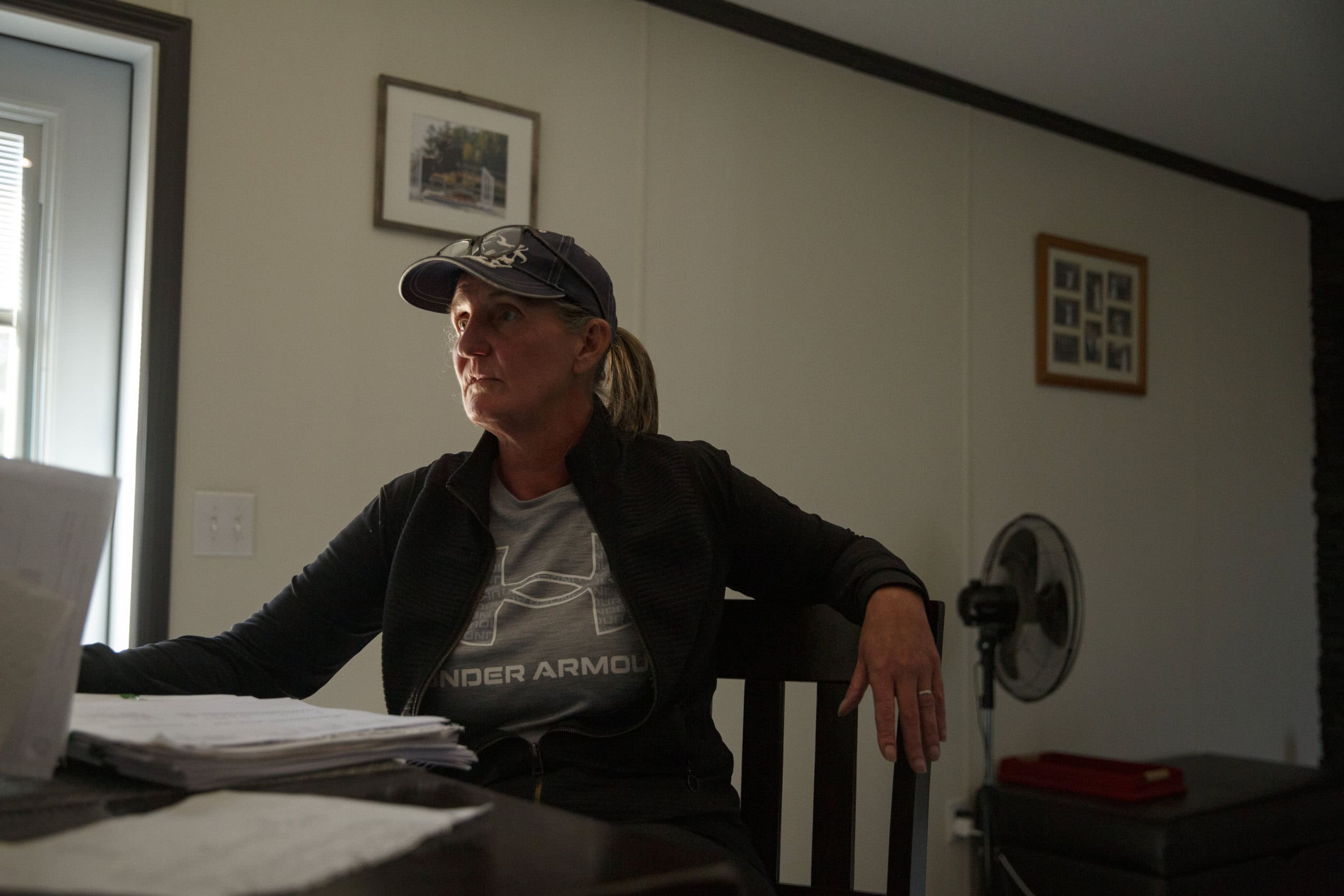
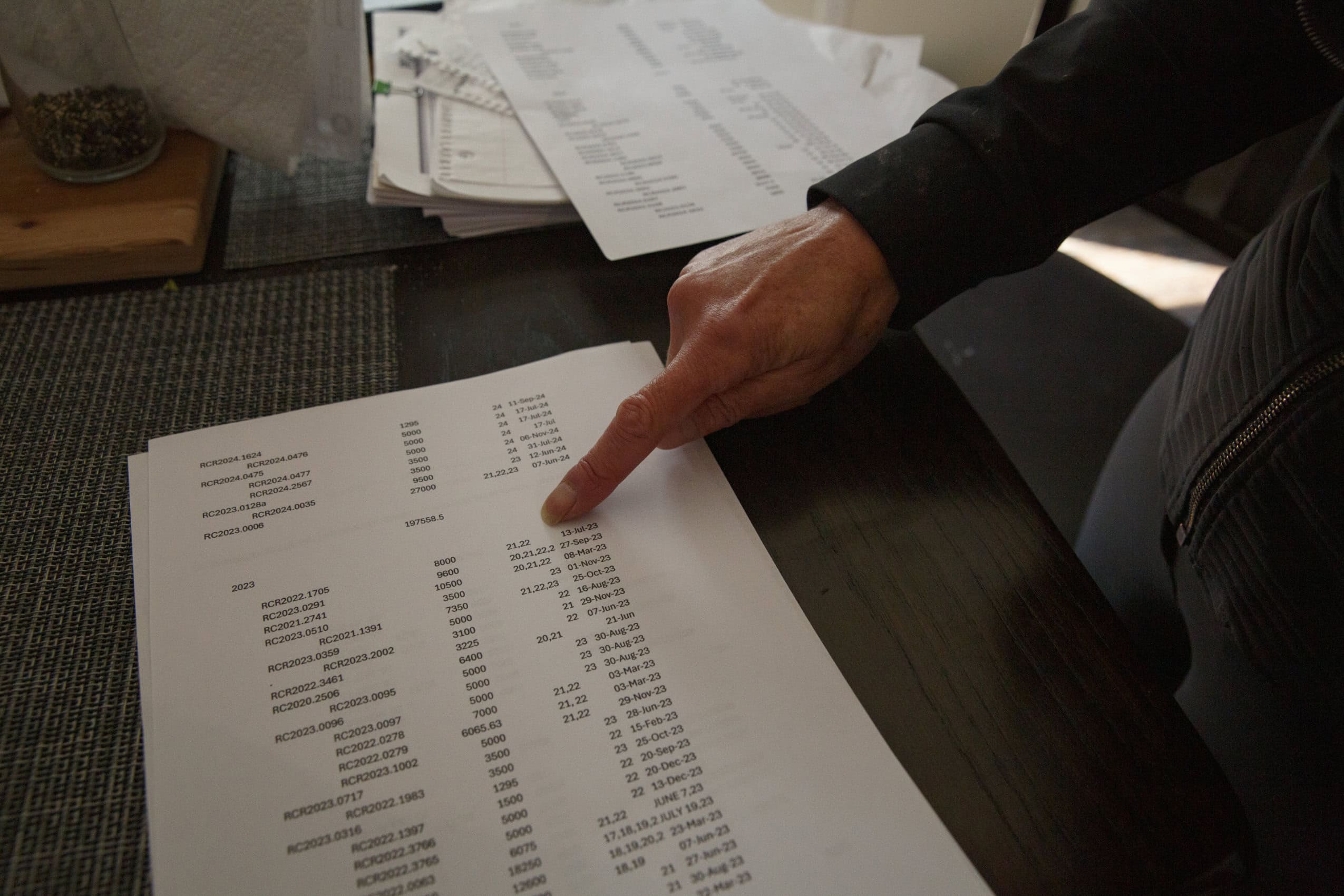
In Alberta, landowners like Jennifer Stephenson cannot refuse an oil and gas company that wants to drill on their property. Landowners are entitled to compensation, but when companies fail to pay, taxpayers pick up the bill. Photos: Isabella Falsetti / The Narwhal
In the meantime, landowners like Stephenson are stuck. She said she’d be happy to see a responsible company take over the wells and resume operations, but wants to see the regulator and the government do a better job of preventing bad actors from taking over wells in the first place.
She wants accountability in the long run, but simple acts could have some short-term impact.
“Even if there was an apology or they said the ball was dropped, that would probably — even for myself — go a long way,” she said.
The Narwhal’s reporters are telling environment stories you won’t read about anywhere else. Stay in the loop by signing up for our free weekly dose of independent journalism.
From The Narwhal | News on Climate Change, Environmental Issues in Canada via This RSS Feed.
10
11
12
13
How the Ford government’s new omnibus bill could affect Ontarians’ say in environmental decisions
(thenarwhal.ca)
Photo: Christopher Katsarov Luna / The Narwhal
On its first day back after a 21-week break, the government under Premier Doug Ford introduced a sweeping bill that could change how Ontarians learn about provincial decisions affecting the environment — and what residents can do if they disagree.
By day two, Bill 140, the Building Ontario Faster Act, 2026, reached second reading. But it didn’t sit well with the opposition.
“The government does not want people to tell them what they think. I very much would like the public to have a chance to participate in their democracy,” Oshawa MPP Jennifer K. French said during debate at Queen’s Park on Oct. 28.
For more than three decades, the Environmental Bill of Rights has given Ontarians a formal role in government decisions that could affect their air, water, land and communities.
“It gives the public a wide range of tools that they can use to protect themselves and protect the environment,” Richard Lindgren, a lawyer with the Canadian Environmental Law Association said. “But if Bill 140 is passed, those rights will disappear.”
Tabled by the minister of red tape reduction, Bill 140 would eliminate legal tools that allow residents to challenge certain environmental approvals, request reviews of existing environmental laws and ask the province to investigate suspected violations. It would also change how the public is notified about proposed environmental laws and policies.
For someone living near a proposed landfill, concerned about industrial pollution or worried about an approval affecting local drinking water, the changes could mean fewer opportunities to question government decisions or seek an independent review.
Environmental lawyers and former provincial watchdogs warn the proposed legislation could significantly weaken public participation and government accountability, leaving communities with fewer ways to challenge decisions that could harm the environment.
But Ontario’s Minister of the Environment, Conservation and Parks Todd McCarthy defended the proposed changes, saying the legislation would eliminate duplication while maintaining environmental protections. He said the changes would maintain opportunities to comment on environmental proposals while eliminating processes he describes as seldom used and resource-intensive.
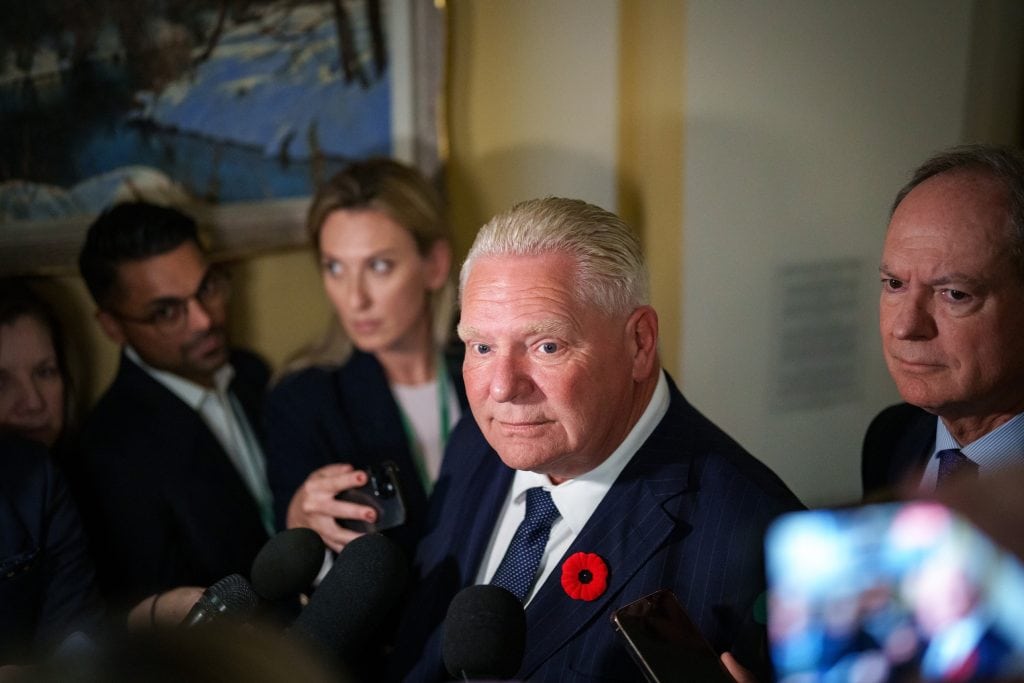
Ontario Premier Doug Ford speaks to reporters during a scrum at the Ontario legislature in Toronto on Tuesday, Oct. 27, 2026. Photo: Arlyn McAdorey / The Canadian Press
“Not only will public accountability not be diminished, it will be enhanced. It will be improved. It’ll be modernized for a modern world,” McCarthy told The Narwhal, standing outside Ford’s office at Queen’s Park.
The legislation has passed second reading and is now being reviewed by a smaller group of MPPs. The government posted the proposed amendments on the Environmental Registry of Ontario in late October, with a 30-day comment period scheduled to close Nov. 26.
Ontario’s Bill 140 and the Environmental Bill of Rights
The Building Ontario Faster Act is an omnibus bill that proposes changes to a wide range of provincial laws to accelerate infrastructure projects, reduce Ontario’s reliance on the United States for landfill capacity and make it easier for workers to move to Ontario from other provinces and territories.
The government says the legislation will make Ontario more competitive by reducing regulatory requirements, speeding up approvals and making it easier for businesses to invest and create jobs. It follows several bills the Ford government has introduced with similar intentions, like Bill 5, the Protect Ontario By Unleashing Our Economy Act, passed in 2025 and Bill 227, the Building Ontario, Cutting Red Tape Act, in 2024.
According to the province’s announcement, Bill 140 would eliminate nearly 220,000 days’ worth of permit processing time. “We’re giving businesses the confidence and predictability they need to invest and create jobs here in Ontario, so we can stand up to tariffs, protect our workers and build the most competitive economy in the G7,” Andrea Khanjin, Ontario’s minister of red tape reduction, said in the government’s announcement.
But among the legislation’s many provisions, Schedule 8 has drawn particular concern as it affects long-standing environmental legislation; Ontario’s Environmental Bill of Rights came into effect in early 1994, following years of public concern about pollution, environmental degradation and the government’s ability to protect natural resources.
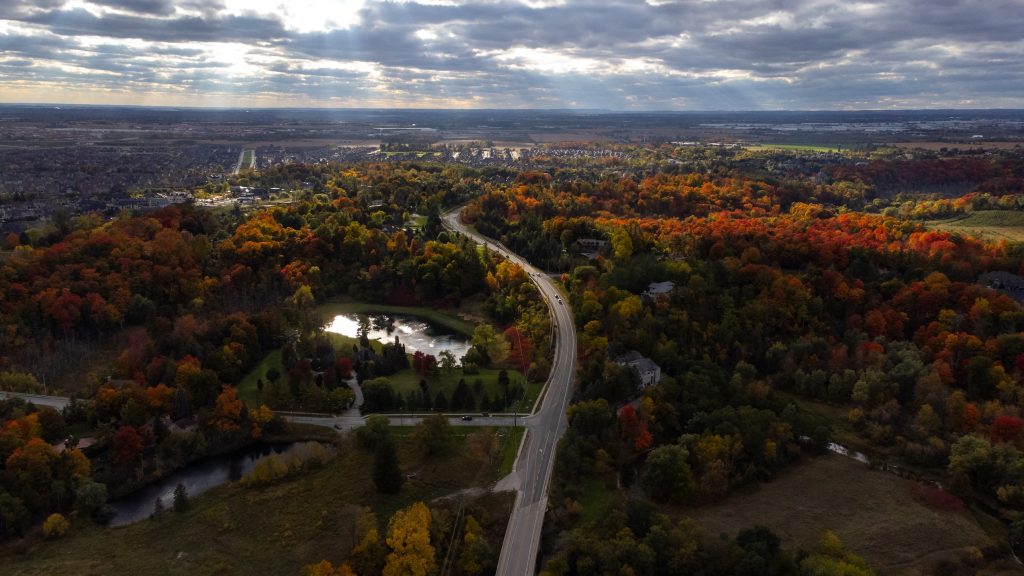
The province’s auditor general has raised concerns about how the Environmental Bill of Rights has been implemented. Its 2025 performance audit found the province had exempted permits and approvals for Highway 413 and the Ontario Place redevelopment from certain consultation requirements. Photo: Katherine KY Cheng / The Narwhal
Before the legislation, environmental decisions were largely made between government ministries and private companies, with little opportunity for residents to provide input. That meant a ministry could approve a facility discharging contaminants into a creek without first notifying the people living nearby or giving them an opportunity to comment.
The public push for change eventually led to a task force created under Ontario’s NDP government in 1990, bringing together representatives from environmental organizations, industry and government. After 55 meetings and months of negotiations, the group reached a consensus on legislation intended to give the public tools to protect the environment and their communities.
Bill 140 further exempts postings on Ontario’s environmental registry
Among the tools introduced by the bill of rights is the Environmental Registry of Ontario, a public website where provincial ministries post notices about certain environmentally significant proposals and decisions, and residents can submit comments. The Ford government has already removed that requirement for some projects, like Ontario Place, and on some types of actions, like those relating to at-risk species.
Under Bill 140, the province would eliminate the requirement for posting notices on the Environmental Registry of Ontario when they are also posted on the Ontario Regulatory Registry, a separate website where ministries post proposed and completed policy changes. Reshaping municipal bike lane policies, for example, would no longer need to be posted to the environmental registry.
Not all environmental notices would move. Proposals for prescribed environmental permits, licences and other approvals would continue to be posted on the Environmental Registry of Ontario. But Philip Pothen, in-house counsel and Ontario environment program manager for advocacy organization Environmental Defence, said the two registries serve different purposes.
He argued the environmental registry provides mandatory advance notice of environmentally significant decisions, while postings on the regulatory registry are not backed by the same legal requirements. Ministries can seek exemptions from posting on the regulatory registry before policy amendments are made, unlike the environmental registry where advance notice of certain environmentally significant proposals are required by law.
“These are totally different things. They are not duplicates,” Pothen said. “If there was some duplication to be eliminated, it should eliminate the regulatory registry posting because that’s the one that’s voluntary.”
He said advance notice is essential because it gives the public time to understand proposed changes and raise concerns before decisions are finalized. “Our system only works when we actually know before laws are brought into force, before they’re introduced to parliament and certainly before regulations or policies become implemented.”
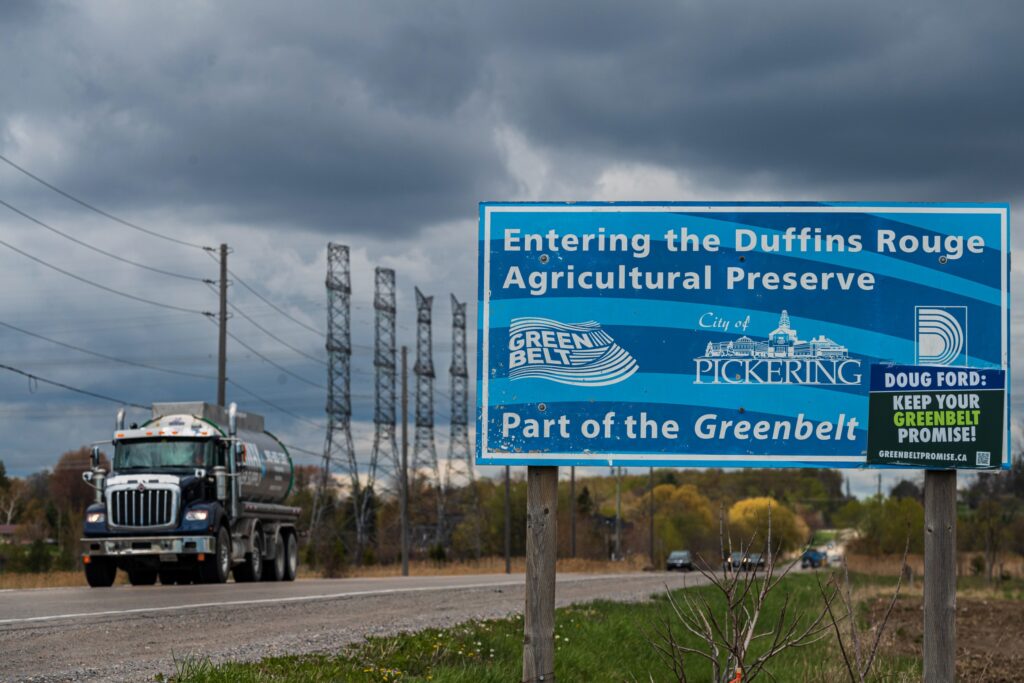
The Duffins Rouge Agricultural Preserve, a section of prime farmland, was removed from the Greenbelt in December 2022 — and reinstated a year later. Photo: Christopher Katsarov Luna / The Narwhal
The environmental registry has brought controversial government decisions to public attention in the past. In 2022, the Ford government’s proposal to remove 7,400 acres from Ontario’s protected Greenbelt was posted on the environmental registry. About 29,200 submissions were received in response to the proposed Greenbelt changes. The government initially made no changes to the proposal in response to those comments, but later reversed its decision amid widespread public and media scrutiny.
Pothen fears weakening advance-notice requirements could allow environmentally significant decisions to proceed before the public has time to scrutinize them.
“They’re not cutting red tape,” Pothen said. “They’re tearing down the guardrails between us and corruption. They’re tearing down the guardrails between us and very serious environmental risks.”
Rights to review and investigate projects with environmental impacts weakened under Bill 140
One of those guardrails is what’s known as Section 61 of the Environmental Bill of Rights, which enables Ontarians to formally ask the government to examine whether an existing rule or approval is outdated or failing to protect the environment.
Lindgren, who was among those who helped draft Ontario’s Environmental Bill of Rights in the ’90s, said his organization has used the process, known as an application for review, on behalf of clients to push for stronger environmental protections. He recalled a case in which the Canadian Environmental Law Association requested a review of an approval allowing a company to release lead into the surrounding air. The approval was subsequently revoked.
The bill would also eliminate the formal application process for requesting investigations into suspected environmental violations. Currently, two residents can apply to the Ministry of Environment for an investigation into violations of environmental laws or conditions of approvals. The ministry must follow prescribed procedures and timelines when responding, including reporting on its findings.
If Bill 140 passes, those formal application rights would disappear. The government said residents would still be able to report suspected environmental violations directly to the Environment Ministry, but the formal process for addressing it and communicating with applicants wouldn’t apply.
Another proposed change would remove the right under the Environmental Bill of Rights for third parties to appeal certain environmental approvals to the independent Ontario Land Tribunal. Lindgren said that mechanism has allowed community groups to challenge approvals for landfills, water-taking and industrial emissions. In some cases, he said, appeals have resulted in permits being revoked or revised to include stronger environmental safeguards.
For residents concerned about a potentially harmful project in their neighbourhood, losing that avenue could mean fewer opportunities to have an independent tribunal examine the government’s decision.
Bill 140 would also repeal provisions allowing certain legal actions for harm to public resources, such as air, land and water, and remove a procedural protection for people bringing public nuisance lawsuits, which include things like pollution. The government said people would still be able to bring public nuisance actions through the courts.
Lindgren warned that affected communities may increasingly turn to civil litigation or judicial review to challenge potentially harmful projects. That could ultimately create the very delays the government said it wants to eliminate.
He said the formal rights to request environmental reviews, investigations and appeals are distinct legal mechanisms and cannot simply be replaced by other government consultation processes. “There are no other alternatives out there,” he said. “There are no other laws that allow people to do what they’re allowed to do, and are entitled to do, under the Environmental Bill of Rights.”
If the legislation passes as written, several of these changes, including those relating to appeals, reviews and investigations, would be retroactive to Oct. 27.
‘The Environmental Bill of Rights is basically gone’: former environment commissioner
The Environmental Bill of Rights also requires designated ministries to develop statements of environmental values explaining how they would consider environmental principles when making decisions. They are held accountable to those statements by another central feature of the bill: an independent environmental commissioner.
But those and other protections have gradually weakened. In 2018, the Ford government passed legislation eliminating the independent environmental commissioner’s office and its responsibilities were subsequently transferred to the auditor general and the Environment Ministry.
Dianne Saxe was Ontario’s final environmental commissioner. “It was my office that was one of the major protections and tools to make the Environmental Bill of Rights count,” she told The Narwhal.
Saxe said successive legislative changes under the Ford government have weakened the province’s environmental protections built over decades. “It’s a death of 1,000 cuts,” she said. “The things that are being eliminated now are actual rights.”
She said the latest proposal eliminates many of the remaining safeguards of the bill.
“The Environmental Bill of Rights is basically gone,” Saxe said. “We have a minor right of notice and comment, knowing that this government ignores most comments that are trying to protect a livable future.”
In a March 2024 report, the Law Commission of Ontario documented several cases in which residents had successfully used their rights to improve environmental protections. These included the revocation of landfill approvals, stopping a cement plant from burning tires, plastic and other waste and an end to snapping turtle hunting. But the commission concluded that the legislation had fallen short of its objectives, citing government non-compliance, weakened public participation rights and reduced independent oversight. The commission recommended broad reforms to strengthen environmental accountability.
The province’s auditor general has also repeatedly raised concerns about how the Environmental Bill of Rights has been implemented. In a 2025 report, the auditor general listed numerous concerns, including the Ford government’s passing of Bill 17, which targeted municipal green building standards, before completing required environmental consultations and considering all public comments. It also found the province had exempted permits and approvals for Highway 413 and the Ontario Place redevelopment from certain consultation requirements.
Still, the auditor general concluded that the law continued to provide meaningful opportunities for public participation. During that reporting period, Ontarians submitted thousands of comments on environmental proposals, requested six reviews and investigations and challenged four ministry decisions involving environmentally significant permits and approvals.
In some cases, public comments resulted in changes to government decisions, such as improvements to how waste is diverted in Far North communities.
For Gord Miller, who for 15 years was Ontario’s environmental commissioner and is now chair of Earthroots, a registered environmental charity, one of the most consequential changes is the proposed elimination of statements of environmental values by ministries.
“Doesn’t the public have a right to know what exactly the environmental values of a ministry are, and what are they making their decisions based upon?”
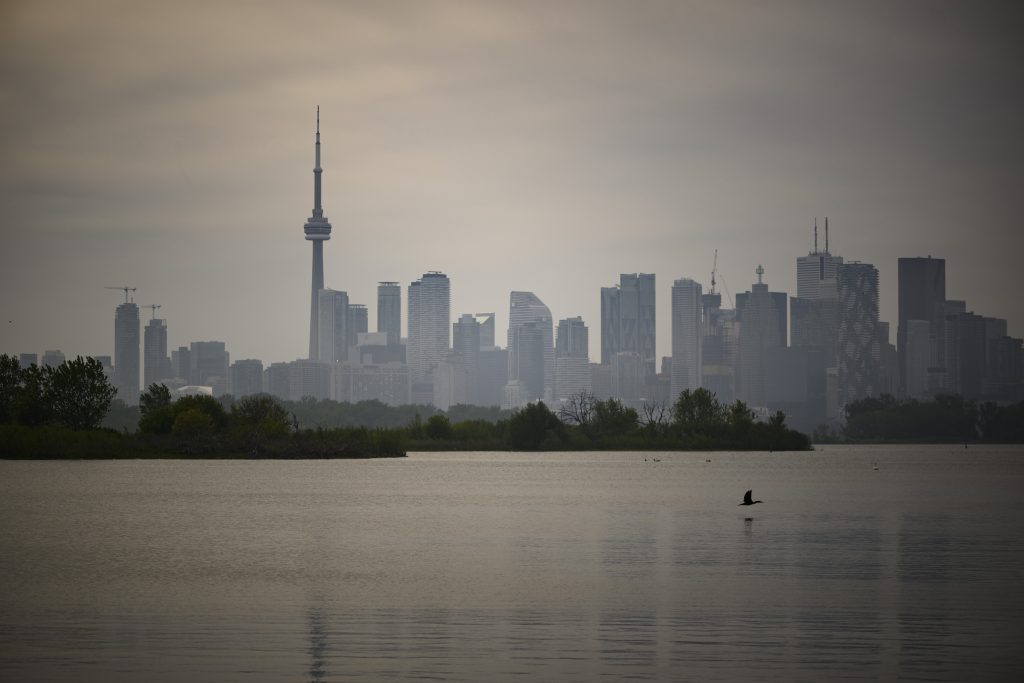
Dianne Saxe, Ontario’s final environmental commissioner, said successive legislative changes under the Ford government have weakened the province’s environmental protections built over decades. “It’s a death of 1,000 cuts.” Photo: Christopher Katsarov Luna / The Narwhal
He said the former environmental commissioner’s office could ask ministries to explain how they had considered those commitments when making major decisions. Removing the requirement, he argued, takes away another way to hold government decision-makers accountable.
Miller fears the changes could bring Ontario back to the situation that led governments to create environmental protections decades ago.
“I know exactly what will happen because it already did back in the late 1960s and into the early ’70s,” he said. And that, he said, is how Ontario ended up with an Environmental Bill of Rights in the first place.
The Narwhal’s reporters are telling environment stories you won’t read about anywhere else. Stay in the loop by signing up for our free weekly dose of independent journalism.
From The Narwhal | News on Climate Change, Environmental Issues in Canada via This RSS Feed.
14
15
16
17
Politicians have floated building more oil refineries in Canada. Here’s what you need to know
(thenarwhal.ca)
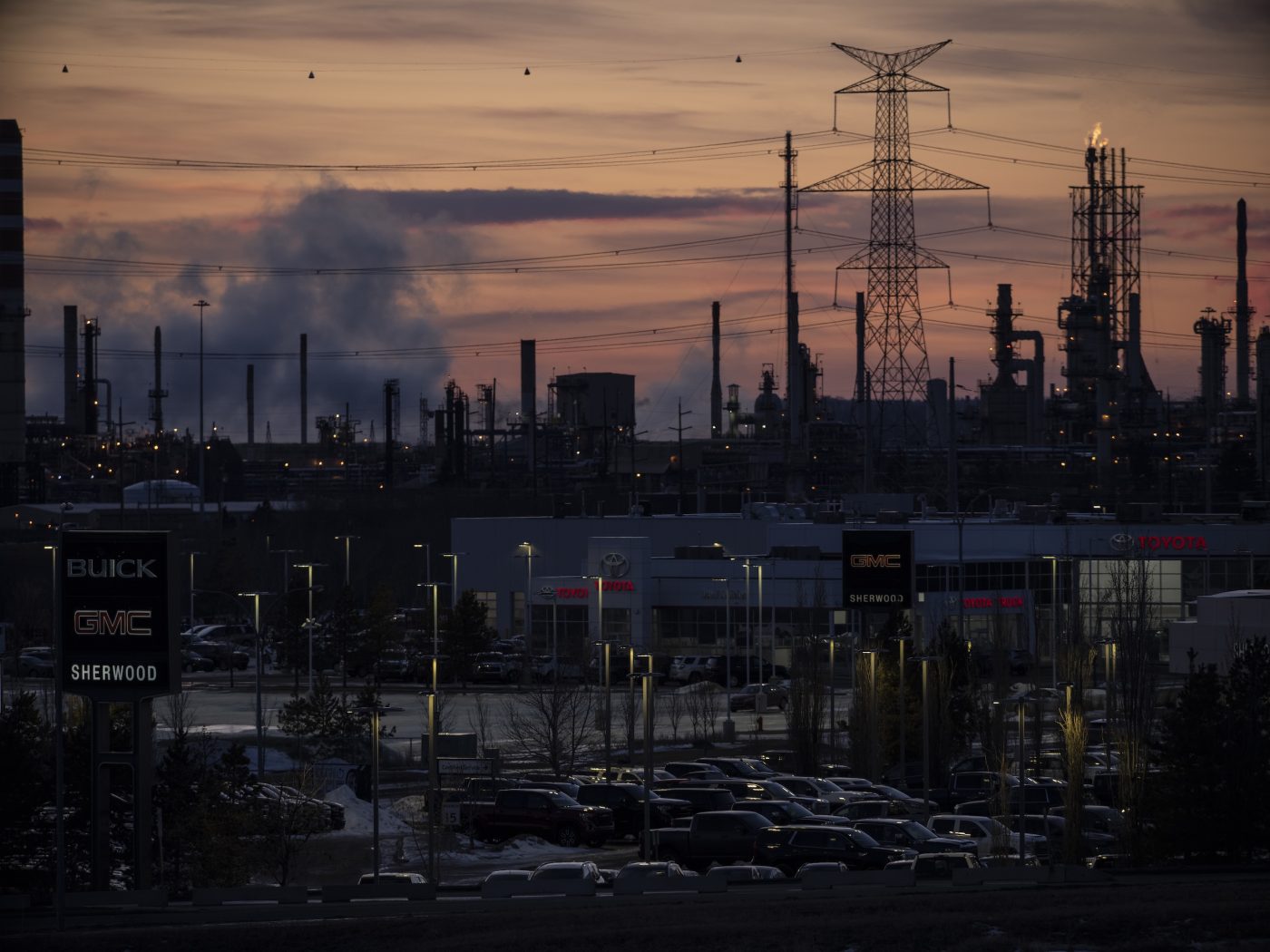
Canada is the world’s fourth-largest oil producer. Yet it imported about 500,000 barrels of crude a day in 2025, three-quarters of it from the U.S., according to the Canada Energy Regulator. And much of the western Canadian oil that reaches Ontario and Quebec travels through pipelines that cross the U.S. before coming back north. As diesel prices have skyrocketed, politicians across the spectrum have pointed to a solution they say is simple: build more Canadian refineries.
Case in point: in September, Conservative Leader Pierre Poilievre pushed Prime Minister Mark Carney to invest in new refineries, saying, “Canadian workers should be turning Canadian oil into Canadian fuel.” In July, Ontario Minister of Energy and Mines Stephen Lecce said Canada needs to “expand domestic refinery capacity.” Departing B.C. premier David Eby said in January that if governments have “tens of billions of dollars to spend,” they should spend it on a refinery rather than a pipeline.
Why now? “Energy security” has become a powerful political argument as the trade war with Washington has made relying on the U.S. feel riskier, and war in Iran and attacks on Russian refineries squeeze global diesel supplies. As Poilievre put it, “the current diesel price crisis will … expose our overreliance on the U.S. to refine our own oil.”
But despite current geopolitics, the idea isn’t new. “It’s like the seasons,” said Pierre-Olivier Pineau, an energy economist at HEC Montréal who has watched refinery fervour come and go for years.

Even though Canada is the world’s fourth-largest oil producer, it imported around 500,000 barrels of crude per day last year — three quarters of it from the U.S. Photo: Amber Bracken. / The Narwhal
The idea returns just as, in Pineau’s words, “there has never been a better time in human history to run a refinery,” profit-wise. Imperial Oil’s refining division, for example, earned $787 million in the second quarter of 2026, more than double a year earlier. The industry, meanwhile, has been busy bending the ear of the federal government. The Canadian Fuels Association, a lobby group for refineries, reported 51 communications with federal officials in the first nine months of 2026 — more than in any full calendar year since at least 2021. Most of those contacts came in the spring, when diesel prices soared.
In the face of all that, seemingly simple solutions can look like a silver bullet. The thing is, everyone The Narwhal interviewed, from the refiners’ lobby group to its critics, agreed on one thing: Canada isn’t short of refineries.
Here’s what you need to know.
What exactly is a refinery, and what does it produce?
A refinery is an industrial plant that turns crude oil into products people can use. In Canada, more than 80 per cent of what refineries produce is gasoline, diesel and jet fuel, according to a 2024 analysis by oil market analyst Rory Johnston.
The rest includes heating oil, asphalt, propane and the base oils used to make lubricants for engines. Refineries are different from Alberta’s upgraders, which turn thick bitumen from the oilsands into lighter “synthetic” crude that refineries can then process.
How many refineries does Canada have?
Canada has 16 oil refineries, including two that make asphalt. They have room to process about two million barrels of crude a day. In 2025, Canadian refineries ran, on average, at 90 per cent of that capacity, according to the Canada Energy Regulator.
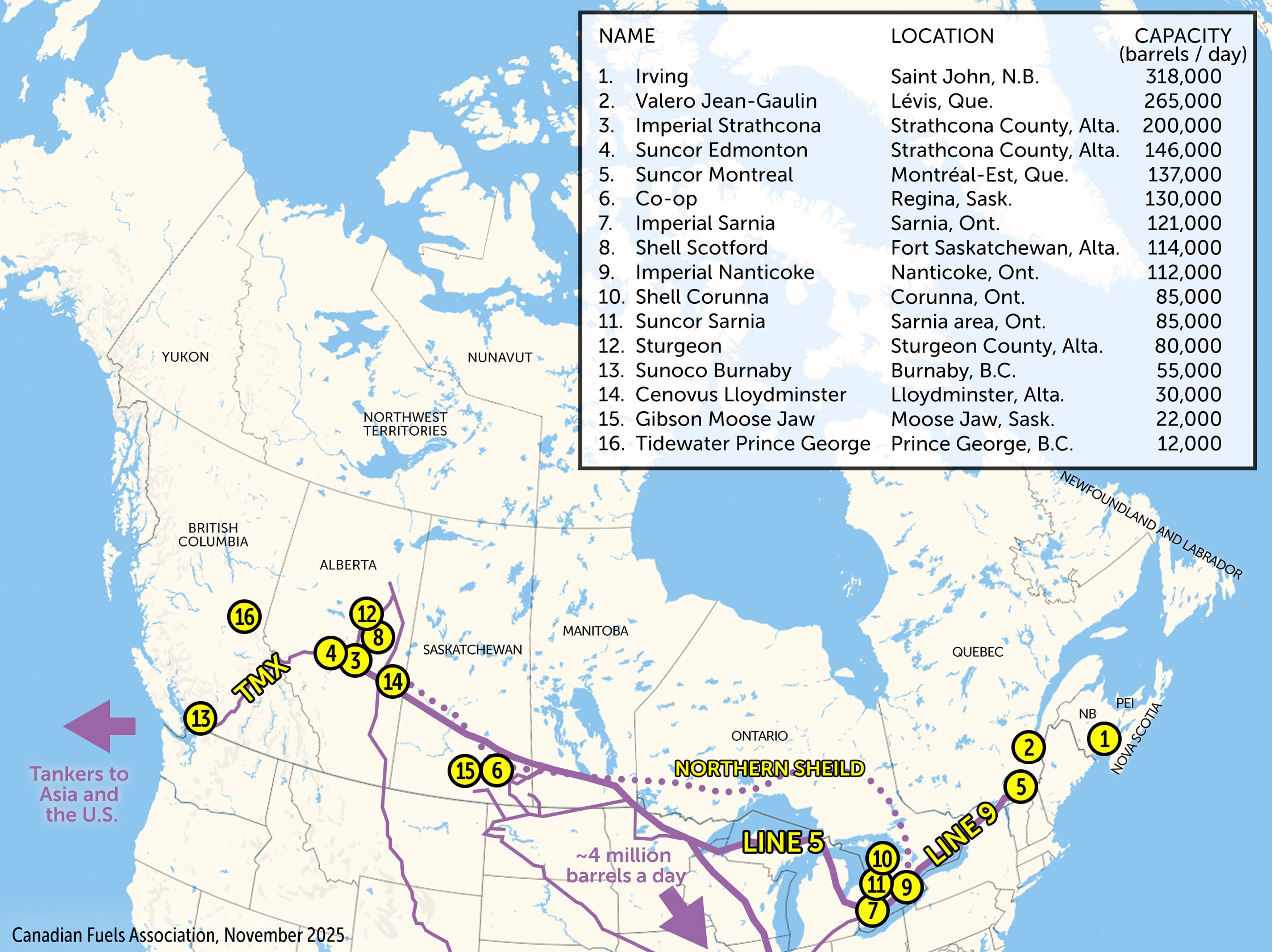
Map of refineries and pipelines across Canada. Map: Shawn Parkinson / The Narwhal
That’s enough for the country’s needs. “The Canadian market is essentially in balance,” said Carol Montreuil, vice-president for Eastern Canada at the Canadian Fuels Association. Pineau, a frequent critic of the industry, agrees. So does Ottawa. “Canada does not need more refining capacity to meet current domestic needs,” the Prime Minister’s Office said in a statement to The Narwhal. In 2025, Canada exported a net 200,000 barrels a day of refined products, it added.
The real issue is that Canadian refineries don’t process much of the oil this country is best known for: thick, heavy bitumen from Alberta’s oilsands. Heavy crude is only about a quarter of what Canadian refineries process, according to Johnston’s 2024 analysis.
For that reason, most of Canada’s heavy oil goes south, via pipelines, to refineries in the U.S. Midwest and Gulf Coast that can handle heavy crude.
How do refineries affect the people next door?
Refineries support more than 18,000 jobs in Canada, according to the industry. For their neighbours, they can be both a paycheque and a burden.
Near Edmonton, the Imperial and Suncor refineries release benzene and sulphur dioxide, among other pollutants. Limited monitoring makes it hard to pin down how much of the region’s air pollution they are responsible for, The Narwhal has reported.

While we do know that the Imperial and Suncor refineries near Edmonton release benzene and sulphur dioxide, limited monitoring makes it tough to quantify. Photo: Amber Bracken / The Narwhal
Sarnia, Ont., is home to Chemical Valley, a cluster of roughly 60 industrial facilities, including three oil refineries. Residents of neighbouring Aamjiwnaang First Nation are exposed to about 30 times more benzene than people in Toronto and Ottawa. Sarnia would be the destination if Ontario and Alberta are able to make Northern Shield happen: that proposed pipeline would carry Alberta crude north of the Great Lakes.
And when the industry leaves, the impact isn’t over. Montréal-Est was a hub of refining activity by companies such as Imperial Oil, which opened the island of Montreal’s first refinery in 1916, and Shell, which closed its last in 2010. Decades after most refineries closed in the 1980s, the area has about 270 hectares of industrial brownfields, roughly the size of 330 football fields, awaiting cleanup and redevelopment.
What are the arguments in favour of a new Canadian refinery?
Gasoline and diesel prices are high, but experts say a new Canadian refinery wouldn’t necessarily ease prices at the pump. Even Montreuil concedes that local refineries offer consumers limited protection from price spikes, since fuel prices are set on global markets.
For Montreuil, it’s more about fuel supply security, which the industry has also raised in recent months, according to the federal lobbyist registry.
Canada’s refineries ensure the country has enough fuel, and without them, we’d be rationing fuel right now, according to Montreuil, who pointed to recent examples around the world. Indonesia and Russia both rationed fuel this year. While some argue refining more oil at home would mean independence from an increasingly unpredictable neighbour, Montreuil and Johnston say that isn’t our only exposure.
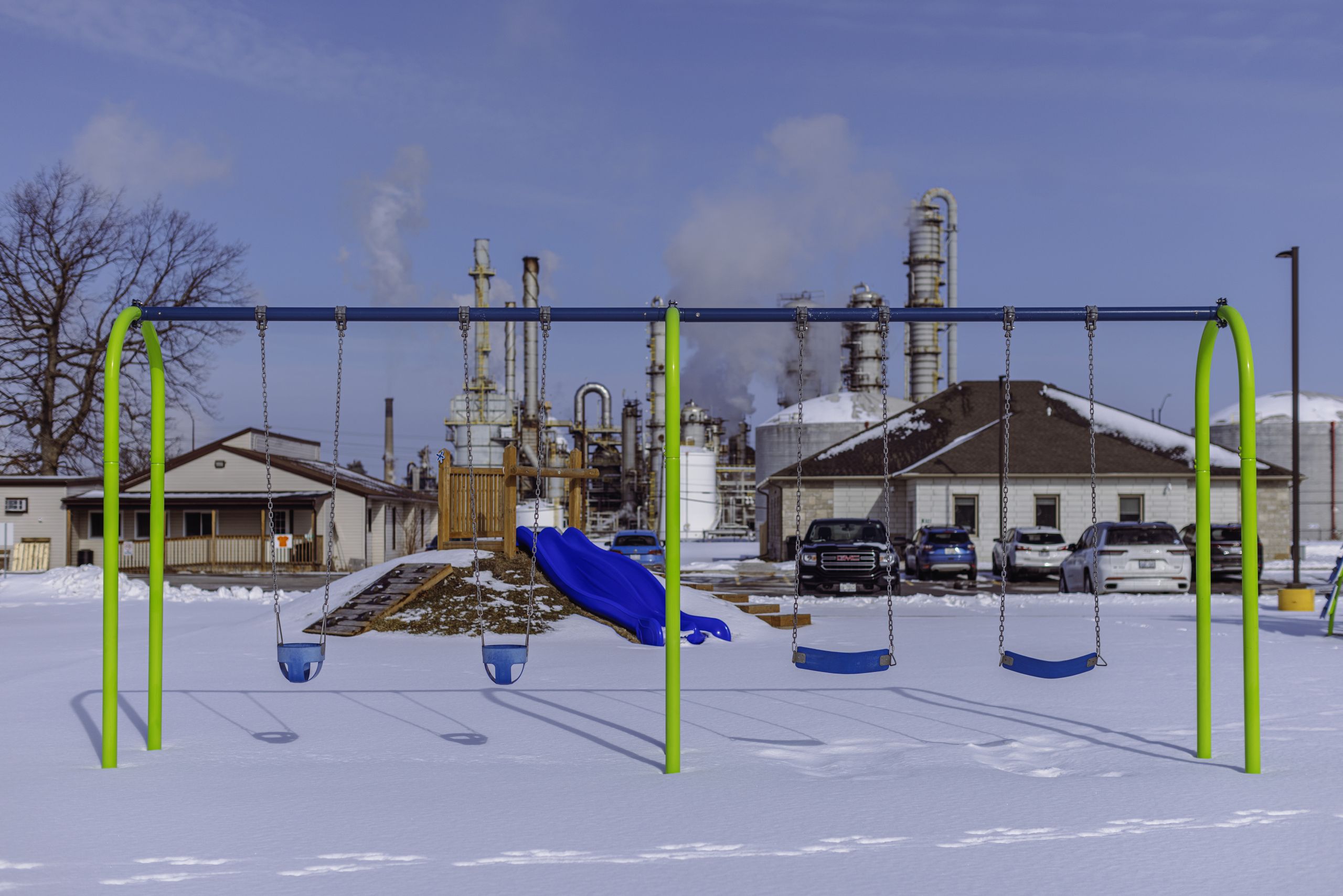
Those living in Aamjiwnaang First Nation — located roughly seven minutes from Sarnia’s downtown core — are exposed to nearly 30 times more benzene than Toronto and Ottawa residents. Increased benzene exposure is linked to a higher risk of cancer — leukemia especially. Photo: Carlos Osorio / The Narwhal
Another vulnerability is pipelines that carry Canadian oil back and forth across the border, such as Enbridge’s Line 5. Political skirmishes with Michigan over that pipeline are one reason Ontario Premier Doug Ford is pushing the Northern Shield Energy Corridor. Much of Atlantic Canada relies on crude, much of it American, delivered by tanker to the country’s largest refinery, Irving’s in Saint John. No pipeline exists to bring Alberta oil to the Atlantic provinces, meaning a U.S. export restriction would leave them scrambling for other fuel sources.
Heather Exner-Pirot, a senior fellow at the Macdonald-Laurier Institute, said federal clean fuel rules are another weakness, because in order to meet emissions reduction targets, suppliers blend in biofuels largely imported from the U.S. “We are artificially making ourselves dependent on an American product,” she said. She argues the rules should be redesigned, and they’ve been a constant topic in the industry’s communications with federal officials, according to the lobbyists registry.
Carney’s government announced tweaks to the clean fuel rules last week, saying it would “make it easier and cheaper for companies to comply.” Transportation is one of Canadian households’ biggest costs, according to Statistics Canada, but Pineau thinks that addressing that by scrapping clean fuel rules would “chain Canadians even more tightly to an extremely expensive way of life,” one built around the car.
On its own, experts say, a new refinery fixes none of that.
How much would it cost to build a new refinery, and who would pay?
Companies are not lining up to build a refinery in Canada, and Ottawa isn’t offering to pay for one. In a statement, the Prime Minister’s Office said the government supports “additional refining capacity where supported by market conditions.”
A large new refinery would cost $10 to $15 billion, take at least five years to build and need 20 to 25 years to pay off, according to Montreuil and Exner-Pirot. Alberta’s last attempt, the Sturgeon refinery near Edmonton, saw its original projected cost double to about $10 billion, with much of the risk carried by taxpayers, though high diesel prices have since improved its profitability.

According to one estimate, a new refinery would cost $10 to $15 billion, take at least five years to build and need 20 to 25 years to pay off. Photo: Carlos Osorio / The Narwhal
A new refinery would also struggle to compete on a global market. India’s newest are so big that two of them could supply all of Canada, from gasoline to jet fuel and more, Montreuil said.
With the domestic market already balanced, the purpose of a new plant would mostly be exports. But there is no real export route for refined products to Europe, Ian Sanderson, a senior oil and gas analyst at the Pembina Institute, said in an interview, adding the biggest markets are in Asia and “have substantial refinery capacity to refine Canadian [crude] at a lower price.”
There’s also the issue of decreased global demand for fossil fuels. Global demand for refined oil products could peak as early as 2027, according to the International Energy Agency. “It really is an act of faith,” Montreuil said, to bet that export markets will still want Canadian fuel by 2030 or 2035.
Sanderson points to the coal phase-out in Alberta, which hit mining towns very hard. The lesson, he said, is to “get ahead of the transition” and support oil workers into new jobs.
So far, though, Canadians aren’t using less fuel.
What part of Canada faces the highest risk when it comes to U.S. energy threats?
The most immediate risk is to Ontario, whose refineries run mostly on western crude carried by Line 5 through Wisconsin and Michigan.
Michigan’s governor has tried for years to shut it down over environmental concerns. In late August, the line was offline for more than two weeks after being struck by a truck at a work site in Wisconsin. The episode offered a glimpse of the crisis Canada would face if the Americans shut Line 5 down for good, Montreuil said.
Northern Shield would carry Alberta crude to Sarnia north of the Great Lakes, bypassing Line 5. It wouldn’t add any refining capacity, though: “Same refinery, same oil, just a different route to get it there,” Exner-Pirot said. The open question is how much this new pipeline would cost, and who would pay.
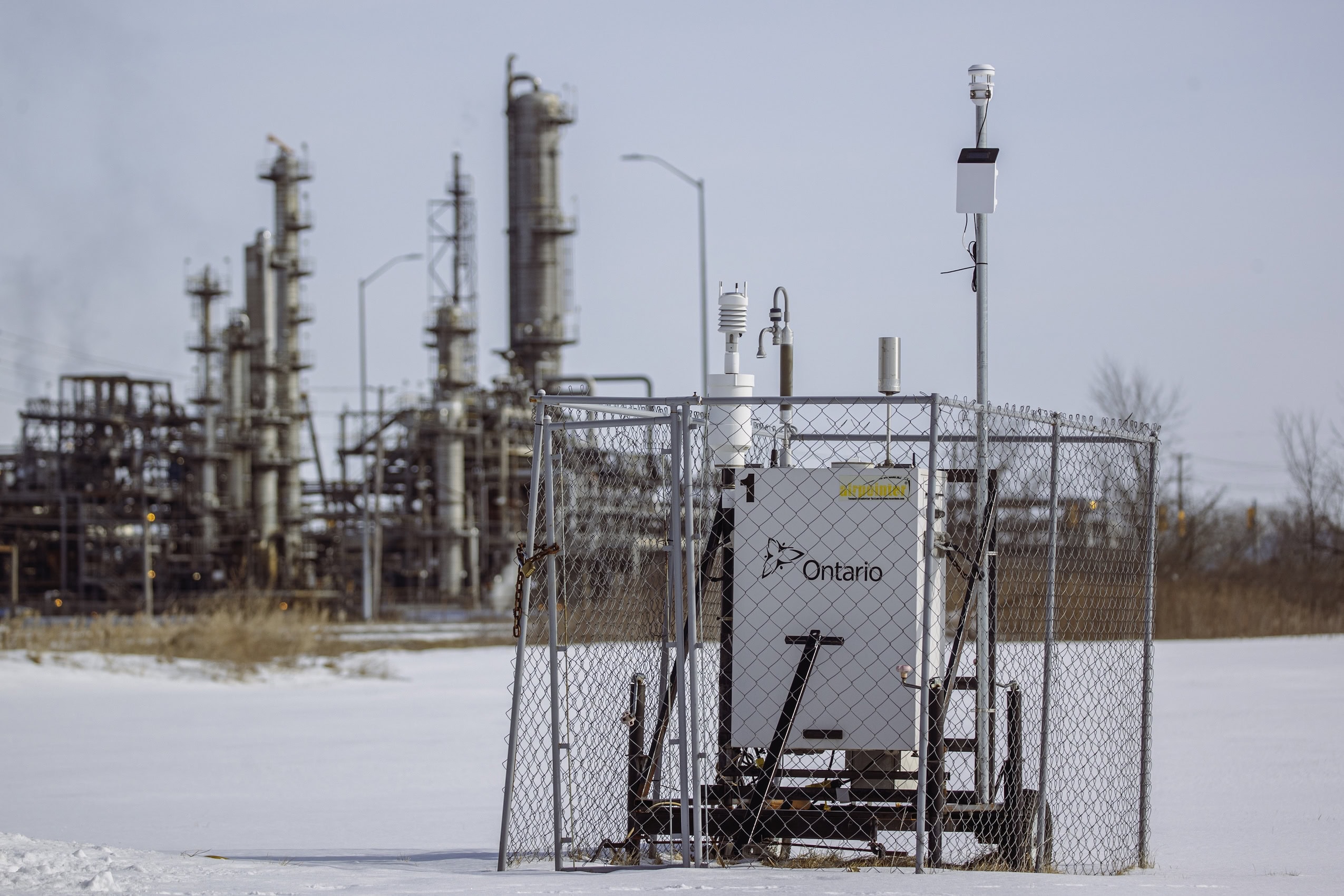
When it comes to U.S. energy threats, Ontario bears the brunt of the risk with its refineries running largely on crude oil carried in through Wisconsin and Michigan. Photo: Carlos Osorio / The Narwhal
Quebec has more options, but not more independence. The Valero refinery in Lévis gets its oil by tanker through the St. Lawrence River, though much of what Quebec imports comes from the U.S. And Suncor’s Montreal-East refinery gets much of its western crude through Line 9, which runs from Sarnia, so it too depends on oil that crosses the U.S. to reach Sarnia.
What would make Canada’s fuel supply more secure?
Without building a new refinery, there are other ways to shore up supply.
Canada is the only G7 country without a strategic petroleum reserve. Despite being a member of the International Energy Agency, we’re formally exempt from its mandate to hold emergency oil stocks equivalent to at least 90 days of the previous year’s net imports because we produce more oil than we import.
Consequently, when the G7 agreed in early October to release 100 million barrels of oil from emergency stocks to lower prices at the pump, Ottawa’s contribution was to stagger maintenance at its refineries so as not to affect supply. Poilievre has proposed a reserve of refined fuels, though someone would have to pay to fill and maintain it.
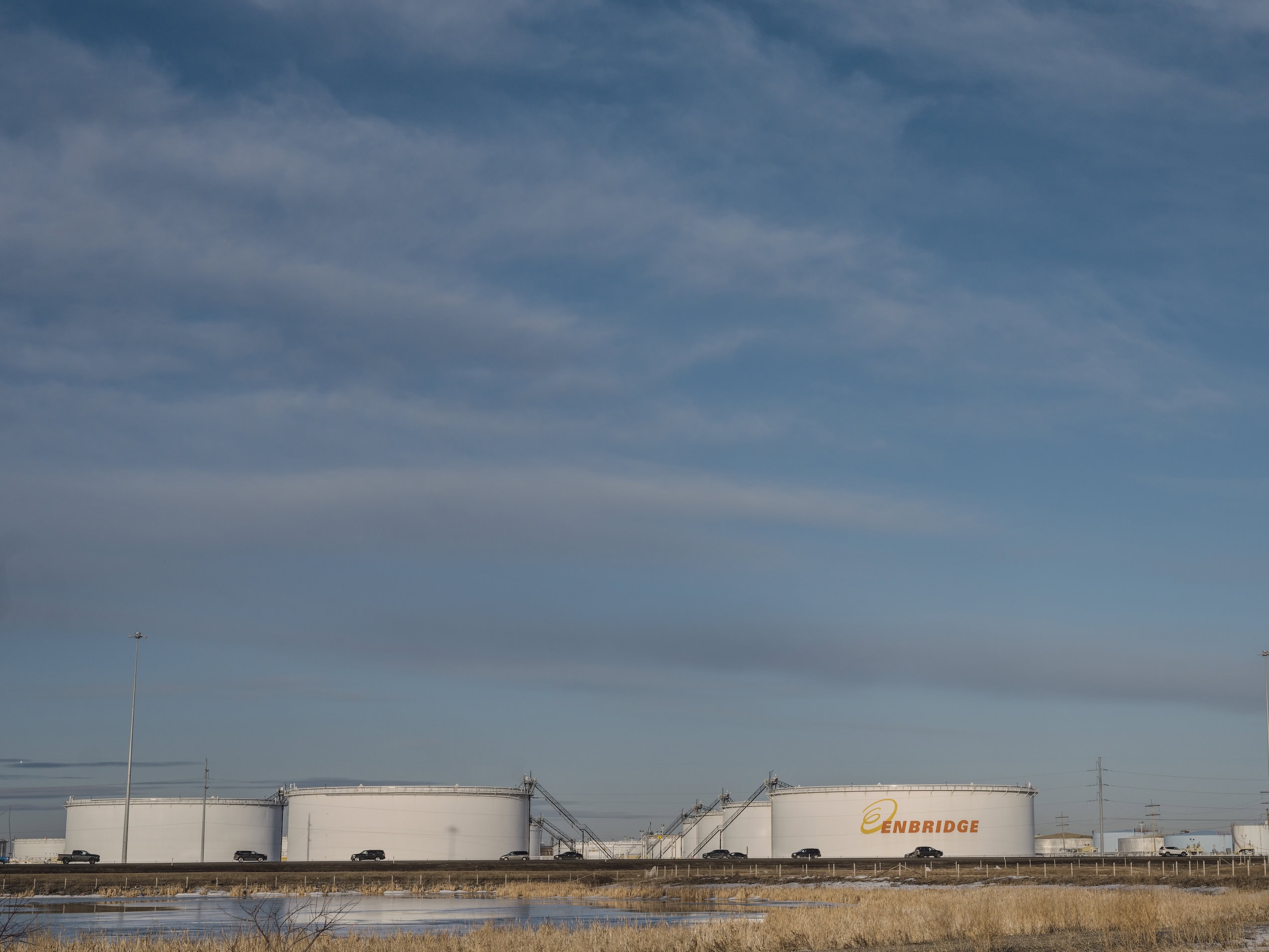
There are other ways to secure Canada’s fuel supply, including creating a strategic petroleum reserve and expanding existing refineries. Photo: Amber Bracken / The Narwhal
Another option is to expand what already exists. Adding 10 to 20 per cent to an existing refinery may be more realistic than building a new one, Montreuil said.
But “the solution isn’t necessarily to cut taxes or to produce more,” Pineau said, noting that new oil and gas infrastructure would run counter to Canada’s climate targets. Unlike past oil shocks, “there are a lot of options to move away from oil,” Sanderson added.
Whichever path Canada takes, the big decisions will largely belong to companies, as HF Sinclair showed this summer by announcing it will stop making base oils in Mississauga, Ont., at Canada’s only such plant. Base oils, used to make motor oil, were already at the centre of a global shortage.
While politicians may bring up building new refineries as an easy solution to a very complicated problem, right now at least, even the industry itself isn’t pushing for it.
The Narwhal’s reporters are telling environment stories you won’t read about anywhere else. Stay in the loop by signing up for our free weekly dose of independent journalism.
From The Narwhal | News on Climate Change, Environmental Issues in Canada via This RSS Feed.
18
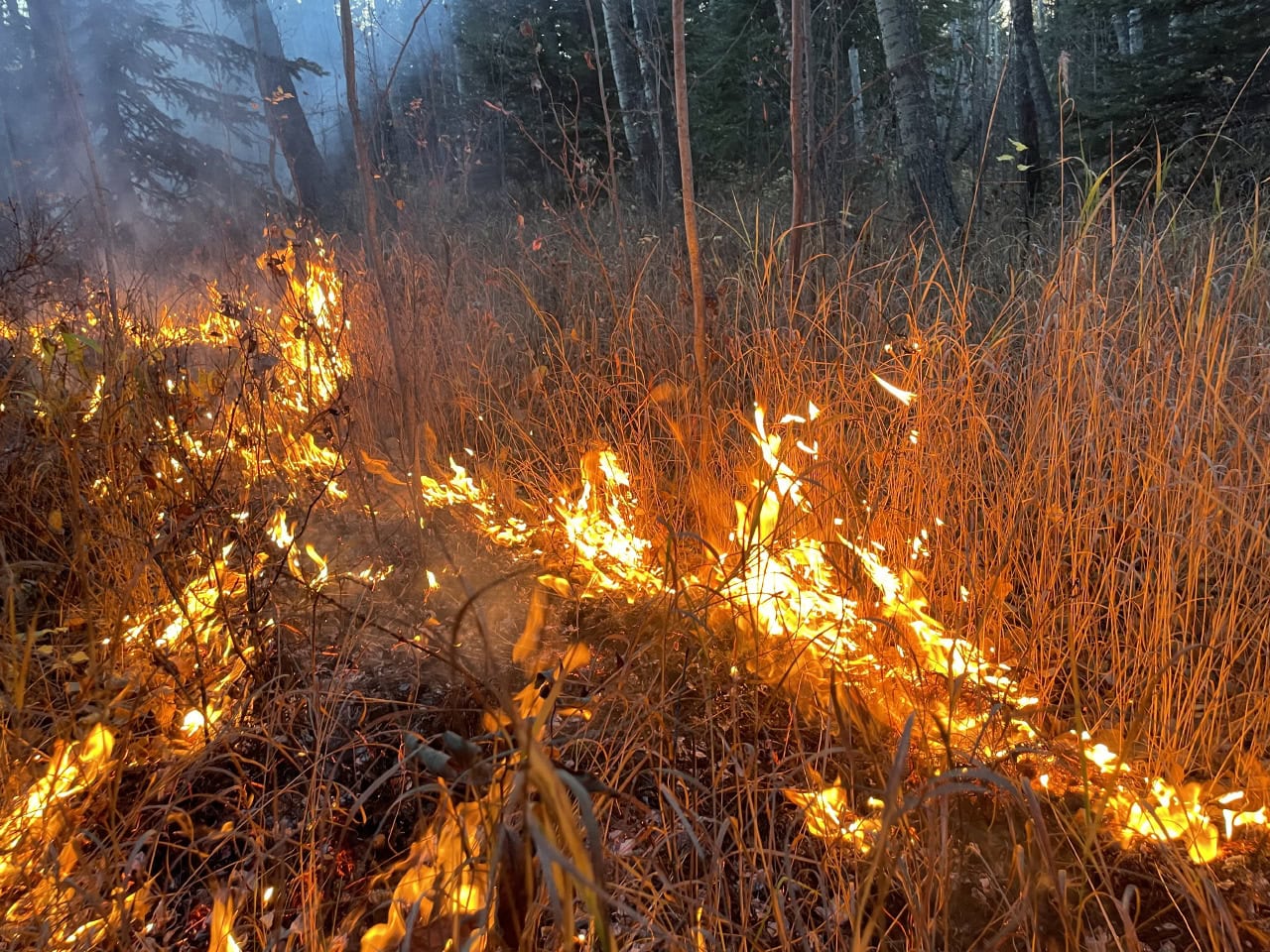
Generations of Indigenous fire stewards have long advocated for their knowledge to be respected as science, in B.C. and across Canada. And now, a national poll suggests Canadians agree Indigenous-led fire management is critical for the future.
A new national poll, conducted by Pollara Strategic, says Canadians are starting to learn more about what Indigenous fire stewardship means, shifting public opinion in support of it.
According to the Indigenous Leadership Initiative data released in September, 49 per cent of Canadians had never heard of Indigenous fire stewardship before, but once it was described, 84 per cent said it is important for Canada.
The poll, which surveyed 2,250 Canadians in August, found that 76 per cent support First Nations cultural burning. For Sheri Lysons, that finding is long overdue.
“It’s about time,” she told The Narwhal.
Lysons is Secwépemc from the Adams Lake Indian Band, located in B.C.’s Southern Interior, and has decades of experience fighting and stewarding fire.
Sheri Lysons is a former fire deputy chief in her nation. She comes from a firefighting family. Photo: Supplied by Sheri Lysons
Lysons says that non-Indigenous people are changing their minds about practices such as cultural burns, “because they’ve seen the benefits of it.”
Reflecting on B.C. provincial legislation amendments made two years ago to support cultural burning, she says Indigenous firekeepers are doing “the work that needs to be done.”
“There’s so much misinformation out there,” she says.
Lysons says education about cultural burns helps remove stigma, and with wildfires becoming more rampant, people are becoming more open to different preparedness methods.
As for the 82 per cent of Canadians in support of federal Indigenous fire stewardship funding, Lysons wants to see that number reach 100.
Indigenous firekeepers surprised by the statistics
Fire has been used by Indigenous people for countless generations as an ancestral land management and ceremonial practice.
But today, a campfire is as close as some Indigenous people get to it, which is by government design. For more than a century, colonial policies disrupted and outlawed the practice of cultural burning, viewing fire as a threat and something to immediately suppress.
For those who come from families who managed to keep the tradition of cultural burns going, many wait year-round for the opportunity to hit the land with their torches.
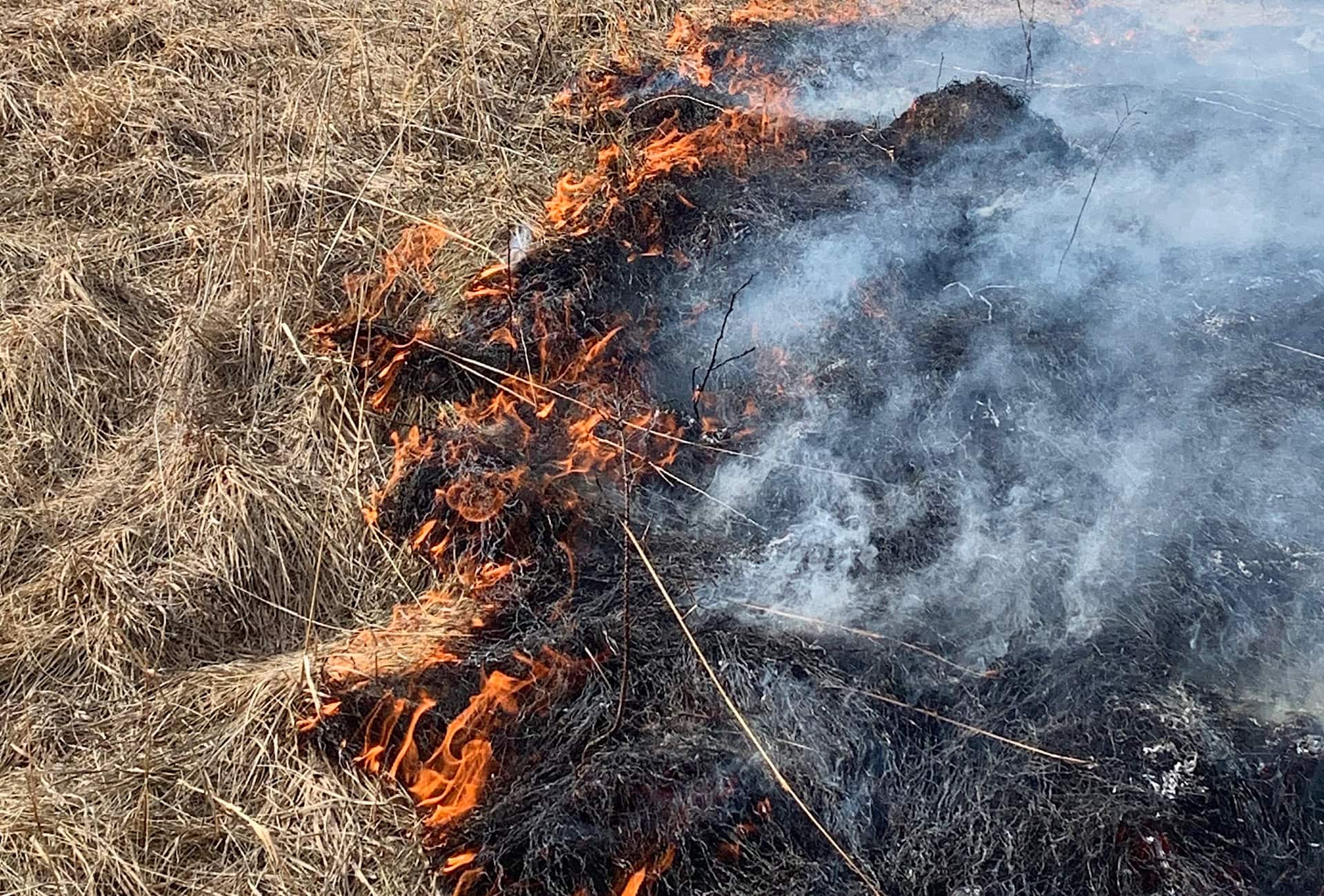
Cultural burns typically happen in the spring and late fall. Photo: Supplied by Amy Cardinal Christianson
While it is serious business, burning days are days when families and the community come together and spend time on the land.
The jokes about which uncle or auntie are going to let the fire get away from them, the stories shared between generations and the smells and crackling sounds of the burn create memories which last a lifetime.
Tiffany Traverse is Secwépemc and has more than a decade of experience working in the fire industry.
She’s held various positions with the BC Wildfire Service and currently has a board position with the Salish Firekeepers Society, a non-profit organization committed to promoting and revitalizing cultural burns in Interior B.C.

Tiffany Traverse is a seed and land steward at Fourth Sister Farm. She says she is “pleasantly surprised” to see people are changing their opinions on Indigenous fire practices. Photo: Supplied by Shelanne Justice
“When I was drilling down into the particulars about that poll, it was really nice to see that people are changing their opinions … on what cultural fire means and how important it is,” she says.
“I was really pleasantly surprised to see that.”
She says education is key to those statistics, having started her career at a time when Indigenous fire stewardship practices were less supported.
“A percentage of people didn’t know about cultural fire and once they were educated on that, their opinion on it changed,” she says.
“I thought it was really refreshing to see, especially with all of the anti-Indigenous racism that we’ve been seeing.”
It’s a sentiment shared by Nlaka’pamux firefighter George Campbell, who was also surprised by some of the statistics.
With 25 years of experience in the fire industry, Campbell remembers when Indigenous people had less engagement with the province.
He attributes a shift in British Columbian’s attitudes about Indigenous fire practices back to a 2018 report on the record-breaking floods and fires of the previous year.
“Ever since then, things have kind of shifted to more engagement in terms of cultural and prescribed fire,” he says.
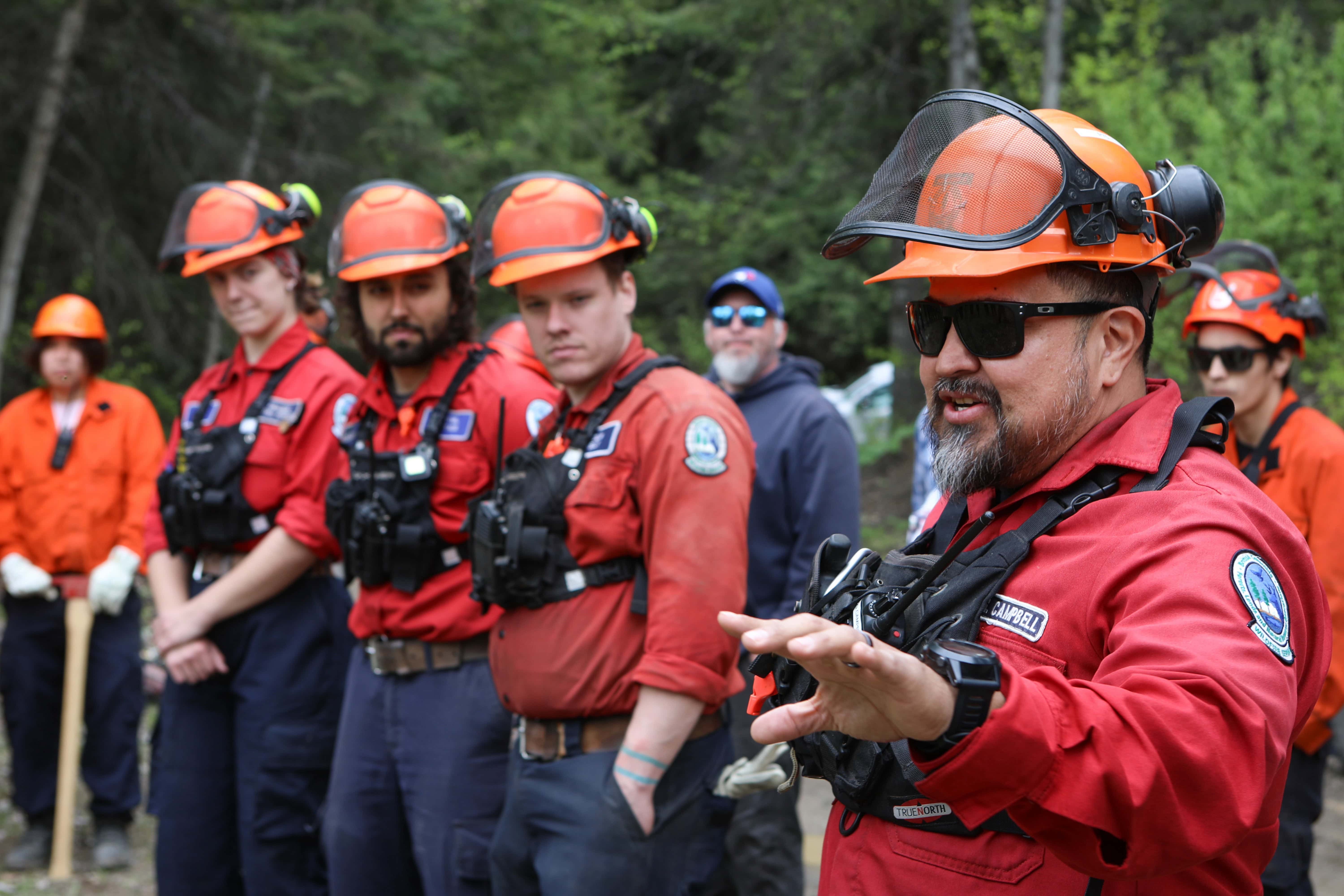
George Campbell is from the Boothroyd Indian Band. He’s been culturally burning for decades. Photo: Aaron Hemens / IndigiNews
Back in the day, firefighting was a low stress summer job for Campbell. But today, fires are more extreme and aggressive due to global warming.
“It was identified in the early 2000s that our forest health was declining. We were getting good at suppressing fires and because of that, everything started to become overgrown and disease started to set in,” he says.
“We got away from our cultural and prescribed fire practices, which in my opinion resulted in an unhealthy forest.”
Reflecting on Canadians’ newly identified support for Indigenous fire stewardship practices outlined in the poll, Campbell says “it’s been a long time coming, to be honest.”
Canadians view wildfires as a national issue
Amy Cardinal Christianson is the Indigenous Leadership Initiative’s director of fire stewardship. She grew up in northern Alberta and has Métis ancestry.
“We’ve had a bunch of severe fire years where there’s been a lot of people impacted. I think when that happens people usually start trying to look for solutions,” she says.
The same national poll found 93 per cent of respondents identified wildfires as a national concern.
Christianson says wildfire smoke is a large factor in those statistics.
“Other hazards, for example earthquakes and flooding, stay very localized. Fire does not. Even if there’s a fire in one area, smoke can travel hundreds of kilometres away. It impacts a lot of people.”
“We found there’s been many Canadians impacted by smoke in the last five years,” she added. “I do think that’s really been the game changer. No one wants to spend their summers in smoke.”
The impacts of wildfires fall disproportionately on Indigenous communities; in 2023, still the most severe wildfire season on record in Canada, 42 per cent of all communities evacuated were Indigenous. This past summer, First Nations communities in B.C. and Ontario were ravaged by wildfires.
The Canadian Senate released a report earlier this year titled: Canada on fire: The catastrophic and escalating effects of wildfires on lives and communities.
It says wildfires are a national crisis, attributing the past three years as record-breaking wildfire seasons. According to the report, millions of Canadians are being exposed to wildfire smoke, for days, weeks and sometimes months at a time.
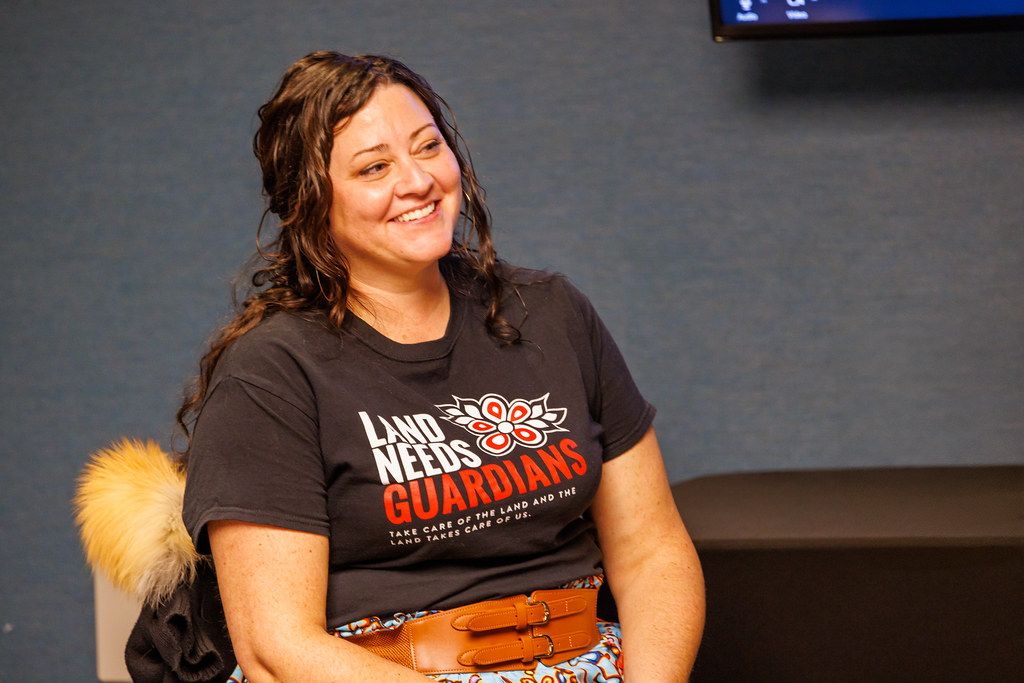
Amy Cardinal Christianson grew up in Treaty 8 Territory, an area familiar with wildfires. Photo: Supplied by Amy Cardinal Christianson
“Indigenous communities — who have lived with fire for millennia — remain under-resourced and sidelined,” the report states. Many have endured repeat evacuations, loss of homes and long-term economic losses.”
“Despite their deep expertise in fire stewardship, Indigenous firefighters often encounter barriers to participating fully in wildfire management and urgent response. Strengthening Indigenous-led governance, training, equipment access and long-term funding is imperative,” it adds.
In the Indigenous Leadership Initiative poll, Christianson was surprised more than twice as many Canadians say they would rather the federal government fund year-round Fire Guardians, compared to spending the same money on water bombers. In 2025, Kainai Nation partnered with Natural Resources Canada to launch the first federally funded Fire Guardians program in the country.
Christianson says Fire Guardian programs are a natural way forward, as they proactively mitigate risks such as built-up fuels and balance the ecological needs of wildfire-prone landscapes.
Fire Guardian programs employ people in their nations year round to work on fire. Responding to fire, doing cultural burns, fire-smarting the community, emergency management and evacuation planning are some of the responsibilities of Fire Guardians. And after a fire has passed, they work with the land to recover.
“If you get to the point where an air tanker is the only saviour of your community, you’ve really lost the plot on living in a good relationship with fire,” she says.
Another Indigenous Leadership Initiative study found the return on investment of Indigenous Guardian programs is even greater than previously found, with every dollar spent putting between nine and 12 dollars back into the economy. But Christianson said these programs need government support, not just public support — and not only in the summer, when wildfires are on everyone’s mind.
“As Indigenous people, we’ve always treated fire as a year-round thing. It’s not something you just fight against in the summer,” she says.
She’s calling for long-term sustainable funding to implement these programs. So far, Kainai’s Fire Guardians program is still the only one of its kind in Canada, and the federal government’s future investments in Guardians programs remains uncertain.
“It’s fine for the Canadian public to support these things, but what we really need to see is actual action in these areas.”
The Narwhal’s reporters are telling environment stories you won’t read about anywhere else. Stay in the loop by signing up for our free weekly dose of independent journalism.
From The Narwhal | News on Climate Change, Environmental Issues in Canada via This RSS Feed.
19
20
With the Paswe Protected Area, Garden River First Nation is stewarding lands ‘for generations to come’
(thenarwhal.ca)
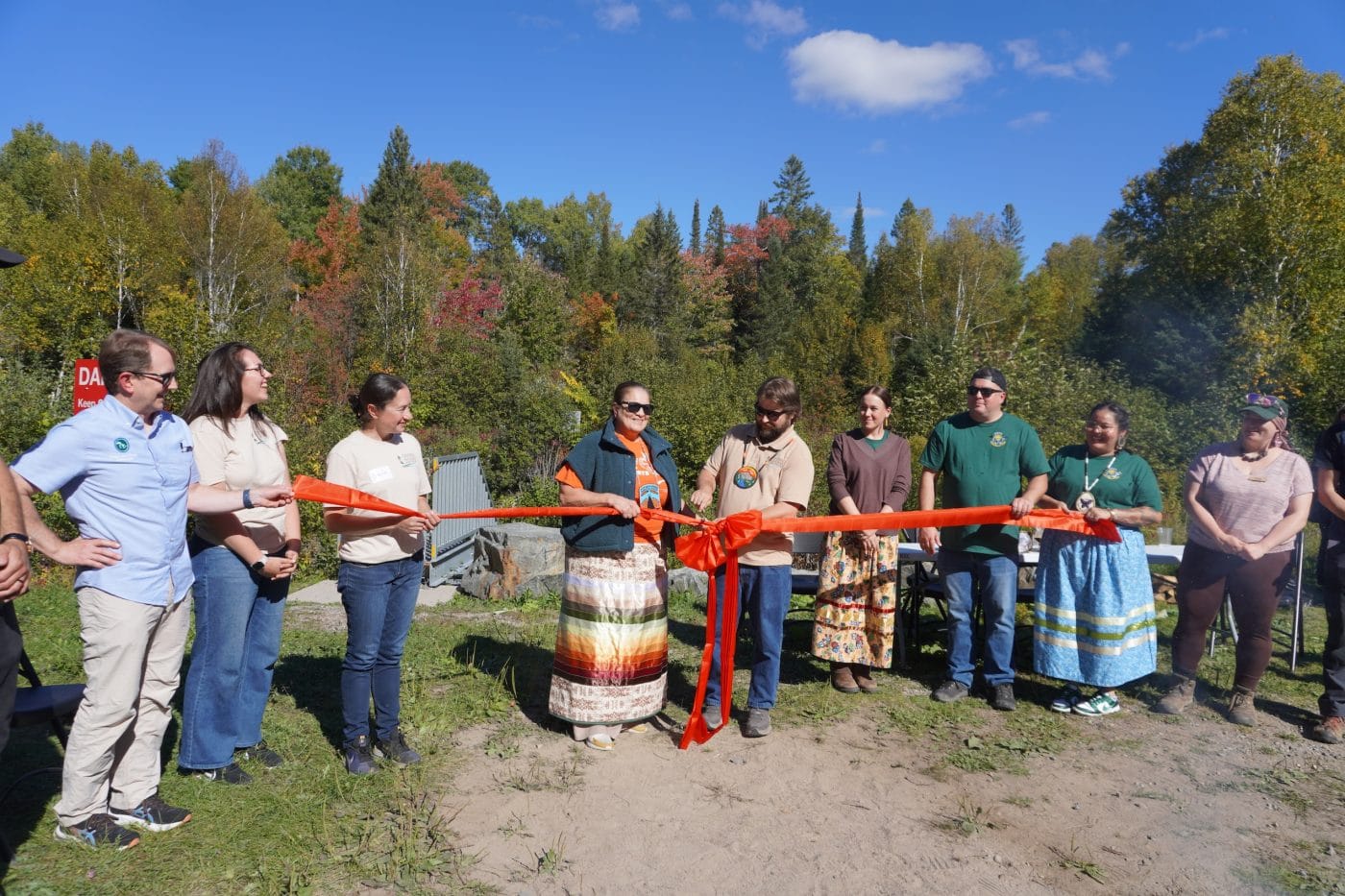
Underneath a warm sun on a late Waagaabagaa-Giizis (Leaves Turning Moon) Sunday afternoon, staff from the Garden River First Nation lands department led a small crowd of people through a forest path to gather in celebration at a clearing next to the Paswe Ziibi (Echo River).
Set against a serene backdrop of colourfully turning leaves, towering cliffs and the babbling river, Garden River announced the creation of the first Indigenous Protected and Conserved Area in the Algoma region. Located at the northeast end of Echo Lake in Kehoe Township, Ont., the 392-hectare Paswe Protected Area borders both Garden River First Nation territory and Crown lands, and holds deep cultural significance to the people of Garden River.
“All of my ancestors, all of the people that came before me and all of the people that came before you, this land was once known as Ketegaunseebee’s place to have those spaces to have ceremony, to utilize and thank the Creator for what a beautiful place that we have, and for the revitalization of providing Anishinaabe knowledge and practice for generations to come,” Garden River’s Ogimaa Kwe Karen Bell, told the crowd at the celebration. Paswe is derived from the Anishinaabemowin word for “echo” in the Garden River dialect, and was selected for the area after consultation with local Elders.
Garden River secured the property along with multiple partners including the Central Algoma Land Trust, Ontario Nature and Ontario Conservation Accelerator, a new organization focused on bringing in private investors to develop land conservation projects, along with private individual donations. The Central Algoma Land Trust, a non-profit charitable organization in the region, has entered into an agreement with Garden River that will see the land trust own the property for the time being, while the First Nation takes the lead with on-the-ground conservation, monitoring and stewardship. Formal ownership of the land is expected to be transferred to the First Nation in the next five to 10 years.
The agreement “guarantees that Garden River First Nation community members will always have access to the property regardless of who owns it,” Aaron Jones, former guardian team lead for Garden River, told The Narwhal. That includes exercising their traditional and Treaty Rights like hunting, fishing, harvesting and holding ceremonies on the land.
Protected area home to endangered and culturally important species
The Paswe Protected Area is situated within one of 23 areas Parks Canada identified where conserved ecological corridors are urgently needed to protect biodiversity, culturally important species and areas at risk from development and climate change. The area provides habitat for multiple species listed under Ontario’s Species Conservation Act and the Federal Species At Risk Act including lake sturgeon, wood turtle, peregrine falcon and the black ash tree.
The original name of Echo Lake was Paswe-Gami. Traditionally, Garden River Anishinaabeg would harvest and then hammer black ash wood to create baskets, and the noise would echo off the cliffs of the north end of the lake and travel across the water. “On a still day where there’s not much wind where everything is really quiet, that hammering would echo across the lake and it would be heard for miles,” Jones explained. “Travelling community members would hear that sound and they would know they were close to home.”
For Jones and Carter Dorscht, the executive director at the Central Algoma Land Trust, the protected area is the culmination of a years-long shared vision to collaborate on a conservation project.
When the property went up for sale by a private owner in early 2025, Dorscht said Garden River and Central Algoma needed to act fast, raising the money required in around six months. The partnership agreement allowed the nation and organizations to do just that, rather than seeing it scooped up on the open market, but the land title is intended to return to Garden River.
Garden River and the land trust have an option-to-purchase agreement that is expected to see the property transferred to the First Nation within a period of five to ten years. This gives the nation time to establish their own land trust to hold the title, or seek out an addition to reserve, a federal process to add new land to an existing reserve.
“It’s very culturally significant to Garden River and they’ve been stewarding this land for a long time,” Dorscht explained. “It makes sense for them to be the ones to continue to do it.”
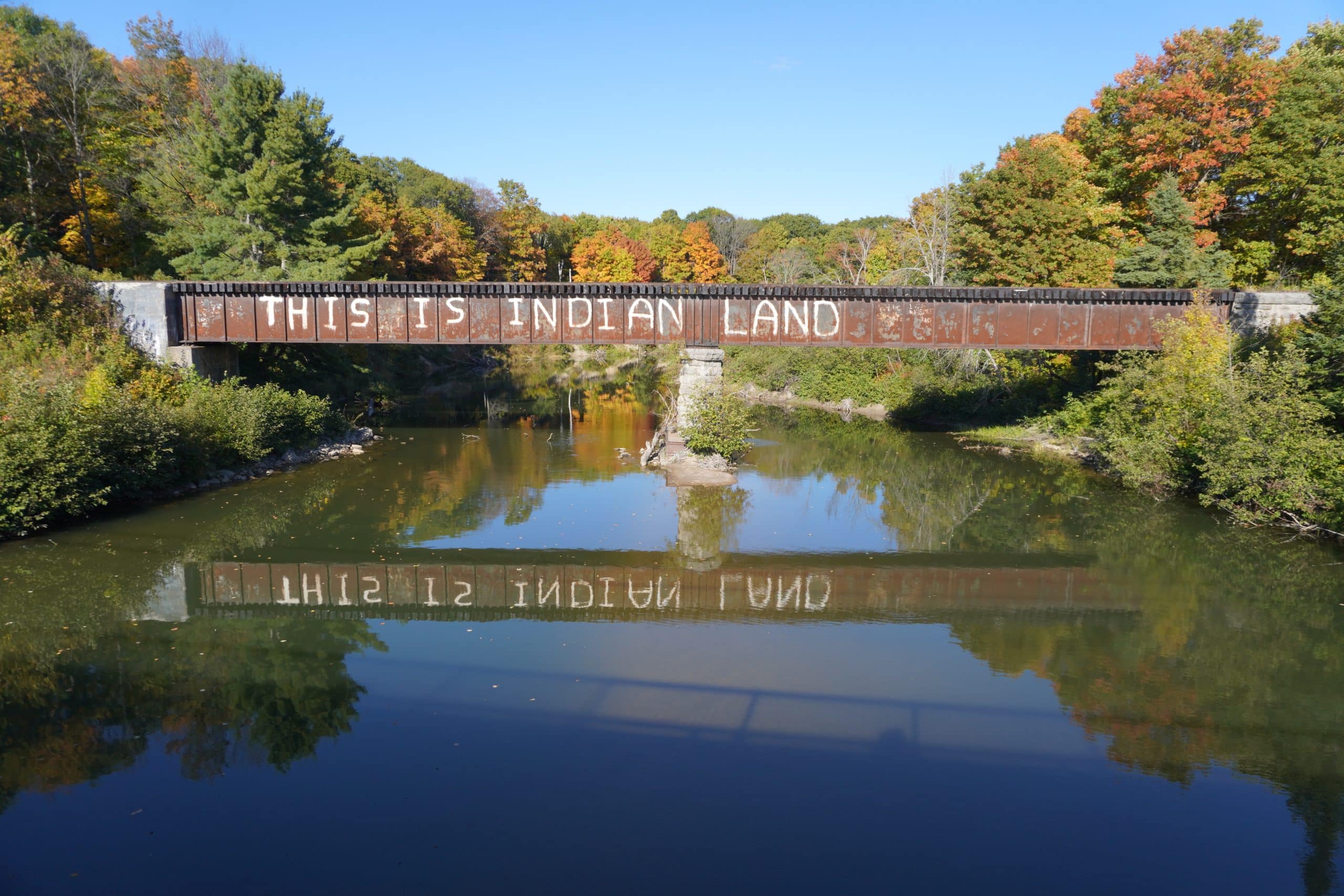
The rail bridge over Garden River, painted by Garden River First Nation members.
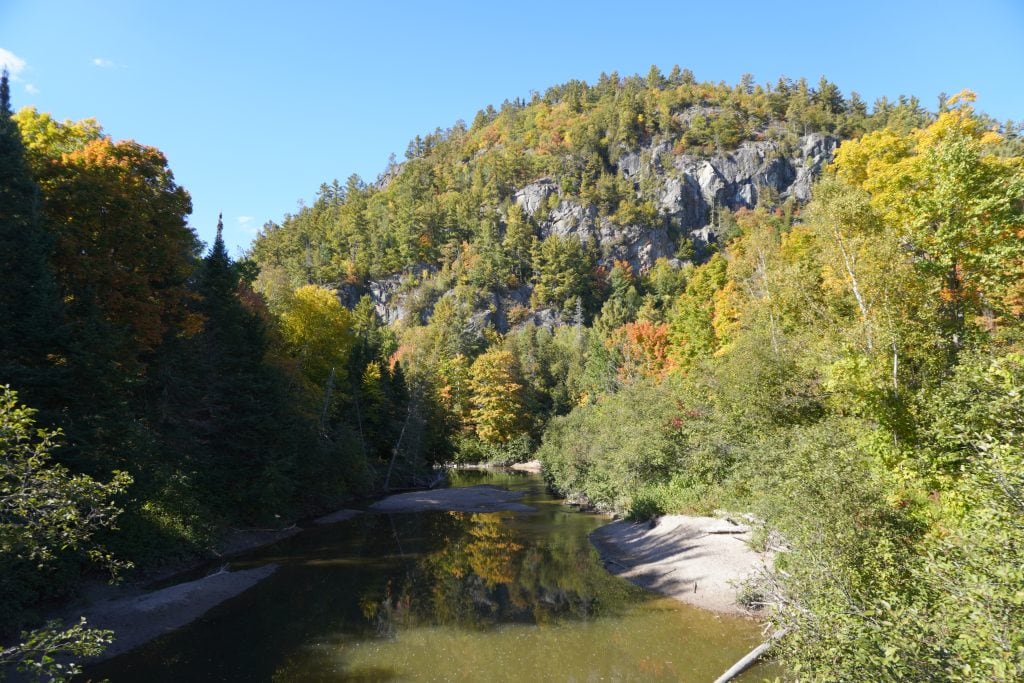
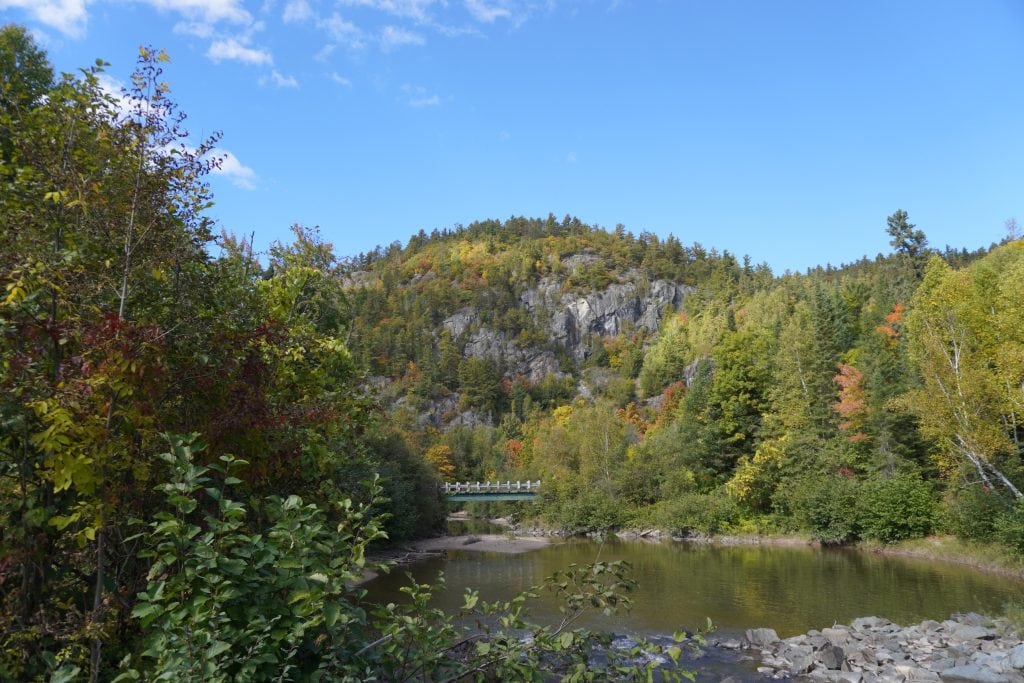
Paswe is an Anishinaabemowin word that means echo. The Paswe Protected Area gets its name from the echoes that bounce off the far cliffs and resound across the lake.
The First Nation and the land trust intentionally avoided government grants when raising funds because they feared government granting policies might block the eventual transfer of the land to Garden River.
“With the general history of how the provincial and Canadian governments have treated our people in the past, we did not want to take on that level of risk,” Jones said. “We could not trust the government to approve a transfer of land to our community because it’s too risky.”
The goal is returning lands to the First Nation as smoothly as possible and, in the meantime, still allowing the band to oversee the property while it’s held by the land trust.
No support for IPCAs from Ontario government
Several other Ontario First Nations are working to establish Indigenous Protected and Conserved Areas in their territories, including Kitchenuhmaykoosib Inninuwug. While the federal government has provided funding to some Ontario nations to support the establishment of their protected areas as part of Canada’s goal to conserve 30 per cent of the country’s land and water by 2030, the Ontario government has not recognized any Indigenous Protected and Conserved Areas within the province. (The Narwhal reached out to the Ontario Ministry of the Environment, Conservation and Parks and Crown-Indigenous Relations and Northern Affairs Canada, but they did not respond by publication time.)
When speaking at the ceremony, Bell said the property is situated on lands that were historically part of the Garden River reserve as established in the 1850 signing of the Robinson Huron Treaty. “Since then, our reserve lands have been wrongfully reduced by more than half,” Bell said.
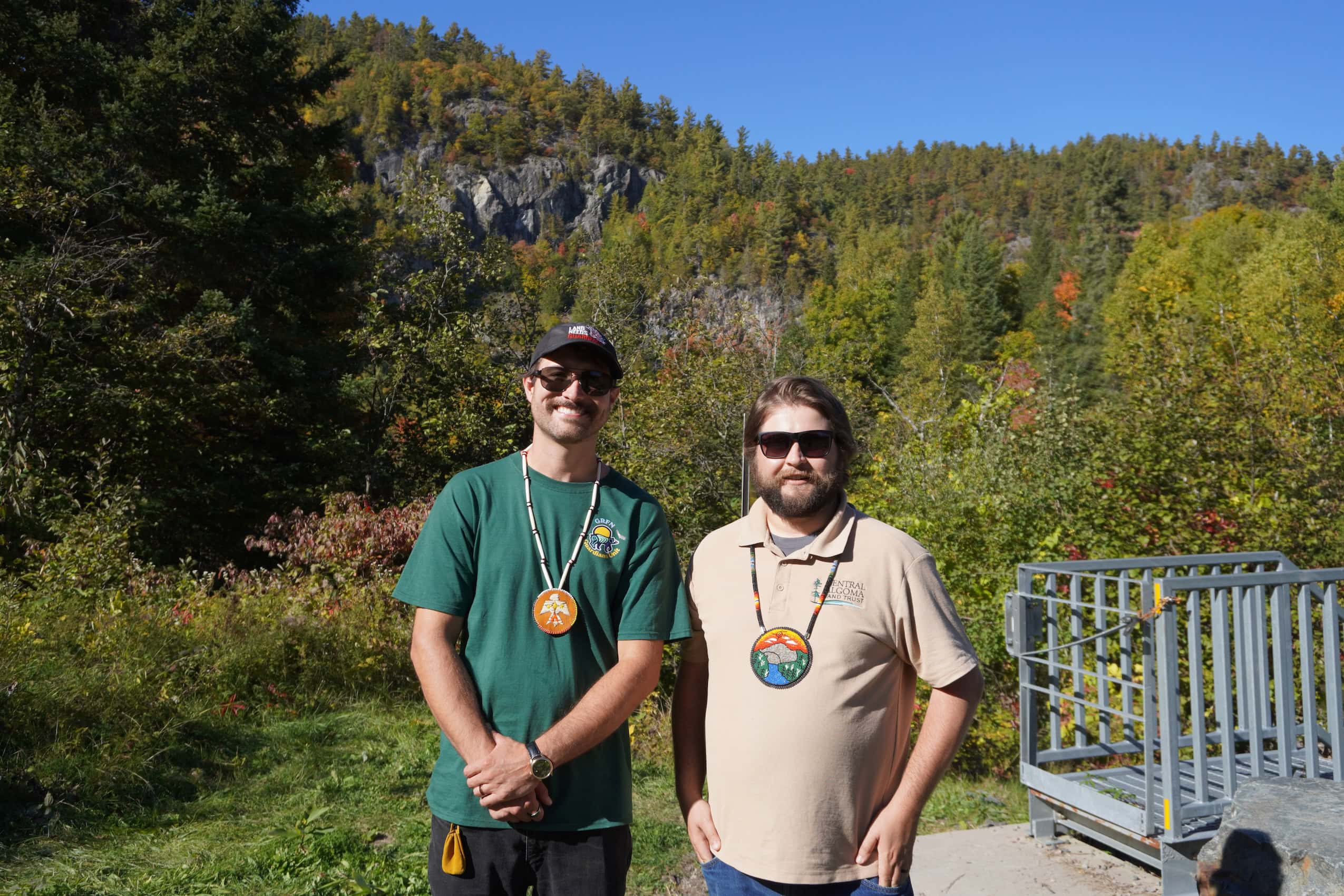
For years, Aaron Jones (left) and Carter Dorscht dreamed of partnering to create an Indigenous Protected and Conserved Area in the Algoma region. When the 392-hectare Echo Lake property went up for sale, they jumped on the opportunity to ensure Garden River First Nation members can continue practising their hunting and harvesting rights on the land in perpetuity.
In 2023, Garden River filed a lawsuit against the Ontario and federal governments for allegedly breaching the Robinson Huron Treaty of 1850, claiming the Crown coerced the sale of 30,000 hectares of its land base. “It’s going to take two decades if not more to actually finish litigating this, but that swath of land that we are asserting is very significant for our First Nation,” Bell said, noting the First Nation is still seeking compensation for lands that now form communities and the return of lands left undeveloped as part of its lawsuit.
In the meantime, Garden River is eager to continue their management of Paswe. The nation has long-term stewardship goals of reintroducing namewag (lake sturgeon) to the area, and removing a Fisheries and Oceans Canada experimental sea lamprey barrier dam from the Paswe Ziibi.
Jones said he and the project partners hope the establishment of the Paswe Protected Area will be a model for Indigenous-led conservation, and help other First Nations to establish their own IPCAs.
“We just want to show governments that Indigenous communities want more land conservation,” Jones said. “We want to see more lands returning into the stewardship of our own communities, and we can do it.”
The Narwhal’s reporters are telling environment stories you won’t read about anywhere else. Stay in the loop by signing up for our free weekly dose of independent journalism.
From The Narwhal | News on Climate Change, Environmental Issues in Canada via This RSS Feed.
21
22
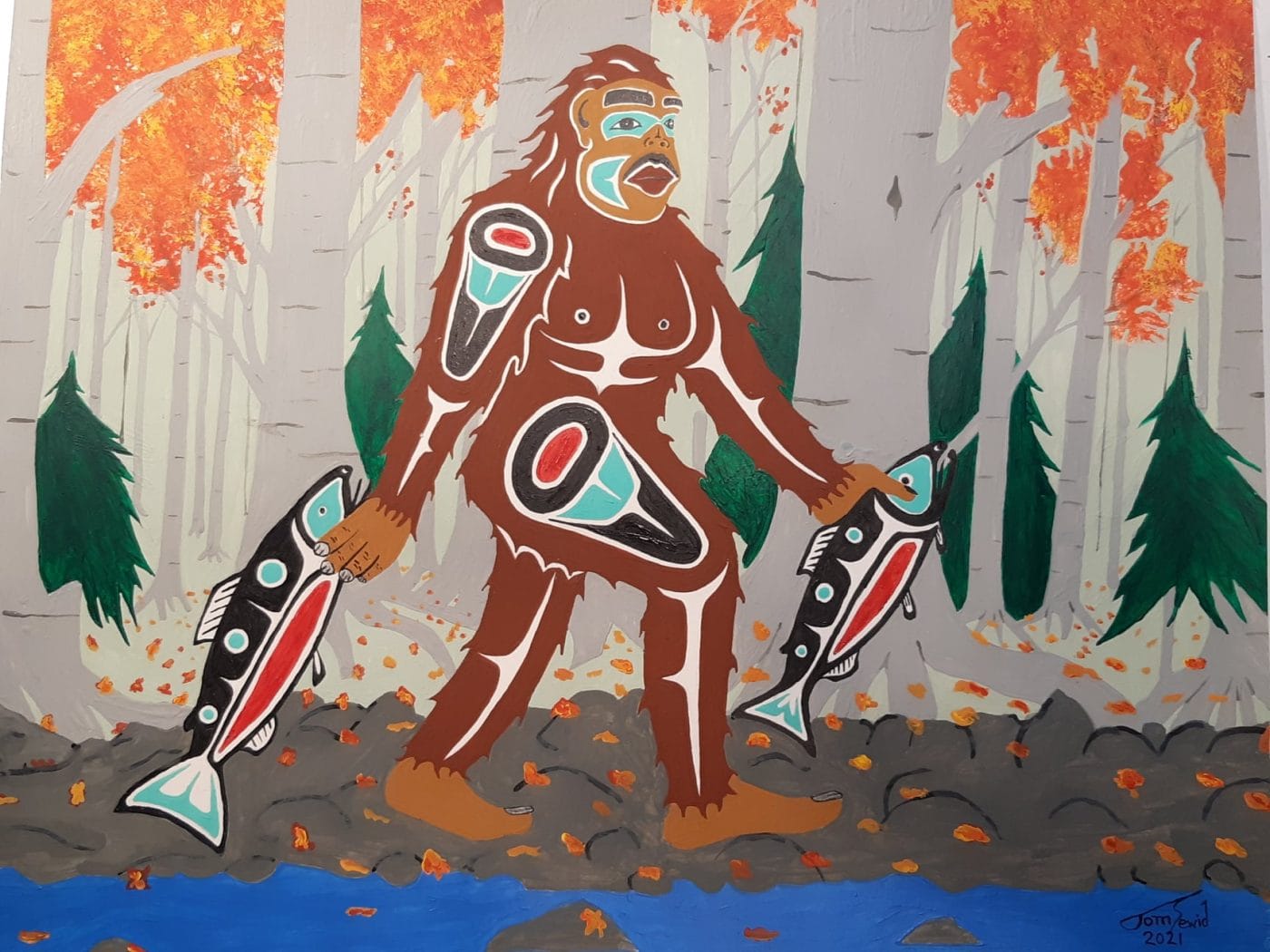
Using night-vision goggles and thermal cameras, believers in Bigfoot traverse North American forests under the cover of darkness, as the large ape-like creature is believed to be nocturnal. Some Bigfoot trackers use plaster kits to make casts of suspected footprints; they record first-hand sightings and mysterious knocking sounds in detailed online databases, much like birders document observations on eBird.
On Oct. 10, about 50 of these believers — many avid outdoors-people who also spend their time camping, hunting and trapping — gathered at a church in North Bay, Ont., to discuss their experiences looking for Bigfoot, also known as Sasquatch. It was a good turnout for a small northern city on Thanksgiving weekend. The energy was lively but focused and, at times, even emotional.
Some were sharing their stories for the first time; this felt like a safe space to discuss their beliefs, one person said, as others agreed that they felt likely to be ridiculed elsewhere. Creating a welcoming environment was the goal of the conference’s organizer, Andrew MacKellar, who has searched for the creature for nearly 15 years, and is a well-known “sqautcher,” or Bigfoot investigator.
“Most humans do find things fascinating that they don’t fully understand,” MacKellar told The Narwhal after the event, the first of its kind in North Bay. “[Recently] there seemed to be, around the Great Lakes, a spike of sightings or encounters with people, even compared to usual. So I just wanted to draw that out for the North Bay area, and to see if that was the case.”
Research from University of British Columbia found that around 10 per cent of Canadians believe in Sasquatch. Some of those believers, like MacKellar, collect detailed data to support their theories, and thousands of reports have been uploaded to the Bigfoot Field Researchers Organization.
Andrew MacKellar, an avid “squatcher” and organizer of North Bay’s first Sasquatch conference, holds a plaster cast of a footprint believed to be that of Bigfoot. Photo: Leah Borts-Kuperman / The Narwhal
And their data, believe it or not, is being put to use by University of Montreal ecologist and data scientist Timothée Poisot. From the documented sightings of cryptids — creatures anecdotally sighted but lacking scientific proof — he is testing how accurately computer models are predicting the impacts of climate change on scientifically accepted plants and animals.
Part of the reason he chose Bigfoot is the abundance of data.
“We have, collectively, more information about Bigfoot sightings than we have about maybe 90 per cent of mammals in North America,” Poisot said.
Bigfoot’s contribution to science
Poisot studies how machine learning tools can help solve complicated ecological problems; he’s been working on improving computer models that predict where species might live in the changing climate. The models use data — like where a certain animal has been spotted, weather conditions of those places and how the climate might change there — to make these predictions for the future.
The problem is these models aren’t always great at communicating how certain they are about a prediction. For example, if we don’t understand a particular climate well, the resulting model’s predictions for that area might be less accurate. This is an issue when policymakers or researchers use those predictions for things like early detection of invasive species or making expensive decisions to protect endangered animals.
To address this problem, Poisot looked to a statistical technique called conformal prediction, which helps scientists measure uncertainty in computer-generated biodiversity predictions.
That’s where Bigfoot comes in.
Poisot fed a computer model data from thousands of reported Bigfoot sightings*,* along with environmental data about the area where they occurred. The model learned patterns in these observations, predicting where Bigfoot might live as the surrounding environment changes. Then, Poisot applied conformal prediction, revealing where the model could confidently predict Bigfoot’s supposed presence or absence, and where it couldn’t.
“I wanted to figure out a way to get a model to tell you ‘I don’t know’ when it’s about to make a prediction about whether species should be here or not,” Poisot said. “The models don’t know and don’t care whether the species that we’re working on actually exists or not. As soon as you feed them numbers, they’re going to give you numbers.”
The model is identifying relationships between the climate conditions and the reported sightings, not determining whether those sightings are real.
“Assume Bigfoot exists,” Poisot said. “We’re going to talk about the models, the behaviour and the statistics and the predictions, and that gets easier to move the conversation to a place where you can make the methodology better by not thinking too much about the biology.”
This makes Bigfoot a useful test case for a technique that can later be applied to other species.

Scientist Timothée Poisot told The Narwhal that researchers need more information in remote areas, far from cities and roads, to be able to make accurate predictions about the state of biodiversity in a changing climate, adding that we have “more information about Bigfoot sightings than we have about maybe 90 per cent of mammals in North America.” Photo: Christopher Katsarov Luna / The Narwhal
What Poisot found using data from Sasquatch enthusiasts surprised even him: the areas where the climate is expected to change the most were not necessarily areas where the model’s uncertainty increased. The models were most uncertain in harder-to-reach areas with fewer observations.
In the future, Poisot told The Narwhal, scientists will need more information in remote areas, far from cities and roads, to be able to make accurate predictions about the state of biodiversity in a changing climate.
“You go to the areas where you are writing a lot of question marks because you don’t really know what’s going to happen here,” Poisot said. “The model is not certain about its outcome, so that should be a priority for sampling.”
Bigfoot’s origin and modern day stories
The legend of Bigfoot has centuries of history rooted in Indigenous storytelling. The name Sasquatch is believed to come from the Halq’eméylem word Sasq’ets meaning “wild man” or “hairy man,” used by the Stó:lō people, a Coast Salish First Nation in what’s now called British Columbia.
For Thomas Sewid, a Kwakwaka’wakw and Cree Sasquatch investigator who guides expeditions in British Columbia and Washington, the subject has been on his mind from his earliest memories. Especially D’sonoqua — Sasquatch’s female companion in Kwakwaka’wakw tradition — thanks to stories from his father.
“He said, ‘Tommy, you behave yourself. D’sonoqua is always watching you,’” Sewid said. Growing up on Vancouver Island, he was told if he didn’t behave, do his chores or listen to his Elders, “she can come at night and reach that big hairy arm into where you’re sleeping and grab you … she’s going to boil you up and eat you.”
“That’s when I became interested in Sasquatch,” Sewid said. “The greatest teaching Sasquatch can share with us is about respect.”
Several of the attendees at the North Bay event from nearby Nipissing First Nation and other Indigenous communities, and agreed with Sewid that many distinct Indigenous cultures across North America have their own beliefs and understandings about the creature.
When citizen scientists across Canada collect data, whether on Bigfoot or using more conventional apps like iNaturalist and eBird, Poisot said it can be used to help inform policy and conservation decisions, or the tracking of invasive species and zoonotic disease. So, despite a recurring theme of distrust toward “mainstream science” in speeches at the North Bay conference, the interests of “squatchers” and scientists may actually be complementary.
“The effort of documenting biodiversity is something that is done primarily by amateur scientists and members of the public,” Poisot said. “It’s really important. Most of what we know about biodiversity was not collected by researchers … and so, the more people contribute observations, the more likely we are to detect trends at the location where they are important.”
While they’re certainly approaching their interest in Bigfoot from different angles, there is one thing MacKellar and Poisot agree on: the value of getting out to collect more environmental data.
“Go out and try and prove their existence, or … go out to disprove them. Either way, you go out for a hike outside in the wilderness. I mean, what side really loses, right?” MacKellar said.
The Narwhal’s reporters are telling environment stories you won’t read about anywhere else. Stay in the loop by signing up for our free weekly dose of independent journalism.
From The Narwhal | News on Climate Change, Environmental Issues in Canada via This RSS Feed.
23
24
Lawyer and professor Pam Palmater tells Desmond Cole that the prime minister could be stirring up a resurgence of Indigenous resistance
The post Will Mark Carney’s extraction agenda stir up an Idle No More revival? appeared first on The Breach.
From The Breach via This RSS Feed.
25
view more:
next ›