I'd try to be patient. I don't think there's anything wrong with the wound or the healing.
The wound, to me, seems to be free of infection, and the black spot is just coagulated blood. Give it time.
I'd try to be patient. I don't think there's anything wrong with the wound or the healing.
The wound, to me, seems to be free of infection, and the black spot is just coagulated blood. Give it time.
Thanks for the reply!
I didn't have sterile saline on hand, so I've been rinsing it with Veterycin instead. Looking closer at the dark patch in the front, I've realized that it looks kind of leathery, and it's actually not touching the wound, but kind of bridging across it without touching it. This leads me to believe it's a dried out skin flap from the edge of the original injury.
I agree it's probably about time to see a professional.
Well, the pic is too low res for my eyes to try and figure out what the dark patch is. Could be what would be called granulation tissue if this were a human; no clue of veterinary medicine uses the same term.
I assume you're flushing the wound with sterile saline when reapplying the various products? If not, then those products that need tissue contact to do their job won't be as effective. That being said, you always expect healing to hit a plateau.
Honestly? This really needs a pro to check it out. Chickens heal incredibly well, but it's a severe wound that's not progressing. I have decades of human wound care experience, and I'd be seeing a vet for this at least once.
I mean, doing a wet on wet application is almost certainly what they would do, so it's not about the basic methodology, it's the details. And once a wound like that stops filling in, it can become a permanent thing, and that is not a good outcome. There should be several ways to encourage continued tissue growth, but it's all about evaluating it in person, you dig?
But! There's no visible sign of infection, and the margins are clear enough overall.
It looks like it's healing fine. It will probably take a while to fully close up. If the other chicks don't peck at it, you're probably fine reintroducing it.
Mind you I'm just a random internet person, not a doctor.
I've been thinking this for days. I've just kept out of the discussion, because I don't want to get OP down. But TBH it sounds like this chick is going that way already, maybe not prolonging the suffering is the most ethical choice?
I'm the biggest softie myself. I'm the one who has to save the last wonky chick in the incubator, and my wife is always after me for doing it. I have to admit these things, because otherwise I'd feel hypocritical. Culling this chick seems like the most humane thing to do.
I've seen similar slings done online. Seems like it should work as well as hobbles do, if with a bit more work on the human end, what with the extra feeding and watering needs.
Thanks.
This is similar to the sling thing that I saw. https://www.youtube.com/watch?v=43w52xkXP4w
It sometimes is, although sometimes you can do miracles on younger animals.
Someone gave me an older chicken the other week, it was clearly genetically unsound to begin with (too many toes) and couldn't walk anymore. I made it into soup quickly. It just makes more sense for everyone involved to keep a healthy and robust flock. If we humans don't get involved with that ourselves the buzzards will.
Yeah, the hobbles are supposed to go below the ankle. I've never done it, but there's plenty of instructions for it. That's the term to use to search, as a sling is a different thing afaik.
Probably the less cruel thing is to put her down.
Thanks. Me too. I don't know if the outcast thing is by choice or not. I noticed late last night that it was sitting in with the two bigger ones (lemon Brahma I think), but then when I looked again, she was back over on her own.
I glanced in this morning, and she was awake with the others, sitting, but awake, so I'm hoping that the feed last night helped. I will keep an eye today and be there to feed when needed/wanted.
I had a look at some cross-beaks.. and yes.. 🤯 some of them do look a lot more severe, so that is something I hope. Meaning, hopefully it will be possible for me (a complete beginner) to look after her without too much difficulty.
I’m hoping your chick makes it! Don’t worry too much about it being an outcast right now. As long as it thrives, it can still socialize with its flock in the future. Good luck!
Edit: I should add that I’ve seen many cases of cross beak from Reddit and backyardchickens.com. Some were quite severe but of mature hens, meaning they can thrive. Your chick was unlucky to have it, but it appears milder than those aforementioned cases.
Great, thanks.
I am just after feeding it a porridge type mix. 😀
I tried earlier, but she kept falling asleep in my hands and wasn't interested. So I eventually gave up, and back in to the cage. I came back in about an hour later and she was pecking away at the food, but ignoring the porridge mix. So I took her out again with the mix, added a little more water with the electrolytes, and she took a minute, but got stuck in. Ate a fair bit of it, so I am happier now, much happier. She could see/watch the other chicks from where she was eating in my hands, so wasn't too stressed. Eventually seemed full and I just put her back in with the others. They are all going to sleep now.
One thing I have noticed is that she seems to be a bit of an outcast among them, doesn't get involved in the playing etc. and sleeps alone. The other three huddle together, and she sleeps out on her own.
Yes, the chick will do what it can to live. Best to keep an eye on it. The balance issues could be from malnutrition from not being able to eat effectively.
I wouldn’t worry about the fights between the chicks. Although they could be male, in my experience, this fighting continues until early adulthood as they begin to form the pecking order. The earliest signs to confirm a chick being a cockerel will be the comb and wattles. They’ll continue to develop from early adolescence until adulthood, well past when pullets finish comb and wattle development.
Here is a video of the chick with the crooked beak drinking water (the chick that comes up beside it is from the same clutch, same age etc.)
https://streamff.com/v/80d051c5
This is two of the chicks playing/fighting ? 🤷♂️ The chick with the crooked beak is in the back right corner sleeping.
https://streamff.com/v/e98d9699
I was wondering if the two fighting could be cockerels?
I have other videos I'll try to upload of the chick with the crooked beak, walking, where she seems slightly unbalanced.
Not about the same size, looking a little bit smaller than the other chick that is the same breed as her. She has been at the food longer, more recently.
Oh.. thanks for that. I checked on them first thing this morning, and I have already noticed that this one is having trouble eating. it was the only one at the food today, and was at it for over 20 minutes yesterday.
It also doesn't seem to have great balance. It's not always obvious, but if I watch her, I can see her lose balance sometimes.
I have a couple of videos I will try to upload somehow to link to here.
Sounds like cross beak. https://en.wikipedia.org/wiki/Crossed_beak
It’s an environmental/genetic disorder. I do not believe there’s a cure.
It isn’t fatal but the chick may fail to thrive due to difficulty eating. You may need to create a special diet just for this chick. For example, I’ve read and seen someone make a mash (like oatmeal but with starter chick feed) just for their cross beaked birds. You’ll need to separate the chick to make sure it can eat. Even then, it may not thrive.
I’ve read the perspective of some chicken owners who had chickens with cross beak. It’s pretty rough, unfortunately. Please be prepared for its sudden passing.
Has she been eating and drinking normally? Is she about the same size as the other chicks? Does she have about the same amount of feathers? Basically, if she seems to be growing and feathering alright, the beak might not cause her any issues. She might be lethargic because of cold temperature, or just a lazy baby, chicks start showing little personalities sooner than you'd think!
another reason to put a branch in.
Just got a fright! I was glancing on them and one was asleep with it's neck back looking up and it's whole body was kinda tilted to the right.
Eyes looked half open. I got a fright, made 'kissing' noises and the other three reacted, that one didn't.. I thought I'm going to have to put my hand in and take this one out to see what's going on.
when I stood up over them, the other three started scattering, and it woke up and looked up and around.
😪🥴
Yeah they'd love a branch. Looks like a high class chicken area. Appreciate the vid! 😃
wow. reading the title perusing all I thought this was something else entirely.
Not a great quality, I will try to get photos tomorrow, but this video is from a few minutes ago, I came into check on them, turn off radio and turned on a lamp behind them, they are wide awake and (still) running crazy.
No more radio at night for them! /s
I just looked up some old photos, I had a piece of a broom stick.
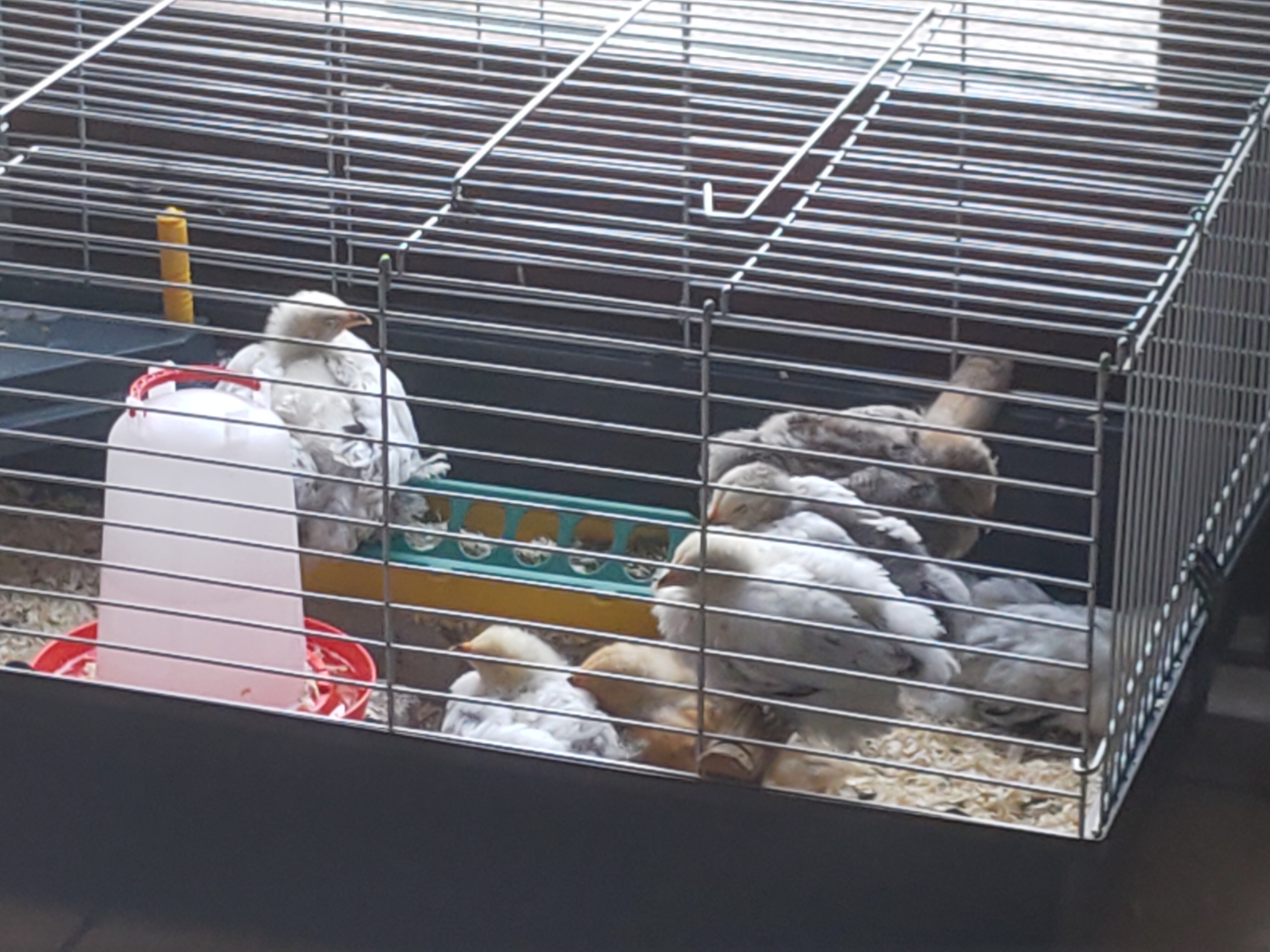
I don't think it really matters that much, in the wild chickens will just sleep in trees. If you go for a branch, just make sure it's clean, fresh cut or debarked without cracks.