Plato: What is good? (piefed.social)
 

When we talk about identifying something there are two interesting ways to do that. The first being with definitions. Where we take a sort of Ideal Form of a thing and go

"If it has 4 wheels, designed to travel at speeds close to 100 miles an hour, has at least 50 horsepower, and can transport at least 2 people then it is a car"

However, these always have a "Diogenes Chicken Threat" in that now someone can strap two electric scooters together and duct tape a jet engine to those and

"Behold! A Car!"

Which is why I think a prototyping understanding of a thing is often better. With the prototyping example we see the more natural way in which humans recognize things. We have a massive brain built for pattern recognition for a reason. So we see a car and we know it's a car. It may be a car that's non functional or maybe it's in a weird context. But we know by some innate thing that it is a car.

Within philosophy, I think we spend a lot of time with the definition approach because it provides something we can do more philosophy with or even the act itself of asking "what is [thing]?" is a core component of philosophy itself.

That said, I think for the type of philosophy that Plato wants to do, it's important to look at something we've prototyped and ask "what is [thing] to me?" Because then we can know our own values in either what we notice or what we find important in our own personal definition, but we're maintaining that this may not be universal. So now we can explore the question of what a thing is with others better.

So with this in mind. I want to explore the question

"What is good?"

This can only be understood in my eyes as an innate feeling. We will look at something and know stereotypically whether or not if it is good.

But the question I want to know is what is the quality good? what does it mean to be good?

And asking this question knowing there is an individual understanding of good for sure and potentially there is a more basic and universal understanding of goodness. Or at the very least there is a actionable definition of good that we can use as a philosophical first principle.

Or maybe there isn't. Maybe good can only be understood as an individual idea and we can share some aspects of it with others. I'm not sure.

So what is good?
[–] [S] 1 point 2 months ago

I'm also a lay person. We all doing a bit of amateur philosophy so worry not.

A couple things that a Platonist perspective implies is

  1. They are religious in a gnostic sense. There's an amount of "this is how I've experienced god so therefore it's an axiom" which is to be expected of any theological arguement.

  2. The world of forms: To the platonists, there is a higher plane of existence in which true forms of base elements exist. The common example is the Triangle. You can draw a triangle and it is never going to be a "perfect" triangle. It will have some amount of imperfection at some scale. However, your mind knows that this is supposed to be a perfect triangle for doing math. This ability to know the thing in front of you is supposed to be a representation of something mathematically perfect leads the Platonists to believe there is a world of forms that must exist because we can intelligibly know what other "perfect" examples of things look like without ever having seen them.

That's sort of the basics of Platonism that everything gets built out from.

Would the conclusion be better if it was something like.

"So since we have a base concept of goodness rooted in the natural beauty of this world and in our ability to craft new things from this natural world, and we know there is some connection between our souls and the One through our ability to imagine the world of forms, then we can assume that the One is good because it must be a pure form of our own minds. The One is in a pure version of existence because it is not in the imperfect world of matter like us. It must be strictly in the intelligible world because it cannot be felt within the world of matter."

Something like that? I'm still not happy with the conclusion.

  • source
  • parent
  • context
  •  

    I am trying to solidify my understanding of why god is necessarily good in Platonic terms and I think I finally get it, but I would love for a double check if anyone is willing. Here's my shpeel

    To the Platonists, our minds are a part of the The One. How this part of the One ended up trapped in a material body is unimportant to the Platonists because they know they cannot know this story only that it must be true (The Timaeus is their "creation story" but it is explicity stated within the Timaeus that it is only a "likely" story). Consider this jump, that our minds are derived from the first principle of the One, as a "leap of faith" (I do think it's a weak connection, but I vibe with the idea.)

    So since our minds are just a sectioned off pieces of the great consciousness that is the One, then values that we hold dear must be values that the One holds. We can deduce to some degree that cultivating the mind, practicing moderation, being a just member of society are all good things because they allow us to see, be, and communally create beauty in this world. To the Platonists, goodness is beauty, order, things pleasing to the examined mind.

    So the logic goes that I feel some sort of connection to a higher order of thing. I can intelligently imagine things that aren't here and create them. So I must have some sort of connection to the entity that has created this world since I have some similar skill. So assuming there is a god and I have some sort of connection to that god, then that god must share some sort of intelligible first principles with humans.

    What do humans value? Beauty, Order, Nature, Creation. These are things that we value so these must be things that god values so these must be good because we find them good. We also value virtues like moderation, learning, justice. These are virtues because they help us grow as individuals and help us strength society.

    So, I know God is necessarily good because I am imbued with the values of god. And when those values aren't corrupted by the material world, they only seek to continue to create what is good. It is diverting from the core values of god that cause corruption and thus things we call "evil".

    [–] 64 points 2 months ago* (last edited 2 months ago) (2 children)

    As with all things, its complicated.

    The romans knew that those who worked in lead mines or were lead smiths suffered tons of problems and died early because of their occupation.

    The dangers of lead were never a mystery.

    But they also knew that it takes more than simply touching lead to get sick. So they knew their lead pipes were fine since it was a low pressure gravity system unlike our modern system that is pressurized. Lead pipes in a pressurized environment actually mixes with the lead and causes problems.

    And water logistics are NECESSARY to keep a city like Rome alive. So lead smiths were needed because lead is CRAZY USEFUL for all things precise and plumbing related.

    But, lead also famously has a sweet smell when formed into lead acetate. And romans love sweet wines. So they'd boil down grapes and berries in lead pots to make a lead acetate sweetener. This theyd mix with wines to enhance them. Something they generally knew was bad but who knows. I like to think of it as the ancient roman equivalent of smoking. Yes objectively bad, but sometimes you need an extra sweet wine to take the edge off.

    I'll give you better sources later. I think I got this from Mary Beards "SPQR" which is a must read. Not chronological, but fuck chronology. Where my thematics gang at!

  • source
  • parent
  • context
  • [–] 8 points 2 months ago (2 children)

    I love to hate on SAO

    But that's true of nearly all anime's. They're filled with plot holes, shitty power scaling, and nonsensical magic/science lore.

    Turns out, having a culture of single authors writing weekly released manga and then rapidly turning them into anime to ride hype trains leads to some honestly terrible stories.

    But its fun! We know they're stories being told by really small teams if a team at all and they're trying their best to entertain us.

    Also, it's a good way to see what you do and don't like in any story. I've found hating on anime's has taught me what I appreciate it something and then I stick to stories that do that well.

    SAO taught me I love fantasy aesthetic anime's but also that lone wolf angst gets old to me.

  • source
  • [–] 2 points 2 months ago

    No, gun parts are "Glock Upper receiver" and "AR-15 Bolt Carrier group"

    These are precision machined pieces that fit within such tight tolerances that fucking it up is how you blow up your hand.

    3D printed guns work because you can 3D print lower receivers because it doesn't actually do anything with containing an explosion.

    It relies on off the shelf parts of guns being available.

    Now could they be printing a fully DIY gun like a "Fuck Gun Control 9MM" aka an FGC-9 and build it out of tube, spring, wood. Yeah, sure.

    But that IS NOT the majority of ghost guns and those are such terrible guns that their intended use is as a modern Liberator: a gun you use to kill someone with a better gun and take that gun.

    Using a FGC-9 in California gang violence is how one gets shot by a flock with a switch. Aka, a better gun.

    Source: I live in a state where its completely legal to build my own guns.

  • source
  • parent
  • context
  • [–] 20 points 2 months ago (4 children)

    Just ban the sale of gun parts in California.

    Obviously they didn't ask how ghost guns were made, but absolutely no one on the streets of Cali is using something like an FGC-9, they're printing Glocks and AR-15 bodies and then filling it with completely legal parts (I think they're legal. Not sure. Not in Cali)

    Anyways, glad they are required to release guidelines for a detection algorithm at least, but its bullshit they can make these requirements WITHOUT a proof of concept at least!

  • source
  • [–] 4 points 3 months ago

    I knew a guy with the shittiest private island. He said it cost him $20,000 USD its in Canada, had enough room for a cabin that was just a shed with a queen mattress in it and a boat dock.

    He showed me a video of him trying to enjoy it in summer and it was just CONSTANT heavy winds. He said he had to soundproof the cabin and goes there to read and write. If he wants to feel the wind he has to wear hearing protection and a jacket no matter the time of year.

    I never thought I'd feel bad for someone who owns an island. Still first world problems galore, but $20k is very affordable for a piece of land.

  • source
  • parent
  • context
  •  

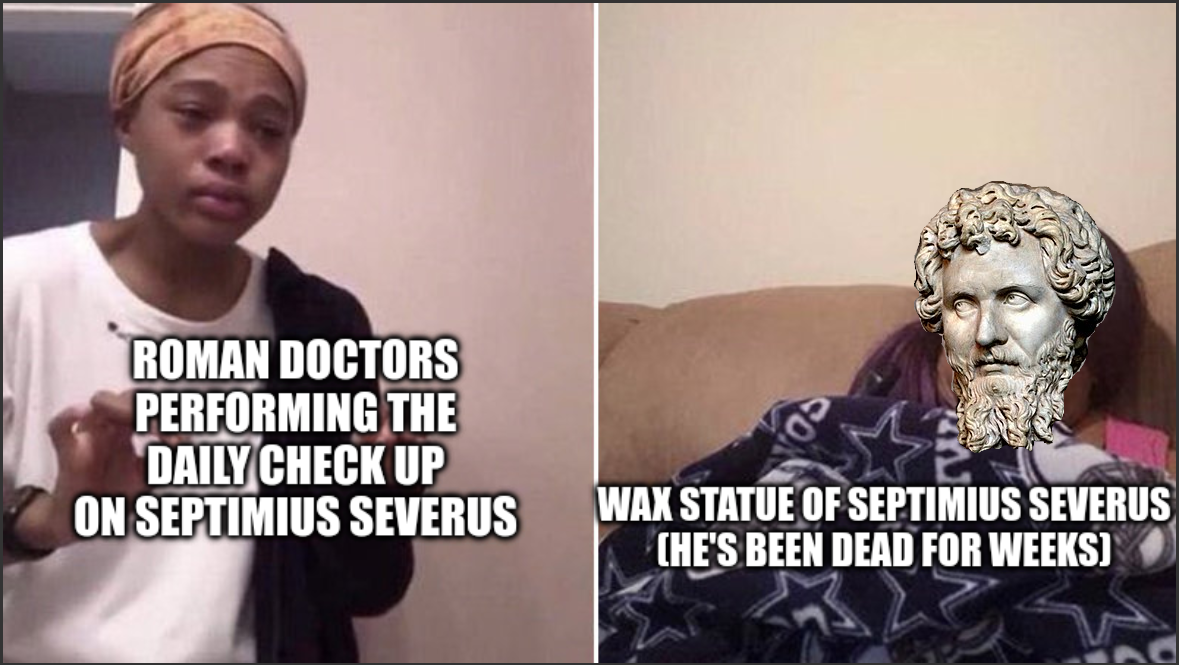
    Explanation: "the historian Herodian described the funeral in Rome of Septimius Severus as an example of the standard pattern for such ceremonies. Not much had changed. Herodian refers to people wearing masks representing Roman generals and emperors of the past (though he describes them now as travelling in chariots, not walking on foot), to choirs singing dirges, and to the procession from the Forum to the place of cremation. But in this account the wax image played an even more prominent role. Septimius Severus had died in York, in northern England, and had been cremated there, before his ashes were brought back to Rome. There was no body whatsoever at this funeral, not even a decomposing one. The waxwork was all there was. According to Herodian, this was displayed for a week on a couch at the entrance to the palace, ‘looking like a sick man’, with the whole senate in attendance. Every day, doctors would come and pretend to examine the model emperor and agree his condition was deteriorating, until they eventually pronounced him dead and the waxwork was taken down to the Forum." - Mary Beard "Emperor of Rome"

    An image of a woman trying to explain something almost at the point of tears with the text "Roman Doctors performing daily check ups on Spetmius Severus" and a second panel of a woman laying down under a blanket with a bust of Septimius Severus covering her face and text that reads "Wax statue of Septimius Severus (He's been dead for weeks)"
     

    Wanting to dip my toes into kubernetes for homelab stuff and I have a few questions.

    1. Do I need a specialized OS for it? I've been trying to get some TalOS VMs running but I've ran into some issues. Would you recommend like a Ubuntu server running kubernetes over something like TalOS?

    2. Could I run this on a Windows server? I'm personally a Linux guy, but a friend who prefers windows server wanted to try it and I thought I'd ask.

    3. Can I migrate Docker services to a Kube cluster? How easy is it?

    4. Any recommendations for learning materials? I've clearly struggled with TalOS's quick start materials as I haven't been able to get into the tutorial cluster made with docker locally. I keep getting weird errors and reinstalling Talosctl and docker. I've diagnosed this as a "skill issue". My learning budget is like $100 for a udemy class or good interactive guide (Paid for by work apparently. I was learning this for fun, but it may actually be needed knowledge for a project)

    view more: next ›