[–] 9 points 1 week ago*

Sadly more and more modern thinkpads come with soldered RAM, which IMO is a deal breaker. Work gave me an X1 Carbon Gen 13 to use, which was indeed both shockingly fast and lightweight, but had soldered RAM and a mobo failure in the first 3 months, so I kept looking for a personal device.

Ended up with a Thinkpad E14 Gen 7 with a Ryzen 7, SODIMM ram and built like a tank. Also much cheaper than the X1. It's heavy, but I'm also not worried about it getting thrown around in my bag.

  • source
  • [–] 9 points 1 month ago* (2 children)

    It's rule 8, if they don't follow it, their post should be deleted. Personally, I feel like accounts should be outright banned for failing to disclose, because it's not fair to put such overdue burden on the moderators to try to figure out whether something is AI generated if they're not going to disclose.

  • source
  • parent
  • context
  • [–] 2 points 2 months ago (1 child)

    The real question in my mind is, do any of these girls speak English natively? Watched Wawa today and she didn't think so.

    I really hope the recent changes at Cover ('One Hololive') doesn't mean that they're basically going to only hire JP Vtubers who some percentage of may happen to speak English.

  • source
  • [–] 18 points 2 months ago*

    Your hardware is actually more than capable. The stuttering in browsers is because Qubes no longer allows hardware acceleration. See https://doc.qubes-os.org/en/latest/user/troubleshooting/media-troubleshooting.html

    The other big OOTB problem is the default private storage size (i.e. /home/user) for VMs is 2GB, which is insanely small for any sort of interactive use, and needs to be bumped up just to enable a web browser's cache to reach a reasonable size. Let alone being able to store a useful amount of data to be stored in the VM.

    I think when you get past these few things, it's more smooth sailing.

    Pointless additional rambling that can be ignored:

    I also at first really liked what QubesOS offers in terms of VM templating, and being able to have multiple AppVM share the same base OS template as more or less immutable (i.e. on next AppVM boot, any changes you made to the system partition in the AppVM are completely reverted to the template's copy). So one can run multiple AppVMs without wasteful duplication of a unique system partition for each VM. This does mean one must boot up the template VM every time new system packages are needed for the AppVMs based on that template, installing the software, shutting down the template VM, then restarting the AppVM.

    Ultimately I ended up just creating a bunch of Standalone VMs, and installed different software into each, rather than trying to come up with an efficient, combined template that had all the software I needed for all my app VMs. Less secure, but just more practical.

    Getting used to the clipboard manager is another thing that just takes time, but eventually you get it down. All these things are there for security and I understand why they are there, but it definitely has a huge learning curve.

  • source
  • [–] 6 points 3 months ago (1 child)

    Since you know Debian, Devuan is there to try it. Given how almost unavoidable systemd is nowadays I basically try all of Devuan, Artix, Void and the first one that works for the task at hand is the one I stick to :)

  • source
  • [–] 1 point 3 months ago* (last edited 3 months ago)

    No, if you mean 192.168.0.0 - 192.168.255.255, that is a /16 192.168.0.0 - 192.168.0.255 is a /24 192.168.0.0 - 192.168.0.7 is a /29

    I was a little glib in my initial response. You really don't want to start your definition in the middle of a subnet.

    I would set it up so your first group of /29 would be 192.168.0.0 - 192.168.0.7

    Second would be 192.168.0.8 - 192.168.0.15 (192.168.0.8/29)

    Third would be 192.168.0.16 - 192.168.0.23 (192.168.0.16/29)

    And so on.

  • source
  • parent
  • context
  • [–] 1 point 3 months ago* (last edited 3 months ago) (3 children)

    The problem looks to be your subnet specification. /24 is 256 addresses. So for your 192.168.0.10/24 export, you're exposing it to 0.10 and the following 255 IPs.

    The closest thing to what you want to achieve would be a /29, which would expose it to the given IP and the following 7 IPs.

  • source
  • [–] 2 points 4 months ago

    The real benefit of PBS is it does not store the backup as just a 1:1 dump of the VM disk, it's incremental - if the VM you're backing up for say the 3rd or 4th or 20th time doesn't have much new or changed data, it's not a linearly increasing amount of storage on your backup server, the new backup is actually trivially small. This really helps you have longer backup retention if files aren't actually changing all that often.

    I got tired of stressing about whether my backup host might be down when my primary Proxmox host dies, even if they're in different data centers - well, as far as I know anyway! Now I just use BackBlaze B2 storage for the PBS off-site backup (compatible with Amazon S3), albeit it's a little finnicky to set up and working 100%. Yes it's still 'just someone else's computer', but for the ~12 bucks it's costing me for almost 2TB of backup data I am not stressing about it.

  • source
  • [–] 19 points 4 months ago (3 children)

    Well aside from the obvious giveaways in the presentation format of the README.md, and .gitignore, the very first question of its FAQ is:

    "You use LLMs? 🤯"

    Yes. Heavily. Claude and GLM-5.2 wrote a lot of this repo.

  • source
  • parent
  • context
  •  

    Hey folks. My understanding of the self-hosting world is that Proxmox is kinda the king of the roost, and deservedly so. I use it myself both for personal and work projects, and love what it provides. I've also used TrueNAS Core/SCALE, and of course just traditional Linux desktop or server distros of various sorts for projects, but out of the corner of my eye has always been sitting XCP-NG. It seems like it could be a real contender in the space.

    I've tried installed it a handful of times, and each time it felt like something with a lot of potential, but the freemium model just felt too onerous to make it worth investing too much into learning it. My initial observations were:

    • (Plus) It may just be my imagination but in my limited interaction with VMs, they felt a little snappier in terms of interactivity compared to Proxmox/KVM. The console clipboard is a bit weird if you're used to NoVNC but I assume I could adapt to it.
    • (Plus) The console for the dom0 and guest VMs is completely persistent, which is awesome. The xsconsole manager program is also a really great management TUI as well, looks great and nice alternative to needing to do things in the GUI or command line. The dom0 console is password protected by default, which I see now in Proxmox 9.x also does. Good security practice, at least there.
    • (Plus) I like the incremental backup system. It's very efficient and I'm not aware of any equivalent in other systems.
    • (Minus) It seems difficult (maybe not impossible?) to manage some things e.g. VM disk allocations, etc from the main XCP web instance only. They really seem to want you using Xen Orchestra.
    • (Huge Minus) The licensing seems extremely expensive compared to Proxmox, to the point where it seems out of reach as a homelab solution. I also really don't like that they don't push updates to the Community edition XO. I know there are some scripts on github to work around this, but it just seems like such a bad look for them to not send security updates to the community edition, even if it's at a slower rate than for the paid customers, which I believe is how Proxmox works.

    Does anyone use xcp in homelab environment, or only in enterprise given the cost issues? What do you like about it compared to proxmox or other multi-VM hosting solutions?
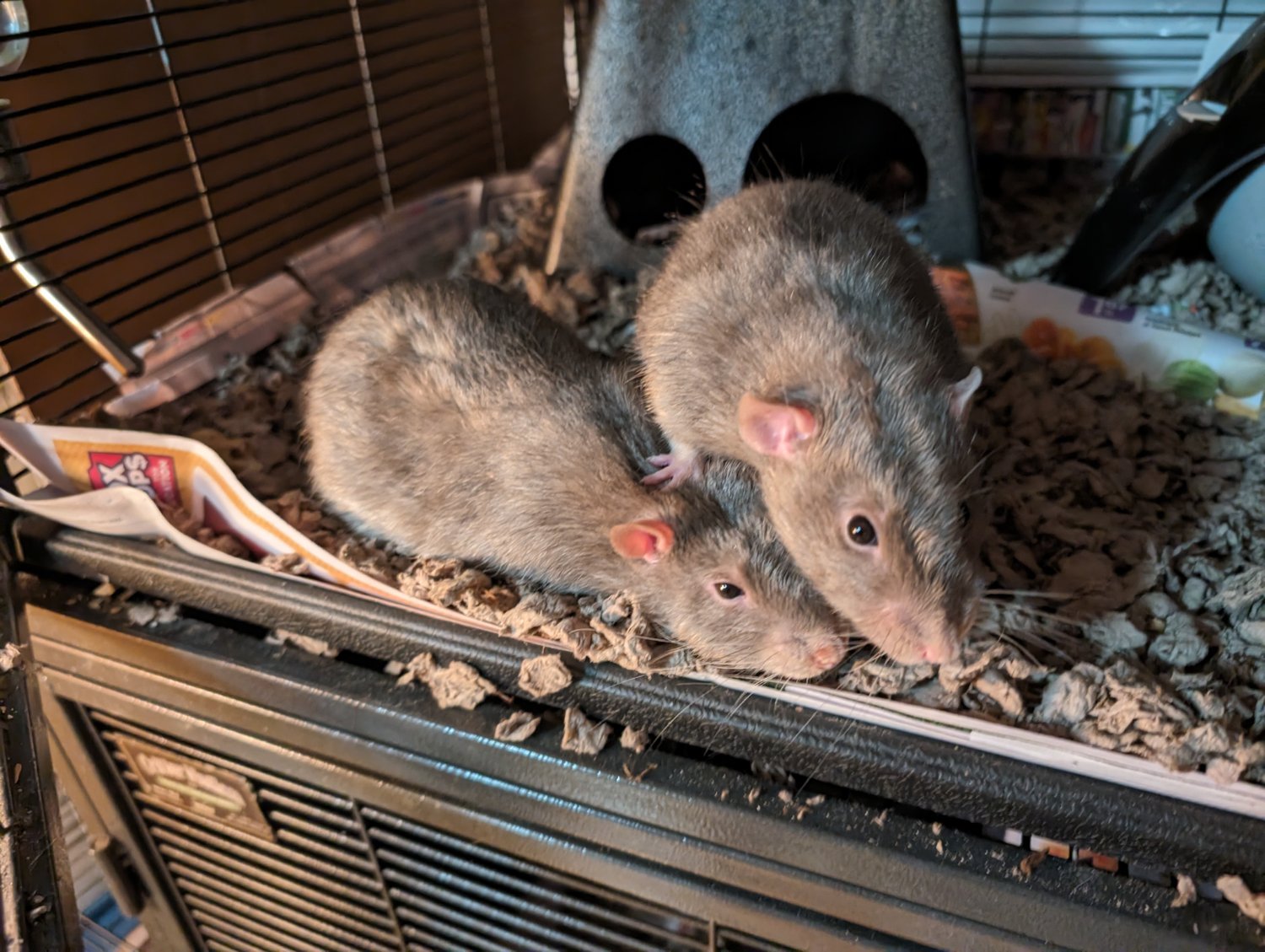
     

    Beans is our only adorable dumbo ear of the four boys, but out of the blue he started attacking his brothers, especially his almost twin (sans ears) Frank. When there's blood, we separate of course.

    Interestingly, after introducing the new bedding they have calmed down, or maybe it was just a temporary issue. Glad to have our boys all back on one cage!

    view more: next ›