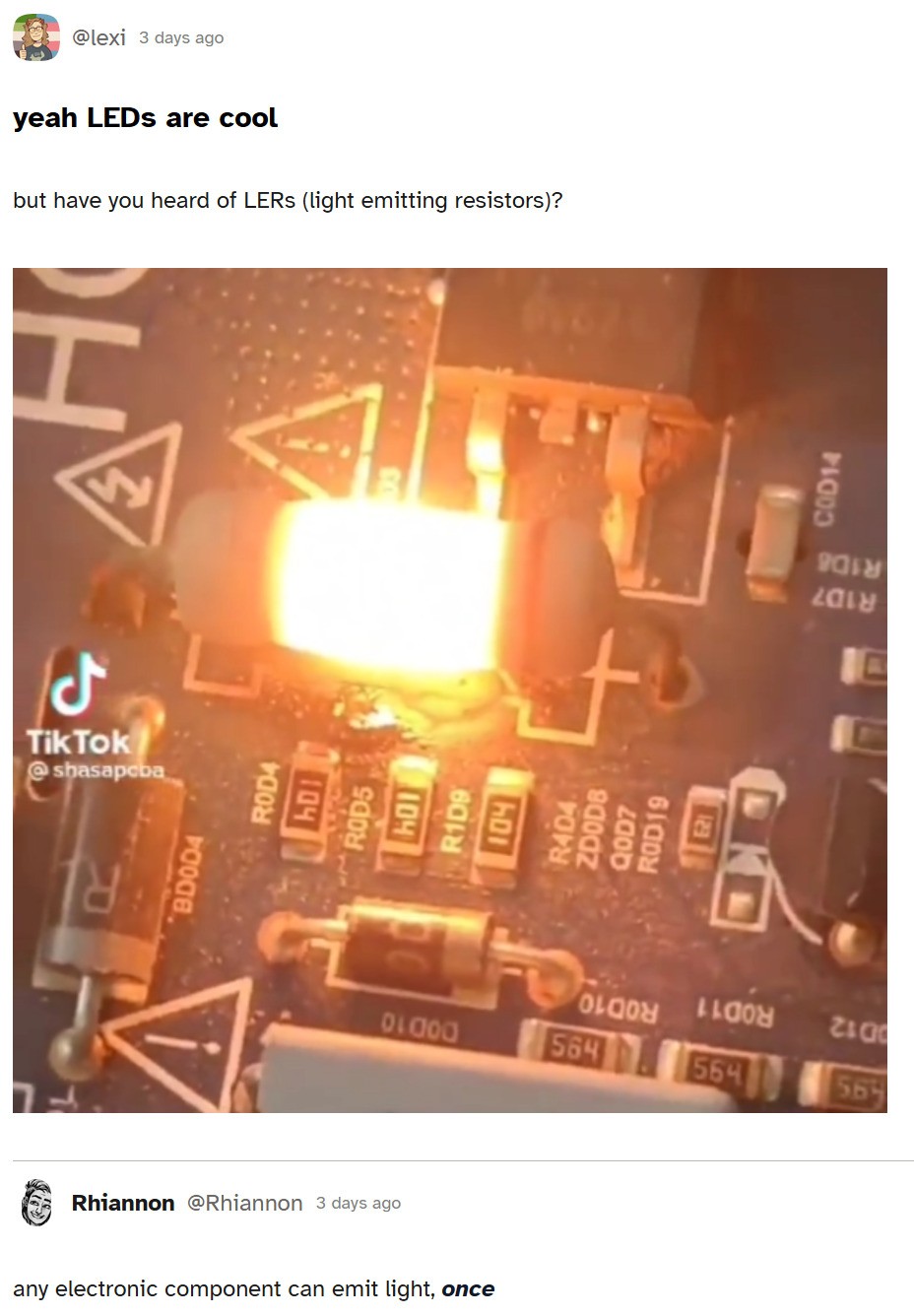
LERs (light-emitting resistors) (piefedimages.s3.eu-central-003.backblazeb2.com)
 
A social media post. yeah LEDs are cool but have you heard of LERs (light emitting resistors)? [A picture of a resistor overheating to the point it lights up] any electronic component can emit light, once

top 28 comments

sorted by: hot top controversial new old
[–] 47 points 10 months ago (1 child)

We have gone full circle; LER is the new retronym for light bulb.

  • source
  • hideshow 1 child comment
  • [–] 44 points 10 months ago (7 children)

    Incandescent lightbulbs are literally this.

  • source
  • hideshow 7 child comments
  • [–] 19 points 10 months ago (3 children)

    More specifically, an incandescent bulb is a light-emitting PTC thermistor. The resistance of the filament is very low at room temperature, acting like a short circuit. With a lot of current, the filament heats up which causes the resistance to go up as well (PTC = positive temperature coefficient). As the resistance goes up, the current goes down, and the filament reaches an equilibrium temperature.

    Incandescent light bulbs can be used as protection devices for repairing electronic equipment. If you make a mistake during the repairs and cause an accidental short circuit inside the device, the incandescent bulb (wired in series with the device) will limit the current based on the wattage of the bulb. 120 Watt bulb on 120 V AC circuit => 1 amp max current through the device. For a 60 W bulb the limit is 0.5 amp.

    This is a lot lower current than the usual 15 amps allowed (before tripping the breaker) by a common NA household circuit.

  • source
  • parent
  • hideshow 3 child comments
  • [–] 7 points 10 months ago

    We can expand on that a bit. A breaker does not simply open at its rated current. It should actually never open at the rated current. At 2x the current it takes some time. At 10x the rated current it still takes WAY too long. Traces, components, etc. everything are long vaporized at that point. And this makes sense too, they protect the wiring in the house, not devices with unknown power draw and current spikes.

  • source
  • parent
  • [–] 50 points 10 months ago (6 children)

    All electronics are light emitting resistors if you use them wrongly enough.

  • source
  • hideshow 6 child comments
  • [–] 14 points 10 months ago

    Isn't this a light bulb?

  • source
  • [–] 13 points 10 months ago

    Been there, done that, never attempted CRT repair after that.

  • source
  • [–] 7 points 10 months ago (1 child)

    Thanks to the capacitor plague 20+ years ago I had to deal with a bunch of FEG’s (flame emitting GPUs)…

  • source
  • hideshow 1 child comment
  • [–] 7 points 10 months ago

    Once the smoke has cleared we check the connections we made earlier.

  • source
  • [–] 6 points 10 months ago (1 child)

    Everything is a light emitting resistor if you push enough power through it.

  • source
  • hideshow 1 child comment
  • load more comments (1 reply)
    [–] 5 points 10 months ago
    [–] 4 points 10 months ago

    For those of you who would like to do stuff of this kind, here's a video of Jeff Geerling showing how to use a microcontroller board and a power supply to blow up a capacitor! (He also shows a few other things you can do with microcontroller boards.) https://www.youtube.com/watch?v=Sd42q3OaOrE

  • source
  • [–] 3 points 10 months ago

    Seems kinda hard on the PCB though.
    But would be useful when you also want to desolder nearby components at the same time, so multipurpose.

  • source
  • [–] 3 points 10 months ago

    I once discharged a 5 F capacitor into a 1 Ohm resistor.

    It created an unpleasant smell on burning up.

  • source
  • [–] 4 points 10 months ago*

    Someone is going to celebrate new computer day pretty soon

  • source
  • [–] 2 points 10 months ago

    Don't let the smoke out. All electronics work due to having magical smoke inside. If you let the smoke out then it stops working.

  • source