cross-posted from: https://lemmy.blahaj.zone/post/32298676

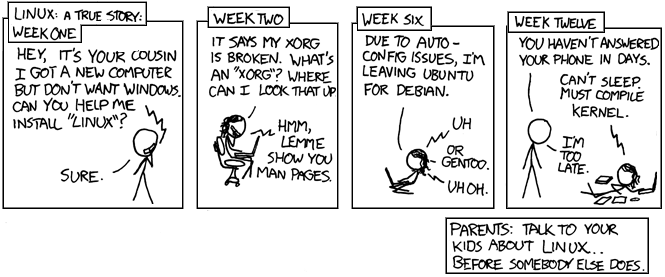
Having seen no context or posts, this is where I assume @The_Picard_Maneuver@lemmy.world currently is.

all 42 comments

sorted by: hot top controversial new old
[–] 128 points 1 year ago (3 children)
  • [–] 35 points 1 year ago (2 children)

    You'd think linux would be the thing Randall Monroe introduced me to that's most destructive to my capacity to live a normal life, but nope Dvorak.

  • source
  • parent
  • hideshow 2 child comments
  • [–] 28 points 1 year ago (4 children)

    I plan switching to Linux mint Debian on my main PC and ditch windows. Mainly use my PC for games,vr and jellyfin.

  • source
  • hideshow 4 child comments
  • [–] 8 points 1 year ago (3 children)

    Vr, as far as i understand it, is a hard no with any Linux.

  • source
  • parent
  • hideshow 3 child comments
  • [–] 14 points 1 year ago (1 child)

    Depends on the headset and depends on the game. The OpenXR standard (open to all, mainly maintained by Valve) does have decent support across windows and linux, but some headsets flip the standard the bird, like the Meta Quest lineup. Also some games break the compatibility with things like anticheats.

  • source
  • parent
  • hideshow 1 child comment
  • [–] 20 points 1 year ago

    I did this on a sparcstation way back in the day, never again. Pray for @The_Picard_Maneuver@lemmy.world

  • source
  • [–] 12 points 1 year ago* (3 children)

    I remember originally installing Slackware linux because someone made a GUI system that mimicked LCARS.

  • source
  • hideshow 3 child comments
  • [–] 11 points 1 year ago (23 children)
  • [–] 5 points 1 year ago (21 children)
  • [–] 25 points 1 year ago (6 children)
  • [–] 12 points 1 year ago (5 children)
  • [–] 8 points 1 year ago (4 children)
  • [–] 8 points 1 year ago (8 children)

    It's very controllable.
    You start out with control over everything, but that also means you have to do everything and know everything. Then you can hand back that control by automating on your terms, and gentoo provides a lot of tools for that.
    But you always have that confidence that when something is weird, you can go back, take the control, see what happens, redo the automation. Or keep it manual.
    Gentoo won't ever touch your config files (It proposes changes you approve), and if something happens you didn't want you can always trace it back to your own mistakes.

    I've never gotten the same feeling of being in control with any other distro. There is always that time it fucks up my ssh config, or breaks due to some oddity I chase back down to a decision by some maintainers.

    It's stable only based on your decisions and skill. It will make you a lot better at using linux. But also if you don't have the time, or the will to keep automating and scripting and learning new things, then you won't be able to use it and you'll have a really bad time.

    It does bring automation but only up to a still very manual level. You can't go "fuck this shit mode" and turn it into opensuse with a config option. For example you can do your own kernel, or add a few changes to a default kernel and use it without init system, or follow a tutorial to pull default binaries and just have what most other distros have, but you won't find an installer to check that as an option, you are forced to still understand what components you are putting in where, connecting how, automating with what commands and tools.

    Also protip if you do your own kernel start with the binkernel config not the default the fresh kernel repo starts out on. You'll never find all the footguns autoconfigured to make your system weirdly choppy. And recompiling stuff you forgot in a module then loading that into the old kernel usually works but can crash your system.
    Change all the options, be my guest, but at least start from a working state so you have a chance of knowing what you fucked up and which flag you didn't understand.

  • source
  • parent
  • hideshow 8 child comments
  • [–] 3 points 1 year ago (2 children)

    Also you can reset a system pretty much by downloading the default config files and rebuilding

  • source
  • parent
  • hideshow 2 child comments
  • [–] 3 points 1 year ago (1 child)

    So NixOS but slower and worse?

  • source
  • parent
  • hideshow 1 child comment
  • [–] 2 points 1 year ago* (last edited 1 year ago)

    Not really

    Btw Gentoo has binary cache, you can also have your own binary cache so build stuff on one machine, deploy on 100

    NixOS is hosted on Github which is kinda insane.

    Also it is very hard to do general compiler optimizations or compile your own kernel on NixOS for reasons

  • source
  • parent
  • [–] 1 point 1 year ago (2 children)

    Sounds a lot like building your own house, car, etc.

  • source
  • parent
  • hideshow 2 child comments
  • [–] 1 point 1 year ago (1 child)

    Yeah, on some fundamental level.
    Most linux distros would be very moddable repairable off-the-shelf cars. LFS would be your diy project with various guides. And gentoo would be a parts garage with their own guides and precompiled kits of components, so you can either follow those sets and build a more off-the-shelf car or diverge at any point for any section and run wild. But also you can still use the machine shop of the store and they offer to custom build some consumables for you and keep shipping them.

  • source
  • parent
  • hideshow 1 child comment
  • [–] 1 point 1 year ago (1 child)

    Thanks for the detail.

    If you ruin your installation, is it easy to rebuild with the automation scripts you wrote?

  • source
  • parent
  • hideshow 1 child comment
  • [–] 2 points 1 year ago

    If it's something outside packages, like say the filesystem, it should be similar to fix to what you did in the initial setup. You already have to know how to partition your system, so at worst you'd have to relearn that if you installed a very long time ago.

    If you mean break some regular file, you can reinstall the package it belongs to or everything if you have the time.

    Gentoo has a proper package manager (portage), so most things you can rebuild. If you fuck some config, you can probably rebuild and get the default files back.

    If you break portage config somehow, you'll probably have to start from scratch in essence. Though there too once you start to redo your setup you'll likely run into the same issue and have to figure it out.


    Because all distro-problems will be caused by you, the only escape is to understand the issue.

    Any "rebuild" would just be you copying in all your old stuff and repeating all the settings, you could just as easily revert your settings till it works again and pinpoint what is causing it.


    I have no specific automation for setting up a system from scratch (did it 2 more times on different systems but manual copy was good enough), but automating it wouldn't be hard. Just dump all the commands I run during setup into a script, and add a few scp to pull in my own stuff (or I could even put it in an official gentoo repo and pull it in with one portage config file).
    But why would I? I don't regularly set up copies of my system, and this is the same as just looking at my system. It can't break itself past what those config files and setup commands do. The system won't diverge from your commands so there is no need to force reset it to your commands.

    I suppose the fact I comment my package set (the config file that contains all the packages I have installed) with install reasons is the same as starting from scratch. I simply reevaluated all my installed packages when I wrote it.


    In a way I did once "fuck my system". I switched to wayland (end of '22, before it was cool) and wanted to remove all X flags from all packages (a global flag unset). So I endlessly figured out what packages really needed that flag, added exceptions, and after months still ran into occasional issues, instability, or the weirdest dependencies. Whenever I had any problem I started considering if it was somehow caused by that.
    I knew it was stupid, I knew plenty issues it had caused, everyone was telling me it was in fact stupid. Basically I was test-running 200 packages at once under settings noone had ever intended. So my "rebuild" was just to remove that -x from my make.conf and rebuild all affected packages. (I may have even rebuilt the entire system just in case).

    The only way I see you actually starting from scratch is if you

    • Did something stupid from lack of knowledge or out of fun
    • forgot about it
    • couldn't trace it back nor anyone else could figure it out
    • it's in something not logged (which I'm fairly certain doesn't exist unless you explicitly turn it off)

    The most "I'm fucked, rebuild everything" moment in my memory was me doing an update after half a year when kde6 was released. What happened was I had manually specified a bunch of kde system components (instead of stripping down the kde meta package via flags) and some were removed in kde6, so portage tried building a kde6 system with kde5 and failed in enough ways to generate like 5k lines of error.
    I was unable to read that error, and while someone in the gentoo irc was able to, I would have had to "rebuild" my package selection otherwise.
    Meaning leave the system running as is, remove stuff from the installed packages config until the update finds a valid config, add back stuff while it keeps working, and be left with in this case the packages that were removed, where I would have then checked them and seen they were removed in kde6.
    This would have essentially been me "rebuilding my installed packages", so "rebuilding the system", but while still using that same system and with the final "apply" being a regular update using my fixed config. No need to throw everything away in the mean time, it may destroy my valid package state but the system doesn't mind (it just stays outdated). I could have even updated only specific important packages and delayed the package rebuild for more months.

    The main flaws here are me (adding stupid dependencies) and portage producing unreadable errors (to be fair there are so many ways to fuck up package configs it's gotta be really hard to make every case readable and traceable to some sane cause).

    Without fixing it I ofc could not have gone to a different system and copied over my stuff (automated or not) since that would also have refused to build all my selected packages.

  • source
  • parent
  • Well, I'm not quite there yet, but I DID remove Windows from my primary PC a couple of weeks ago too and now have no windows machines in the house. It's great.

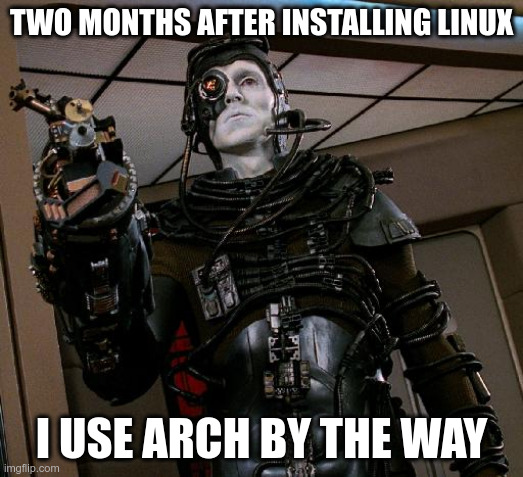
    Part of me is wondering if it would be fun to install base Debian and manually add all the things I want from there as a learning experience, or if that's a dumb idea. Also, the Arch wiki sounds like an incredible resource to have if I went down that route instead...

    Either way, I've been taking a short break from Lemmy because some stuff had bothered me, but I'm sure I'll be back in earnest soon.

  • source
  • [–] 5 points 1 year ago

    The 24.04 beta of Pop! with cosmic just dropped.

  • source
  • [–] 2 points 1 year ago*

    emerge -ave @universe

  • source
  • [–] 1 point 1 year ago

    Comping the kernel wasn't so bad on Gentoo. I hated compiling OpenOffice on a P4 1.6GHz...
  • source
  • 20 comments in c/tenforward@lemmy.world view that post
    [–] 38 points 1 year ago (7 children)
  • [–] 12 points 1 year ago (6 children)

    Isn't Nixos the new Arch? Its way more byzantine, still under development, a silicon valley darling and requires learning a new DSL to install packages.

  • source
  • parent
  • hideshow 6 child comments
  • [–] 5 points 1 year ago (3 children)

    a silicon valley darling

    is it really? i had no idea

  • source
  • parent
  • hideshow 3 child comments
  • [–] 5 points 1 year ago* (2 children)

    Its starting to replace ansible/puppet/etc as the IAC tool of choice.

    As an example, one of the core nix maintainers works for Anduril, the AI weapons/surveillance company run by right wing shit head Palmer lucky. Ive heard they are deep in the Nix ecosystem. Here is their nixos stig config.

  • source
  • parent
  • hideshow 2 child comments
  • learning a new DSL to install packages.

    This is an understatement. It's like a build system, package manager, and git repository were thrown in a blender. Those don't need to be separate systems, but boy does it help pin down what's going wrong.

    Rant:

    I noped right the fuck out after 60 minutes of trying to get nix to work as an isolated dev+build environment under Ubuntu. It probably works better under NixOS, but it's documented for this use-case too. After things stopped lining up with the docs, I realized it was going to cost me more time than it it would save.

  • source
  • parent
  • [–] 24 points 1 year ago (1 child)

    "Captain, I'm afraid we've lost him."

  • source
  • hideshow 1 child comment
  • [–] 16 points 1 year ago

    This account was last seen two weeks ago. Still a long time for this user, I think

    https://piefed.world/u/The_Picard_Maneuver

  • source
  • I was literally wondering that this morning! Noticed the non-political shitposts had largely dried up, and realized I hadn't seen TPM for a good minute. Come back, we need you.

  • source
  • [–] 8 points 1 year ago (4 children)

    I’m sure they will emerge soon

  • source
  • hideshow 4 child comments
  • [–] 5 points 1 year ago (3 children)

    Stronger and wiser, having communed with the GURU

  • source
  • parent
  • hideshow 3 child comments
  • [–] 6 points 1 year ago (2 children)
  • [–] 3 points 1 year ago (1 child)

    I have no idea what a gnuru is πŸ˜…

  • source
  • parent
  • hideshow 1 child comment
  • [–] 1 point 1 year ago

    I'd just like to interject for a moment. What you're refering to as Linux, is in fact, GNU/Linux, or as I've recently taken to calling it, GNU plus Linux. Linux is not an operating system unto itself, but rather another free component of a fully functioning GNU system made useful by the GNU corelibs, shell utilities and vital system components comprising a full OS as defined by POSIX.

    Many computer users run a modified version of the GNU system every day, without realizing it. Through a peculiar turn of events, the version of GNU which is widely used today is often called Linux, and many of its users are not aware that it is basically the GNU system, developed by the GNU Project.

    There really is a Linux, and these people are using it, but it is just a part of the system they use. Linux is the kernel: the program in the system that allocates the machine's resources to the other programs that you run. The kernel is an essential part of an operating system, but useless by itself; it can only function in the context of a complete operating system. Linux is normally used in combination with the GNU operating system: the whole system is basically GNU with Linux added, or GNU/Linux. All the so-called Linux distributions are really distributions of GNU/Linux!

  • source
  • parent
  • TPM: *Wakes up on the floor of the bridge 20 minutes later having experienced installing and removing 20 distros, finally landing on FreeBSD and coding the perfect shell.*

  • source
  • I didn't realize he was back. I remember the last post I read from him stated he was taking a break

  • source
  • [–] 3 points 1 year ago

    I’m installing Pop_OS right now! I’m not expecting it to pull me away from Fedora + KDE, but I’m interested in the new Cosmic Desktop beta. It’s not every day we get a major new DE built entirely from scratch.

  • source