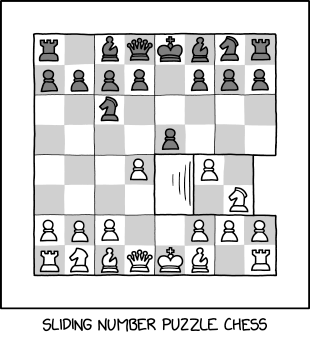
This could be a real thing: at each turn, you can either make a standard chess move, or slide one of the board tiles ... who wants to code it up?
post
If I were to make up the rules:
- Black gets to select at the start, which of the 8 empty tiles of the board should be voided.
- Pieces can move and capture across the void but can't land in it. It is an invalid move when considering checkmate/evading check/stalemate.
- Black or White can choose to move an adjacent tile into the void regardless of what pieces are on it. This uses their move.
- The tile can be moved to get out of check or avoid checkmate or stalemate. (edit: to make things interesting, you can't simply reverse the tile move that puts you in check, but you can move a different tile)
- You cannot put yourself or both players in check with the tile move.
- The tile cannot be moved if you are in check and moving the tile doesn't get you out.
- The space between where a king starts and ends when sitting upon a sliding tile does not count as a vulnerable space, unlike the normal rules for castling.
- The king can castle under otherwise normal rules, if it and the target rook are in the original position even if the tile that they sit on had moved away then back, so long as those pieces were never moved normally. (To prevent the king being forcibly moved by the opponent solely to deny castling opportunity)
- Moving a tile causing one's own pawn to bypass an opponent pawn's attacking space (anywhere on the board) only triggers the en passant rule if there is a valid space where the opponent's piece would capture. No en passant for moving backwards or moving your opponent's pieces past yours. (edit: Horizontal en passant is out as well, forward only.)
- Pawn Promotion doesn't happen even if a pawn moves backwards to the player's own end row.
- It would be rare, but en passant could capture a newly promoted piece if someone had moved their pawn one row backward from their starting row, and their opponent used the tile move to try to bypass it.
- Two promotions can happen in one tile move.
- The opponent chooses the piece(s) to promote if you move their pawn(s) to your end row.
- You cannot move the tile if a resulting opponent's promotion(s) to queens and/or knights would cause a check on you, even if for whatever reason the opponent would not choose that promotion.
- No prohibitions on causing stalemate through tile moves. Though it is more likely to cause a repetition draw due to the trapped player being able to simply reverse it.
Did I forget to cover anything?
It 👏 needs 👏 more 👏 horsey 👏 shenanigans.
The greatest minds of the Internet are assembling at !anarchychess@sopuli.xyz to create the best variant of this game.
I would say you can only move a tile if you have a piece on it as well.
In some aspects this results in situations that the original Star Trek 3-D chess has with its movable platforms. The issue with chess variants is always how it adds while not unbalancing the game, and that's a difficult thing to test since chess by itself is complex even with its simple rules.
So now that the black pawn has reached "the last rank", does it get promoted?
no, because it hasn't reached the 8th rank.
So even if it does not move, this pawn could get promoted by some future tile-slide... come to think of it, I guess two pawns could get promoted in the same turn via a tile-slide.
That does seem to be the case, yes. Although I expect your opponent wouldn't let you pull that off so easily.
That's an aspect to Star Trek's 3D chess, you can move the smaller platforms around in lieu of moving one of your pieces. I have no idea if it adds or subtracts from the game.

all 27 comments