While Democratic leadership takes credit for the party’s takeover of both houses of Congress and several state governments, progressives and socialists are calling for change at the top.
“Democratic House members and members-elect are being bombarded with phone calls and emails urging them not to elect Minority Leader Hakeem Jeffries (D-N.Y.) as speaker,” Axios reported (11/6/26). A petition to replace Jeffries has hit 500,000 signatures (Newsweek, 11/5/26).
Meanwhile, several of the new Democratic senators-elect have said they do not support longtime top Dem Charles Schumer of New York for majority leader (Guardian, 11/6/26).
Reasons for pushback
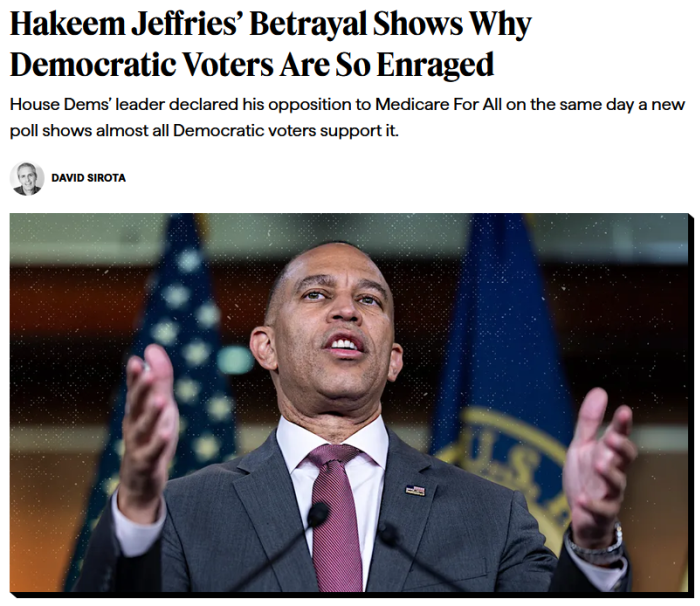
David Sirota (Lever, 8/17/26) notes the “important context: Jeffries has raked in hundreds of thousands of dollars of campaign cash from healthcare PACs in the 2026 election cycle.”
There are a variety of reasons for the pushback. Schumer’s silence in the face of the administration’s politicized attack on Democratic Rep. Ilhan Omar (Minn.) angered many (Talking Points Memo, 10/26/26). Said Time (11/6/26):
The ubiquitous New Yorker was, detractors said, too prone to seek compromise, too wary of committing to fights with President Donald Trump and his administration.
And International Association of Machinists and Aerospace Workers President Brian Bryant sent a letter to Schumer insisting that he not seek the majority leadership position (Politico, 11/9/26). Bryant noted that the “elections sent a clear message: working people are demanding change.
Jeffries, for his part, opposes Medicare for All (Newsweek, 8/17/26), despite the fact that the policy proposal currently receives 66% approval from the public—and from 84% of Democrats (The Hill, 10/6/26). As the Lever (8/17/26) explained:
Jeffries has raked in hundreds of thousands of dollars of campaign cash from healthcare PACs in the 2026 election cycle and didn’t face any primary challenge holding him accountable to Democratic voters’ desires.
Jeffries is also known for his ties to AIPAC. “At a conference hosted by the group in 2020, Jeffries opposed putting conditions on US aid to Israel and described Jerusalem as New York City’s ‘sixth borough,’” reported Al Jazeera (11/7/26).
And the Democrats will need strong leaders against the White House; Trump is still in power, despite the Republicans’ recent drubbing, and he elevated Stephen Miller, the architect of his administration’s brutal and deadly anti-immigrant round-ups and martial occupations of US cities, to White House chief of staff. The move signals “a combative posture for the final two years of the Trump era,” the Wall Street Journal (11/6/26) noted.
“Democrats were in shambles and historically unpopular after the presidential election. That was because of Democrats like Schumer and Jeffries,” said USA Today columnist Sara Pequeño (11/9/26). “I did not hear a peep from them throughout this election cycle, and they failed throughout Trump’s first two years.” Pequeño is a lonely voice in corporate media, which largely reject such insurgent talk.
‘Candidates who can defeat Republicans’
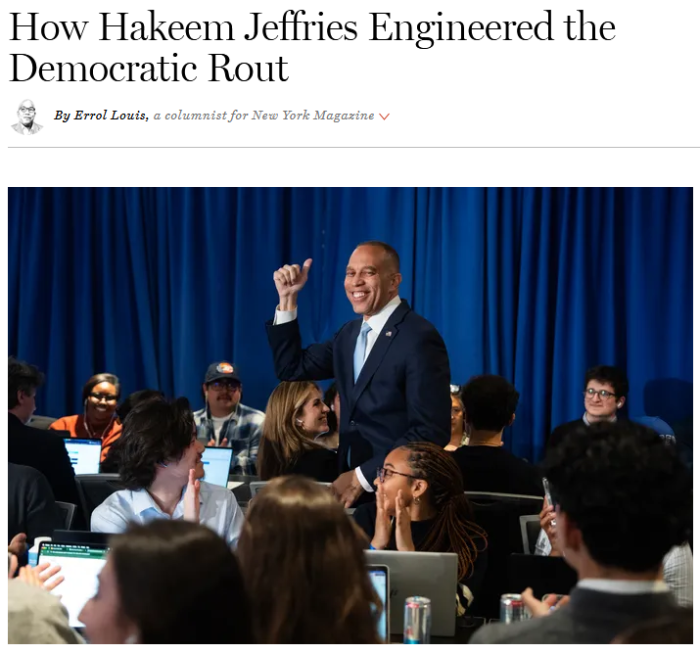
Errol Louis (New York, 11/6/26): “The new House majority represents the victory of realism over rhetoric.”
Errol Louis, host of NY1‘s Inside City Hall, wrote a column for New York magazine (11/6/26) under the headline “How Hakeem Jeffries Engineered the Democratic Rout.” Louis wrote:
For all the headlines given to the supposed influence of socialists and ultraprogressives, Jeffries’ majority was created by painstakingly recruiting and supporting the kind of candidates who can defeat Republicans. In New York, while the Democratic Socialists of America were attacking mainstream Democrats like Adriano Espaillat and Antonio Reynoso, and debating over who was first to use the word “genocide” to denounce attacks on Gaza, Jeffries was lining up candidates in red-to-blue districts that included ministers, combat veterans, farmers, prosecutors and other centrists from blue-collar backgrounds.
Louis clearly suggests that only “centrists” are the “kind of candidates who can defeat Republicans,” and that “ultraprogressives” waste valuable resources attacking those centrists. But clearly progressives can and did defeat Republicans, including Maine’s Troy Jackson, an insurgent candidate at odds with the national party who took down Sen. Susan Collins, who survived decades of challenges from more conventional Democrats.
DSA’s primary campaigns against Jeffries allies Espaillat and Reynoso were successful because the challengers had voters’ support. Primaries are just as much a function of electoral democracy as the November elections, whether Louis likes it or not.
And in many of the successful Democratic House races, it wasn’t “centrism” that was being heavily promoted; it was popular progressive policies like Medicare for All or other forms of healthcare expansion, taxing the rich, paid family leave and ending US support for genocide (FAIR.org, 11/6/26).
But also, let’s not oversell Jeffries’ involvement in these races—the minority leader doesn’t abracadabra their campaigns into victory mode. Louis noted that Jeffries “personally campaigned” for Cait Conley in upstate New York against Republican incumbent Mike Lawler. Great, but scores of union members from around the state went door-to-door to turn out union households against Lawler as well. Louis presents elections as moved by individual leaders rather than masses of people. That’s not how democracy works.
‘Tricky for Mr. Schumer’

Who does the Atlantic (11/5/26) see Schumer getting “revenge” on? Democratic voters?
Over at the Atlantic (11/5/26), Franklin Foer defended Schumer, again invoking the idea that the leader of the old guard was responsible for beating the Republicans this year. The piece highlights Schumer’s support for Scott Colom in Mississippi, where the Democrat is looking likely to squeak out a victory over Sen. Cindy Hyde-Smith (Washington Post, 11/9/26): “Flipping Mississippi, he boasted, was an old fixation, his ‘white whale.’ It’s the state with the largest share of Black residents in the country.”
Tellingly, El Kilgore (New York, 11/10/26) downplayed national Democrats’ role in Mississippi, saying that “compared to what the party was committing to other Senate races,” Colom received “sofa-cushion money.” He added, “Colom understandably doesn’t want to blame Chuck Schumer and his likely future colleagues in the Senate Democratic Conference,” but noted that “he’s clearly annoyed with the Beltway conventional wisdom and the institutions that help define it.”
Even if we give Schumer credit for the successful candidates he helped, to whatever extent, we still need to blame him for the losing candidates he didn’t help. Progressives complain that Schumer ignored democratic socialist Angie Nixon’s campaign for a Senate seat in Florida, which she narrowly lost (Atlanta Black Star, 11/9/26).
Meanwhile, the Washington Post (11/8/26) reported that “Democrats’ Senate campaign arm ultimately did not spend on [Nixon’s] race, though Schumer helped her fundraise last month.” According to the Post, the Republican incumbent “had more than 60 times the amount of outside money supporting her.” Had the national party been more involved in Florida, Nixon might be a senator-elect today.
Salon (11/5/26) described Schumer’s lack of support for Nixon:
Since her shock primary win in August, Nixon has complained about Democratic Senatorial Campaign Committee recalcitrance to anyone who will listen. In September, she told MS NOW hosts Symone Sanders Townsend and Eugene Daniels that Senate Minority Leader Chuck Schumer was less than thrilled about her race.
“When I did speak with Sen. Schumer on the phone, it was basically a ‘we will see,’” she said. “He’s going to look into it. That’s what was said, that he’s going to look into it.”
Any statewide Democratic victory in Florida would have been enormous, because under Republican Gov. Ron DeSantis, the state has been a laboratory for anti-trans legislation and the destruction of public higher education (Guardian, 6/24/21; Human Rights Campaign, 5/17/23; AP, 3/30/23; Advocate, 5/15/23; PEN America, 8/10/23; People, 3/27/26). Leaving the state to the Republicans signals that Democratic leadership is more comfortable with Florida staying in MAGA-land than adding to the national presence of democratic socialist elected officials.
A New York Times piece (11/7/26) treated Schumer’s ascension to the top Senate spot as a foregone conclusion, without ever mentioning the issue with Nixon. It also contains this nugget:
Michigan was tricky for Mr. Schumer as he leaned toward the centrist Rep. Haley Stevens, while her ultraprogressive primary opponent, Abdul El-Sayed, was among a group of candidates who said they would not back Mr. Schumer for leader. Still, the day after Mr. El-Sayed won the primary, Mr. Schumer began injecting funds to help him win.
Electing Democrats is literally Schumer’s job. How is it “tricky” that Schumer ultimately supported the charismatic progressive who faced an onslaught of racist attacks?
‘Noxious newbies’
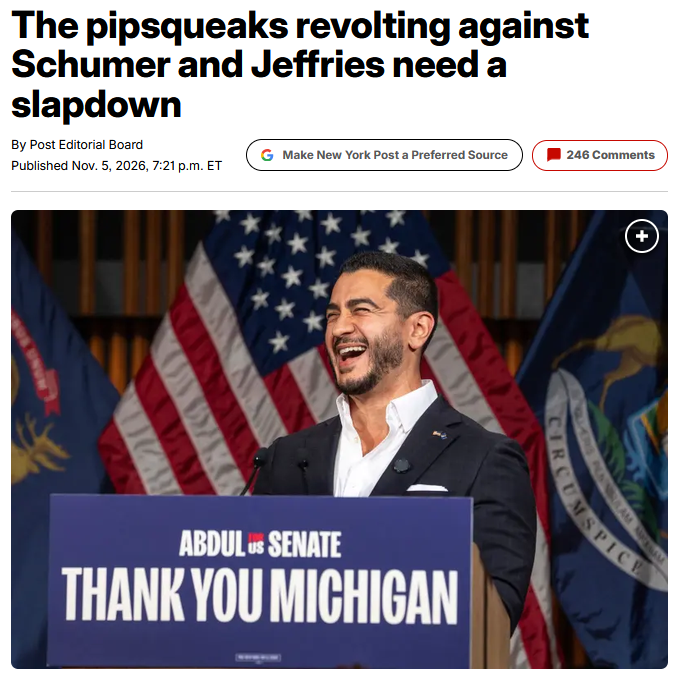
New York Post (11/5/26): “No one’s allowed to be decent, principled or practical if it gets in the way of the revolution.”
It isn’t just centrist media going to bat for the current Democratic congressional leadership. Rupert Murdoch’s New York Post editorial board (11/5/26) called incoming progressive senators and congressmembers who are demanding new congressional leadership “pipsqueaks”:
Voters handed Dems control on Tuesday out of frustration with living costs, economic uncertainty and corruption: Schumer and Jeffries need to focus on delivering on those fronts, not the agenda of a handful of urban elitists.
Indeed, they’d be wise to make the noxious newbies pay some price for their petulance—the very worst offices and committee assignments, for starters.
The right way to handle such tantrums is, if not a spanking, then a solid time-out.
Referring to party dissidents as cranky children who should receive corporal punishment is a disdain for democracy itself, not whatever ideology they are advancing.
But perhaps more telling is how eager the Post is to defend the centrist leadership of the Democratic Party. This is the same editorial board that accused Jeffries of advancing “pure hokum” (4/13/23) and scolded Schumer for showing insufficient deference to Israeli Prime Minister Benjamin Netanyahu (3/14/24).
It’s a reminder that while right-wing and centrist media can seem far apart, they can still come together when it is time to fend off progressives and protect people in power.
From FAIR via This RSS Feed.
all 2 comments