Personal opinion: Nathan seems to be really side-stepping a lot of concerns brought of up in the comments there. And referring to people coming together collectively in an open-letter when virtually all other channels are closed as 'brigading' is... Not cool. Edit: he retracted the use of brigading.

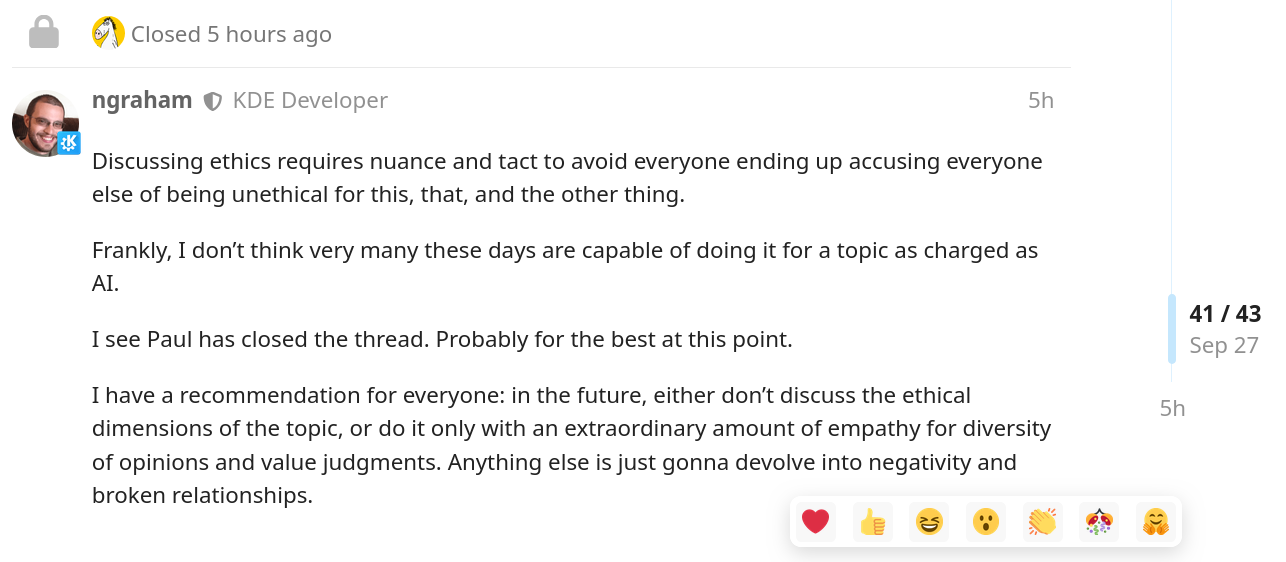
EDIT 2: Nate has since closed the comments on his blog, and the one discussion thread on KDE Discuss about the AI Policy was closed suddenly without explanation after a KDE developer began to discuss the ethics of AI use. Nate then responded after the thread was closed with this:
all 25 comments

sorted by: hot top controversial new old
[+] 31 points 1 month ago (3 children)
  • [–] 8 points 1 month ago* (last edited 1 month ago) (2 children)

    literally the next sentence after the reasons, he calls LLMs "bad stuff". That does not sound like "equal weight on the scale" to me.

    So yeah, bad stuff. I completely understand why a lot of people have problems with LLMs. I have these concerns as well.

    I agree that the license issue should be enough to not touch anything generated by AI, to not taint the codebase

  • source
  • parent
  • hideshow 2 child comments
  • [–] 23 points 1 month ago* (last edited 1 month ago) (6 children)

    Earlier I already noticed OP glossing over nuance when commenting about this.

    Reading the blog linked here I really don't see any issue, esp. not of the "drunk with power" kind which seems to be a go-to for certain people as soon as something icky comes up.
    Being "leader" of an OSS project is not fun. It's like herding cats. And the money probably isn't so hot either.
    Your skepticism rocks, but please attack actual rich assholes instead.

    AFAICS so far, KDE likes to discuss things even more than other OSS projects, including public brainstorming.

    I hope they come to a good policy against AI, which is problematic not only from a developer's POV.
    So far KDE still seem to be in the brainstorming phase though.

    To round off, some key parts (which I fear will get misquoted/overblown) from this very article:

    • Everyone agreed it (AI slop) was a problem, and that we don’t want that crap.
    • There was less certainty about the best way to handle it socially.
    • Several wished for an official policy so we didn’t all have to figure it out on our own. I proposed a set of draft guidelines making it quite clear that slop merge requests are unwanted, and can be ignored or closed. It received a generally positive reception.
    • Another KDE developer requested that we workshop it somewhere more modern and capable.
    • I got busy and didn’t do so.
    • Several weeks later, various people on the internet discovered that a talk proposing “a lovable, sovereign, AI-native KDE” had been accepted at Akademy 2026 and created drama around it. [ Already then Nate replied that this was just one speaker of many and in no way representative of KDE as a whole ]
    • Akademy happened, and the talk was given to what I’m told was a fairly chilly reception. The next day, a workshop was held about the topic, also receiving a chilly reception.
    • Realizing this topic was not going away, later that day I re-opened a second draft of my LLM guidelines on invent.kde.org. KDE contributors began to discuss the draft proposal.
    • Two people unknown to any KDE contributors appeared and began fighting with one another about the broader topic of the morality of AI, not the proposed guidelines.
    • One of those people exposed the other person’s odious Twitter posts in an effort to discredit them.
    • Later, the identity of the doxxed exposed person was verified, and they were also banned for their conduct outside of KDE being so unacceptable that people inside KDE did not want to associate with them.
    • Someone else outside of KDE set up https://.com in an attempt to pressure KDE into banning LLMs. A bunch of people signed onto it, almost none of whom are known KDE contributors (I see one person I know in there).
    • The topic was picked up on social media and the press with… varying levels of accuracy.
    • The draft proposal was removed and the whole topic hidden.

    It wasn't my intention to leave anything important out here.

    edit:

    But I was in a hurry when I wrote this.
    I wanted to include/quote this post where Nate Graham states that simply forbidding AI-assisted contributions is no good because you cannot be 100% sure of any code not having been written with the help of AI.
    Therefore such a roundabout rule makes no sense; instead one should ban the use of slop.
    I am not a developer so I have to takes his word, but this makes a lot of sense to me.

    The OP of that thread (who seems to be similarly inflamed as the OP of this one) then replied:

    Even a policy that can’t be enforced very well is better than none. We are still making an ethical stand and we can ban obvious usage of the technology.

    ngraham replied:

    I disagree. Policies that can’t be enforced breed disrespect for the rules.

    And once again I find myself agreeing.

    That said, developers (and project leaders) should never forget the overall threat of AI, which goes well beyond software development. Like fucking our environment even more, and the people that live in it.

    Whether KDE is willing to take such a political stance remains to be seen I guess? IDK what their track record is there.


    I have since seen the proposal of a KDE AI policy - and no thanks to the "Nate Graham is bad" party in this thread. My takeaway:

    • I personally believe that being against AI goes beyond just code. It's ethical, political, whatever you want to call it. AI sucks, quite literally, the life out of people and the ground they're living on.
    • Unfortunately most FOSS projects concentrate more on code quality etc. in their AI policies, not on these overarching issues.
    • KDE seems to be a little late to the party wrt AI policies written out
    • Their proposal is just that atm and personally I applaude the transparent decision making process
    • There are too many people who are understandably outraged about the whole issue, but go about opposing it in a bad way, distorting or obfuscating facts in favor of a more dramatic good vs bad narrative - as seen right here
    • In the extreme this becomes indistinguishable from trolling. It's totally understandable that blog or repo owners shut hard-to-moderate comment sections down. If you're serious about this topic and having a nuanced discussion about it, there are places to do this; forums, for example.
  • source
  • hideshow 6 child comments
  • [–] [S] 4 points 1 month ago* (last edited 1 month ago)

    The way Nate is framing the original intent of the proposal, that KDE was swamped with AI slop and they just needed a quick policy that would allow them to comfortably reject it, doesn't seem quite accurate. If that was all they needed, it seems like it would've been quite easily to propose an ad-hoc policy of allowing maintainers to reject suspected AI slop PRs at will, which would solve the immediate problem while allowing them to gather more feedback on a 'proper' policy. Adding a provision to not require any AI disclosure doesn't help with the stated goal of just wanting a way to easily reject slop.

    I've read the positions of some of the developers involved in the proposal thread on other platforms, and most have made it very clear that they are pro-AI (I do not include Nate among them, as he has stated he actually dislikes AI and doesn't use it). Among that group, the concerns about AI ethics and their use are, ultimately, of secondary concern over the prospect of increased productivity and time savings. That inclination is what resulted in so little credence given to the people raising concerns against it in the proposal thread (it was clear that the concept of not accepting AI code, or even just limiting it to self-hosted models, was not on the table from the outset).

    Nate is clearly distressed from the negative reaction the proposal has caused, and I can sympathize with that. However, from what I've read of his responses on his linked blog, IMHO it is mostly damage control, and still isn't addressing the main concerns people had about the original policy proposal. When people point out the copyright, environmental, and ethical issues, Nate will acknowledge those, but insists that the original proposal, by virtue of it allowing them to quickly reject obvious AI code, would've been an improvement (despite it also giving the provision that AI use didn't have to be disclosed, essentially meaning that those skillful enough to make it not obvious will still be perpetuating the ethical, environmental, and copyright issues, but just in the dark without anyone knowing the severity).

    In the linked blog post, many of the comments are saying that KDE effectively closed down most avenues to provide feedback on the proposal, thus leaving them with essentially the only option of making the KDE For People open letter, as otherwise it appeared that any public dissent against a permissive AI policy was ultimately going to be dismissed as the Pro-AI group decided on a policy behind closed doors.

    Their justification for planning to make it a closed door decision was two people in the proposal thread, both of which easily could've been removed from the thread, or the thread closed to developers only, and their discussion could've continued without any difficulty. I personally don't believe their justification, as it clearly seems like it was closed and ultimately made hidden to avoid the public relations fallout the main discussion was having for being so dismissal of the AI concerns brought up.

    I invite anyone curious to read the blog and the comments below, and come to their own conclusion. (Be sure to click 'old comments' on that blog, as most are now hidden behind that).

  • source
  • parent
  • [–] -3 points 1 month ago (3 children)

    KDE right now has a very reasonable position, but of course being utilitarian and reasonable wouldn't be ever enough for purists that will be throwing shit on the project regardless of what policy will be accepted in the end (OP is already doing it, some other people on fedi as well).

  • source
  • parent
  • hideshow 3 child comments
  • [–] 4 points 1 month ago* (last edited 1 month ago) (2 children)

    By your account I guess Cheaters in college should have used the defense of professors that caught them as "purists" ... Get the FO of here with that.

  • source
  • parent
  • hideshow 2 child comments
  • [–] 1 point 1 month ago

    You misunderstood your relationship with kde, they aren't your student, nor they are accountable or obligated to you in any way. This purity testing thing is dumb and achieves nothing but drama.

  • source
  • parent
  • load more comments (-1 replies)
  • [–] 16 points 1 month ago* (4 children)

    "various people on the internet"

    "Two people unknown to any KDE contributors"

    "Someone else outside of KDE"

    "A bunch of people [...] almost none of whom are known KDE contributors"

    "A bunch of people mostly outside of KDE"

    Geez, can you condescend your users any harder? Or, like me, people who want to continue recommending your shit to noobs?

  • source
  • hideshow 4 child comments
  • [–] 10 points 1 month ago* (last edited 1 month ago) (2 children)

    It was clear he was referring to anyone involving themselves unnecessarily in the business of maintainers trying to create a policy. This tends to happen whenever maintainers discuss things openly.

    It didn't seem condescending to me. You have to accept that non-contributors simply don't get as much weight as contributors in this kind of discussion. So when a lead maintainer sees non-contributors starting debates and criticizing the project when they don't have their facts straight and it really wasn't any of their business to begin with, they have a right to call them out.

  • source
  • parent
  • hideshow 2 child comments
  • [–] 11 points 1 month ago (1 child)

    Ok, but how can it be called unnecessary involvement when it's simply public comment, for which an avenue was provided? What is "the business of maintainers" only? Of course maintainers get more say... that does not mean everyone else who has a say should shut up if they don't like it. If all of the public feedback was constructive towards the proposal without such severe disagreement on the basis, surely the author would welcome it. When popular disagreements like this come up it would be nice to have the crux of it addressed without being strawmanned to answer for the actions of some hooligan of the day.

  • source
  • parent
  • hideshow 1 child comment
  • [–] 8 points 1 month ago

    The main point of OP is that this was a misunderstanding that turned into an overreaction. It sounds like there was never any confusion among the maintainers that they were trying to create a policy to prevent LLM slop PRs and reduce maintenance burden. Somehow non-maintainers derailed the discussion into an anti-AI tirade that was completely unproductive.

    So basically: yes people should shut up if they don't have anything productive to add to the discussion.

  • source
  • parent
  • [–] 1 point 1 month ago* (last edited 1 month ago)

    I did not like that condescending wording either, as I was also considering signing this "KDE for People" petition yesterday. (but I didn't, because I'm not important, not a developer or anything)

    I guess he just wanted to make clear, that KDE does not yet have an official stance, and those movements (the akademy talk and KDE for People) are not official kde projects/opinions

  • source
  • parent
  • [–] 8 points 1 month ago*

    Since his rise to power within the project (kind of around the 5 launch) I felt like Nate's vibe was more to cater to the suits than anything else so I don't find this surprising. I just hope common sense prevails and he can see he's fucking it up.

  • source
  • [–] 6 points 1 month ago (5 children)

    How about extending some benefit of doubt to project like KDE? It has an excellent track record which can't be said for the likes like: Ubuntu, RedHat, Omarchy (duh), Mozilla, even Linux with GPLv2 vs GPLv3

  • source
  • hideshow 5 child comments
  • [–] 4 points 1 month ago (1 child)

    Yeah that's kind of where I'm at. KDE has been pretty right-on for as long as I can recall, and it looks like at the moment they're just discussing AI broadly, which I personally don't think is an unreasonable thing to do, but even that's enough to get everyone riled up at the moment. Obviously if they actually do something sketchy like adding AI slop into Plasma then I'll revise my opinion, but it doesn't look to me like they've done anything especially egregious so far.

  • source
  • parent
  • hideshow 1 child comment
  • [–] [S] 4 points 1 month ago (1 child)

    Xfce and Debian have long track records as well, yet both have adopted permissive AI policies.

  • source
  • parent
  • hideshow 1 child comment
  • [–] 3 points 1 month ago

    And has the quality dropped? I agree that this increases the likelihood of bad code/docs etc. and that developers will need greater self-control. But I think the conversation should try to frame the question similarly as C memory safety. Yes its dangerous but despite the possibility of bugs we have lots of good software written in it.

    Of course one can object on more fundamental grounds...there then can be little conversations, instead we have persuasion.

  • source
  • parent
  • load more comments (1 reply)
    [–] 2 points 1 month ago

    Dear god the condescending tone. The passive-aggressive edit to the statement so that it still says the Nazi was "doxxed". The inability neither apologize nor correct their bad behaviour (the original reporter is IIRC still banned). The between-the-lines insistence on "please be kind (to centrists and nazis)". The insistence that making decisions on AI usage does not involve ethics.

    Reminds me of the times when Fedora was exclusionary and racist to South Americans (dunno if they still are, lost them long ago).

    KDE went to the trash like, woosh. This fast.

  • source
  • [–] 1 point 1 month ago

    Yah, the last is way too much to ask of places like Lemmy, that's for sure.

  • source