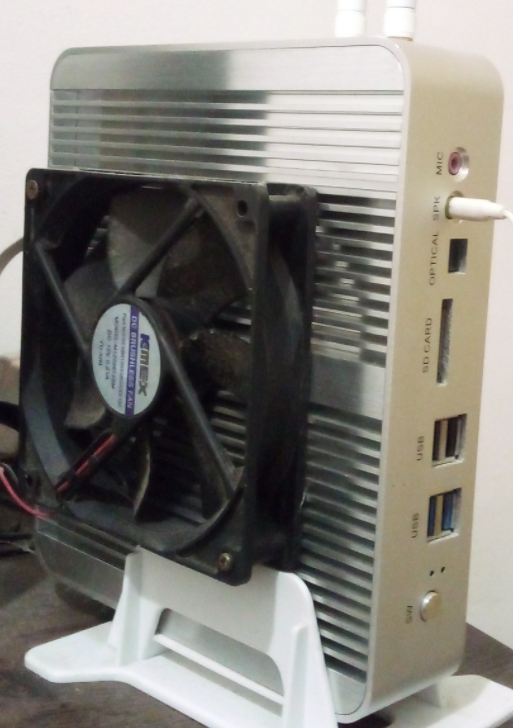
I got a pc that suffers from severe heating problems because of its poorly designed passive cooling case. I tried several strategies to put temperature under control, did a lot of tests with thermald, but ended up hacking a fan into the case. However, I still have problems with ssd temperatures.

Right now, as I write this, the nvme ssd is at 67ºC and easily goes beyond 80 or 90 during data transfers. I already lost 2 ssds before realizing this was the problem, because I was controlling just the cpu temperature.

There's no physical way to force airflow where the ssd is, so I was wondering if there's some way to throttle data transfer of something to prevent the ssd temperatures from reaching a threshold. All I could find was a vibecoded github repository. I don't care if data transfer gets ridiculously slow, as long as the ssd remain safe, and I can't consider getting any new hardware right now.

I'm currently running fedora 44 on that machine

Edit: I thought there was an easier software mitigation to that, but apparently, solutions will tend to the hardware side, so here are the hardware details:

  • It's an unbranded chinese cheap mini pc with a heat dissipation case that doesn't dissipate well
  • The ssd is mounted on the back of the motherboard. The model is a sandisk M.2 1TB 2280
    Here's a photo of the case, for the reference (don't judge me lol):
image

you are viewing a single comment's thread
view the rest of the comments
[–] 1 point 11 hours ago (3 children)

What does the present +22C leap from expected idle ssd temps signify? How much energy does this take, where is it coming from and how much do you expect it to drop with even a puny 60mm fan circulating air in the area? What does not addressing this signify for overall system lifespan?

It doesn't take much experience to get these answers right (which you have loads of!!!) but it does take skill to be this wilfully dense. Which puts you among that one group of people you always find in any newbie-oriented hardware forum, people who offer bad but seemingly well-meaning advice, but are well-meeaning only up to the point where they have to admit they are wrong at which point they do what you're doing and double down for ego's sake. This deserves ire.

FYI when a real trauma surgeon hears "heart problem", they're thinking beta blockers, blood thinners and vasodilators - you know, the stuff most cardiac patients take that would cause you to bleed out on the operating table without special precautions. An ironic demonstration of your inability to scratch beyond the surface of any given topic. I bet you don't even clean the toilets properly.

  • source
  • parent
  • hideshow 3 child comments
  • [–] 1 point 11 hours ago (2 children)

    It signifies that the ssd is in a passively cooled case without a heatsink.

    I’d say adding a heatsink to the ssd will drop the idle temperatures down at least ten degrees (more like fifteen or twenty, but it’s important to not overestimate no matter how optimistic someone might be!). During long transfers is where the real benefit comes in, it’s still possible to get the ssd in the 90c zone but it’s gonna take much, much longer because the package will take forever to heat the heatsink up and the heatsink will much more efficiently dump that heat into the air. That flatter curve is gonna be a huge help to the op because most people aren’t running constant data transfers as fast as their equipment can handle them 24/7, 365. It’s likely op is seeing ssds die when they transfer their 200gb futa SpongeBob memes folder and the temperature spikes up into the 90s for a few minutes, not while serving that folder to all their fellow bikini bottom enthusiasts at the 10gbps lan party. A flatter curve keeps the ssd at a safe temperature longer.

    It’s possible that the ops combination of pcie version and usbc revision (it’s a 7th or 8th gen intel iirc) can’t even do enough operations to get the heatsinked ssd up into the water messes up your packages seal zone when making transfers onto or off of it. Internal action will still heat it up as fast as possible though because the snappy ssd controller won’t be checking its watch and tapping its foot while some packet takes precious microseconds to come down the bus.

    The computer has been fine. It will probably continue to be fine once the op gets a heatsink on their ssd. They did not ask us to help them price out and build a new computer, but to keep their ssds from dying, and not to repeat myself too much but that’s what a heatsink will do.

    Now it’s also possible that their power supply is whats periodically killing their disks but the heat is a good first step.

    You really gotta ease up. Insults and rudeness couched in flowery language are no shield. If this is your first time on lemmy, people take that kind of stuff much more serious than on Reddit.

    There’s uh, also a pretty flagrant degree of classism in your replies that might not go over well on the left wing servers like ml. Just be aware.

  • source
  • parent
  • hideshow 2 child comments
  • [–] 1 point 8 hours ago* (last edited 8 hours ago) (1 child)

    The computer has been fine

    It had not.

    It will probably continue to be fine .

    It would not.

    once the op gets a heatsink on their ssd

    If you put a heatsink in an oven set to 100C, does it become cooler? Technically, yes, but- "LA LA LA I CANT HEAR YOU!!!"

    They did not ask us to help them price out and build a new computer

    "Doctor, I'm here for medication for my 4 year long bloody cough."

    "Here are your antibiotics and some benadryl. Off you go!" (In comic book villain voice: "You fool! You should've known to ask for an x-ray, ct and all the other doctor-ey things only I could know about! Only a matter of time now rubs hands gleefully as maniacal laughter echoes)

    Also, a shitty case with 2 well positioned fans would still have leagues better airflow for a fraction of the cost of a 1TB ssd and a fraction of a fraction of replacing the entire pc.

    There’s uh, also a pretty flagrant degree of classism in your replies that might not go over well on the left wing servers like ml. Just be aware.

    Is it classism to call someone an asshole for falsely claiming to have experience they do not, defying reason for the sake of ego and all at the expense of someone else? Because if it is, you're still an asshole.

    EDIT: Wait. you're right. Even if I was working with your inflated analogy where you likened yourself to a trauma surgeon, comparing you to a janitor was disparaging to extremely hard working people everywhere. I take it back. You're not a janitor. You're the guy that keeps finding their way into the operating theater and masturbating ferociously in the corner.

  • source
  • parent
  • hideshow 1 child comment
  • [–] 1 point 6 hours ago

    Okay now stop calling names too and you’ll be doing good.

    The big difference I notice when I look back at our conversation is that your replies use wildly exaggerated comparisons like pointing a hair dryer or a 100c oven while mine stay rooted in the actual conditions the op describes.

    I’d like to refute one that you threw out there earlier using the conditions the op described.

    We already know the forumula for conductance is kaTd/l so let’s see what coupling the package of their ssd nand chip to an aluminum heatsink does for that:

    Air has a k value of .025 or so. Aluminum has a thermal conductivity of 237. Even with the worst thermal pad or goop imaginable that’s several orders of magnitude better. Just for the sake of completeness, let’s assume the nand chip is about 2cm on a side for an area of 4cm square, we’re only working with a miniscule 20c gradient and we’re measuring one centimeter away. You could pick any numbers you want here for comparison, we’re literally multiplying them all together so it doesn’t matter for the purposes of determining how much of an improvement a heatsink would make.

    (.025 x 4 x 20)/1 =2

    (237 x 4 x 20)/1 =18,960

    That’s a thermal conduction much greater than the 100% improvement you expressed doubt about.

    Now will that translate into their ssd reaching absolute zero and levitating the pc a few inches off the desktop as it superconducts SpongeBob futa memes down the bus at near infinite speed? Of course not, but it will be much cooler.

    Now let’s compare that math to a fan! Using a fan forces cool air into the system, increasing the temperature gradient. Let’s assume the fan driven air is 80 degrees c cooler than the ssd die.

    (.025 x 4 x 80)/1 =8

    That’s an improvement but it’s nothing compared to the heatsink.

    Now this is obviously a gross oversimplification meant to illustrate the relative importance of coupling to materials with a higher k value as opposed to blowing air across things. If you wanted to pick apart my math you could bring up that I’m comparing bulk conductivity across a block of aluminum as opposed to two dissimilar materials coupled imperfectly by a third material. It would make me actually do the real math for bulk conductivity across a series of different materials and show that while the improvement isn’t over 9000 times better it’s still much, much better — but you could do that.

    And to be fair, the k value of a good heatsink acts as a lever that even small increases in temperature gradient can multiply to great effect. Which is why you don’t usually put a fan on something without a heatsink.

    The point of this exercise is to make it clear to anyone reading this exchange where each of us is drawing from and how each of us is expressing ourselves. I don’t seek to convince or educate you, but to leave behind a powerful wealth of knowledge that anyone can draw upon in the future.

  • source
  • parent