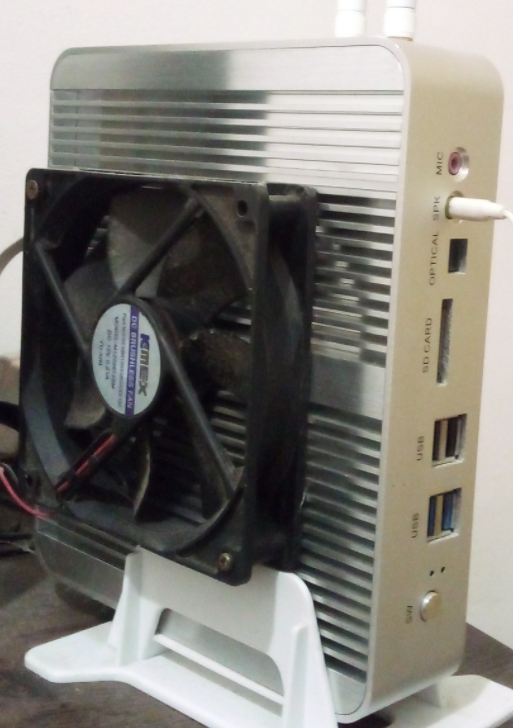
I got a pc that suffers from severe heating problems because of its poorly designed passive cooling case. I tried several strategies to put temperature under control, did a lot of tests with thermald, but ended up hacking a fan into the case. However, I still have problems with ssd temperatures.

Right now, as I write this, the nvme ssd is at 67ºC and easily goes beyond 80 or 90 during data transfers. I already lost 2 ssds before realizing this was the problem, because I was controlling just the cpu temperature.

There's no physical way to force airflow where the ssd is, so I was wondering if there's some way to throttle data transfer of something to prevent the ssd temperatures from reaching a threshold. All I could find was a vibecoded github repository. I don't care if data transfer gets ridiculously slow, as long as the ssd remain safe, and I can't consider getting any new hardware right now.

I'm currently running fedora 44 on that machine

Edit: I thought there was an easier software mitigation to that, but apparently, solutions will tend to the hardware side, so here are the hardware details:

  • It's an unbranded chinese cheap mini pc with a heat dissipation case that doesn't dissipate well
  • The ssd is mounted on the back of the motherboard. The model is a sandisk M.2 1TB 2280
    Here's a photo of the case, for the reference (don't judge me lol):
image

you are viewing a single comment's thread
view the rest of the comments
[–] 1 point 5 hours ago

Okay now stop calling names too and you’ll be doing good.

The big difference I notice when I look back at our conversation is that your replies use wildly exaggerated comparisons like pointing a hair dryer or a 100c oven while mine stay rooted in the actual conditions the op describes.

I’d like to refute one that you threw out there earlier using the conditions the op described.

We already know the forumula for conductance is kaTd/l so let’s see what coupling the package of their ssd nand chip to an aluminum heatsink does for that:

Air has a k value of .025 or so. Aluminum has a thermal conductivity of 237. Even with the worst thermal pad or goop imaginable that’s several orders of magnitude better. Just for the sake of completeness, let’s assume the nand chip is about 2cm on a side for an area of 4cm square, we’re only working with a miniscule 20c gradient and we’re measuring one centimeter away. You could pick any numbers you want here for comparison, we’re literally multiplying them all together so it doesn’t matter for the purposes of determining how much of an improvement a heatsink would make.

(.025 x 4 x 20)/1 =2

(237 x 4 x 20)/1 =18,960

That’s a thermal conduction much greater than the 100% improvement you expressed doubt about.

Now will that translate into their ssd reaching absolute zero and levitating the pc a few inches off the desktop as it superconducts SpongeBob futa memes down the bus at near infinite speed? Of course not, but it will be much cooler.

Now let’s compare that math to a fan! Using a fan forces cool air into the system, increasing the temperature gradient. Let’s assume the fan driven air is 80 degrees c cooler than the ssd die.

(.025 x 4 x 80)/1 =8

That’s an improvement but it’s nothing compared to the heatsink.

Now this is obviously a gross oversimplification meant to illustrate the relative importance of coupling to materials with a higher k value as opposed to blowing air across things. If you wanted to pick apart my math you could bring up that I’m comparing bulk conductivity across a block of aluminum as opposed to two dissimilar materials coupled imperfectly by a third material. It would make me actually do the real math for bulk conductivity across a series of different materials and show that while the improvement isn’t over 9000 times better it’s still much, much better — but you could do that.

And to be fair, the k value of a good heatsink acts as a lever that even small increases in temperature gradient can multiply to great effect. Which is why you don’t usually put a fan on something without a heatsink.

The point of this exercise is to make it clear to anyone reading this exchange where each of us is drawing from and how each of us is expressing ourselves. I don’t seek to convince or educate you, but to leave behind a powerful wealth of knowledge that anyone can draw upon in the future.

  • source
  • parent