you are viewing a single comment's thread
view the rest of the comments
[–] 90 points 1 month ago (19 children)

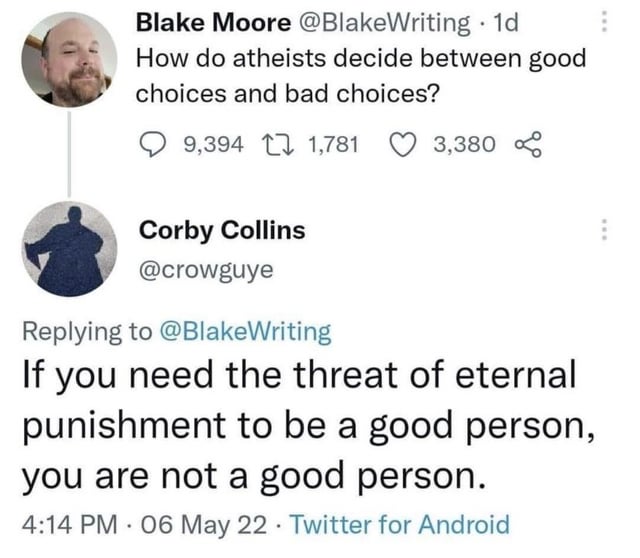
Ironically, biblical morality is absolutely fucked in the head.

Killing women because they didn’t scream while they were raped (probably because the uncle or father or brother raping them was either choking them out or holding a knife to their throat or something worse.)

Killing infants and unborn children because someone 3 generations ago did a thing.

Stoning teenagers for being, you know, teenagers.

It really is a good thing morality doesn’t come from god.

  • source
  • hideshow 19 child comments
  • [–] 42 points 1 month ago* (last edited 1 month ago) (2 children)

    Sending bears after teenagers because they called you bald once is crazy Elisha.

  • source
  • parent
  • hideshow 2 child comments
  • [–] 22 points 1 month ago* (last edited 1 month ago) (7 children)

    The best part is when God goes " see that guy over there, he believes so much in me, i will torment him beyond reason to proof his dedication to me"

    There are so many of these terrible examples of god being this huge asshole. When i read the bible in my early teens, it was reading the bible that 'made me an atheist'. Seeing that people took this asshole god serious.

    Over the years i did get to learn more about Jesus, he is the proto-hippy about sharing love and kindness. But somehow, very few christians follow up on his words and teachings. Christians actively chosing to be assholes when they have Jesus as a deity in their mythological fanfinction. It boggles the mind.

  • source
  • parent
  • hideshow 7 child comments
  • [–] 9 points 1 month ago (3 children)

    I think my favorite morality-thing to bring up is Song of Solomon.

    Especially when people get on about purity culture. It’s Bronze Age porn.

    I mean, yeah. god is a raging asshole, but that one usually gets more entertaining reactions.

  • source
  • parent
  • hideshow 3 child comments
  • [–] 1 point 3 weeks ago* (2 children)

    This is good. 'Our life is short and tedious, and in the death of a man there is no remedy; neither was there any man known to have returned from the grave. For we are born at all adventure, and we shall be hereafter as though we had never been; for the breath in our nostrils is as smoke, and a little spark in the moving of our heart, which being extinguished, our body shall be turned into ashes, and our spirit shall vanish as the soft air, and our name shall be forgotten in time, and no man shall have our works in remembrance, and our life shall pass away as the trace of a cloud, and shall be dispersed as a mist that is driven away with the beams of the sun, and overcome with the heat thereof. For our time is a very shadow that passeth away, and after our end there is no returning; for it is fast sealed, so that no man cometh again. Come on, therefore, let us enjoy the good things that are present, and let us speedily use the creatures like as in youth. Let us fill ourselves with costly wine and ointments; and let no flower of the spring pass by us. Let us crown ourselves with rosebuds before they be withered; let none of us go without his part of our volup- tuousness, let us leave tokens of our joyfulness in every place; for this is our portion, and our lot is this. 'The Wisdom of Solomon, ii, 1-9

    This is pefaced with "And the ungodly say"

    The Wisdom of Solomon, ii, 1-9

  • source
  • parent
  • hideshow 2 child comments
  • [–] 1 point 2 weeks ago (1 child)

    I was referring to a book called Song of Solomon, or Song of Songs.

    For example, an excerpt from chapter 4:

    ^11^Your lips distill nectar, my bride;
        honey and milk are under your tongue;
        the scent of your garments is like the scent of Lebanon.
    ^12^A garden locked is my sister, my bride,
        a garden locked, a fountain sealed.
    ^13^Your channel is an orchard of pomegranates
        with all choicest fruits,|     henna with nard,

    Literally, porn. It’s describing tossing her salad.

  • source
  • parent
  • hideshow 1 child comment
  • [–] 0 points 2 weeks ago

    'Our life is short and tedious, and in the death of a man there is no remedy; neither was there any man known to have returned from the grave. For we are born at all adventure, and we shall be hereafter as though we had never been; for the breath in our nostrils is as smoke, and a little spark in the moving of our heart, which being extinguished, our body shall be turned into ashes, and our spirit shall vanish as the soft air, and our name shall be forgotten in time, and no man shall have our works in remembrance, and our life shall pass away as the trace of a cloud, and shall be dispersed as a mist that is driven away with the beams of the sun, and overcome with the heat thereof. For our time is a very shadow that passeth away, and after our end there is no returning; for it is fast sealed, so that no man cometh again. Come on, therefore, let us enjoy the good things that are present, and let us speedily use the creatures like as in youth. Let us fill ourselves with costly wine and ointments; and let no flower of the spring pass by us. Let us crown ourselves with rosebuds before they be withered; let none of us go without his part of our volup- tuousness, let us leave tokens of our joyfulness in every place; for this is our portion, and our lot is this.' The Wisdom of Solomon, ii, 1-9 The preface to this says 'The ungodly believe this'

  • source
  • parent
  • [–] 3 points 1 month ago* (last edited 1 month ago) (2 children)

    A screenshot of a comment I made a while back. Link to original comment

  • source
  • parent
  • hideshow 2 child comments
  • [–] 2 points 1 month ago* (last edited 1 month ago) (4 children)

    Not to mention the whole Exodus problem

    The pharaoh was bad guy at first but then became a victim of Adonaiyahwehjehovahbob's torture

    (I didn't mean to comment twice)

  • source
  • parent
  • hideshow 4 child comments
  • [–] 4 points 1 month ago* (last edited 1 month ago) (3 children)

    I mean, if you believe their stories, god told the first lie. so why would you believe his divinely inspired horror novel when it says someone is the bad guy?

    (good news- the exodus never happened. you'd think that rivers turning to blood would be something somebody in egypt would have mentioned/written down. Or the frogs. or the locusts or the whole slew of dead first born sons.)

  • source
  • parent
  • hideshow 3 child comments
  • [–] 2 points 1 month ago* (last edited 1 month ago) (2 children)

    Not to get into a debate, but someone did write about (something that could reasonably be) it, potential motivated reasoning by the source aside. Sources from that far into the past (or even the relatively closer past) very rarely survive to the present day, especially literary sources (which tend to be written on papyrus that rots away), and even historians of relatively well-attested periods like Rome and Classical Greece basically have a few texts they rely on*, supplemented with archeology, epigraphy (inscriptions on stone) and straight up magic, and that's a thousand years before (edit: after) the period in which the Exodus is taken to have happened without the advantage of Medieval monks painstakingly preserving the material. Now the Egyptian corpus is uncommonly big (yay for the Sahara), but it's also very fragmented. For the most part what we don't and can't know is orders of magnitude more than what we can know, and it's not even like we've studied the whole Egyptian corpus (we haven't; there's a shortage of trained Egyptologists able to do that work), so it's very plausible that an event of even that magnitude would just... not show up in a way we can recognize. So what I want to say is: Truth of the Exodus aside, our sources for ancient history are nowhere near that comprehensive. Three thousand years is a long time.

    *For example Roman military history basically entirely relies on two guys (Livy and Polybius), whose works very frustratingly only survive in part, supplemented by some less reliable sources and fragments. When talking about Alexander the Great it's basically just Arrian, again supplemented by less reliable/comprehensive sources and fragments. And it can get worse; we get straight up nothing in the way of literature from Carthage. There's a lot of dumb luck involved in what does and does not survive.

  • source
  • parent
  • hideshow 2 child comments
  • [–] 3 points 1 month ago (1 child)

    Nope. not really.

    it's an apologist website, and while that in of itself is not something to suddenly dismiss out of hand, it is something to take a skeptical approach towards. for example, there's more than a few red flags in how they talk about things.

    For example, when they're talking about the discovery of the Tomb of Sobeknakht II, they're grossly misrepresenting things. They describe an attack that led to the complete occupation- at least, for a time- of Egypt.

    Except that the inscription in the tomb they're talking about, claims that Sobeknakht was successful in his defense at Elkab. At the time Sobeknakht was alive, 'Egypt' wasn't even one kingdom. it was split between the Thebans (Who Sobeknakht led) and the Hyksos to the north. this attack was was in, at the latest 1550 bce (Sobeknahkt II was ruling somewhere in the sixteenth and seventh dynasties.)

    it's this kind of gross- and lets be honest, probably intentional- misrepresentation to conflate that with the Kush Empire's conquest of Egypt in 700-500 bce. there's 850 years gap- at the most generous- along with multiple kingdoms and dynastic succession separating the events of Sobeknahkt and the conquest of the kushites in 700ish. Even to suggest that behavior in one case would be the way that Egyptians of another time and another place behaved elsewhere.

    And that suggestion would in fact be somewhat wrong. we do have things in the archeological record that show Egyptians suffered defeat. We even have things in the historical record where they're talking about those defeats and what happened how to keep them from happening again- including, as an example, the adoption of certain kinds of composite bows, the adoption of chariots were brought to Egypt by the Hyksos (asiatic peoples, less a race and more a class of people- that is the "foreign rulers".)

    I have to assume this was an intentional lie, given that it took all of five minutes for me to find whose tomb they were talking about and that they were talking about a military invasion a thousand years later as if Sobeknakht would be there. You'll notice my opinion of apologists are rather low- this kind of lie is common, and either they're to ignorant not to believe it or it's intentional.

    which brings us to the next thing.

    The argument is "Well, just because we don't have evidence, doesn't mean there wasn't evidence we just haven't found yet." The question that needs to be asked is should we find evidence? The historical record we have that mostly survives comes from monuments and inscriptions. things on tombs and such like (like the inscription on Sobeknakht's tomb) lauding their accomplishments and victories. One certainly does not generally put shameful things on such tombs or monuments.

    So no, we wouldn't really expect to see much in the way of historical records. that is to say, we wouldn't expect to find much in the way of writings- histories- on the defeats. Not by the Egyptians, anyway. any writings, as you note, would have fallen away and moldered into nothing, etc. But we would expect to find things in the archaeological record. That is- in the artifacts left behind. Things like the trash heaps that have pork bones in them- or no pork bones- or the kinds of weapons, tools, and armor, the vehicles, the remains of humans themselves, the fossil record. all that kind of stuff.

    And, if those stories are true and accurate, we would expect to find evidence of those stories being true in the archaelogical record. For Manetho's story, that would have included Avaris, which has been excavated extensively, finding evidence of the lepers and corrupted people and such like. For example, the wall that Manetho says Osareph ordered built. Avaris had a wall. It was built by the Hyksos in the 1600's and served as their capital city; where as Osareph and Amenophis were probably in the mid 1400's. or later.

    Neither do we have any evidence at all that the 80,000 were forced to work in stone quarries, nor that they moved to Avaris, and subsequently got crushed by a force 300,000 strong, nor did Amenophis (possibly Amenhotep II or Akhenaten) have major campaigns that saw them removed from their own lands and hiding with nubians to the south. Which is ludicrious to imagine that the Kush would have harbored them. the Kush and the Egyptians did not get along particularly well. (that is to say, they absolutely hated each other.)

    As you can see, we have the same reasons for discounting the Exodus narrative, as well. Most scholars believe that the two narratives are separate legendary accounts. It's absolutely ludicrous that you would expect us to believe that 2-3 million Israelites somehow managed to live in the nile delta (where the population at the time is also estimated to number 2-3 million....) without leaving so much as a trace.

  • source
  • parent
  • hideshow 1 child comment
  • [–] 1 point 1 month ago

    I want to note at the outset that I'm not necessarily trying to convince you that the Exodus happened. I mean I believe it did, but the part about the weakness of ancient sources was what I actually wanted to say here. That said, since you responded along these lines I might as well, so instead my argument is that Exodus is a plausible interpretation of the available evidence. Also for clarity's sake I'll be working off the Islamic narrative, which differs from the Biblical one but not by much (mainly the lack of outlandish numbers, or indeed any numbers at all).

    You'll notice my opinion of apologists are rather low- this kind of lie is common, and either they're to ignorant not to believe it or it's intentional.

    They didn't strike me as the most trustworthy, but still: The text says the things they say it says (CTRL+F "Jew"), which is what I wanted to get at with that link. That's one way we might expect the Exodus to appear in a native Egyptian secondary source.

    Things like the trash heaps that have pork bones in them- or no pork bones- or the kinds of weapons, tools, and armor, the vehicles, the remains of humans themselves, the fossil record. all that kind of stuff.

    The ban on pork postdates the Exodus, and I'm not sure how you want the other stuff to be distinguishable from the stuff locals leave behind (assuming it survives, which weapons and armor at least almost certainly won't).

    It was built by the Hyksos in the 1600's and served as their capital city; where as Osareph and Amenophis were probably in the mid 1400's.

    Cities outgrowing their walls isn't exactly unheard of, but more importantly I think we ought to forgive the guy on stuff like that given that he's writing more than a thousand years later. The narrative is bound to get a little (or very) jumbled up.

    Neither do we have any evidence at all that the 80,000 were forced to work in stone quarries...

    With the obvious caveat that we can't trust the numbers here, what kind of evidence are you expecting? Slaves are notoriously archaeologically invisible.

    Which is ludicrious to imagine that the Kush would have harbored them. the Kush and the Egyptians did not get along particularly well. (that is to say, they absolutely hated each other.)

    I mean, while it's possible that Manetho or his sources are confused or lying (in particular it sounds like something the Kushite pharoahs would want on the books), and while this isn't necessary for my point, Nubia isn't fully unified in this time period, so it's plausible that the Egyptian pharaoh had an ally or similar in the region.

    It's absolutely ludicrous that you would expect us to believe that 2-3 million Israelites somehow managed to live in the nile delta (where the population at the time is also estimated to number 2-3 million....) without leaving so much as a trace.

    And here's where I play the Muslim card, because yeah that's right, and in any case they'd have starved on the way.

  • source
  • parent