you are viewing a single comment's thread
view the rest of the comments
[–] 59 points 3 months ago* (8 children)

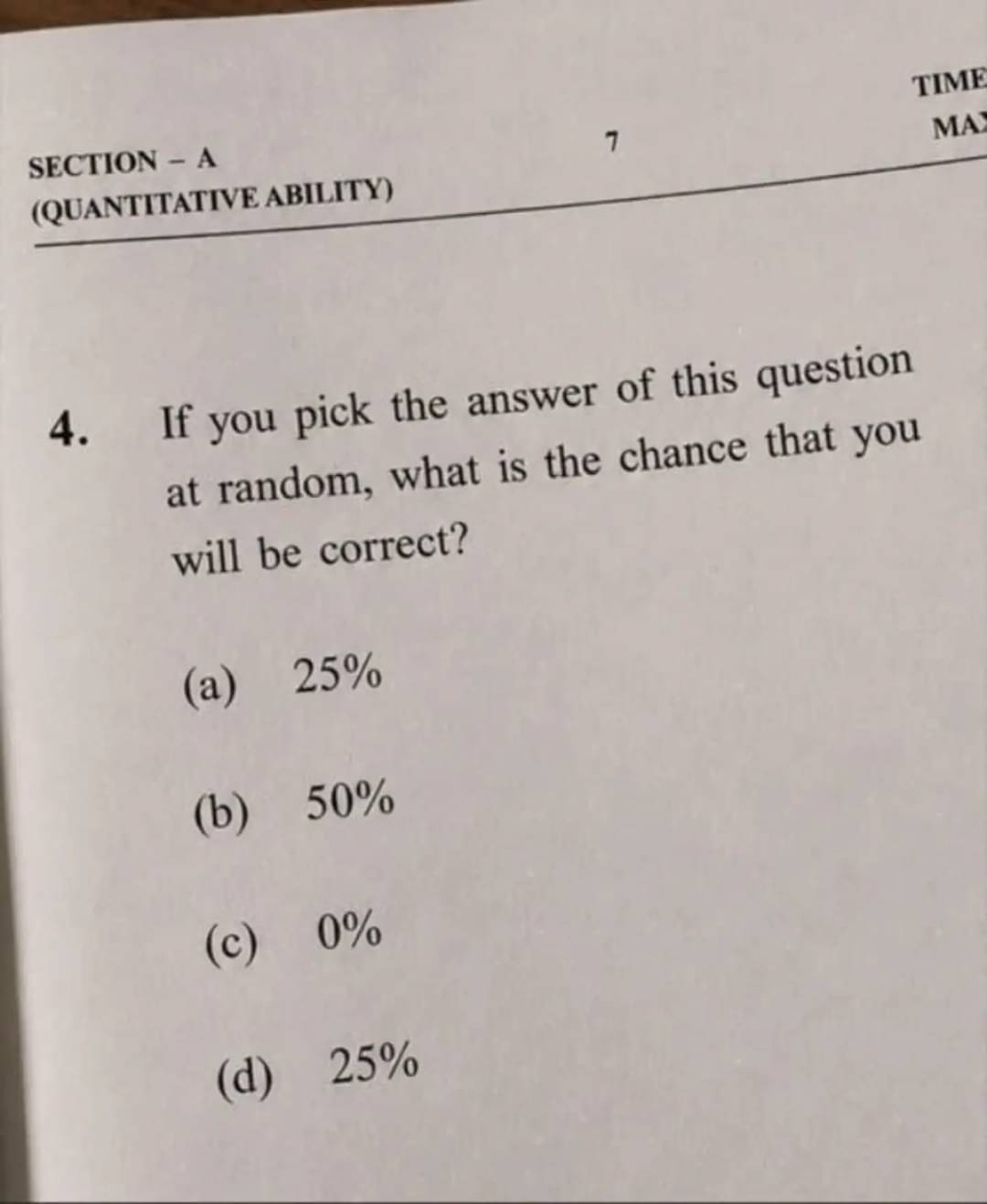
Couldn't you argue that 0% is correct?

It's a paradox, no of the answers can be correct, so the chance that you pick the correct one is 0%.

Sure, by picking it, it makes it wrong, but you don't care about that.

If you ran a infite monte carlo test on it, you'd end up with 0% correct answers.

Sure, picking the zero makes it not true again, but you don't care about that - it prooves that the statistical test holds.

  • source
  • hideshow 8 child comments
  • [–] 25 points 3 months ago

    Nah it's a paradox. There's no such thing as just a freestanding Monte Carlo test that you can just "run" - you do actually need to define enough parameters to make it tell you anything.

    This kind of self-referential stuff feels like a proof of Gödel's incompleteness theorems with extra steps.

  • source
  • parent
  • [–] 11 points 3 months ago (5 children)

    The trick is that there is no paradox, only the implication of one. 'If' being the key word - you're not actually being asked to answer randomly, but you are being subtly trolled.

  • source
  • parent
  • hideshow 5 child comments
  • [–] 5 points 3 months ago (4 children)

    You do not need to pick at all for the paradox to exist. If either A or D is correct, the other is also correct, and the random odds of selecting the correct answer should have been 50%. This is a contradiction. Neither A nor D can be the correct answer.

    If B is correct, the random odds of selecting it is only 25% - a contradiction, so B cannot be correct. Likewise, if C is correct, there is a 25% chance of randomly picking C. C is also not correct.

    None of the four answers is correct, so there is a 0% chance of randomly picking the correct answer. C is correct, contradiction, C is not correct, C is correct, is not, is too, etc.

    The paradox is resolved by knowing the the scantron answer key has A selected. D is not sufficiently identical to A in javascript, so only the students that randomly guessed the correct answer will get credit.

    Because the paradox can only be resolved with either A or D as the selected answer, well informed students picking randomly would have a 50% success rate.

  • source
  • parent
  • hideshow 4 child comments
  • [–] 2 points 3 months ago (3 children)

    But why is C a contradiction? I'm not randomly picking it.

  • source
  • parent
  • hideshow 3 child comments
  • [–] 2 points 3 months ago (2 children)

    Because your c is their c. If you were right then those randomly choosing test takers are also right.

  • source
  • parent
  • hideshow 2 child comments
  • [–] 3 points 3 months ago*

    If you ignore self-referential nature of the question and stop the iteration at some point, sure, you can argue that any answer is correct.

    If you ran a infite monte carlo test on it, you’d end up with 0% correct answers.

    That would mean your Monte Carlo test is set up incorrectly because at least 1/4 of the results of the test would be the "correct" answer as per your own argument, thus invalidating it.

  • source
  • parent