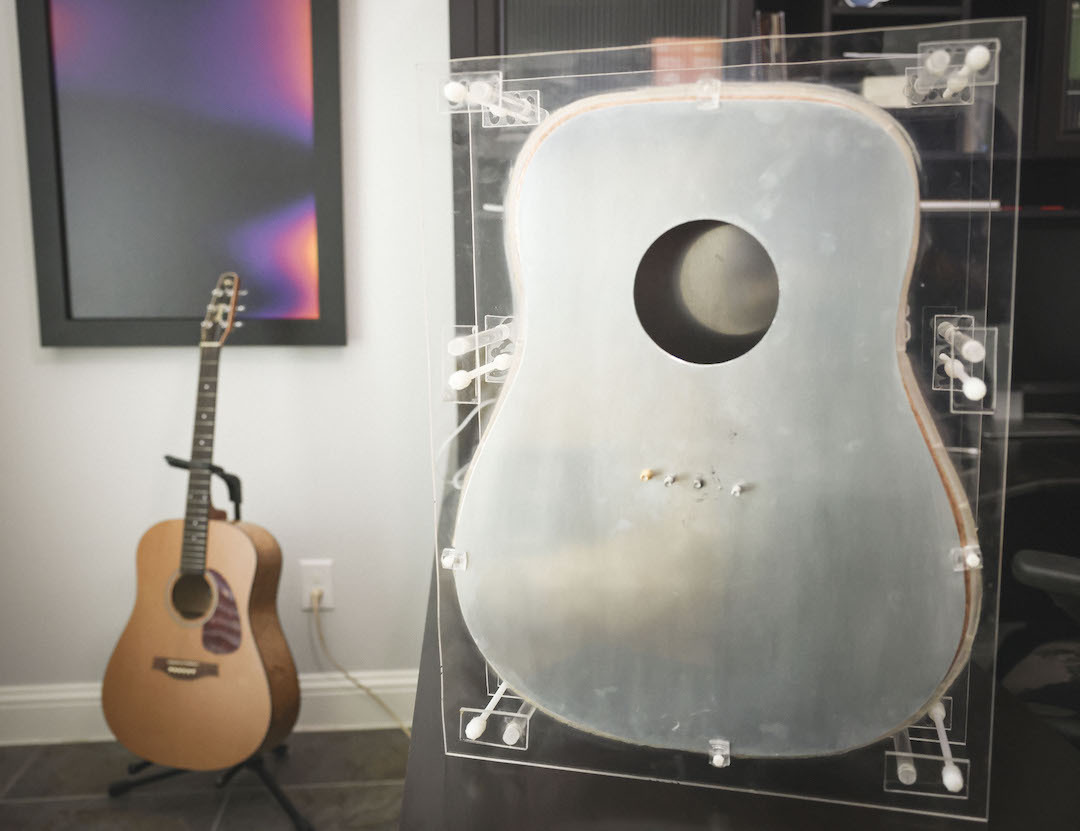
I created a new kind of guitar that y'all may be interested in. The photonic guitar uses the resonance of electricity and light to create music in the same way an acoustic guitar uses the resonance of vibration and acoustic waves. I started research on this instrument as a physics undergrad and focused on the topic for my Ph.D. After graduating, I spent time doing space science research for government agencies like NASA and the DoD. I quit being a professor a few years ago so I could resume research on my photonic guitar. We can't hear this instrument directly, for a variety of reasons, so I've created a plugin that utilizes measurements of these instruments to recreate their musical output as an effect for electric guitars. While the photonic guitar shares the same kind of physical foundation as an acoustic guitar, the photonic guitar is capable of a broader array of musical effects. I've linked to a demo of an electric guitar, played through the photonic guitar plugin, and connected to the drive channel on a fender amp. The photonic guitar pushes the existing distortion into a new regime. https://cosmicstudio.io/wp-content/uploads/2026/02/Demo-2-Master_1.mp3