cross-posted from: https://piefed.social/c/shermanposting/p/1825854/i-mean-she-s-right
cross-posted from: https://piefed.social/c/shermanposting/p/1825854/i-mean-she-s-right
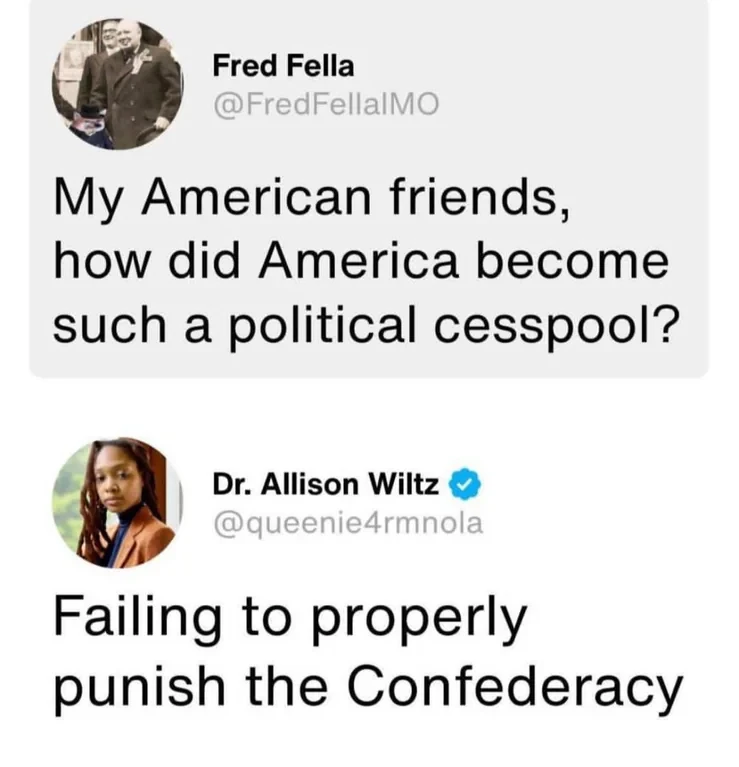
Oh for the love of God. Reducing the current political climate of the United States to “we didn’t punish the Confederate States of America hard enough” is the kind of historically illiterate, rage-bait nonsense that thrives online because it’s emotionally satisfying, not because it’s true.
Yes, Reconstruction after the American Civil War was mishandled. Yes, former Confederates regained power. Yes, Jim Crow laws were a moral stain and a catastrophic policy failure. All of that is real.
But to pretend that modern polarization, institutional decay, media fragmentation, algorithmic brain rot, primary-election extremism, and post–Citizens United v. FEC campaign finance insanity are somehow just delayed consequences of not lining enough people up against a wall in 1865 is obscene. It is cartoon history. It is Tumblr-tier cause-and-effect thinking.
America’s current dysfunction has proximate causes. Social media incentive structures. Partisan media silos. Gerrymandered districts. The aftershocks of the 2008 financial crisis. The political realignment of the South over decades. None of that is explained away by “we didn’t punish them hard enough.”
And let’s be honest about what that statement implies. It implies that mass punitive retribution 160 years ago would have somehow engineered a permanently virtuous republic. That is magical thinking. Nations are not firmware you can permanently patch with one decisive punishment event.
This is the kind of meme that sounds profound to people who consume history as morality theater instead of as institutional analysis. It’s outrage fuel. It’s not serious.
You want to critique Reconstruction policy? Fine. That’s a legitimate academic discussion. But boiling the entirety of 21st-century American political dysfunction down to one glib sentence about punishment is lazy, inflammatory, and historically unserious. We can do better than this. Or at least we should.