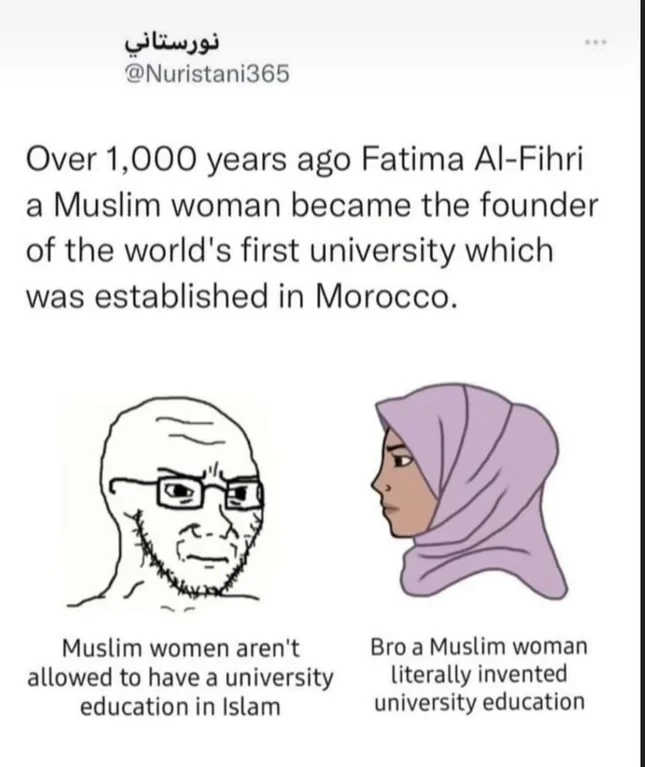
I don’t think that’s an accurate summary of the authors findings. He says she likely founded a mosque, and there is zero evidence from midevial sources and earlier, that she did anything more than that (it’s worth pointing out that her very existence is disputed by some historians because there are no references to her until centuries after her death). It’s impossible to prove a negative, but there is no evidence the mosque operated as either a library or a university at the time of its founding.
The issue is that mosques in that period are synonymous with schooling and text storage in the context of North African Islamic polities. The objection then, necessarily, is either "It's not certain that it taught the 'right' subjects to be a university immediately, therefore, we can dismiss Fatima as founder" or "Storage of academic and literary texts only counts as having a library if it's a specialized building, otherwise it's just a sparkling shelf."
So again, I can’t debunk this- nobody can - I just think it’s pretty flimsy. I could claim the world’s first university was an Egyptian temple, because they probably taught things there.
Some issues with this:
You could... if there was an Egyptian temple in continuous usage to the modern day that you could point to, with a long and uninterrupted history of operating as an institute of learning that has the features we generally recognize as belonging to a university.
Egyptian temples were used for textual storage (mostly records), but largely not teaching. Medieval Islamic mosques had a very core focus on learning, not just Friday Prayers and the Quran.
Al-Qarawiyyin is decisively recognized as a university now; the question of whether it 'counts' as a university is settled, the only question, then, is should the founder who created an institute for the purpose of learning, teaching, and information retention, be recognized as its founder, or should they not for some arbitrary criteria that we wouldn't apply to any other institution or founder?
I dont think it’s fair to say people are being overly pedantic because she was a Muslim women when the only reason this is getting shared in the first place is because she was Muslim woman.
It's entirely fair to say people are being overly pedantic because she's a Muslim woman when it's shared because she's a Muslim woman. How that does follow?
If I brought up a Black inventor who made something in a way that we would recognizably understand as having invented something, and the response was "Well that Black inventor didn't REALLY invent it, the concept and previous prototypes were already there", would it be unfair to point out that that's a pedantic position, simply because the inventor was brought up because he was Black? What about if the person making the response recognized other inventors as normal, even though almost all of them had established concepts and prototypes which came before them? Would you dismiss any possibility of pedantry being related to racism in that case?