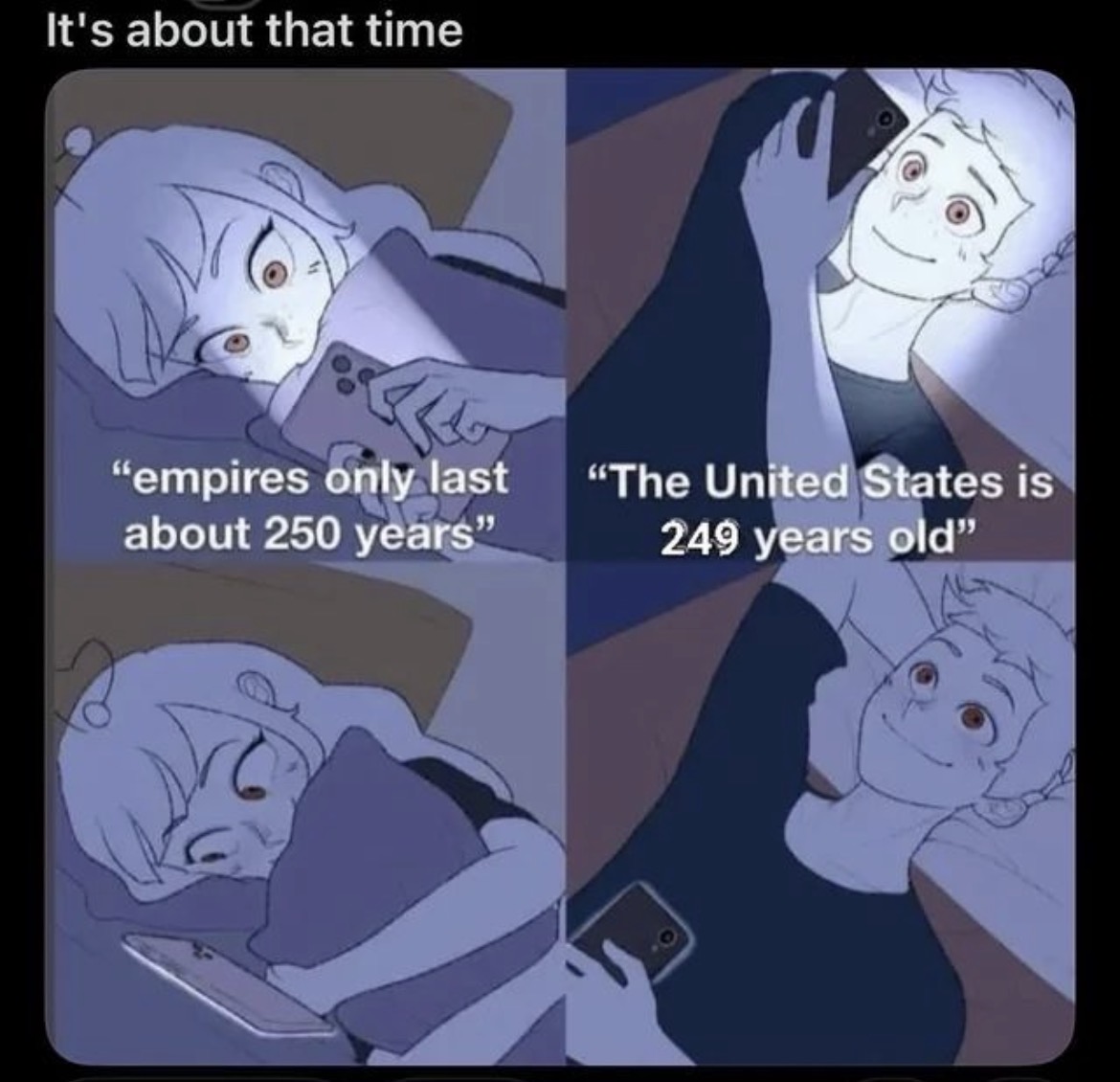
▲ 484 ▼ Any minute now (files.catbox.moe) submitted 9 months ago by mudkip@lemdro.id to c/memes@lemmy.ml 39 comments fedilink hide all child comments 1
[+] umbrella@lemmy.ml 11 points 9 months ago* (last edited 8 months ago) (9 children) [deleted] permalink fedilink source hideshow 9 child comments replies: [–] LemmyKnowsBest@lemmy.world 6 points 9 months ago Thanks for trying to buy us a little more time. permalink fedilink source parent [–] arctanthrope@lemmy.world 4 points 9 months ago (6 children) so you're saying going to war against a neighboring nation to expand your territory is not what an empire does? permalink fedilink source parent hideshow 6 child comments replies: [+] umbrella@lemmy.ml 1 point 9 months ago* (last edited 8 months ago) (4 children) [deleted] permalink fedilink source parent hideshow 4 child comments replies: [–] arctanthrope@lemmy.world 2 points 9 months ago (3 children) the "neighboring nation" I was referring to were the indigenous people. North America was not a blank slate before Europeans arrived. "manifest destiny" was imperialism permalink fedilink source parent hideshow 3 child comments replies: [+] umbrella@lemmy.ml 0 points 9 months ago* (last edited 8 months ago) (3 children) [deleted] permalink fedilink source parent hideshow 3 child comments replies: [–] arctanthrope@lemmy.world 1 point 9 months ago (2 children) and my question is why do you think that's not a form of imperialism permalink fedilink source parent hideshow 2 child comments replies: [+] umbrella@lemmy.ml 0 points 9 months ago* (last edited 8 months ago) (2 children) [deleted] permalink fedilink source parent hideshow 2 child comments replies: [–] arctanthrope@lemmy.world 2 points 9 months ago (1 child) so, just walking through your own argument as I understand it: situations that are similar to the treatment of indigenous North Americans by the US can be considered imperialism, if it's done by one nation to another nation. but the actual treatment of indigenous peoples by the US doesn't meet that condition. the result of that syllogism must be: between the US and the indigenous peoples, one of them is not a nation. I assume you're not saying that the US is not a nation. so the conclusion must be that the indigenous North American peoples were not a nation, or multiple nations; that there was no political or societal organization in the Americas before Europeans came. is that what you mean, or have I misunderstood? permalink fedilink source parent hideshow 1 child comment replies: [+] umbrella@lemmy.ml 2 points 9 months ago* (last edited 8 months ago) (1 child) [deleted] permalink fedilink source parent hideshow 1 child comment replies: [–] arctanthrope@lemmy.world 4 points 9 months ago ok I see. my understanding of imperialism is that it encompasses both of those, meaning broadly, expansion of influence, especially (but not necessarily) by claiming areas of land, in order to gain control of resources currently held by others. but I agree, there are two types within that, and the distinction between them is whether the people currently occupying the land (or in particular their labor) are part of the resources that the empire is trying to claim permalink fedilink source parent load more comments (-1 replies) load more comments (-1 replies) load more comments (-1 replies) [–] orc_princess@lemmy.ml 2 points 9 months ago (1 child) The US was very unremarkable globally compared to Britain or France for example, people thinking it wasn't dominant enough to be an empire doesn't mean they think it wasn't cruel or expansive permalink fedilink source parent hideshow 1 child comment replies: [–] Bloomcole@lemmy.world 1 point 9 months ago They terrorized and looted plenty of the world in the 19th century already. permalink fedilink source parent load more comments (-1 replies) [–] Rcklsabndn@sh.itjust.works 3 points 9 months ago Yeah, wasn't much of a world power until WW1. permalink fedilink source parent
[–] LemmyKnowsBest@lemmy.world 6 points 9 months ago Thanks for trying to buy us a little more time. permalink fedilink source parent
[–] arctanthrope@lemmy.world 4 points 9 months ago (6 children) so you're saying going to war against a neighboring nation to expand your territory is not what an empire does? permalink fedilink source parent hideshow 6 child comments replies: [+] umbrella@lemmy.ml 1 point 9 months ago* (last edited 8 months ago) (4 children) [deleted] permalink fedilink source parent hideshow 4 child comments replies: [–] arctanthrope@lemmy.world 2 points 9 months ago (3 children) the "neighboring nation" I was referring to were the indigenous people. North America was not a blank slate before Europeans arrived. "manifest destiny" was imperialism permalink fedilink source parent hideshow 3 child comments replies: [+] umbrella@lemmy.ml 0 points 9 months ago* (last edited 8 months ago) (3 children) [deleted] permalink fedilink source parent hideshow 3 child comments replies: [–] arctanthrope@lemmy.world 1 point 9 months ago (2 children) and my question is why do you think that's not a form of imperialism permalink fedilink source parent hideshow 2 child comments replies: [+] umbrella@lemmy.ml 0 points 9 months ago* (last edited 8 months ago) (2 children) [deleted] permalink fedilink source parent hideshow 2 child comments replies: [–] arctanthrope@lemmy.world 2 points 9 months ago (1 child) so, just walking through your own argument as I understand it: situations that are similar to the treatment of indigenous North Americans by the US can be considered imperialism, if it's done by one nation to another nation. but the actual treatment of indigenous peoples by the US doesn't meet that condition. the result of that syllogism must be: between the US and the indigenous peoples, one of them is not a nation. I assume you're not saying that the US is not a nation. so the conclusion must be that the indigenous North American peoples were not a nation, or multiple nations; that there was no political or societal organization in the Americas before Europeans came. is that what you mean, or have I misunderstood? permalink fedilink source parent hideshow 1 child comment replies: [+] umbrella@lemmy.ml 2 points 9 months ago* (last edited 8 months ago) (1 child) [deleted] permalink fedilink source parent hideshow 1 child comment replies: [–] arctanthrope@lemmy.world 4 points 9 months ago ok I see. my understanding of imperialism is that it encompasses both of those, meaning broadly, expansion of influence, especially (but not necessarily) by claiming areas of land, in order to gain control of resources currently held by others. but I agree, there are two types within that, and the distinction between them is whether the people currently occupying the land (or in particular their labor) are part of the resources that the empire is trying to claim permalink fedilink source parent load more comments (-1 replies) load more comments (-1 replies) load more comments (-1 replies) [–] orc_princess@lemmy.ml 2 points 9 months ago (1 child) The US was very unremarkable globally compared to Britain or France for example, people thinking it wasn't dominant enough to be an empire doesn't mean they think it wasn't cruel or expansive permalink fedilink source parent hideshow 1 child comment replies: [–] Bloomcole@lemmy.world 1 point 9 months ago They terrorized and looted plenty of the world in the 19th century already. permalink fedilink source parent load more comments (-1 replies)
[+] umbrella@lemmy.ml 1 point 9 months ago* (last edited 8 months ago) (4 children) [deleted] permalink fedilink source parent hideshow 4 child comments replies: [–] arctanthrope@lemmy.world 2 points 9 months ago (3 children) the "neighboring nation" I was referring to were the indigenous people. North America was not a blank slate before Europeans arrived. "manifest destiny" was imperialism permalink fedilink source parent hideshow 3 child comments replies: [+] umbrella@lemmy.ml 0 points 9 months ago* (last edited 8 months ago) (3 children) [deleted] permalink fedilink source parent hideshow 3 child comments replies: [–] arctanthrope@lemmy.world 1 point 9 months ago (2 children) and my question is why do you think that's not a form of imperialism permalink fedilink source parent hideshow 2 child comments replies: [+] umbrella@lemmy.ml 0 points 9 months ago* (last edited 8 months ago) (2 children) [deleted] permalink fedilink source parent hideshow 2 child comments replies: [–] arctanthrope@lemmy.world 2 points 9 months ago (1 child) so, just walking through your own argument as I understand it: situations that are similar to the treatment of indigenous North Americans by the US can be considered imperialism, if it's done by one nation to another nation. but the actual treatment of indigenous peoples by the US doesn't meet that condition. the result of that syllogism must be: between the US and the indigenous peoples, one of them is not a nation. I assume you're not saying that the US is not a nation. so the conclusion must be that the indigenous North American peoples were not a nation, or multiple nations; that there was no political or societal organization in the Americas before Europeans came. is that what you mean, or have I misunderstood? permalink fedilink source parent hideshow 1 child comment replies: [+] umbrella@lemmy.ml 2 points 9 months ago* (last edited 8 months ago) (1 child) [deleted] permalink fedilink source parent hideshow 1 child comment replies: [–] arctanthrope@lemmy.world 4 points 9 months ago ok I see. my understanding of imperialism is that it encompasses both of those, meaning broadly, expansion of influence, especially (but not necessarily) by claiming areas of land, in order to gain control of resources currently held by others. but I agree, there are two types within that, and the distinction between them is whether the people currently occupying the land (or in particular their labor) are part of the resources that the empire is trying to claim permalink fedilink source parent load more comments (-1 replies) load more comments (-1 replies) load more comments (-1 replies)
[–] arctanthrope@lemmy.world 2 points 9 months ago (3 children) the "neighboring nation" I was referring to were the indigenous people. North America was not a blank slate before Europeans arrived. "manifest destiny" was imperialism permalink fedilink source parent hideshow 3 child comments replies: [+] umbrella@lemmy.ml 0 points 9 months ago* (last edited 8 months ago) (3 children) [deleted] permalink fedilink source parent hideshow 3 child comments replies: [–] arctanthrope@lemmy.world 1 point 9 months ago (2 children) and my question is why do you think that's not a form of imperialism permalink fedilink source parent hideshow 2 child comments replies: [+] umbrella@lemmy.ml 0 points 9 months ago* (last edited 8 months ago) (2 children) [deleted] permalink fedilink source parent hideshow 2 child comments replies: [–] arctanthrope@lemmy.world 2 points 9 months ago (1 child) so, just walking through your own argument as I understand it: situations that are similar to the treatment of indigenous North Americans by the US can be considered imperialism, if it's done by one nation to another nation. but the actual treatment of indigenous peoples by the US doesn't meet that condition. the result of that syllogism must be: between the US and the indigenous peoples, one of them is not a nation. I assume you're not saying that the US is not a nation. so the conclusion must be that the indigenous North American peoples were not a nation, or multiple nations; that there was no political or societal organization in the Americas before Europeans came. is that what you mean, or have I misunderstood? permalink fedilink source parent hideshow 1 child comment replies: [+] umbrella@lemmy.ml 2 points 9 months ago* (last edited 8 months ago) (1 child) [deleted] permalink fedilink source parent hideshow 1 child comment replies: [–] arctanthrope@lemmy.world 4 points 9 months ago ok I see. my understanding of imperialism is that it encompasses both of those, meaning broadly, expansion of influence, especially (but not necessarily) by claiming areas of land, in order to gain control of resources currently held by others. but I agree, there are two types within that, and the distinction between them is whether the people currently occupying the land (or in particular their labor) are part of the resources that the empire is trying to claim permalink fedilink source parent load more comments (-1 replies) load more comments (-1 replies) load more comments (-1 replies)
[+] umbrella@lemmy.ml 0 points 9 months ago* (last edited 8 months ago) (3 children) [deleted] permalink fedilink source parent hideshow 3 child comments replies: [–] arctanthrope@lemmy.world 1 point 9 months ago (2 children) and my question is why do you think that's not a form of imperialism permalink fedilink source parent hideshow 2 child comments replies: [+] umbrella@lemmy.ml 0 points 9 months ago* (last edited 8 months ago) (2 children) [deleted] permalink fedilink source parent hideshow 2 child comments replies: [–] arctanthrope@lemmy.world 2 points 9 months ago (1 child) so, just walking through your own argument as I understand it: situations that are similar to the treatment of indigenous North Americans by the US can be considered imperialism, if it's done by one nation to another nation. but the actual treatment of indigenous peoples by the US doesn't meet that condition. the result of that syllogism must be: between the US and the indigenous peoples, one of them is not a nation. I assume you're not saying that the US is not a nation. so the conclusion must be that the indigenous North American peoples were not a nation, or multiple nations; that there was no political or societal organization in the Americas before Europeans came. is that what you mean, or have I misunderstood? permalink fedilink source parent hideshow 1 child comment replies: [+] umbrella@lemmy.ml 2 points 9 months ago* (last edited 8 months ago) (1 child) [deleted] permalink fedilink source parent hideshow 1 child comment replies: [–] arctanthrope@lemmy.world 4 points 9 months ago ok I see. my understanding of imperialism is that it encompasses both of those, meaning broadly, expansion of influence, especially (but not necessarily) by claiming areas of land, in order to gain control of resources currently held by others. but I agree, there are two types within that, and the distinction between them is whether the people currently occupying the land (or in particular their labor) are part of the resources that the empire is trying to claim permalink fedilink source parent load more comments (-1 replies) load more comments (-1 replies)
[–] arctanthrope@lemmy.world 1 point 9 months ago (2 children) and my question is why do you think that's not a form of imperialism permalink fedilink source parent hideshow 2 child comments replies: [+] umbrella@lemmy.ml 0 points 9 months ago* (last edited 8 months ago) (2 children) [deleted] permalink fedilink source parent hideshow 2 child comments replies: [–] arctanthrope@lemmy.world 2 points 9 months ago (1 child) so, just walking through your own argument as I understand it: situations that are similar to the treatment of indigenous North Americans by the US can be considered imperialism, if it's done by one nation to another nation. but the actual treatment of indigenous peoples by the US doesn't meet that condition. the result of that syllogism must be: between the US and the indigenous peoples, one of them is not a nation. I assume you're not saying that the US is not a nation. so the conclusion must be that the indigenous North American peoples were not a nation, or multiple nations; that there was no political or societal organization in the Americas before Europeans came. is that what you mean, or have I misunderstood? permalink fedilink source parent hideshow 1 child comment replies: [+] umbrella@lemmy.ml 2 points 9 months ago* (last edited 8 months ago) (1 child) [deleted] permalink fedilink source parent hideshow 1 child comment replies: [–] arctanthrope@lemmy.world 4 points 9 months ago ok I see. my understanding of imperialism is that it encompasses both of those, meaning broadly, expansion of influence, especially (but not necessarily) by claiming areas of land, in order to gain control of resources currently held by others. but I agree, there are two types within that, and the distinction between them is whether the people currently occupying the land (or in particular their labor) are part of the resources that the empire is trying to claim permalink fedilink source parent load more comments (-1 replies) load more comments (-1 replies)
[+] umbrella@lemmy.ml 0 points 9 months ago* (last edited 8 months ago) (2 children) [deleted] permalink fedilink source parent hideshow 2 child comments replies: [–] arctanthrope@lemmy.world 2 points 9 months ago (1 child) so, just walking through your own argument as I understand it: situations that are similar to the treatment of indigenous North Americans by the US can be considered imperialism, if it's done by one nation to another nation. but the actual treatment of indigenous peoples by the US doesn't meet that condition. the result of that syllogism must be: between the US and the indigenous peoples, one of them is not a nation. I assume you're not saying that the US is not a nation. so the conclusion must be that the indigenous North American peoples were not a nation, or multiple nations; that there was no political or societal organization in the Americas before Europeans came. is that what you mean, or have I misunderstood? permalink fedilink source parent hideshow 1 child comment replies: [+] umbrella@lemmy.ml 2 points 9 months ago* (last edited 8 months ago) (1 child) [deleted] permalink fedilink source parent hideshow 1 child comment replies: [–] arctanthrope@lemmy.world 4 points 9 months ago ok I see. my understanding of imperialism is that it encompasses both of those, meaning broadly, expansion of influence, especially (but not necessarily) by claiming areas of land, in order to gain control of resources currently held by others. but I agree, there are two types within that, and the distinction between them is whether the people currently occupying the land (or in particular their labor) are part of the resources that the empire is trying to claim permalink fedilink source parent load more comments (-1 replies)
[–] arctanthrope@lemmy.world 2 points 9 months ago (1 child) so, just walking through your own argument as I understand it: situations that are similar to the treatment of indigenous North Americans by the US can be considered imperialism, if it's done by one nation to another nation. but the actual treatment of indigenous peoples by the US doesn't meet that condition. the result of that syllogism must be: between the US and the indigenous peoples, one of them is not a nation. I assume you're not saying that the US is not a nation. so the conclusion must be that the indigenous North American peoples were not a nation, or multiple nations; that there was no political or societal organization in the Americas before Europeans came. is that what you mean, or have I misunderstood? permalink fedilink source parent hideshow 1 child comment replies: [+] umbrella@lemmy.ml 2 points 9 months ago* (last edited 8 months ago) (1 child) [deleted] permalink fedilink source parent hideshow 1 child comment replies: [–] arctanthrope@lemmy.world 4 points 9 months ago ok I see. my understanding of imperialism is that it encompasses both of those, meaning broadly, expansion of influence, especially (but not necessarily) by claiming areas of land, in order to gain control of resources currently held by others. but I agree, there are two types within that, and the distinction between them is whether the people currently occupying the land (or in particular their labor) are part of the resources that the empire is trying to claim permalink fedilink source parent load more comments (-1 replies)
[+] umbrella@lemmy.ml 2 points 9 months ago* (last edited 8 months ago) (1 child) [deleted] permalink fedilink source parent hideshow 1 child comment replies: [–] arctanthrope@lemmy.world 4 points 9 months ago ok I see. my understanding of imperialism is that it encompasses both of those, meaning broadly, expansion of influence, especially (but not necessarily) by claiming areas of land, in order to gain control of resources currently held by others. but I agree, there are two types within that, and the distinction between them is whether the people currently occupying the land (or in particular their labor) are part of the resources that the empire is trying to claim permalink fedilink source parent
[–] arctanthrope@lemmy.world 4 points 9 months ago ok I see. my understanding of imperialism is that it encompasses both of those, meaning broadly, expansion of influence, especially (but not necessarily) by claiming areas of land, in order to gain control of resources currently held by others. but I agree, there are two types within that, and the distinction between them is whether the people currently occupying the land (or in particular their labor) are part of the resources that the empire is trying to claim permalink fedilink source parent
[–] orc_princess@lemmy.ml 2 points 9 months ago (1 child) The US was very unremarkable globally compared to Britain or France for example, people thinking it wasn't dominant enough to be an empire doesn't mean they think it wasn't cruel or expansive permalink fedilink source parent hideshow 1 child comment replies: [–] Bloomcole@lemmy.world 1 point 9 months ago They terrorized and looted plenty of the world in the 19th century already. permalink fedilink source parent
[–] Bloomcole@lemmy.world 1 point 9 months ago They terrorized and looted plenty of the world in the 19th century already. permalink fedilink source parent
[–] Rcklsabndn@sh.itjust.works 3 points 9 months ago Yeah, wasn't much of a world power until WW1. permalink fedilink source parent
 1