Apparently a page from an internal IBM training manual. Some further attempts at source it
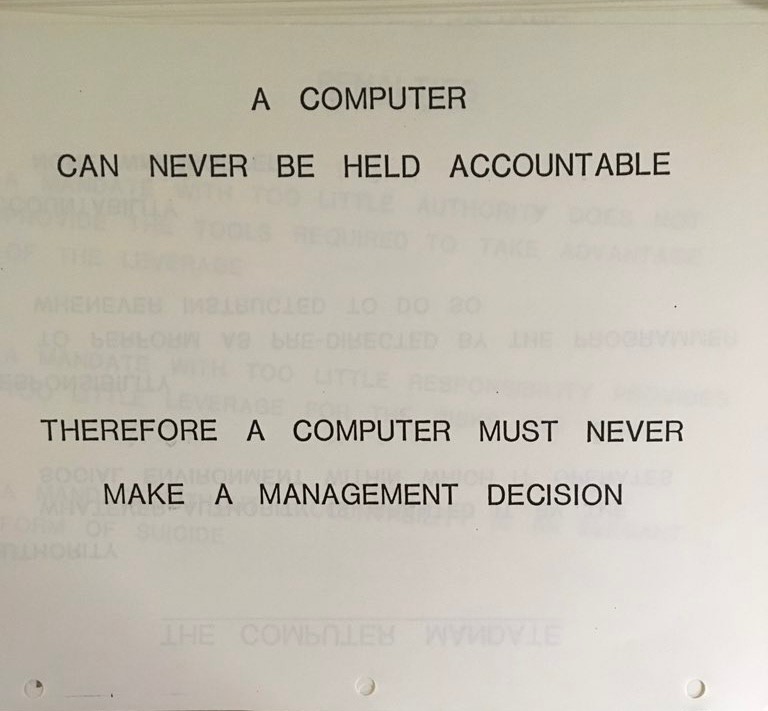
Ancient IBM wisdom (from 1979) that the bosses just straight up promptly forgot
you are viewing a single comment's thread
view the rest of the comments
[–] 5 points 1 year ago* (last edited 1 year ago) (6 children)

I generally agree.

Imagine however, that a machine objectively makes the better decisions than any person. Should we then still trust the humans decision just to have someone who is accountable?

What is the worth of having someone who is accountable anyway? Isn't accountability just an incentive for humans to not just fuck things up? It's also nice for pointing fingers if things go bad - but is there actually any value in that?

Additionally: there is always a person who either made the machine or deployed the machine. IMO the people who deploy a machine and decide that this machine will now be making decisions should be accountable for those actions.

  • source
  • hideshow 6 child comments
  • [+] 6 points 1 year ago (3 children)
  • [–] 2 points 1 year ago (1 child)

    Tbf that leads to the problem of:

    Company/Individual makes program that is in no way meant for making management decision.

    Someone else comes and deploys that program to make management decisions.

    The ones that made that program couldn't stop the ones that deployed it from deploying it.

    Even if the maker aimed to make a decision-making program, and marketed it as so. Whoever deployed it is ultimately the responsible for it. As long as the maker doesn't fake tests or certifications of course, I'm sure that would violate many laws.

  • source
  • parent
  • hideshow 1 child comment
  • [–] 2 points 1 year ago

    The premise is that a computer must never make a management decision. Making a program capable of management decisons already failed. The deployment and use of that program to that end is already built upon that failure.

  • source
  • parent
  • [–] 2 points 1 year ago

    I believe those who deploy the machines should be responsible in the first place. The corporations who make/sell those machines should be accountable if they deceptively and intentionally program those machines to act maliciously or in somebody else's interest.

  • source
  • parent
  • [–] 2 points 1 year ago (2 children)

    Imagine however, that a machine objectively makes the better decisions than any person.

    You can't know if a decision is good or bad without a person to evaluate it. The situation you're describing isn't possible.

    the people who deploy a machine [...] should be accountable for those actions.

    How is this meaningfully different from just having them make the decisions in the first place? Are they too stupid?

  • source
  • parent
  • hideshow 2 child comments
  • [–] 1 point 1 year ago* (last edited 1 year ago) (1 child)

    You can evaluate effectiveness by company profits. One program might manage a business well enough to steadily increase profit, another may make a sharp profit before profit crashes (maybe by firing important workers) . Investors will demand the best CEObots

    Edit to add: of course any CEObot will be more sociopathic than any human CEO. They won't care about literally anything unless a score is attached to it

  • source
  • parent
  • hideshow 1 child comment
  • This... requires a person to look at the profit numbers. To care about them, even. I'm not really sure what you're getting at.

    I think you're saying that computers can be very good at chess, but we are the ones who decide what the rules to chess are.

  • source
  • parent
  • load more comments (-1 replies)