The other fellas:

The other fellas:
Unless they are for spouting water, they're only grotesque socks.
thank you!
Argyle socks.
can you help out those of us who aren't as quick?
Oh god. High school flashbacks. Did anyone else have to pick why this is funny?
Lol this one took me a minute.
Some background on this comic:
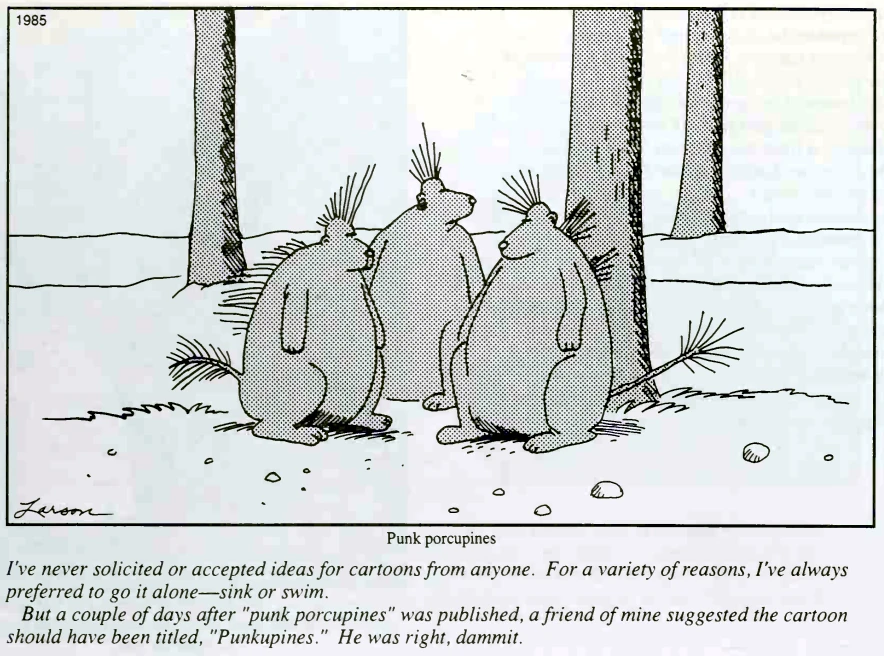
Transcript:
I've never solicited or accepted ideas for cartoons from anyone. For a variety of reasons, I've always preferred to go it alone―sink or swim.
But a couple of days after "punk porcupines" was published, a friend of mine suggested the cartoon should have been titled, "Punkupines." He was right, dammit.
This is clearly the artichokie ranch, you fellas missed all them artichokies on your way in?
Palaeontologists: "Write that down!".

Lead wouldn't ignite if some dripped on the outside of the container it was in. You could also move it separately from the container and just refill the container after each pour.
If that skelly was me it’d be Homo erectus hnnnng
According to https://www.tastesofhistory.co.uk/post/dispelling-some-myths-medi%C3%A6val-murder-holes
There are only a very small number of scattered references to the use of hot oil. It was prohibitively expensive, not often available in large enough quantities to be effective, would have been difficult to heat, problematic to transport around the parapets, and could have been a fire risk in itself.
There are far more accounts of boiling water, molten lead, and even heated sand being used.
And molten lead was easier to handle on the parapets? I wonder.
Biology lab daily experience.
Depends on how they store it and who's willing to handle it, I suppose. It was pretty common in castles to dedicate one wall to the latrines, which would protrude outwards over the wall, with the holes having no bottoms. So #1 and #2 would just drop and collect next to the wall, outside the castle. Before an impending siege or whatnot, you could maybe have people go down there, collect the leavings, and haul it up top to dump on the invaders.
In reality, I'm guessing that a mix of substances were probably used depending on place and circumstance. Just emptying the nights collection of chamber pots would work, which is probably what you were thinking of, right?
Meanwhile, paleontologists adopt thagomizer as the name of the thing.
Nobody would use oil when they have an endless always renewing supply of shit...
This looks like tar, which would have to come from far away tarpits.
That was my first thought, and my second was that such is maybe just a trope.
Faraway tarpits means effort, expense, and inconvenience. Plant-sap pitch might be more likely as something with a double-use for sealing various castle cracks (wood, stone).
There's also the fact that pouring boiling tar or pitch would be difficult all the way around-- to heat as necessary, pour, and later to clean up. Whereas oil would be easier all-around, methinks. And much better if it could be locally-sourced.
Some background on this comic:
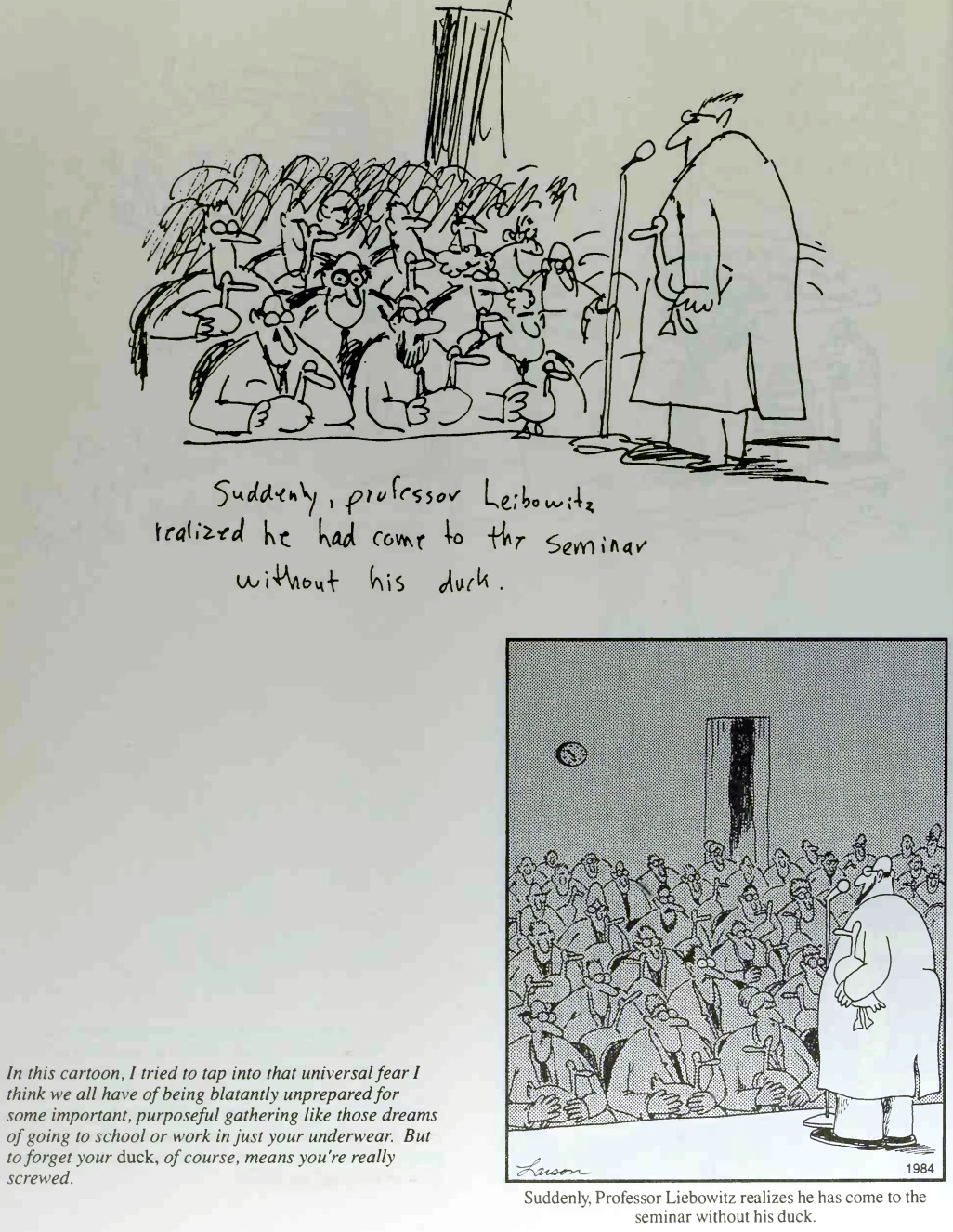
Transcript (commentary):
In this cartoon, I tried to tap into that universal fear I think we all have of being blatantly unprepared for some important, purposeful gathering like those dreams of going to school or work in just your underwear. But to forget your duck, of course, means you're really screwed.
Transcript (sketch):
Suddenly, professor Leibowitz realized he had come to the seminar without his duck.
Some background on this comic:
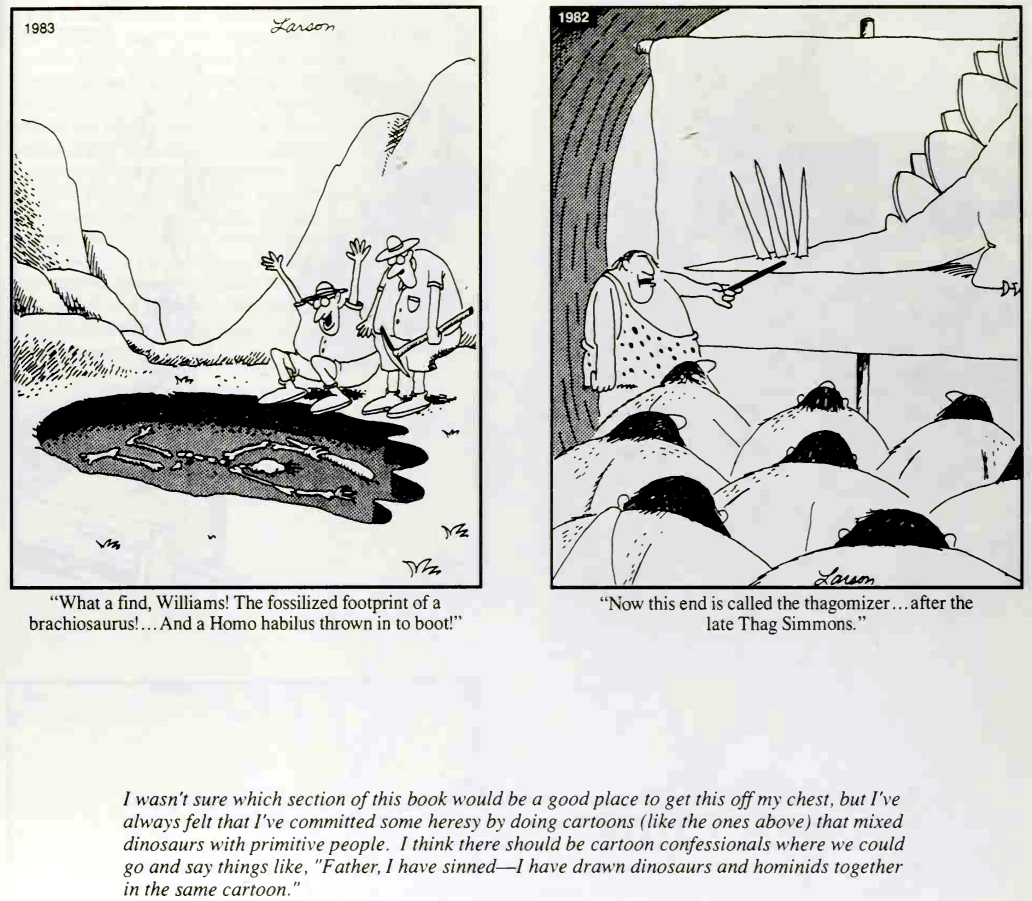
Transcript:
I wasn't sure which section of this book would be a good place to get this off my chest, but I've always felt that I've committed some heresy by doing cartoons (like the ones above) that mixed dinosaurs with primitive people. I think there should be cartoon confessionals where we could go and say things like, "Father, I have sinned―I have drawn dinosaurs and hominids together in the same cartoon."
This looks like tar, which would have to come from far away tarpits. Hot oil was likely molten animal fat.
Duckshit. Allll over the place.
Merlin potion.
I never really thought about it, but where did that oil come from, anyway? From the kitchens, perhaps? From lamp-oil storage? Stores that they'd actually keep around the battlements?
And where did the oil come from in the first place? Bacon or duck grease? Crude oil deposits? By way of crushing plants?