1


Transcript:

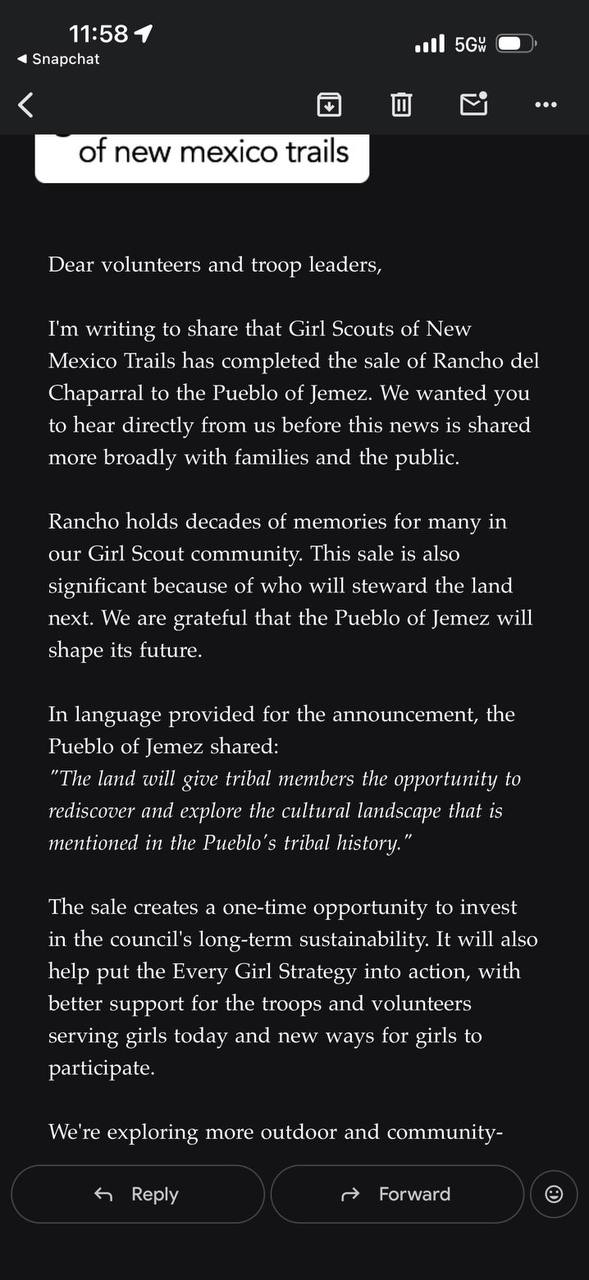
Dear volunteers and troop leaders, I'm writing to share that Girl Scouts of New Mexico Trails has completed the sale of Rancho del Chaparral to the Pueblo of Jemez. We wanted you to hear directly from us before this news is shared more broadly with families and the public.

Rancho holds decades of memories for many in our Girl Scout community. This sale is also significant because of who will steward the land next. We are grateful that the Pueblo of Jemez will shape its future.

In language provided for the announcement, the Pueblo of Jemez shared: "The land will give tribal members the opportunity to rediscover and explore the cultural landscape that is mentioned in the Pueblo's tribal history."

The sale creates a one-time opportunity to invest in the council's long-term sustainability. It will also help put the Every Girl Strategy into action, with better support for the troops and volunteers serving girls today and new ways for girls to participate.

It was announced earlier this year that GSNMT was unable to maintain their Rancho Del Chaparral Scout Camp and was having to sell it. I was very worried some rich asshole would buy it and turn it into some commercial hunting grounds.

I am very happy to hear that it was purchased by the Pueblo of Jemez.
2
3
4
5


just gonna leave this here for no particular reason...

Independent artist Benjamin Hammond Haggerty – better known by his stage name Macklemore – is the featured guest on this episode. He speaks vulnerably about his journey to understand the intertwined nature of white supremacy, colonization, oppression, land theft, and more. On the episode, Nick Tilsen and Macklemore delve into how they met at a rally for Palestinian liberation, politically educating their children, reckoning with past cultural appropriation, the fear white people have of losing power, landback movements across the globe, and more.

macklemore | lftp season 2 episode 2

6
7
8


TLDR: A new (2022) school in "rapid city" is bringing Lakota language and culture to local kids.

9
10
11
12


archived copies of the article

13
14
15
16


Snippet:

The repatriation process took four years to complete, involving many visits to the East Coast by Chumash representatives. It was the culmination of years of consultation and collaboration between the tribe and both institutions, said Marshall, who is the tribe’s NAGPRA representative.

“I promised my ancestors that I was gonna bring them back, and it took a while, but we did it,” she said. There were many difficult conversations, and turnover of staff at Harvard forced Marshall to retell her story repeatedly. The scale of the repatriation also prolonged the process.

Ultimately, though, Marshall said they created a relationship with both institutions that was transparent and genuine. 

“They learned from us; they listened. It did not come without conflict and hard conversations, but ultimately, they did the right thing,” Marshall said. “The people who are in place now respect cultural knowledge, and it ended up with our ancestors and their belongings coming home in a positive way, leaving behind respectful relationships.”

17


Chief Elliott paused for a long while before responding. “There’s going to be a day and time,” he said, “when we’ll sit with them, have the conversation of how we are going to work this out.” He sighed and then reiterated the point the Cowichan had made often: “We’re not kicking them off.”

When I put the question to Chief Thomas, over the phone, I could almost hear her eyes roll. “Obviously, the Cowichan have been really clear that they’re not targeting individual homes,” she said. “The judge said, ‘There is Aboriginal title here, but fee simple remains intact, and it’s up to the province to negotiate what that means.’ ”

Until the province does so, Thomas said, there’s not much more the Cowichan can do to assuage concerns. Thomas did, however, suggest a template for a positive outcome: “Take a look at the Haida ‘Rising Tide’ agreement.”

18


Even before history was recorded in Canada, First Nations, Métis and Inuit people practiced cultural burning, regular, carefully timed, low-intensity fires used to restore ecosystems, open travel routes, enhance food sources and reduce the fuel loads that now feed catastrophic wildfires.

Across B.C.’s Interior and Rocky Mountains, there were intentional fires “every five to 15 years” — “which meant that forests were much more wide open and they actually contained different species”.

“They are mostly sun tolerant species because you'd have a forest where the sun is actually reaching the ground beneath the canopy,” Grenz added.

However, settlers that first came to Canada brought with them colonial forestry practices that fundamentally altered those landscapes by suppressing cultural fire and transforming forests into dense, tree-dominated stands.

19


The Nature Conservancy (TNC) has announced the sale of The Great Cumbung, an internationally significant wetland in south-west New South Wales[, Australia].

Through an open and competitive bid process, Nari Nari Tribal Council (NNTC), a proven conservation land management entity, are the property’s new owners, with settlement now finalised.

[...] the agreement includes proposed permanent protection of the wetland through a 16,000‑hectare covenant, along with a commitment to seek Ramsar listing as a wetland of international importance

If it isn't relevant to c/landback, let me know

20


Thr plan is to destroy it in the hopes of extracting oil

21
22


The data center boom has roiled communities across the country, but on Native land, a Big Tech push for quick approvals has pitted the need for development against a history of exploitation.

23
 
 
  • California will transfer 136 acres of Blues Beach and Mendocino County bluffs to Kai Poma.
  • The move marks the first time Caltrans-managed land has been returned to Indigenous tribes.

Archived copies of the article:

You can also put a '.' after the '.com' and before the '/'

24
25
view more: next ›