Contact cement is great for putting soles back on cheap shoes and slippers, and I've seen it used on wood. I think it would work. Try a small patch overnight maybe? Remember to let it get tacky before bringing them together.
comments
This sounds like what cyanoacrylate (Crazy Glue) was made for.
I have some on hand. Maybe I’ll try it. Thanks for the suggestion.
What about PVC plumbing glue?
Really nasty dense sticky oil used as fuel for container ships and cruise ships.
What's fuel oil?
Are we updating Saddam Hiding to Putin Hiding?
Updated it for 2026:
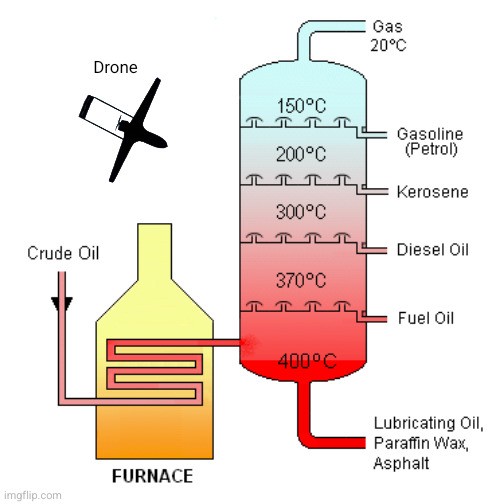
Huh... I figured it was more complicated. I'm going to start baking my own gasoline at home!
Yeah I think dilution is the intuition OP was missing too, well phrased
comment on
Quantum Dot Suite
Indeed, it is a database of what they have calculated. You can write to the authors from the contact link in the website (I'm not involved, just found it :)
It's https://en.wikipedia.org/wiki/Law_of_mass_action mostly; also for cross-linking, polymer chunks should be brought close to each other to make better bonds. Wood will absorb the compound better when dry, as it'll have higher surface energy and no water trapped to be displaced as compound moves in.
The version I've used before penetrated really well on dry wood. If yours is water based, I'd assume the more moisture present, the weaker the bond, like diluting it.
comment on
Quantum Dot Suite
Damn this looks cool, but
I can't find band structures promised in title page.
The database is short of "massive", I wish there were the golden classics of Au, Si, etc.
The largest gallium arsenide particle in the library seems to be messed up quite badly. I kind of suspect there is no solution stability check in this web tool.
comment on
Oxygen made from Moon dust for first time
[Blue Origin] released footage from inside the machine, which is housed at the Space Resources Centre of Excellence in Los Angeles, showing bubbles of oxygen emerging from the melted regolith.
The reactor relies on electrolysis – a chemical process that uses direct electric current to split compounds into their basic elements.
The Moon dust is melted to 1,600C and then a current passes through, which separates the metal and silicon ions from the oxygen ions to which they were bound.
The positive metal and silicon ions migrate to one electrode and the negative oxygen ions to the other, where the gas bubbles out and can be collected to be used as air or propellant. Metals sink to the bottom.
The process can separate oxygen from metals such as iron, aluminium, and silicon.
Electrolysis of molten regolith seems pretty neat!
comment on
Periodic Table of the Elements
I love the black text on basically black background in dark mode, basically unreadable. Thanks color coordinators, no sense of legibility and visual contrast, well done! /s
Edit: Is 100% unreadable in Jerboa, black text on black background.
read about this stuff in a journal from 1930s. In German.
comment on
Can I throw away H2S-laced bentonite?
If it is stinky, it would get stinkier in an indoors bin once food waste gets in and starts fermenting and heating up; those rooms are not well ventilated usually.
That is, I'm assuming you have many bucketfuls of the stuff.
Dacha is perfect solution imo. Latrines have same stuff in them naturally, you won't make a difference. H2S is natural product of biowaste decay in anaerobic condition, and it is itself biodegradable. If you own the soil, you could also use it as soil modifier if you know what you are doing. Or pile it up, rains and bacteria will deal with soon.
comment on
Can I throw away H2S-laced bentonite?
Sorry for the late reply. Don't worry, I understand very well how contacting my government is going to go.
I live in Moscow, and have neither a car nor a license and nobody to help me with this, so the logistics of just dumping it off is complicated. I can't just dump a small bucket of a suspicious-looking smelly substance on the ground in the nearby forest where it'll be found, it'll get trivially traced back by DNA, and every corner here has a camera. It gets worse if I try to bring a shovel.
I've once crossed Bitsevsky Forest, which is a dense forest without infrastructure on foot across the thick part in the middle of winter and that experience have taught me there's always a good chance at least one other person is nearby.
I have reasons not to trust my nose anymore, so if it's attention-attracting kind of smelly, I can't ride public trains into the sticks and do it there.
My options as I see it are to dump it into an urban creek (get spotted doing something suspicious) or to bury it on a dacha, a gardening allotment loosely connected to me or just dump it into an ancient pit latrine located on it. Is that going to poison groundwater and local wells?
What's wrong with dumping it bit by bit into trash, coating it in a cat litter bentonite and making it look like a regular kitty litter?
comment on
Can I throw away H2S-laced bentonite?
Yep, let mother nature do her thing, which she does well
comment on
Can I throw away H2S-laced bentonite?
is there no way you could seal the leak yourself? its usually considered non-hazardous, but i dont know the rules in russia. If it were me, and knowing H2S being a very dangerous and noxious gas, I would throw it in the trash. especially if there is a worry of getting put into trenches. hopefully this gets fixed by your maintenance people
comment on
Can I throw away H2S-laced bentonite?
In Russia? Just dump it dude. Hazmat department would screw you up unless you are in one of the capitals or in science-city, and now probably even there.
Bentonite with sulfides is more or less naturally occurring stuff. Sulfur is probably well chemically bonded with whatever metal ions were there by now, it will stink but not nearly as much as original stuff; clay also has lots of surface for adsorption. You did a sane thing. Now dump it - just not in "indoors" trash container, drive it off.
comment on
Chemistry lab safety: gloves or no gloves
I never thought of it. My bachelors is in microbiology and I worked a bit in blood diagnostics and the gloves are also to keep from contaminating things so you definitely use them with that.
comment on
Chemistry lab safety: gloves or no gloves
Mostly disagree with your new dept here. It's true that, if everyone had perfect technique, perfect eyes, perfect sense of touch, perfect decision making, and perfect reaction speed, PPE would be a lot less important. But people don't, and reducing chemical exposure purely to a skill issue is nonsensical and hubristic. Accidents happen, and by definition there is always some unknown component of R&D that might manifest as splashes, loss of containment, etc, which gloves (and labcoats and goggles) may protect against. Furthermore, it's not just about one person's skills; without gloves, one must rely on labmates' collective hygiene and that there are no spilled residues on the outsides of the chemical containers.
To the point that gloves are ineffective: then the wrong gloves are being used. Glove manufacturers provide compatibilty charts, and SDSs give glove recommendations for more niche chemicals. Nitrile has okay enough compatibility to be the default, but chemical labs should stock other commonly needed kinds.
To the point that gloves reduce one's sense of touch, I think the decrease is minimal for standard-issue nitrile, though agree for thicker varieties like butyl which reduce dexterity.
To the point that gloves prevent one from noticing chemical exposure, again I disagree. Splash contact for solvents on gloves is pretty noticeable, though different from uncovered skin, and I find it much easier to see chemical residues against the clean monochrome of the gloves. As you mentioned, contaminated gloves should be removed ASAP to guard against breakthrough; without gloves, there is no breakthrough period, just immediate contamination of the skin.
Finally, gloves may protect you from chemicals, but they also protect the samples from you. Skin oils or microorganisms can cause issues, though I have found this more problematic for bio than chemistry.
comment on
Chemistry lab safety: gloves or no gloves
Nah, you should never wear gloves blindly, but fit them to type of hazards. There are published tables, preferably, use ones from your safety authority and ones from glove manufacturer. Misusing gloves is indeed a serious violation of safety codes and a hazard.
There is also anti-industrial common sense stance, but you wouldn't be asking this question if you respected that.
view more:
next ›