This made me smile. I like the perspective :) I have no idea if it's true or not, or how relevant the definition of a star is here. Now quickly, find cover, before anyone might come trying to correct this!
comments
comment on
Some thoughts on collective life
comment on
Some thoughts on collective life
Life came from the damn stars
Fun fact: I consider Earth a star as well so we're still literally on a star. :D
Hmm yeah you're right, it's not directly a nuclear process nor is it driven by cosmic expansion, but it's still somehow related to mechanical energy (i think), since basically black holes use their enormous gravitational force gradient to basically rip the vacuum apart and that way release energy. And gravitational energy is a kind of mechanical energy, i'd say.
Yes absolutely true. I've thought about this before. Thank you for explaining it so clearly
Thank you :D I can have my cake and eat it too!
Oh this is interesting! And it would be really cool to see if there's a correlation between someone's level and field of education and their preferred social media platform. Interestingly, biological and medical articles also use the (Name, year) style of citations. This makes me think there could be some confounding factors:
-
If you're in school (presumably post-secondary), your college or faculty might mandate a specific citation style for all student papers submitted for grading.
-
Similarly, the scientific journals themselves might mandate a specific citation style within the articles they publish.
-
And there might be a root cause to points 1 and 2. The way in which you included a doi for the tech citation but not the socio one makes me think the age of the scientific field also matters. Older fields perpetuate the name-centric style because that's what was in use before the 70s(ish). When research was still seen as an "individual" (white male-centric) pursuit and contributors were purposefully left out (cf. Watson & Crick omitting Franklin). Whereas more recent fields incorporated the more modern content-centric approach from the start.
And beyond the link with citation styles, I wonder if your preferred type of social media reflects if you experienced the Internet prior to the rise of people-centric platforms. Back when interactions between people occurred through content-centric platforms like forums, mailing lists, comment sections, or social bookmarking.
Edit: Reorganized some paragraphs for clarity, because it's 4 AM and I'm sleep-deprived.
I think you're right that nerds are more interested in topics and non-nerds might be more interested in people. Maybe it's just an introvert/extrovert thing?
Also happy cake day!
While not super relevant to earth, black holes are thought to slowly convert their mass into energy and radiate it off over a very long time (slower the bigger the thing is). Since what they are made of can't really be described as atoms anymore, this isn't really a nuclear process, and as far as I'm aware, this isn't driven by the universe's continued expansion either.

Is geothermal every mainly fission? I thought it was mostly residual heat from earth's formation. In your picture it is also expansion. Here I disagree because your argument only holds for hydrogen and helium. Everything else comes from exploding stars so the mass distribution of the earth (and moon) is also nuclear's wrongdoing.
I commented on this in another comment: Large-scale flat-area solar parks (called "utility-scale solar") are simply much cheaper (per kWh produced) than rooftop and parking-lot solar panels.

Im more talking about german style plugin balcony solar. The panels are normally hung off the side of the balcony and plugged into an outlet directly:
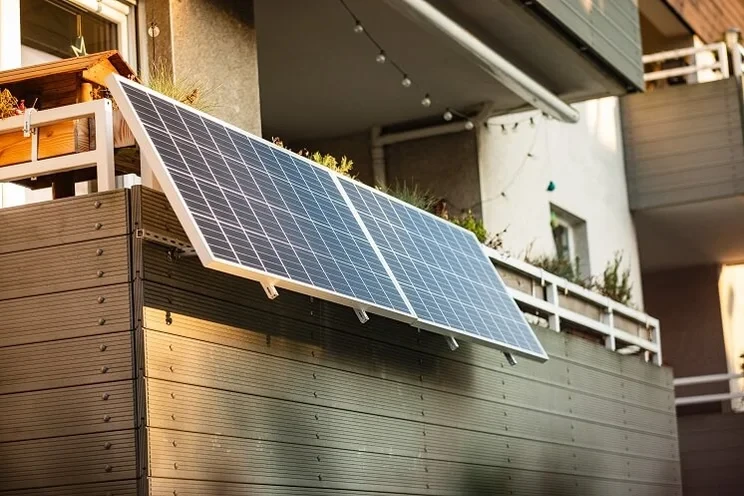
Im 100% with you on rooftop solar.
You gain plenty of postivies with that expense. Individual energy independence, system resilency, price stabalization, on and on. Lifespan of solar panels is 30+ years, and payback is often in the 4-7 year range. The numbers work out in your favor for a long time.
But okay, leaving out rooftop solar, and just going grid scale. With the renewable mix your city has now, and assuimg your intial power usage numbers are correct, you need 30% of the 150km to have the city running on 100% renewables. Thats 45 kilometers of nearby land. Seems way more doable than 150km, especially if its 10km here, 15km there, etc. Using a mix of agrivoltaics (farm + panels) and distressed land (old mining/industrial/military/etc) should make that even more viable.
That's definitely a lot of solar panels!
I really don't understand why fields are used for solar panels, instead of parking lots
I'm not a fan of rooftop solar because it's expensive. I remember reading it's about twice as expensive as large-scale flat-area ("utility-scale") solar arrays, in fact.
I would prefer it if the solar panels were installed on large-scale flat-area patches of land, close to the city. Because of cost and simplicity of maintenance. These factors matter because it makes the whole system easy-to-build and easy-to-maintain, which leads to a much faster solar energy transition, IMHO.
This. Leave people their balcony to enjoy, but I don't know why we haven't plastered solar panels on every roof in the city yet. Even if it's not enough to push us to 100%, it's better than nothing or are we using that space for anything else?
Whats the total surface area of Veinna rooftops? Square footage of balconys in the city? How nearby is 150km of rural land? How windy is the surronding area?
Im betting you can get 30% there with a mix of rooftop and balcony solar. The rest of the renewable influx can be from local wind or large scale solar farms. Worst case, you build long distance, low loss DC power transmission lines to interconnext to another clean grid within 1000 miles.
Clean power is best when its very local, but it doesnt have to be. As an example, Washington state exports hydroelectric power a 1000 miles to Los angeles, California. It can be done.
EDIT:
Looking into Viennas current power, it looks to get around 60% from hydro, 6% from wind, and currently 6% from solar. Yall are at 72% renewable right now. Some random info docs also put Vienna greenspace at 40% of the city, so that means you have 240km of some kind of private or public building. Knock off 100km for errors sake, and yall may even have roughly 150km of solar area availible, right now.
If you use just 18% of it for solar roofs/balconies, you will get to 90+% renewable. At that point smile and have a glass of local wine from one of your city vineyards. You did it.
Honestly thats fascinating and cool as fuck, thanks for sharing!