1
2


In Utah someone was jailed for posting a factual sign on a light pole.

3


Watch Footage of the Flock Search a Judge Ruled Unconstitutional

Jason Koebler

Oct 8, 2026 at 11:24 AM

"I saw her go by, and I just started running her info on Flock."

composite image showing stills from the two youtube videos linked below, one from the bodycam showing a laptop screen with a national map showing locations the suspect's vehicle was seen and the other from the police vehicle's camera showing the sheriff deputy who made the arrest

Body camera footage obtained by 404 Media reveals the first Flock camera searches ruled unconstitutional by a federal judge, and highlights how the system has turned otherwise mundane traffic stops into interrogations for drivers.

On Friday, we reported that a federal judge ruled the use of license plate reader systems in the arrest of a woman named Melissa Kyle to be an “unconstitutional warrantless search,” “indiscriminate mass surveillance,” and a violation of the driver’s Fourth Amendment rights. The judge in that case ruled that, even though Kyle had more than 91 pounds of meth in her vehicle, the police had no justifiable reason to search Flock for her license plate and no reason to suspect that her travel as shown on Flock’s system was suspicious. Therefore, all of the evidence from Flock and the search of her vehicle must be thrown out.

https://storage.ghost.io/c/0f/76/0f76b548-bc58-4f25-abc3-3f5ebca07da4/content/media/2026/10/unconstitutional-flock.mp4 (short edit from youtube videos)

The body camera and in-vehicle footage, alongside records from Flock and the Motorola ALPR system obtained by 404 Media shows how the use of license plate reader systems is being used to create probable cause where a person’s driving patterns are suspicious enough to pull them over.

404 Media obtained the footage with the help of one of our readers, who agreed to go to the U.S. District courthouse in Tulsa and purchase it from the clerk; the court did not make the footage available online even though it was entered as evidence in the case.

In the footage, which is from Tulsa County deputy sheriff Freddie Alaniz’s body camera, Alaniz is seen driving 60 miles per hour, one hand on the steering wheel, one hand on his laptop, searching Flock before he had even fully pulled over Alaniz. Alaniz had seen the car Kyle was driving had California license plates, and decided to pull it over for no reason other than it was from California, the court determined. The video shows that Alaniz told his colleagues that he was sitting on the highway and “saw her go by, and I just started running her info on Flock and Vigilant [Motorola’s ALPR system].”

“She actually didn’t have any [Flock] hits until just west of Amarillo, [Texas], so I thought I’d drive up,” he said, suggesting that he thought it was odd she was driving back from California. “I got her for a lane violation.”

In the footage, Alaniz tells Kyle he pulled her over ostensibly for changing lanes without a turn signal. Kyle tells Alaniz that the car is a rental, and he asks her to step out of the vehicle and get into his car while she looks up the rental information. While she is looking up the rental information, he tells her she is only going to get a warning, but proceeds to interrogate her about the travel while going through the car’s driving history on his in-car laptop.

Body camera footage obtained from the court: https://www.youtube.com/watch?v=pstRT4qsRfY

In-car footage obtained from the court: https://www.youtube.com/watch?v=nb-ZSY65VQQ

Kyle told Alaniz she had been visiting family in California from Missouri for a few days after separating from her husband. As she’s telling him this, Alaniz scrolls through a record of her travel history on his in-car laptop, which documents every time the car passed a Flock or Motorola automated license plate reader camera over the last 30 days. Visible on the screen, there are a total of 79 hits, and roughly 50 during the few-day period Kyle was renting it. The ALPR hits show the car leaving Missouri, driving through Oklahoma, Texas, New Mexico, Arizona, and entering California when she passed a Motorola ALPR camera in Topock, Arizona, on the border with California. They then show her essentially reversing the route, and driving back through Oklahoma. (Alaniz did not have access to ALPR hits from California; this may be because Flock drastically limited nationwide sharing from California ALPR cameras following illegal searches for immigration violators and a woman who had an abortion.)

Alaniz asks Kyle where she’s been and where she stayed, and compares it to the license plate camera records. He begins quizzing her: “Do you remember what day you left Missouri?,” he asks.

Alaniz clicks different ALPR hits on his map, each bringing up a photo of her car, a geographic location, and a timestamp of when she drove by the camera. The government’s lawyers later argued in court that minor discrepancies between what Kyle told Alaniz and what the ALPR data showed meant she was lying about where she’d been on which specific days and therefore gave Alaniz probable cause to search her vehicle.

Alaniz tells Kyle that he is giving her a warning for changing lanes without a turn signal, closes his laptop, then says he wants to ask her a few questions.

“Your short trip to California, I feel like. I don’t feel, I know from my training and my experience that people who do very short trips to California and come right back are transporting large amounts of drugs,” he says. “People who do that—not everybody, but some people do. With my training and experience, I feel that may be something going on here. May I search your car?”

She says no. Alaniz calls for backup, and says “You are being detained. You are not free to go.” In the footage, Alaniz tells a colleague that “she went to California for two days, kind of making stuff up when I ask her where she stayed at.”

He used Alaniz’s travel history, her “nervousness,” and the fact that she doesn’t recall every detail of her travel precisely as probable cause to search her vehicle, where he and his colleagues found 91 pounds of meth. Alaniz described this in the footage as “a motherlode,” and “a shit-ton of meth.”

But the way that he came to this conclusion was unconstitutional, U.S. District Court Judge Sara Hill ruled last week, and all of the evidence—including the car’s travel history and everything the police found during the search of the vehicle—must be disregarded in court as “fruit of the poisonous tree.”

It is often the case that unconstitutional, privacy-violating searches that are regularly done on everyday people doing nothing wrong are discovered in court cases in which serious crimes have occurred. In this particular case, Alaniz discovered what appeared to be meth trafficking, but he did so only after suggesting that an ordinary interstate travel pattern was somehow suspicious, and only after using the Flock and Motorola systems to show an incredibly detailed history of a person’s travel and to interrogate her about it.

https://storage.ghost.io/c/0f/76/0f76b548-bc58-4f25-abc3-3f5ebca07da4/content/media/2026/10/1008.mp4 scrolling through flock search results

Hill wrote “The factors that the government relies upon [to search Kyle’s vehicle] are the same type of circumstances that everyday Americans encounter on long road trips for many legitimate reasons. Many of us drive longer than we want to get to a desired destination, or to no destination at all other than the road and sights ahead. Many of us lose track of what exact day of the week it is when we are traveling, even if it is for just a moment. Many of us travel for myriad reasons (some better than others), cross state lines, pack too much, buy too much, smoke cigarettes, and rent cars. And many of us even get a bit nervous when talking to law enforcement.”

One of the problems with automated license plate reader systems is that they allow police to recreate not just a single person’s movements and travel history, but any driver’s movements and travel history. Documents filed with the court show the totality of both the Flock and Motorola records, and show timestamped, geographically mapped images of the vehicle multiple times per day, driving throughout the entire country. The records also highlight just how many jurisdictions and businesses have Flock and Motorola ALPR cameras, and how that data forms a nationwide network.

For example, Alaniz had access to a photo of the rental vehicle taken by a Lowe’s hardware store-owned camera in Missouri, various Texas state police-owned cameras, by the New Mexico State police, the Kingman police department. In a five-day period, the car was scanned more than 50 times by 11 different law enforcement agencies.

“Alaniz’s search in just the ALPR system provided him with more than 50 individual records of Kyle’s whereabouts across the country for an entire month,” Hill wrote. “The Court finds that because the ALPR systems Alaniz used to search Kyle’s historical location information intruded on her reasonable expectation of privacy in the whole of her physical movements, it was a search under the Fourth Amendment. Based on the information in the record, the only reason Alaniz conducted that search was because he saw her license plate was from California. That search was not supported by probable cause, and it was done without a warrant in violation of Kyle’s Fourth Amendment rights.”

The Motorola ALPR report shows that, after the car was impounded, it was scanned two more times on the back of a tow truck later that day.

4


Cross posted from https://news.abolish.capital/post/80424

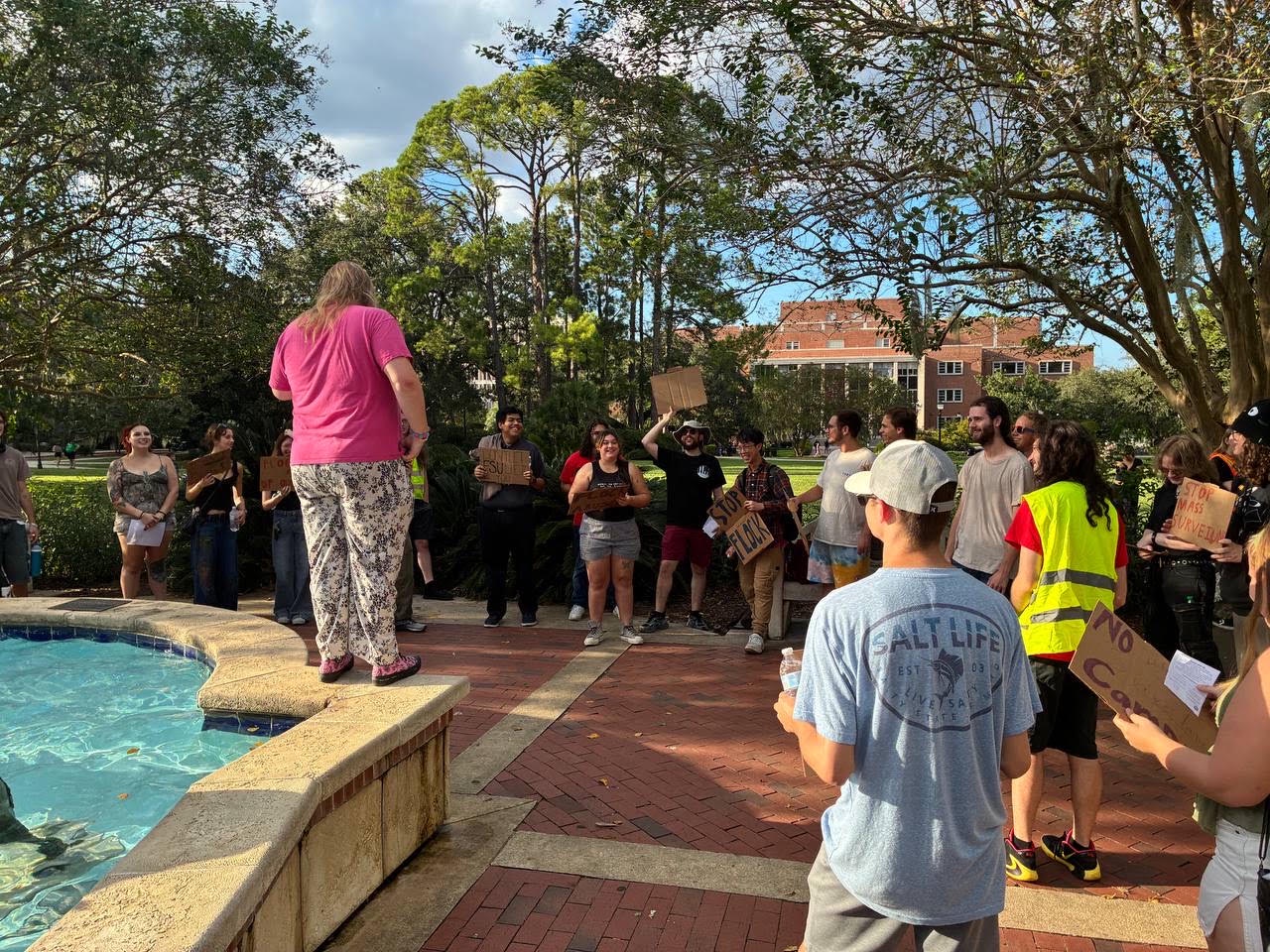
Tallahassee, FL – On September 17, Tallahassee Students for a Democratic Society gathered at Landis Fountain to demand an end to “Flock Safety” in the city. Around 30 students gathered holding signs against Flock mass surveillance, and speakers discussed the harmful effects of Flock on our community. Student slogans included “What do we want? Privacy! When do we want it? Now!” and “No justice, no peace! No racist police!”

On August 31, Governor Ron DeSantis announced the removal of LPRs (License Plate Readers) on state roads, with a 30-day deadline. County and city governments, such as Tallahassee, have followed up on this move in an atmosphere of opposition to Flock surveillance, with Tallahassee City Commission voting to suspend ALPRs (Flock and Motorola cameras) on September 9.

However, the city commission rejected a vote to cover these cameras, which would prevent them from recording. Leon County voted on September 15 to remove all ALPR cameras within 30 days.

These removals and suspensions have so far not included cameras in neighborhoods and campuses. The frequent misreports from ALRPs and their constant recording have been met with backlash, but the state campaign for mass surveillance has not ended.

Amy Farnum-Patronis, the senior director of university communications at FSU, reported vaguely to FSView that, “in light of current ongoing conversations on this topic and in the interest of being as transparent as possible, we can confirm that the core of FSU's campus does not contain Flock devices.”

The Tallahassee Police Department wants people to think they can regulate Flock. They claim to have “have implemented policies governing the professional and appropriate use of ALPR technology.”

Flock, a private company for mass surveillance, wrote in its own February 2026 Terms of Service that the company has “irrevocable, perpetual, worldwide license to (a) use and disclose Customer Data to provide the Flock Services.” Customer data, defined as whatever Flock cameras record, can be shared by Flock to local and federal agencies around the country for “investigative purposes,” even if TPD opts out of data sharing. Flock has frequently used this data to aid the ICE terror campaign.

As residents of Tallahassee know, our city has been a center for ICE deportations in Florida. On May 29, one of the largest ICE roundups in Florida occurred in Gaines Street, Tallahassee, detaining more than 100 construction workers. Tallahassee has also agreed to the 287(g) agreement, whereby police officers can take on ICE duties and racially profile the residents of Tallahassee.

At the SDS protest at Landis Fountain, a speaker and Tallahassee Immigrant Rights Alliance member said, “These cameras have been used by police for their own personal gain, to stalk and harass primarily women.” He pointed out, “We have no idea how they’re using this technology right now, because there is no transparency. Recently, the Florida governor made it illegal for undocumented students to even enroll in Florida public colleges. So, do you think that the only line of defense is going to be the admission’s office? What happens when they start to be even more muscular in their crackdown against students on campus? When they start to suspect that some brown kid might actually be illegal on campus?”

FSU students refuse to accept the vague sidestepping of FSU admin and refuse to back down on the fight against Flock. Suspension and ALPR removal are not enough, and SDS will keep up the pressure to protect the right to privacy for all residents of Tallahassee. SDS will demand Flock removal until every Flock camera in Tallahassee is removed.

#TallahasseeFL #FL #StudentMovement #FlockCameras #Flock #SDS #ImmigrantRights #Surveillance #ALPR

From Fight Back! News via This RSS Feed.

5
6


It would be kind of nice to see a website that tracks the cities that are the most anti-flock and who have had success in blocking flock. We see it all the time. People embrace technology and then they regret their purchases. Like all of these spy chatgipity cars. I mean, even the mechanics are quitting because they're not getting better pay and they're not even able to work on these cars without all these special tools. They are also designed to break... like they have a artificial expiration date. So when you buy these chatgipity spy cars for a fortune you shouldn't think that somehow you've made an investment. You're just a sucker that paid way too much for a subscription but this is all across the spectrum of American life. There are the High IQ people and then there is the turd herd. We need to figure out a way to get all the smart people together. Shit. Even your property value would go up. Possibly because people really want privacy in this time of secret police Salazar tyranny.

7


Historic opioid settlements were supposed to be a lifeline for underserved communities. But much of that money is flowing to law enforcement.

Get your news from a source that’s not owned and controlled by oligarchs. Sign up for the free Mother Jones Daily.

More than a dozen local law enforcement agencies across the country have used opioid settlement money to procure Flock cameras and other AI-powered automated license plate readers (ALPRs), an investigation by Mother Jones has found.

Settlement funds began flowing to states and localities in 2022, after major pharmaceutical companies agreed to resolve thousands of lawsuits over the industry’s role in the opioid crisis. Altogether, state and local governments secured more than $50 billion in funds, to be paid out over 18 years, from the various manufacturers, distributors, and pharmacies accused of fueling the deadly epidemic.

Public health advocates hoped the settlements would provide lifesaving resources for historically underserved communities ravaged by opioid addiction. But as the money has been disbursed, local officials have come under fire for putting crucial dollars toward policing instead of prioritizing addiction prevention, recovery, treatment, and harm reduction services: KFF Health News found that police spent settlement money on Tasers, firearm silencers, drones, and more; in West Virginia, some rural counties used the funds to pay off their jail bills.

“Whatever funds you’re spending on a camera, you’re not spending on getting someone into treatment.”

But little attention has been paid to how police departments have used those opioid funds to build out AI-powered surveillance networks like Flock, whose ALPRs have become increasingly popular with police even as they’ve drawn intense bipartisan pushback in the communities where they’ve been deployed. A review of meeting minutes, local reporting, state opioid expenditure disclosures, and invoices obtained via public records requests reveals that at least twelve sheriffs’ offices and police departments have since 2024 spent their opioid funds on Flock cameras. Another seven law enforcement agencies used the money to purchase similar ALPR technology from competitors Motorola, Axon, and Verkada.

In sum, Mother Jones found that 19 agencies in ten different states spent more than $920,000 in opioid funds on Flock and other ALPRs, a likely undercount given the inconsistency with which opioid settlement expenditures are tracked and disclosed across states and local jurisdictions.

In city council and county commission meetings, police sought to convince local officials that the cameras were a good use of the opioid money because they would help catch drug traffickers and reduce drug-related crimes. But Robyn Oster, director of policy at the nonprofit Partnership to End Addiction, said that this type of spending doesn’t honor the spirit of the settlements.

“It’s just really not the way to make the most impact in addressing addiction,” said Oster. “While $50 billion may seem like a lot of funds, once it’s divided up over 18 years and thousands of localities, a lot of places really aren’t getting that much, particularly given the scope of the crisis…Whatever funds you’re spending on a camera, you’re not spending on getting someone into treatment.”

At a June 2025 meeting in Sunnyside, Washington—an agricultural hub where roughly one in five people live in poverty—council members were thrilled by the prospect of spending their opioid settlement money on a Flock camera. Around $200,000 had been sitting, untouched, in the city’s coffers since 2022, even as the area faced a dire need for expanded treatment services: Yakima County lacks a medical detox center and has one of the highest overdose death rates in Washington state.

“We’ve had several people … in that strip mall next to the hotel … that have complained about drug use and things like that behind their business, and they’ve asked us to place a trailer there,” the Sunnyside police chief told city councilmembers. He requested the approval of $24,000 in opioid settlement funds to go to a one-year lease for a mobile Flock security trailer, which would integrate with the city’s existing Flock surveillance system.

“I was trying to find creative ways to pay for one because $24,000 wasn’t in our budget this year,” he added, “but we’ve got this opioid settlement money, and if we’re tying it to the drug use problem we’re having at these hotels, I think we can justify the expenditure there.”

The city council unanimously voted to approve the police chief’s request. “Can we afford two of them?” one councilmember asked with enthusiasm.

Thousands of miles away, in Ohio County, West Virginia, county commissioners also voted unanimously in favor of spending opioid money on Flock cameras. In September 2025, the commission approved the sheriff’s office’s request for six Flock ALPRs, totaling $57,900 for the first three years. According to meeting minutes, Chief Deputy Kent Lewis “said a representative from the company is able to come and give a presentation,” and “added that Walmart and Lowe’s use FLOCK, so we may be able to tie into their system as well.” When one commissioner asked whether the cameras were an appropriate use of the funds, the deputy sheriff responded that they would “[help] track drugs coming into our area.”

Three months later, Sheriff H. Nelson Croft Jr. gave an update on Flock to the commissioners. According to meeting minutes, the system logged 28,000 license plate readings on Black Friday alone. Ohio County has a population of around 40,000.

The surveillance industry has taken notice, explicitly encouraging cops to spend opioid money on the technology. A December blog post from the multinational security firm Leonardo called opioid settlement funds “a major new opportunity” for law enforcement to invest in license plate readers.

“Eligible spending categories vary by state,” the blog post noted, but approved uses often include “LPR technology due to its role in detecting vehicles tied to drug trafficking, overdose events, and fugitive recovery.” In June, 404 Media reported that Leonardo planned to add sensors to its ALPRs that “would also sweep up unique identifiers of mobile phones, wearables, and other Bluetooth-enabled devices” in passing cars, enabling the cameras to track not just cars but “the location of particular people.”

“The funds that are supposed to go to the public to help build back and reverse the nightmare that we lived through are being appropriated to use artificial intelligence to surveil us.”

Mother Jones identified four additional locations where local officials explored using opioid money to pay for Flock cameras but ultimately funded them through other parts of city or county budgets. In Green, Ohio, for instance, the city council approved the purchase of 14 Flock cameras in 2024, and the mayor stated at the time that the city could use $20,000 of opioid money to offset the cost. But Shelley Goodrich, Green’s director of finance, told me the city ultimately paid for the first two years of the contract using a different funding source. “We were planning to use Drug Task Force funds beginning in 2026; however, we have not made any payments in 2026,” she wrote. This month, the Green City Council voted against renewing its contract with Flock, citing concerns about privacy and oversight.

In Etowah County, Alabama, commissioners authorized two disbursements from the opioid settlement fund to pay for ten Flock cameras in August 2024 and March 2025, totaling $42,267. But minutes from October 2025 show that the sheriff department’s budget was increased by $42,267, “to reimburse the Opioid Settlement fund for the FY 2024 and FY 2025 annual contract for the Flock safety cameras.” The Etowah County Sheriff’s Office did not respond to questions about why it reimbursed the funds or whether it plans to use opioid money for future renewals of the Flock contract.

Opioid spending on police surveillance technology isn’t limited to ALPRs. Mother Jones also identified six locations that have used opioid settlement money to fund contracts with Peregrine Technologies, an AI-powered software platform that integrates law enforcement surveillance data from a variety of sources.

In October, the city of Campbell, California, approved a three-year, $71,500 annual contract with Peregrine using opioid settlement funds. A publicly accessible copy of the contract states that “the initial Customer Data sources and systems” integrated into Peregrine would include both Flock and Axon ALPRs, as well as Axon body cameras, police records, and the Axon Fusus intelligence platform. Two months later, the city council in Chicopee, Massachusetts, approved a five-year, $837,500 contract with Peregrine, to be paid using opioid funds.

Chicopee was among the western Massachusetts cities hit hardest by the opioid crisis, and in 2024, it still had the second-highest overdose rate in Hampden County. In meeting minutes, the Chicopee mayor noted there was “quite a bit of money in the opioid agreement account” and said that the Hampden County Sheriff’s Office supported increasing the Peregrine contract from three years to five years.

Peregrine itself has been proud to announce “new partnerships” with police departments in Cranston and South Kingstown, Rhode Island. “Both agencies leveraged opioid settlement funds to invest in their communities by strengthening interagency collaboration, operational awareness, and investigative workflows through Peregrine,” stated a July LinkedIn post from the company.

Revelations that local governments spent residents’ opioid money on Flock cameras has stoked furor in both Pensacola, Florida, and Monongalia County, West Virginia. In Pensacola, the mayor approved a two-year, $108,000 contract for 18 Flock cameras using opioid funds. After seven months of public backlash, the Pensacola City Council announced in June that it would no longer allow opioid money to be spent on Flock cameras when the contract next came up for renewal.

In Morgantown, West Virginia, constituents have shown up at the Monongalia County Courthouse every Wednesday morning to speak out against local officials’ support for Flock. In November, the Monongalia County Commission approved the sheriff’s request to use up to $180,000 of settlement funds to install 20 Flock cameras across the county. To some people in the area, this use of the opioid money felt like salt in an all-too-fresh wound.

“As somebody who has had family members directly affected by the opioid crisis, I find the use of these funds absolutely disgusting,” said Harrison York, a 25-year-old electrical engineering student at West Virginia University in Morgantown. “The thing that got my family members clean were methadone services, and that’s what this opioid settlement money should be used for.” He pointed to research showing that criminalization does little to help people struggling with drug addiction, and contended that further policing “would punish the poor and the working class, who are victims” of the opioid epidemic.

Adam Menear, a 45-year-old father born and raised in Morgantown, started a petition in March calling on the Monongalia County Commission to halt the installation of Flock cameras that has received more than 1,500 signatures to date.

“There is not a single human being inside the state of West Virginia who was born and raised here who has not been adversely affected by the opioid crisis,” Menear told me. “The new crisis is the fact that the funds that are supposed to go to the public to help build back and reverse the nightmare that we lived through are being appropriated to use artificial intelligence to surveil us.”

8
 
 
9


Cross posted from https://lemmy.ca/post/69489539

10


Cross posted from https://lemmy.ca/post/69488700

Technically, there were mixed views. Five is not zero. But journalism should communicate proportion as well as existence. Describing a hearing where roughly nine out of ten public speakers opposed the cameras simply as “mixed views” is like describing a 90–10 election result as evidence that voters supported both candidates. It is literally true and substantively misleading. More importantly, this framing obscures what opponents actually argued.

Police provide facts. The public provides feelings. That is not what happened Monday.

11


Authorities in the metro and across Minnesota say they’re seeing an uptick in damage to license-reading cameras, especially Flock cameras.

12
ICE PIG (pxlmo.com)
submitted 3 months ago by to c/DeFlock@lemmy.ml
 
 
13


An automotive journalist was boxed in by Plymouth police after a stolen plate mix-up based on a Flock camera system error. FOX 9's Corin Hoggard has more.

14


Cross posted from https://lemmy.wtf/post/46917300

Prescott Flock Cameras | March 26, 2024 Worksession

Piggie says oink oink oink

15


The growing grassroots movement against Flock cameras has entered a new phase. As citizens’ concerns have gone largely unheard by local governments, the people have begun taking action on their own: disabling, destroying, stealing and vandalizing Flock cameras. And if social media is any indication, it is inspiring the people.

16
17


They gonna ram it in. They create the problem to solve the problem. Boy oh boy they getting creative on those camera tricks.... @1:49... constitution be damned... there is nothing good left in the USA... nothing but a zombie corporation ran by pdfiles. We are slaves no doubt about that. It is like us plebs get no chances but the corpos get infinite forgiveness.

18


Cross posted from https://lemmy.ml/post/50588230

They gonna ram it in. They create the problem to solve the problem. Boy oh boy they getting creative on those camera tricks.... @1:49... constitution be damned... there is nothing good left in the USA... nothing but a zombie corporation ran by pdfiles. We are slaves no doubt about that. It is like us plebs get no chances but the corpos get infinite forgiveness.

19


...more Atlanta News First Investigates identified at least 19 Georgia cases in the past year involving alleged personal searches, including accusations of stalking. MORE ON THIS INVESTIGATION: atlantanewsfirst.com/2026/07/17/ai-audit-tool-flags-suspicious-police-searches-flock-misuse-cases-mount-georgia

20
21


Cross posted from https://lemmy.ca/post/67719605

22


A Pasadena police sergeant has resigned from the department while he remained under an active internal investigation, according to the Pasadena Police Department.

PASADENA, Texas – A Pasadena police sergeant has resigned from the department while he remained under an active internal investigation, according to the Pasadena Police Department.

The resignation comes as a Pasadena city council member exclusively told KPRC 2 that the sergeant was being investigated for allegedly misusing the department’s Flock Safety license plate reader camera system to track a fellow officer.

For months, KPRC 2 has been looking into allegations surrounding Sgt. Michael Palitz after receiving information about an internal investigation. As part of that reporting, KPRC 2 requested Palitz’s personnel records, receiving a heavily redacted file, and continued pressing city officials for answers.

During a Pasadena Civil Service Commission meeting in June, KPRC 2’s Rilwan Balogun spoke with Police Chief M.P. Jackson about the ongoing case after encountering him at the meeting.

When asked whether Palitz had been suspended after KPRC 2 submitted public information requests, Jackson said, “I don’t think the two are connected,” but declined to discuss the pending investigation.

“I can’t really discuss pending cases,” Jackson said.

When asked if there was anything else he could share, Jackson responded, “No, sir.”

Council member details allegations

Pasadena City Council Member Emmanuel Guerrero told KPRC 2 he believes the investigation centered on allegations that Palitz improperly accessed the city’s Flock camera system to monitor another officer.

“Based on what we gathered, [he] was using our camera system, our Flock system, to track and stalk a female officer,” Guerrero said.

When asked to clarify whether he was alleging Palitz was under investigation for misusing the Flock camera system and stalking a fellow officer, Guerrero responded, “correct.”

Guerrero said his understanding is that the system itself flagged repeated use of the account.

“To my understanding, it was an overwhelming use that the system itself flagged and notified that account associated to the officer,” Guerrero said.

KPRC 2 has not independently verified the specific allegations discussed by Guerrero, and Pasadena police have not publicly released details of the investigation.

Department confirms resignation while investigation continues

In a statement to KPRC 2, Pasadena Police Sergeant April Ontiveros, with the Administration & Media Relations Unit, confirmed Palitz resigned while the investigation remained active.

“Yes, he resigned while under investigation,” the statement said. “Regardless of his employment status, our investigation will continue in accordance with legal requirements until it reaches its conclusion. Additionally, our department does not release information on open/active personnel investigations to protect the integrity of the investigation.”

Palitz’s resignation does not end the department’s internal investigation, according to the department.

Questions about use of surveillance technology

Flock Safety describes its cameras as investigative tools designed to identify vehicles, not people.

According to the company:

“A Flock camera is a license plate reader camera built to identify vehicle details that may help generate investigative leads. That includes the license plate, along with attributes like make, model, color, and other visible characteristics. Flock cameras are not general-purpose surveillance systems designed to identify people. They are built to focus on the vehicle involved in an incident and the details that can help distinguish it from other vehicles on the road.”

Guerrero, who said he supported implementing the Flock system, said the allegations concern him because of the trust residents place in law enforcement.

“The people put their confidence in us to utilize systems that could support and protect the way of life, and to use it against certain individuals is a betrayal of our community’s trust,” Guerrero said.

KPRC 2 is not aware of any open criminal investigation or whether any case has been presented to the Harris County District Attorney’s Office.

KPRC 2 sought responses from city leaders

KPRC 2 reached out to Sgt. Michael Palitz on Friday seeking comment regarding his resignation and the allegations surrounding the investigation. As of publication, he had not responded.

KPRC 2 also emailed Mayor Thomas Schoenbein and city council members Bianca Valerio, Emmanuel Guerrero, Pat Van Houte, Jonathan Estrada and Dolan Dow seeking comment because they served on the city council in 2025 when Palitz was suspended and later returned to duty.

Council Member Pat Van Houte was the only person, other than Guerrero, to respond.

“I had not heard about this. The last I heard was two days ago, and Sgt. Palitz was still an employee at that time. I am not in a position to have the details as to why the sergeant resigned. I checked with the Mayor and he said your best contact would be Police Chief M.P. Jackson.”

23


Cross posted from https://lemmy.ca/post/67605879

24
25


Well said fellow citizen.

view more: next ›