[–] 2 points 3 days ago

They do/can, but it's not like you physically look like the opposite gender the moment that you decide you were assigned the wrong gender. People will give you looks or get upset if you look like a dude barging into the women's toilets, so (from what I've heard) it's a struggle during the transition period where you feel like you belong in one place but society wants you in another. Unisex toilets make this easy. I'm not familiar with toilets specifically reserved for trans people but I assume unisex is what's being referred to

  • source
  • parent
  • context
  • [–] 3 points 3 days ago (1 child)

    I mean, yes, but I'd add the qualifier "so long as it doesn't impact others". If you want to dump your trash in a communal area, it's imo a bit too easy to say that it's a free country and who am I to tell you not to do that. Maybe this sounds too obvious to spell out (to me it would have until recently) but I recently met two persons in unrelated places who really felt that nobody should tell them what to do because they didn't tell anyone else what to do either. As if we don't all share resources on this planet

  • source
  • parent
  • context
  • [–] 1 point 3 days ago* (last edited 3 days ago)

    Usually about 25 of the 30 questions in the voting adviser. I don't care if some party wants to take budget from primary schools and stick it in kindergartens instead or if we fund the F35 or whatever. I'm not a military plane expert nor work in educational finance but these are literally the questions they select to use as basis for your vote. Dudes, ask an expert! They'll probably tell you "don't know, but we can do a scale study to see which way works better"

    Whatever topic I know has a reasonable expectation of making more people sustainably happy is what I click, and then usually it tells me I haven't clicked enough answers for it to produce voting advice...

    Most 'current hot topics' are either unknowable with current information, or just wholly irrelevant to bigger problems like when we're going to reach net zero greenhouse gas emissions and stop discriminating people

  • source
  • [–] 1 point 4 days ago*

    Fwiw I do this in three languages. It's not just English. It's literally all spelled and pronounced partner and means partner. Somehow even the connotations stayed intact. There's probably more languages that I don't regularly speak that have it too

  • source
  • parent
  • context
  • [–] 2 points 4 days ago

    Small note: versifft afaik has a strong connotation that drenched does not have, so the translation sounds to me almost neutral whereas it's more like "filthy left-green-like" (or something — translations are hard!)

  • source
  • parent
  • context
  • [–] 2 points 4 days ago

    Tried to help someone who has a stalker and no tech literacy and everything (email, photos, documents, everything) in a Google account that the stalker can access. Got nowhere because Google doesn't let her control her own account, she sees spies everywhere by now (bad translation of an "open source licenses" menu sounded like "connected third parties" and she screenshotted page upon page of mysterious names) and can't live her life, and there is no new phone to start fresh on or other options to get this cleaned up without nuking the remaining data further. Felt defeated, but maybe there's another chance next week (the computer help sessions are weekly, people often don't come back if we didn't immediately find a solution). I'm going to be prepared for the next time someone has an issue like this 💪

  • source
  • [–] 2 points 3 weeks ago* (last edited 3 weeks ago) (3 children)

    Done 90 words now, bit annoyed that none of them were new to me even while I selected progressively higher levels (C2 for the last 15 or so). I definitely don't know the entire dictionary just yet 😅

    And it also just occurred to me that you're missing the gender that you're supposed to learn with the word, else you just end up having to learn everything twice. Which seems like a pretty basic omission 🤔

  • source
  • parent
  • context
  • [–] 2 points 3 weeks ago* (last edited 3 weeks ago) (4 children)

    What's the source for the data (ranking, definitions, parts of speech, examples, audio fragments, A1–C2 categorisation, ...)?

  • source
  • [–] 2 points 3 weeks ago (1 child)

    No engine noise, but also not having to pedal, just you and the forest. I love driving it at night as well :)

    Mapping with StreetComplete is my excuse to take it places, but I'm running out of places to map that can be reached either directly or by train (considering I also need to make it back before the trains decide it's sleepy time — I'd stay out overnight but more days than not there's work in the morning. Strange how that works :P)

  • source
  • parent
  • context
  •  

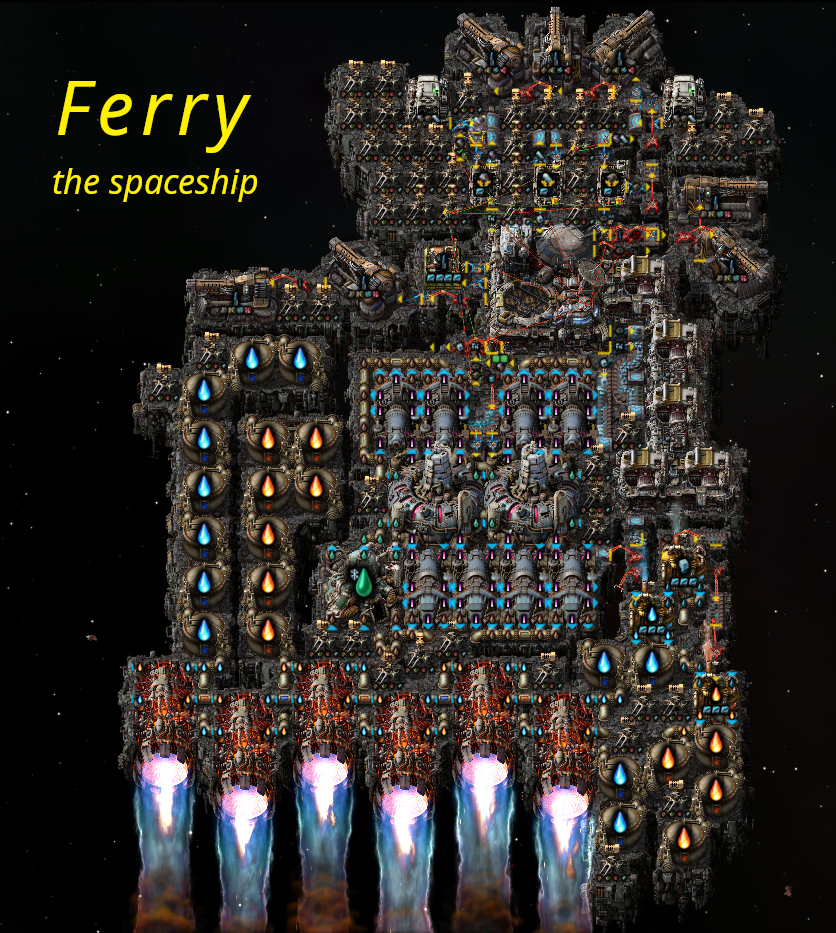
    Meet Ferry the Spaceship.

    When you need a quick one-off delivery, Ferry is your chauffeur. We hired him because there is no traffic or possibility of collisions in space. This makes him excellently suited for the job: fast, reliable, and no driver's license required.

    When this boat floors it, the first 100 km/s out of a planetary orbit are reached in less than a second. My trusty qalculater tells me that

    > 100km/s /1s to gees
     (100 kilometers/second) / (1 second) ≈ 10197.2 gees
    

    Being used to tens or perhaps hundreds of gs at most, I thought my calculation had gone wrong, but no: with one earth g at ~9.8m/s², these 100km/s² aren't a mere ten of those, there is an extra kilo of them.

    Ten thousand earth gravities. Fancy that pulling on your buttocks! Ferry's leap into interplanetary space is, however, no unparalleled feat. Desiring to put this number into context, my deep dive research (i.e., opening Wikipedia) landed me at this comparison table. Coming in at 10'400 g, a Mantis Shrimp's claw during predatory strike accelerates as fast as Ferry's six rocket engines.

    The next entry of the table is also of Factorial relevance: the electronics in military artillery shells is rated up to 15'500 g. I am glad I haven't pushed a little harder! Poor Ferry, his electronics broken, völlig losgelöst

    I hope this fun fact made your day just a little better :)


    The Factoriopedia lists one "/m" rate for each asteroid type at a given position on a space route, but you clearly have to kill more asteroids as you go faster so it cannot be "per minute" (Factorio uses /m to mean per minute elsewhere in the game). However, it cannot mean metre either because you travel at many kilometres per second: you'd get thousands of asteroids per second per type! Searching through the forums, Lemmy, and reddit, I didn't find an answer to this conundrum of space versus time

    I've now gotten around to figuring out how the spawn rate varies :)

    Method

    1. Let the ship fly at the indicated speed (V) for 10 minutes (plus margin, because the asteroids need a bit of time to move from spawn to the ship) between Solar System Edge and Shattered Planet
    2. Open the production stats window, set to 10 minutes, select the kills tab, and take a screenshot so that we can work with nonmoving values
    3. Calculate the ship's average position, namely: position at time of screenshot minus (5 minutes × V km/s)
    4. Look up the expected spawn rate at that position by linearly interpolating between the nearest values in the Factoriopedia (they are precise to 40 km, so we know the value at 0km, ..., 960km, 1000km, 1040km, etc.)
    5. Calculate the ratio between how many huge asteroids were killed per minute (per the kills graph) and how many huge asteroids should have spawned
    6. Plot that value on the graph as a percentage

    Results

    There seem to be two or three formulas in use: one for 10km/s and below (it appears as though this is in effect when your ship touches 10.xx km/s every few seconds, but that seems strange), one for a rapid but smooth transition (or maybe they blend the two other formulas together?), and then one for speeds above 15 km/s. The middle formula may also just be a blend of the other two, perhaps they average the result between 10 and 15 km/s (or apply a sigmoid or whatnot)

    • The formula for slow speeds seems to spawn 1.1x (or 10%) more asteroids as the speed doubles from 5 to 10 km/s (not many data points in this range; value is very approximate)

    • The formula for high speeds spawns about 1.5–1.7x more asteroids when you go 2x faster

    The Factoriopedia value isn't distance-based (one could think "/m" is a shorthand for "/10km" or so), because then it would have been 1:1 linear: when you cover twice as much distance per unit of time, the number of kills would double. It also isn't time-based, because then the graph should have shown a flat line at 100%. It appears to be a derivative of your ship's speed (and perhaps other factors, such as its width)

    Sorry for the sparse data above 50 km/s btw. I had spent a bunch of time and already pretty much gotten the answer when I realised that I could go back to an earlier save and do the same thing for an easier section of the route where the ship can safely fly faster. I collected just these two data points and, when that also looked close enough to linear, called it "good enough" =)

    Discussion/limitations

    1. I wonder if the Factorio developers made Promethium much more common if you fly slow, to make it easier to collect for players that didn't build a great ship

    2. Not all asteroids that spawn get killed, so the graph must be wrong in absolute terms, i.e., the actual spawn rate is higher than what I calculate using the "killed" statistic. My railguns' range about covers as far as the huge asteroids spawn out and I see that only a few on the edges (faded out, only visible when hovering over them) make it down the length of the ship, so the absolute number is probably not super far off. In any case, my personal goal was to figure out the relative number, not the absolute one

    3. Yes, I know these speeds are rookie numbers compared to some of the things I see online. But it's all my own work :). I purposefully don't look at other designs in detail because the satisfaction of figuring it out is the point of the game for me. The "not invented here" syndrome is a problem for my workplace, not my gaming experience :D

    Future work

    A. I'm also curious how platform width affects the rates, but did not have time to design another ship for trying that out

    B. Check that the results are identical on other routes

    C. Check how it behaves at and below zero speed

    Supplementary material

    The Factoriopedia does not show the total spawn rate and so it's hard to see what the difficulty is of each segment towards Shattered Planet. I've added a few data points to what I needed for the above calculation anyway and now we have the answer to that as well:

    Basically a copy of the Factoriopedia graph, but with two lines added: the sum of the four values (sharp increase until 674 at 1.6Mm, then roughly flat (if you plot it on a log scale with a fat marker) until 3Mm, and finally it increases until 795 at 3.96Mm), and the sum of the three base asteroid types, that is, excluding Promethium (peaks at 1.6Mm, just shy of 400)

    Spreadsheet with raw data for your enjoyment: https://lucgommans.nl/p/factorio/space-age-asteroid-spawn-rate-factoriov2.0.48.ods

    Feel free to share the graphs or infos around, consider it CC-BY-SA or a similar flavor if you like ^^

    Graph showing the relative spawn rates of the four asteroid types as the speed increases. It is very low, between 10 and 40 percent of what the Factoriopedia says, until 11 km/s. After about 15 km/s, it increases roughly linearly where you are at precisely the Factoriopedia's value at 23 km/s, and twice the value at like 67km/s
    view more: next ›