Here's what we know for certain (very little, I'm afraid):

  • The rover was operating normally until at least 30 October (sol 2024), the last date for which we seem to have a full complement of images on the Raw Images server
  • JPL has not posted any images from any dates following sol 2024, except for a small handful from SuperCam that were taken on sol 2031 (6 November)
  • No images from sols 2025-2030 have been posted, and nothing more recent than the sol 2031 images has appeared
  • This problem is unique to Perseverance, as Curiosity is still returning images at a normal pace. The orbiter missions that normally return Percy's data, like Mars Recon Orbiter or Mars Express, are fine

Here's what I know to a high degree of confidence (via a trusted source):

  • There has been communication with the rover more recently than 6 November, but we're talking small amounts of data, not images.

I have to presume that the rover is experiencing what we'd call an anomaly, i.e. a hardware or software problem that is interfering with operations - perhaps both.

This does not mean that Percy is dead or dying. Rovers have recovered from serious problems before - Spirit nearly died very early on in its mission, which lasted over six Earth years. Percy itself seems to have experienced an anomaly which limited the rover to "runout" (minimal, automated) operations for several consecutive sols, earlier in 2026.

With active communication between the rover and JPL, the engineers will definitely be working to fix this problem. If I'm having sleepness nights and withdrawal symptoms from the lack of new imagery, I can only imagine what they're going through. That being said -

NASA/JPL should really post an update about this. With dispatch.
[–] [S] 3 points 2 weeks ago

The NASA/ESA mission was cut, yes. China's Tianwen-3 is reportedly still on track, and Japan launched theirs this week, although that one is going to Phobos (Mars' first moon) instead. Nonetheless, if either mission succeeds, even partially, they leapfrog any Western-led Mars sample return by several years, at least.

  • source
  • parent
  • context
  • [–] [S] 5 points 2 weeks ago* (last edited 2 weeks ago)

    Have they figured out how that’ll happen yet?

    Short answer: If "they" refers to NASA (and ESA) - no.


    Long answer:
    China has plans to launch their Mars Sample Return (MSR) mission, Tianwen-3, in 2028, though they won't be grabbing these samples from Perseverance, obviously (even the nearest proposed landing site is ~2000 km away). The samples would be returned in 2031.

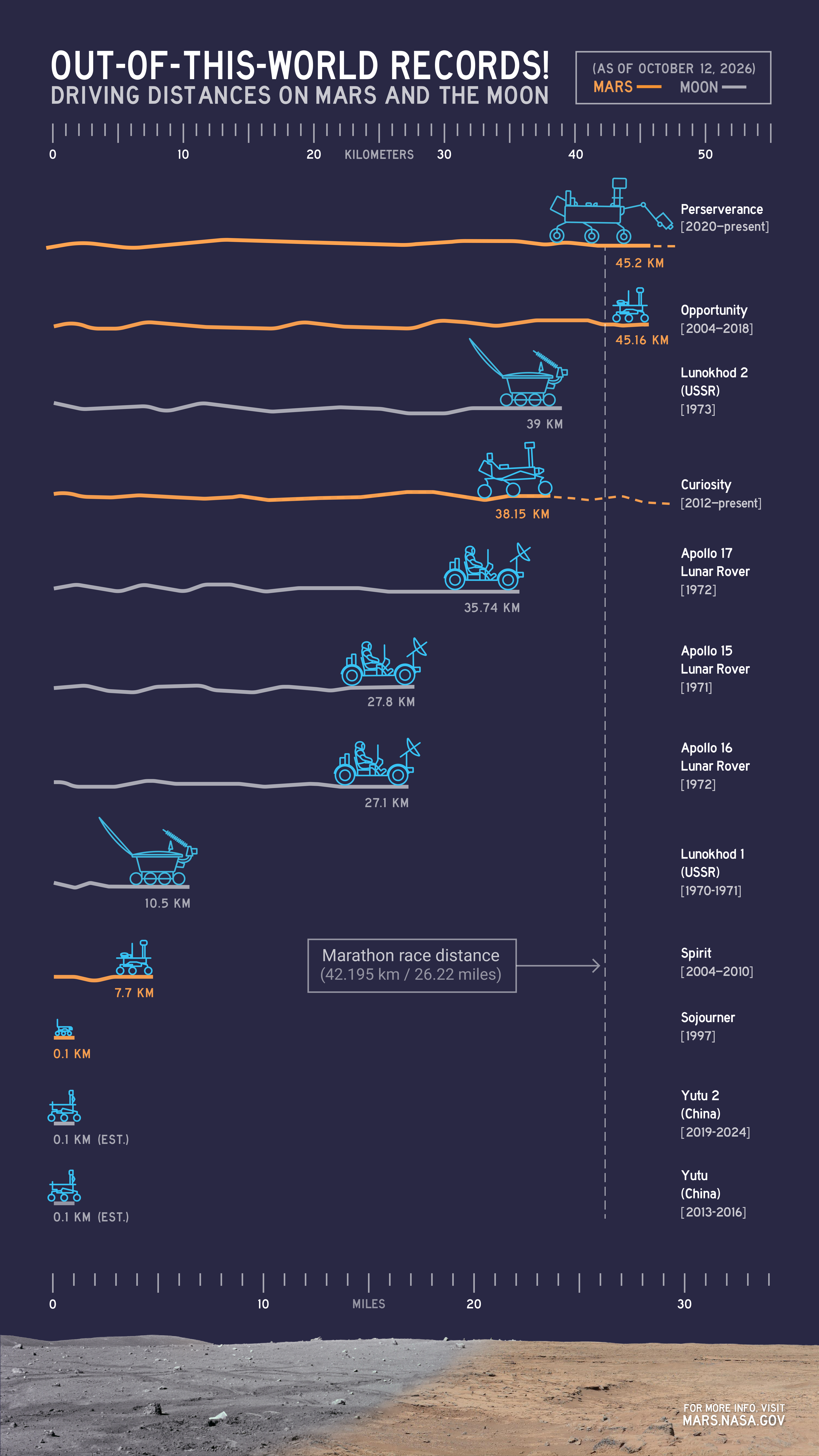
    Now I will gladly accept any samples from a known site on the Martian surface - even contaminated ones. However, we should all remember that the 30 core samples gathered by Perseverance (so far) have been chosen with great care, across 45+ km of roving and years of careful analysis, right there on the Martian ground. Their science value is already known to be off the charts, representing a variety of different environments and time periods in Martian history, and that includes the era where this region hosted the Neretva River watershed and Lake Jezero. This comprehensive slice of Martian history is not something that Tianwen-3 or any single-phase MSR mission will be able to match, I am certain, no matter how skilled (or lucky) the landing site selection may be.

    Certain prominent figures in the United States (hint: they're not popular on Lemmy, or in the planetary science community) have hindered plans for a Western-led MSR. They seem to think that we can bypass the robotic sample return phase altogether, and simply launch a human crew to the surface. For reasons I won't get into here, I think it is highly unlikely that a first human landing on Mars would be able to return the sheer variety of high-value samples that Perseverance has gathered - certainly not with the landing sites that have been proposed so far.

    I hope this was clear, happy to answer any related questions.

  • source
  • parent
  • context
  • [–] 19 points 3 weeks ago (2 children)

    I quite appreciate the visceral dislike that people have for Tesla. Given that we see their products directly in our everyday lives, I certainly don't blame people for reacting this way, and I'm happy to encourage this sort of scrutiny, especially over the longer term. I sometimes think, though, that the zeitgeist is missing some of the deeper damage that Musk's enterprises are inflicting. I don't think there's nearly enough journalism about the ongoing effects of DOGE cuts, for example.

    And then there's SpaceX. In all the anger over the throttling of Starlink ("Starshield") for the defenders in Ukraine, I haven't seen a single note of awareness about Starlink and LEO satellite megaconstellations being inherently harmful (regardless of who launches them). Aside from the increased orbital collision risk, the atmospheric pollution, and the blinding of astronomical facilities (including asteroid defense), there's the threat to the ozone layer from all that reentering aluminum. All of which will only increase as lunatics continue to use near-orbital space as their dumping ground.

    It's a powerful metaphor for our time. When it comes to Tesla, I think there's a good company in there, somewhere. And SpaceX absolutely employs some of the best aerospace talent on the planet, capable of advancing legitimate science and exploration in space. And yet, so many brilliant folk are caught up employing their skills in juvenile displays like flying car stunts and planet-encircling rings of disposable satellites.

  • source
  • [–] 2 points 1 month ago (2 children)

    Once upon a time, NASA and JPL would themselves take up the task of adding scale to rover images, by adding in a correctly scaled model of the vehicle to actual photographs:

    Now Opportunity compares to a golf cart in size, whereas Curiosity and Perseverance are nearer a car or van. The above image of Opportunity at Victoria Crater, a small break in the immense flatness of Meridiani Planum, would seem modest compared to a scaled model of Curiosity ascending Mt. Sharp. I wish I had the skills and time to do that kind of work...

  • source
  • parent
  • context
  • [–] 3 points 1 month ago

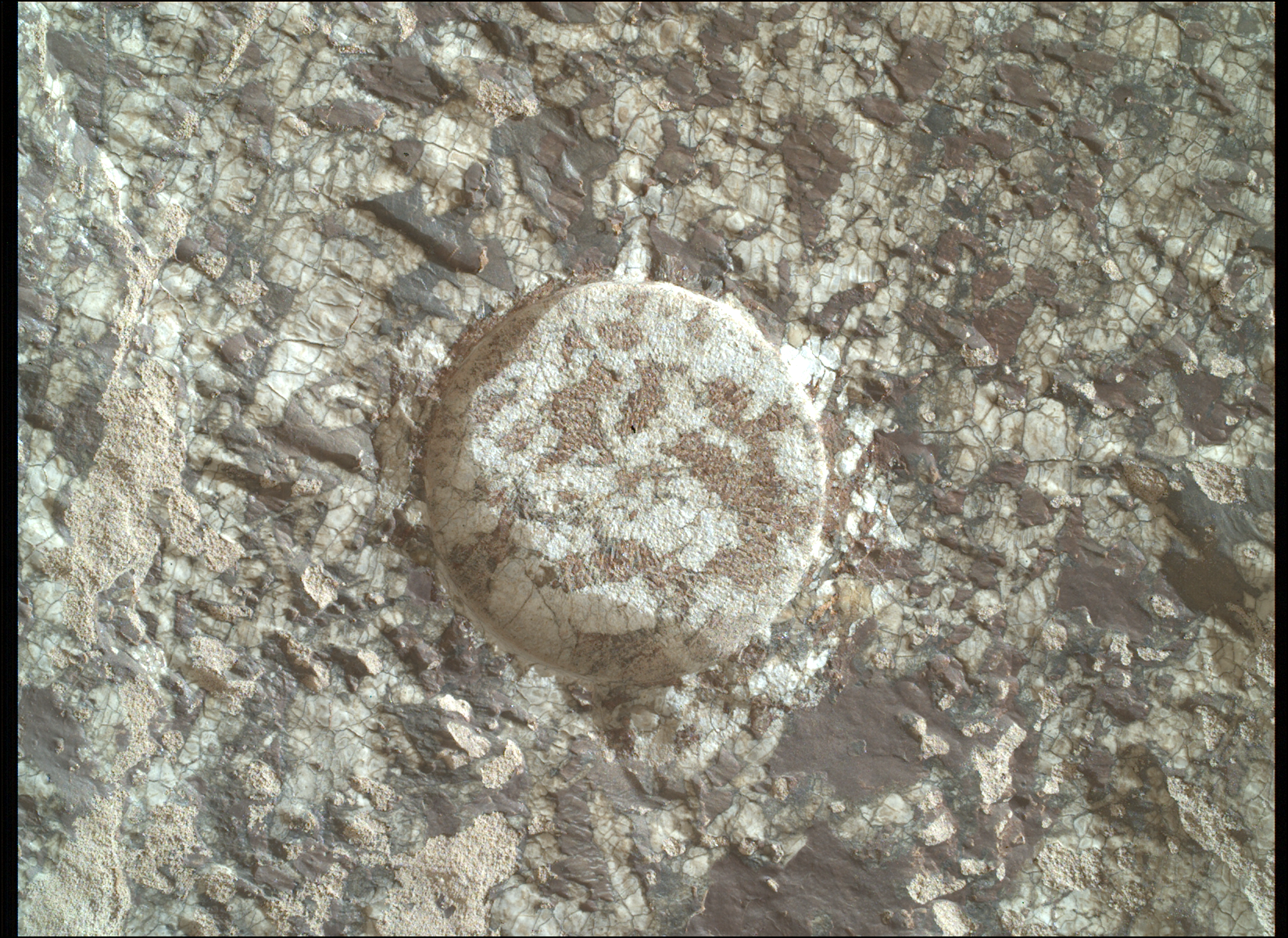
    Oh, no, it was definitely interesting enough. This latest sampling attempt took place a good eight sols after the abrasion, and they were hitting this thing with the X-ray and LIBS (laser) instruments for more than five sols, all of that before they broke out the coring drill. By my count, only one rock at Lac de Charmes got anything quite like this kind of treatment (the Vingeanne target), and the only target in this entire mission that took hits from SuperCam for longer was this conglomerate (sedimentary) rock down on top of the delta, where they did end up sampling.

    Yeah, they irradiated this rock like Curiosity taking potshots at cats.

  • source
  • parent
  • context
  • [–] 5 points 1 month ago

    are they abandoning any thought of retrieving it?

    Long answer:

    I could go on about this entire part of the mission for several posts, but suffice it to say that abandoning this sample is a matter for tears, not shrugs. Trust me on this. The backtracking required by Percy to reach this spot was incredible, possibly unprecedented in planetary exploration (the only comparable example I can recall came at the beginning of Curiosity's mission, but that was a lateral move and not a true backtrack).

    The basic problem we have here is that most of these amazing "spotted white" rocks here are too small, and appear to be too rough, for similar coring attempts. Aside from this big one we've already tried, there aren't many solid-looking ones to choose from:

    To be honest, I wasn't sure that abrading was going to work well in the first place, as I believed the rock would be pretty hard/tough, but I was pleasantly surprised by how clean and well-defined the abrasion patch was. Between that, and the huge and somewhat unusual number of photos and geochemical measurements they took here, I can assure you that the science team was highly interested in this material, which has never been seen by any rover before, certainly not before this mission.

    I cannot emphasize enough how much of a "detour" this sample and the entire visit to this area has been. It was never part of the original plan for exploring this area (we're a fair bit northeast of the "Lac de Charmes" marker at the moment), which involved getting two samples down at Lac de Charmes - and those were supposed to be bedrock samples, not "float" rocks (clasts) like this one. To date, they didn't take a single one! And now, here they are, on this huge detour. I would gladly give up one of our six remaining empty tubes to get a sample here, no regrets, no matter what we find later. Exciting times!

  • source
  • [–] 4 points 1 month ago

    They drove off today, did I miss it or are they abandoning any thought of retrieving it?

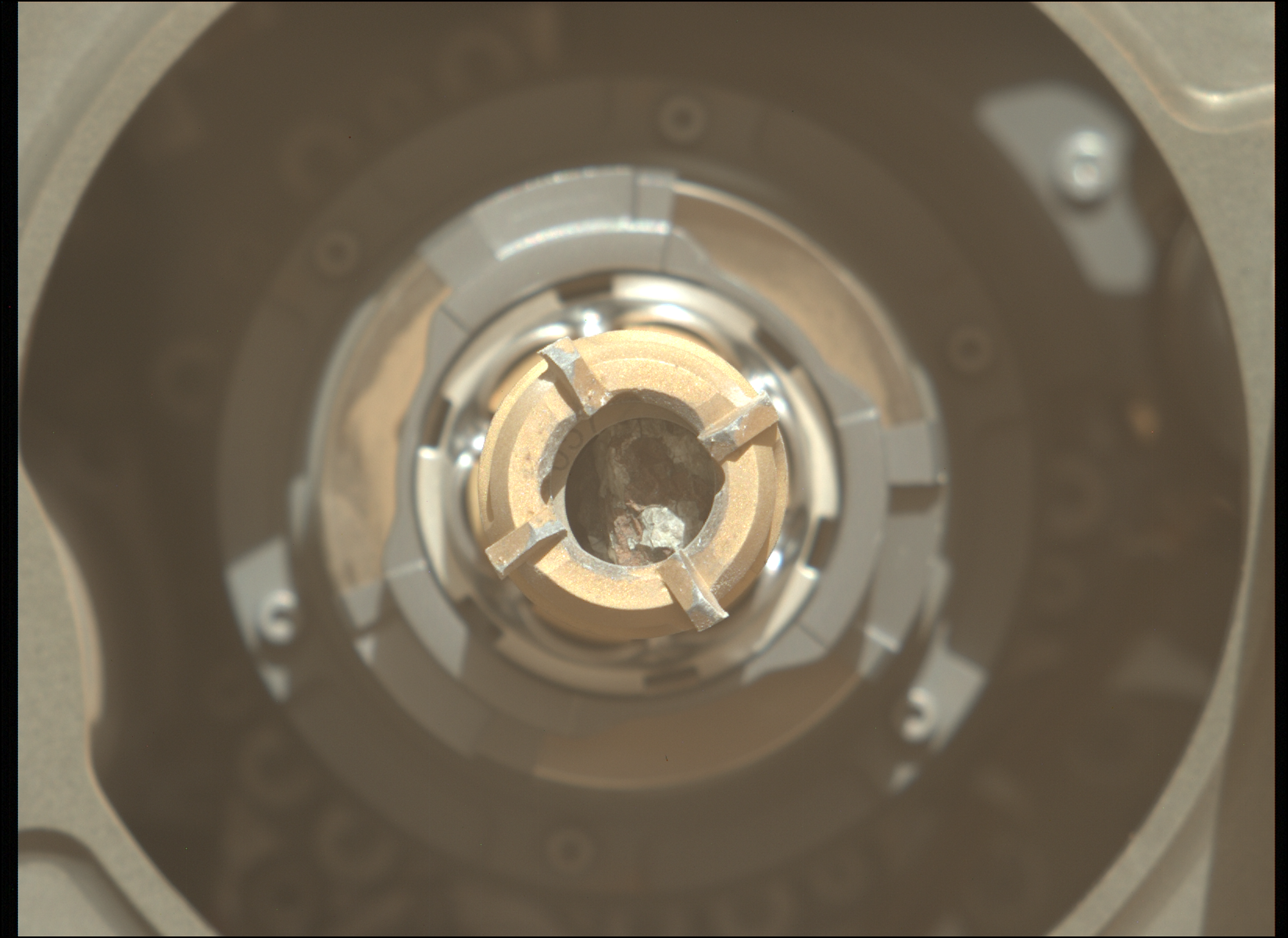
    Short answer: yes, it appears they have given up on this particular sample. The rock simply didn't cooperate - its hardness is apparently such that it allowed the drill to penetrate, but prevented the detachment of the desired material within the drill! And there it remains within the borehole, intact and still connected to the rock.

  • source
  •  

    Sol 5013 MAHLI image (using the microscopic imager at the end of Curiosity's arm, FOV ~20 cm across).

    For wider context:

    Fortunately, those small linear flakes in the colour MAHLI image are not sandworm larvae or anything so disgusting. I haven't the faintest idea about the detailed geologic process represented here, alas. All I know is that this portion of the mountain features a lot of beauty granted us by erosion:

    [–] 4 points 2 months ago

    most meteorites are primarily iron

    I have to note that this is not correct. Chondrites make up the vast majority of meteorites, and even the most iron-rich chondrites contain much less than 50% iron by weight.

    I haven't been to Barringer Crater and I don't know all the sweet, gory details of the big bolide that made it, but LPI seems to have a nice summary. The estimated 30 tons of meteoritic iron retrieved from the site certainly isn't very much, and I have heard a variant of Agent641's story before, so I'll refrain on commenting there.

    I'm a little sad thinking about all that oxidized iron, though. On Luna that stuff gets reduced instead, so that the regolith is peppered with little spheres of iron. Of course, here, we don't get the little balls of iron, or much in the way of intact craters at all... damn it, we could use a few more.

    Sighs Earth. For all the predators and the continent-busting rifts here, this place just isn't very hardcore sometimes.

  • source
  • parent
  • context
  • [–] 1 point 2 months ago

    Denying your opponent the use of space, be it Low Earth Orbit or points beyond in cislunar space, is hardly trivial. You would notice if the GPS, weather and communication functions of Earth's satellite swarm were denied you. China and Russia understand this well, no matter how many people here may be stuck in their blinkered, reactionary opinion that "space is a waste of money".

  • source
  • parent
  • context
  •  

    Since the earliest weeks of the mission, the science team has been documenting an interesting type of feature found on many of the rocks Perseverance has encountered, dubbed the "purple coating". This has often been found on rocks that have been abraded by the rover (e.g. abrasion patches #2, left, and #18, right)...

    ... as well as natural, untouched surfaces. Some of these feature truly bizzare patterns:

    The terrain being explored by Perseverance in Jezero Crater and Nili Planum is unique to date in our explorations of Mars, in that these coatings seem to be very widespread here. A much smaller number of rock coatings which may or may not be similar were found by Spirit and Opportunity, but Curiosity has notably found none. A 2025 paper by Garczynski et al. offers an explanation for these coatings - "indurated dust".

    This "indurated" (solidified) coating forms may form in a series of steps:

    • Windblown dust and very fine soil particles settle onto a rock
    • Electrostatic charges may make the dust "clump" and stabilize on the rock surface
    • Sand buries the stabilized dust
    • Humidity beneath the sand increases under certain scenarios (e.g. frost formation events)
    • The water reacts with iron and sulfur-bearing minerals in the deposited dust and soil, "cementing" it into a thin coating

    This recent image captured by MastCam-Z shows a material very reminiscent of the purple coating on the rover's deck, near the base of the mast. If this material is related to the purple coating, it may have formed fairly recently. To my mind, the flat and homogeneous appearance of the material resembles the kind of thin layer you'd expect would form first.

    Perseverance was parked for 46 sols (Earth dates 11 December 2025 to 28 January 2026) during solar conjunction, when the Sun prevented communication between Earth and Mars. Crucially, these dates correspond to late summer and early autumn in this region, when humidity is known to be high (as the longer, warmer days evaporate the north polar ice cap). Given the amount of fine regolith and dust that the wind has deposited onto the rover deck, and the relatively gentle slopes of the terrain we've been exploring in the last few months, it is conceivable that the loose material simply hasn't moved much recently, thus "sheltering" the deck, the same way sand can shelter the rocks where the coating has formed.

    If correct, this observation of a coating on the body of Perseverance has interesting implications. It would mean that the coating can form quite quickly, and that this process is occurring today, not millions of years ago. Water actively altering the surface of Mars (and our rover) today is something we must observe closely, for many exciting reasons. If this process is active on an exposed and seemingly unsuitable surface like the rover deck, one wonders how widespread it is in the soil...


    Further post-drive info for mission context

    Updated maps of Percy’s whereabouts as of this sol below. The outer rim of Jezero Crater is to the right.

    The sites of the two most recent rock abrasions, #50 and #51, are labelled (red boxes) above.

    In the higher-resolution view above, local features are visible, such as the field of mega-ripples to the rover's northeast, two small craters with dark sandy floors to the east, and the "bench" of lighter-toned, flat, fractured bedrock now below the rover's wheels.

    view more: next ›