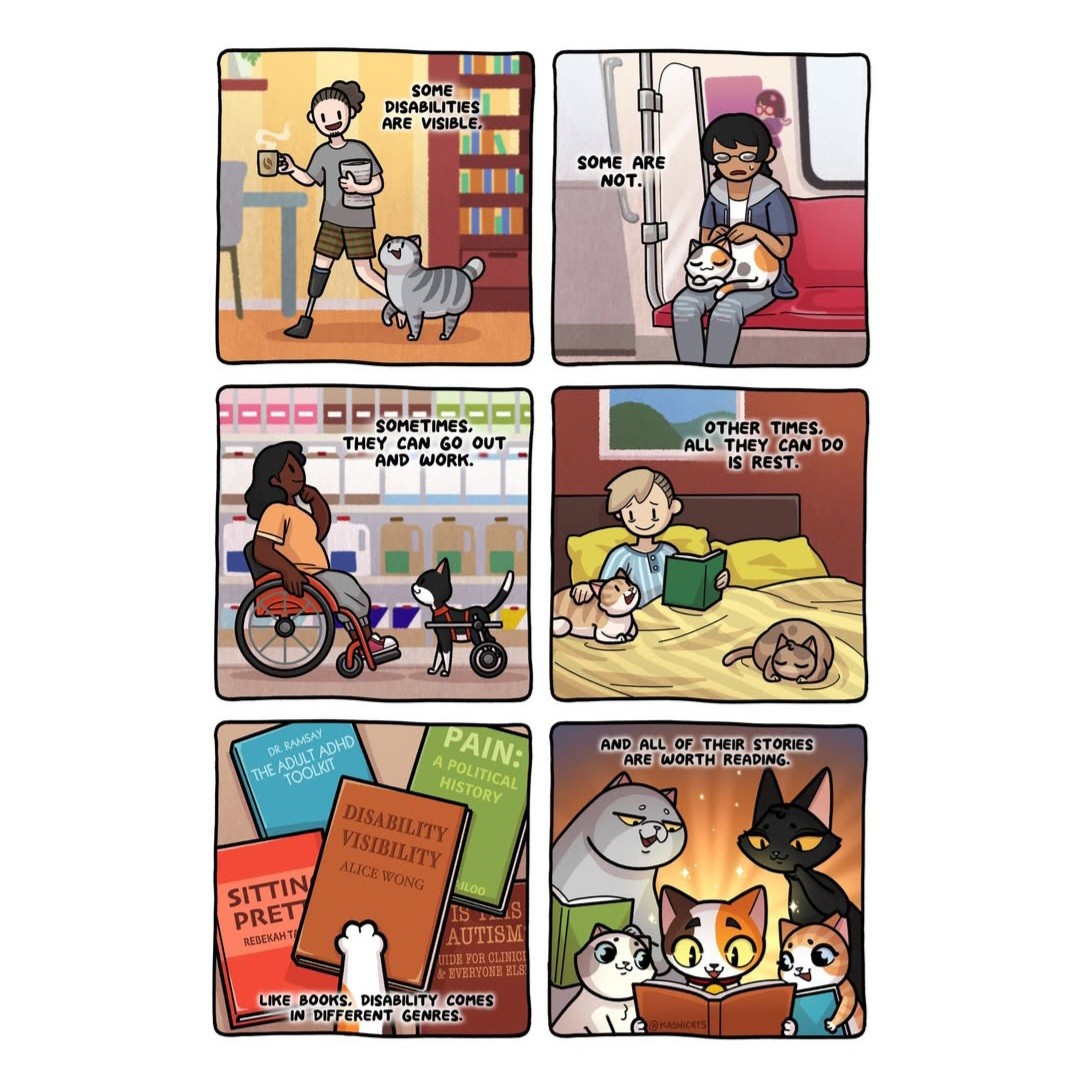
cross-posted from: https://piefed.blahaj.zone/post/153661

By kashi cats
all 3 comments

sorted by: hot top controversial new old
[–] 33 points 1 year ago (2 children)

I wish people would keep in mind that they can become disabled at any time for any number of reasons. I think the world would be a lot less hostile to us if they recognized that they might end up like us too.

  • source
  • hideshow 2 child comments
  • [–] 14 points 1 year ago* (1 child)

    This.

    My brother and father died and all I got was Fibromyalgia at 34, probably due to traumatic grief. (Heroin OD and Brain Cancer are so fun to witness. /s

    That's combined with burning out as a professional Cook for 23 years.

    All combining with cPTSD.

  • source
  • parent
  • hideshow 1 child comment
  • 20 comments in c/comicstrips@lemmy.world view that post
    [–] 79 points 1 year ago (8 children)

    I get the point you're trying to make, but as someone with multiple disabilities, both mental and physical, I can't help but feel an icky taste in my mouth after saying "disability pride". As if my brain damage, anxiety or cerebral palsy, to mention a few, is something to be proud of, rather than something to work on overcoming, in order to live my best life.

    Don't get me wrong, I'm not saying one should be ashamed of ones disabilities, not acknowledge ones limitations and be comfortable with that, but to have them as an object of pride seems counter productive at best.

  • source
  • hideshow 8 child comments
  • [–] 50 points 1 year ago (2 children)

    Shouldn't it be disability awareness month as opposed to pride.

  • source
  • parent
  • hideshow 2 child comments
  • [–] 16 points 1 year ago

    Agreed, awareness is great.

    I think we all could use some time to reflect on how other people experience their day to day, at least I know I benefit from trying to raise my perspective to above my immediate self.

  • source
  • parent
  • [–] 11 points 1 year ago

    I see where you are coming from but I personally like Disability Pride. I have schizo affective disorder, Fibromyalgia and Ehlers Danlos syndrome. My mind and body are a dumpster fire on the best of day's but I feel pride in my body never giving up and always doing its best despite everything wrong with it. I feel pride for my mind continuing to fight, sometimes for literal survival.

    Your disabilities might not be something to feel proud of, but the fact you continue to live and function as much as you can, is.

  • source
  • parent
  • [–] 5 points 1 year ago*

    not saying one should be ashamed of ones disabilities

    But that's the point though. In our (at least western because that's the ones I'm familiar with) societies it is shameful to have disabilities. And pride is the opposite of shame. It's resistance against the norm

    I get what you're saying, but the way I look at it is as a protest. A recognition that we're here, despite society's best efforts to sweep us under the rug

  • source
  • parent
  • [–] 24 points 1 year ago (4 children)

    It's estimated that around 80% of disabilities are invisible. Also, many disabilities are intermittent or contextual.

    It's always good to keep this in mind when you interact with people you don't know, regardless of what they seem to be able or unable to do.

  • source
  • hideshow 4 child comments
  • [–] 0 points 1 year ago (3 children)

    Could you go into detail what you mean with the last sentence? Example: Should I assume someone else can not walk somewhere when they ask me for directions after walking to me? Surely that is not what you mean, but all the examples I can come up with in this moment are about as absurd as that. I can not see how always assuming others might have some (relevant to the situation) disability would help me interact with them instead of doing the exact opposite.

  • source
  • parent
  • hideshow 3 child comments
  • [–] 19 points 1 year ago* (last edited 1 year ago)

    Very specific examples I have personally witnessed would include:

    • People getting angry/irritated when they see young people exiting a car parked on a disabled spot without any obvious impairment or disability.
    • People in public spaces (museums, tourist spots, etc.) taking it for granted that if they just saw you climb a few steps, that means you are necessarily able to climb 50 steps without any issues.
    • When someone asks if there is a place to sit in a public building/area, staff/officials will often just answer "no, sorry" without considering that the person may actually really need to sit, even if they don't have a cane or something similar (in which case, they are often much more accommodating)

    These are anecdotal, and specific to people I know and their disabilities, but I feel they illustrate how it's always good to just take a second to think about this sort of thing. It's also usually a good idea to just ask, instead of assuming.

  • source
  • parent
  • [–] 7 points 1 year ago (1 child)

    I think the trick is to make an effort to cover as many possibilities as can be dealt with by a reasonable effort (definition of "reasonable" varies significantly by context) when setting up something which you expect the general public to interact with. Not so much assuming that any given person has some disability you can't see, but that any large group of people will have at least a few.

    Interactions with a specific person are another matter entirely, as you point out. There, I think the best you can do is roll with it if someone tells you that they're unable to do something without subjecting them to interrogation or scepticism

  • source
  • parent
  • hideshow 1 child comment
  • [–] 8 points 1 year ago (1 child)

    🫡

    It feels nice to feel seen and not be dismissed as a political issue for once. Thanks.

  • source
  • hideshow 1 child comment
  • [+] 6 points 1 year ago* (last edited 1 year ago) (1 child)
  • [–] 11 points 1 year ago* (last edited 1 year ago)

    image containing text lacking accessible alternative such as link to accessible source or proper alt text (instead of "July is disability pride month!")

    dat irony: a message to support disabilities begins with an accessible message

  • source
  • [–] 3 points 1 year ago*
    [–] 3 points 1 year ago

    Going by that last panel, Disability Visibility by Alice Wong must be so enthralling that nearby people who are reading Pain: A Political History by Keith Wailoo will stop reading their book to read Disability Visibility over your shoulder.

  • source