Want to wade into the snowy surf of the abyss? Have a sneer percolating in your system but not enough time/energy to make a whole post about it? Go forth and be mid.

Welcome to the Stubsack, your first port of call for learning fresh Awful you’ll near-instantly regret.

Any awful.systems sub may be subsneered in this subthread, techtakes or no.

If your sneer seems higher quality than you thought, feel free to cut’n’paste it into its own post — there’s no quota for posting and the bar really isn’t that high.

The post Xitter web has spawned so many “esoteric” right wing freaks, but there’s no appropriate sneer-space for them. I’m talking redscare-ish, reality challenged “culture critics” who write about everything but understand nothing. I’m talking about reply-guys who make the same 6 tweets about the same 3 subjects. They’re inescapable at this point, yet I don’t see them mocked (as much as they should be)

Like, there was one dude a while back who insisted that women couldn’t be surgeons because they didn’t believe in the moon or in stars? I think each and every one of these guys is uniquely fucked up and if I can’t escape them, I would love to sneer at them.

(Credit and/or blame to David Gerard for starting this.)
top 100 comments

sorted by: hot top controversial new old
[–] 15 points 8 months ago (1 child)

Julia Angwin:

I'm suing Grammarly over its paid AI feature that presented editing suggestions as if they came from me - and many other writers and journalists - without consent.

State law requires consent before someone's name can be used for commercial purposes.

  • source
  • hideshow 1 child comment
  • [–] [S] 15 points 8 months ago

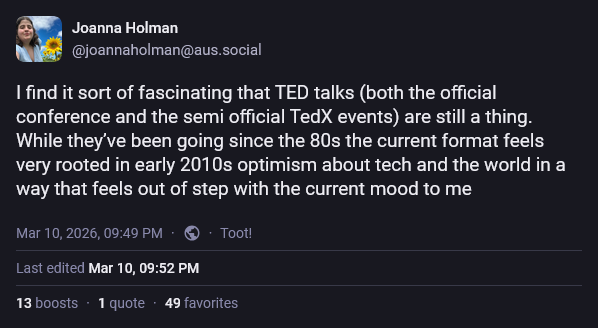
    OT: an interesting musing I found on fedi:

  • source
  • [–] 14 points 8 months ago (5 children)

    FT reports from Amazon insiders that they're investigating the role AI-assisted development has played in a spate of recent issues across both the store and AWS.

    FT also links to several previous stories they've reported on related issues, and I haven't had the time to breach the paywalls to read further, but the line that caught my eye was this:

    The FT previously reported multiple Amazon engineers said their business units had to deal with a higher number of “Sev2s” — incidents requiring a rapid response to avoid product outages — each day as a result of job cuts.

    To be honest, this is why I'm skeptical of the argument that the AI-linked job losses are a complete fabrication. Not because the systems are actually there to directly replace the lost workers, but because the decision-makers at these companies seem to legitimately believe that these new AI tools will let their remaining workforce cover any gaps left by the layoffs they wanted to do anyways. It sounds like Amazon is starting to feel the inverse relationship between efficiency and stability, and I expect it's only a matter of time before the wider economy starts to feel it too. Whether the owning class recognizes what's happening is, of course, a different story.

  • source
  • hideshow 5 child comments
  • [–] 8 points 8 months ago (2 children)

    So oil prices are down again, and on nothing but a promise from Trump and a promise from the EU. The economy has proved remarkably resilient to me; the attack on Iran is like, wild nonsense number 17 that the USA regime did that I thought would trigger a major recession, and didn't.

    I mean don't get me wrong, things are much worse now than 3 years ago, clearly. But they're not like, Great Depression worse. They're not even 2008 worse. It's just a certain level of degradation (cost of living is higher, purchasing power is lower, concentration of wealth is higher etc.) that people got used to as the new normal. People can get used to lots of things.

    To make the IT analogy, I think the global economy is like Twitter. Sure, it feels like a Jenga tower held up by thoughts and prayers, but it's holding up. When Musk took over I really did think his catastrophic management philosophy would completely break Twitter, but no, it trudges on. Yes, moderation is now nonexistent, and I'm told it's down more often, and often in "soft downtime" like notifications not working, or DMs, or some other feature, or it's working but slow, and so on. But clearly the site is up most of the time and more or less functional. Users just get used to degraded quality as the new normal.

    I predict AWS will 1) get slower and costlier thanks to "AI", with higher downtime, at higher stress for the workers; 2) the leadership will refuse to see or admit or even consciously be aware of this; 3) the worsened services will be the new normal. I predict similar developments for the socioeconomic situation of the world, too; though I'm not ruling out a spiral into complete recession, either.

  • source
  • parent
  • hideshow 2 child comments
  • [–] 7 points 8 months ago* (last edited 8 months ago) (1 child)

    I somewhat agree although when the "other shoe drops" and these things start impacting the money men they may start to realise AI isn't the magic cure they thought it was (he says kind of hopefully)

    6 hours of downtime for Amazon shopping. A very simple back of a napkin calculation. They made $213.4bn in sales in q4 2025. So divide that by 90 days and then 24 hours and multiply by 6... We are talking a $0.26bn loss for 6 hours downtime... That is not an insignificant amount of money. I imagine most bosses would be screaming for heads having lost that much money in sane non-hyper-scaled businesses.

  • source
  • parent
  • hideshow 1 child comment
  • It's also a trend that I don't see stopping without a major structural change. I don't think there's a point at which they're going to say "we've cut enough corners and are going to stop risking stability and service degradation." The principal structure driving the economy, especially in the tech sector, is organized around looking for new corners to cut and insulating the people who make those choices from accountability for their actual consequences.

  • source
  • parent
  • [–] 13 points 8 months ago (3 children)

    Silicon Valley is buzzing about this new idea: AI compute as compensation

    These people are genuinely unhinged.

    As the recent harpers article says:

    "...people who should be in The Hague are giving [startups] twenty million dollars. Something bad is gonna happen here, something really fucking bad is gonna happen...”

  • source
  • hideshow 3 child comments
  • [–] 11 points 8 months ago

    DAIR, the AI-critical research organization founded by Timnit Gebru, is looking for a communications lead

  • source
  • [–] 11 points 8 months ago
    [–] 11 points 7 months ago
    [–] 10 points 8 months ago

    Previously, on Awful, I predicted that Oracle would be all-in on the bubble:

    Microsoft knows that there’s no money to be made here, and is eager to see how expensive that lesson will be for Oracle; Oracle is fairly new to the business of running a public cloud and likely thinks they can offer a better platform than Azure, especially when fueled by delicious Arabian oil-fund money.

    But, uh, there's not going to be any Arabian money while we're dancing in the desert, blowing up the sunshine. The lawnmower is now running low on gas. Today, Oracle continues to make astoundingly bad business decisions:

    Oracle is the only major player funding the AI buildout with debt, carrying over $100 billion on its books while free cash flow has gone negative.

  • source
  • [–] 10 points 8 months ago

    Chris Stokel-Walker at Fast Company reports:

    High-level information about the private work of students and staff using ChatGPT Edu at several universities can be viewed by thousands of colleagues across their institutions due to a misunderstanding of what is being shared, according to a University of Oxford researcher who identified the issue.

    The problem affects Codex Cloud Environments in ChatGPT Edu and exposes the names and some metadata associated with the public and private GitHub repositories that users within a university have connected to their ChatGPT Edu accounts. [...] “Anyone at the university, or a large number of people at least—including me—can see a number of projects [people have] been working on with ChatGPT,” says Luc Rocher, an associate professor at the University of Oxford, who identified the issue and raised it with both the University of Oxford and OpenAI through responsible disclosure. He later approached Fast Company after what he felt was an inadequate response from both.

    Just one of many reasons that the mere existence of "ChatGPT Edu" means that many people need to be tased in the nads

  • source
  • [–] 10 points 8 months ago* (last edited 8 months ago) (5 children)

    new development in ontology: "the ontology that makes ai models valuable is american"

    https://bsky.app/profile/atrupar.com/post/3mguiup62lt2j

  • source
  • hideshow 5 child comments
  • [–] 8 points 7 months ago

    Actually the race-realism use last week, combined with this one, makes me realize that for them it's just a fancy way of saying "world-view" [or what they consider to exist, and be true, which is not the craziest use of the word, but I would say unhelpful, and probably a small in-group marker].

    It's just a way of calling biases/prejudice legitimate.

    And you know what, inasmuch the models have a "world-view" it IS annoyingly american in many ways. (at least the wrong kind of american.)

  • source
  • parent
  • I mean I guess given how the current guy took a chainsaw to American soft power, industrial capacity, economic prospects, and so on I guess our wildly over funded military is probably the only comparative advantage we unambiguously hold onto.

  • source
  • parent
  • [–] 10 points 7 months ago* (2 children)
  • [–] [S] 9 points 8 months ago (7 children)

    Starting this Stubsack off, I've found another FOSS project that hit the digital krokodil - ntfy.sh v2.18.0 was written by AI

  • source
  • hideshow 7 child comments
  • [–] 4 points 8 months ago (5 children)

    guess i'll have to write my own unifiedpush provider

  • source
  • parent
  • hideshow 5 child comments
  • [–] 4 points 8 months ago (4 children)

    I’m still happy with Pushover. Hasn’t changed in a decade (and a half?! Been using that since 2012, damn), works really pretty well.

    It’s not self-hosted but when there are push notification services on the path, nothing really is.

  • source
  • parent
  • hideshow 4 child comments
  • [–] 5 points 8 months ago (3 children)

    there's also overpush, which is meant as a self-hostable drop-in replacement for pushover and does not use ai afaict.

  • source
  • parent
  • hideshow 3 child comments
  • [–] 5 points 8 months ago (2 children)

    Ooh, that’s really cool. Also, very sobering section on the various e2e methods that are a pretty thorough indictment of all the chat systems out there.

  • source
  • parent
  • hideshow 2 child comments
  • [–] 5 points 8 months ago (1 child)

    That didn't really surprise me tbh, I follow a blog that is ostensibly meant to be a furry blog but gets repeatedly sidetracked into cryptographic stuff, and the conclusion for anything e2ee is essentially that only signal is worth using if you are looking for actual e2ee. But yeah, encryption is generally pretty bad on this kinda thing.

  • source
  • parent
  • hideshow 1 child comment
  • [–] 9 points 8 months ago (6 children)

    It turns out we didn't need that list of AI-corrupted open source projects after all...

    At this rate it's actually going to be easier to make a list of projects that don't have AI...

    Systemd and libuv now on the slop hype train

  • source
  • hideshow 6 child comments
  • [–] 5 points 7 months ago* (last edited 7 months ago) (4 children)

    Eh, straight pip with venv and pip-tools for support worked fine anyway. wrong uv!

    As for systemd... time to look at the BSDs? Was Debian among the anti-slop projects? Would be nice if they took an interest in preventing the slopification of one of their core system.

  • source
  • parent
  • hideshow 4 child comments
  • [–] 7 points 7 months ago* (last edited 7 months ago) (3 children)

    Different UV! Libuv is the event loop/scheduler that powers node.js. could be a funky new way to compromise a whole bunch of node applications

    Edit: typo - although "nose applications" being compromised sounds bad too.

  • source
  • parent
  • hideshow 3 child comments
  • [–] 4 points 7 months ago (1 child)

    Ah, thanks! My expectations of node aren't much affected I guess. Bun.js maybe?

  • source
  • parent
  • hideshow 1 child comment
  • [–] 9 points 8 months ago* (last edited 8 months ago) (3 children)

    Anthropic is suing the Pentagon

    This whole saga is a resounding “everyone sucks here”. but I’m gonna have to side with Anthropic on this one because at least they have some incredibly basic standards, which is far more than I can say for the current government and OpenAI, though the real best outcome is if the government and the AI industry destroy each other

    (this has now been deemed high-quality enough for its own post)

  • source
  • hideshow 3 child comments
  • [–] 9 points 8 months ago* (last edited 8 months ago)

    The specific article's framing pisses me off...

    Anthropic CEO Dario Amodei picked a major fight with the Department of Defense last month, asserting that his company’s AI models couldn’t be used for mass surveillance of Americans or direct autonomous weapons systems.

    As to who picked a fight with who, the DoD wanted to change the terms of their contract, to which Anthropic apparently compromised on every term except for mass surveillance of Americans (fuck the rest of the world I guess) and fully autonomous weapons (cause a human clicking "yes to confirm" makes slop-bot powered drones so much better). This wasn't good enough for this authoritarian strongman administration, so Pete Hegseth took the fight public with tweets first. So the article framing it as Anthropic "picking a fight" is a bullshit framing. I mean, they did kind of bring it on themselves hyping up their slop machine like it was a sci-fi AGI, but they didn't start the fight.

    For one, “it’s 100 percent in the government’s prerogative to set the parameters of a contract,” Snell & Winter partner Brett Johnson told Wired, effectively meaning there may be very little chance of an appeal.

    So they find a quote about contracts, but a Supply Chain Risk isn't just the DoD deciding on contracts, it is a specific power that has specific mechanisms set by legislation. If (and it is a big if with the current Supreme Court's composition) the court actually considers the terms set out in the legislation (including, most problematically for the DoD, a risk assessment and consideration of less intrusive alternatives), I think the DoD loses. Of course, the SC has all too often been willing to simply defer to the executive branch's judgement, even if the process for the judgement was "Trump or one of his underlings made a choice on a spiteful or idiotic whim, announced it on twitter, and the departments underneath them rushed to retroactively invent a saner rationalization". If the DoD decided to just end the contract (without all the public threats of SCR or invoking the Defense Production Act) Anthropic wouldn't be in a position to sue and this drama wouldn't have been as publicized in the first place.

    But the lawsuit itself takes a dramatically different tone.

    Yeah because one set of a language is a CEO trying to grovel and backtrack on one of the rare few ethical commitments he has ever made, and the other is making a court case about the actual law.

  • source
  • parent
  • [–] 6 points 8 months ago (1 child)
  • [–] 7 points 8 months ago

    If the DoD accidentally pop the AI bubble by triggering a cascade when Anthropic runs into issues; then later the DoD loses the court case in a humiliating enough way; then DoD loses a civil case with the money going to pay the debts owed in Anthropic's bankruptcy proceedings, and the American public blames all of (without letting one shift the blame to the other) the Trump administration, the Republican party, the parts of the Democrat that acted as pathetic enablers, and the tech ceos for the following economic depression... I would count that as a relative win?

  • source
  • parent
  • [–] 9 points 7 months ago (4 children)
  • [–] 9 points 7 months ago (3 children)

    It was very good, and I'm glad I clicked through to the link to Robert Kingett's story "The Colonization of Confidence", which deserves its own highlight.

    Even if the constant reminders that I'm trapped in the machine are painful.

  • source
  • parent
  • hideshow 3 child comments
  • [–] 6 points 7 months ago* (2 children)

    Hey, he's posted here before!

    That story is rad as hell. I was ready to run through a wall for those folks at the end. Appreciate you, Robert!

  • source
  • parent
  • hideshow 2 child comments
  • [–] 6 points 7 months ago

    I noticed that too which is an extra reason why I figured I'd drop the link and name in. His posts about receiving an LLM-generated happy birthday is something I think about surprisingly frequently.

  • source
  • parent
  • I swear every time his stuff floats through here I end up standing as I read it and wildly gesticulating at my living room or ranting extemporaneously to my basement about something it made me think of or feel. After reading this piece I hope that comes off as more complimentary to his work than showing myself to be a freaking weirdo.

  • source
  • parent
  • [–] 9 points 7 months ago* (26 children)
  • [–] 17 points 7 months ago* (1 child)

    It's true that these analogies can be stigmatizing, but they needn't be. As someone with an autoimmune disorder, I am not bothered by people who describe ICE as an autoimmune disorder in which antibodies attack the host, threatening its very life.

    This bothers me more than I can explain.

    ICE as autoimmune disorder presupposes that it's normally a good thing to have ICE around and it's just malfunctioning as an exceptional state of things. If ICE is an immune system (malfunctional or not), what are we immigrants?

  • source
  • parent
  • hideshow 1 child comment
  • [–] 10 points 7 months ago

    Yeah. When it comes down to it, the libs think the problem with Trump isn't the fundamentals of what he is doing, it is that he is doing it without decorum or checking all the legal boxes or saying the usual lib pabulum to justify American imperialism. Skipping the legal checks and decorum is also bad, but in fact kids in cages was horrible when Obama was doing it the "right" way.

  • source
  • parent
  • [–] 13 points 7 months ago (6 children)

    They're not vibe-coding mission-critical AWS modules.

    1. Yes they are

    and

    1. It's worse than that, they're vibe coding critical operating system components
  • source
  • parent
  • hideshow 6 child comments
  • [–] 9 points 7 months ago* (5 children)

    It is nuts to deny the experiences these people are having. They're not vibe-coding mission-critical AWS modules. They're not generating tech debt at scale:

    https://pluralistic.net/2026/01/06/1000x-liability/#graceful-failure-modes

    They're just adding another automation tool to a highly automated practice, and using it when it makes sense. Perhaps they won't always choose wisely, but that's normal too. There's plenty of ways that pre-AI automation tools for software development led programmers astray. A skilled, centaur-configured programmer learns from experience which automation tools they should trust, and under which circumstances, and guides themselves accordingly.

    Wow, the whole thing is indefensibly capital-W wrong, just an utterly weird rose-tinted view of the current corporate experience.

  • source
  • parent
  • hideshow 5 child comments
  • [–] 8 points 7 months ago (3 children)

    A skilled, centaur-configured programmer

    This is like reading Yud mumbling about "Shoggoths". It's giving knight errant, organ-meat eater, Byronic hero, Haplogroup Rlb.

  • source
  • parent
  • hideshow 3 child comments
  • [–] 6 points 7 months ago (2 children)

    Man, due to a weird alignment of the spheres I started reading those Honor Levy excerpts in the voice of Max Payne-style hardboiled narration and it fits weirdly well? Like a bargain version of the same sort of mid-budget semi-affectionate parody of existential angst that's all tone and minimal substance.

  • source
  • parent
  • hideshow 2 child comments
  • [–] 7 points 7 months ago (1 child)

    I am retrospectively disturbed by how well "I really came in a fluffer that time" slots into Dorothy Parker's flow.

  • source
  • parent
  • hideshow 1 child comment
  • [–] 11 points 7 months ago*

    Take "Morgellons Disease," a psychosomatic belief that you have wires growing in your body, which causes sufferers to pick at their skin to the point of creating suppurating wounds. Morgellons emerged in the 2000s, but the name refers to a 17th-century case-report of a patient who suffered from a similar delusion:

    Nitpick but this is unusually sloppy for Doctorow. 1) People with Morgellon's don't believe they have wires growing out of sores, but fibres (which upon examination turn out to be cotton for clothes). 2) The original Morgellons is a putative children's disease «wherein they critically break out with harsh Hairs on their Backs, which takes off the Unquiet Symptomes of the Disease, and delivers them from Coughs and Convulsions.» Which is quite different from the modern condition, whose sufferers have skin sores anywhere in the body with fibrous material looking like lint, dandelion fluff etc., and not particularly associated with convulsions. And 3) The association between the two was made by Miriam Leitao, a mother who believes her son suffers from the disease, and has gone to countless doctors and media trying to prove it's real. So it's an attempt to legitimise the postulated disease by cherry-picking something "historical" that vaguely resembles it.

  • source
  • parent
  • [–] 10 points 7 months ago*

    Kind of wild that the guy who popularized "enshittification" as a term will die on the hill that the technology which drives the industrial enshittification of all human media is fine actually, because some people find the plugins useful.

  • source
  • parent
  • [–] 9 points 7 months ago (3 children)

    The one-shotting phenomenon (or how a positive initial experience with the technology seems to lead to a heavily biased view of its merits) should probably be considered a distinct cognitive bias at this point.

    Turns out a lot of bright people can't deal with a technology being utterly subjective in its efficiency, and also how that's specifically the part that reduces it to being so narrowly useful as to force the existential question, given the insane resource burn and the socioeconomic disruption that's part and parcel, even if like Doctorow you think that their rape and pillage of artist's rights and intellectual property in general isn't an especially big deal.

    Also, local LLMs are hardly extricable from the whole mess, they are basically a byproduct, and updated versions only will keep coming as long as their imperial size online counterparts remain a viable concern.

  • source
  • parent
  • hideshow 3 child comments
  • It's gotta be tied to the idea of anchoring, right? Like, the first credible bit of information you have is what sets the tone for everything that comes afterwards. At that point in a sufficiently complicated information ecosystem, confirmation bias kicks in and it's hard to break out of.

  • source
  • parent
  • [–] 3 points 7 months ago (1 child)

    even if like Doctorow you think that their rape and pillage of artist’s rights and intellectual property in general isn’t an especially big deal.

    It's not that he doesn't think it's a big deal. It's the one thing he's most consistently cared about for most of his career as an activist. He's willing to put up with anything else if it circumvents copyright. And that's why he's been consistently pushed, I reckon, despite his nominal hostility towards the hands that feed the media ecosystem he flourishes in.

  • source
  • parent
  • hideshow 1 child comment
  • [–] 9 points 7 months ago (8 children)

    He knows how LLMs work, right? This really is just cope because he got called out for being weird about using them. Really fucking disappointing

  • source
  • parent
  • hideshow 8 child comments
  • [–] 7 points 7 months ago* (last edited 7 months ago) (1 child)

    In the original post he kept referring to Ollama like it was an LLM instead of a server app that hosts LLMs so I'd say the jury's out on that.

    edit: Also, throughout this piece he keeps equivocating between local LLMs and their behemoth online counterparts with their heavily proprietary tooling that occasionally wraps them into a somewhat useful product.

    I think he assumes that because he can load up a modest speech-to-text model locally and casually transcribe several hours of video resources in somewhat short order (this was apparently his major formative experience with modern AI) it works the same with e.g. coding.

    Like, hey gpt-oss please make sense of these ten thousand lines of context without access to a hundred bespoke MCP intermediaries and one or three functioning RAG systems as I watch the token generation rate slow to a trickle while the context window gradually fills up.

  • source
  • parent
  • hideshow 1 child comment
  • [–] 4 points 7 months ago

    piece he keeps equivocating between local LLMs and their behemoth online counterparts with their heavily proprietary tooling that occasionally wraps them into a somewhat useful product.

    This is fundamental to his approach. He believes that technology is inherently liberatory as long as it's in the hands of the consumer.

  • source
  • parent
  • [–] 4 points 7 months ago (5 children)

    This really seems to be the case.

  • source
  • parent
  • hideshow 5 child comments
  • [–] 6 points 7 months ago (4 children)

    @o7___o7 @anise Hey, can't get that SXSW London (a truly cursed event, but I digress) bag unless you're willing to say LLMs Are Good, Actuallysxswlondon.com/speakers/cory-d

  • source
  • parent
  • hideshow 4 child comments
  • [–] 9 points 7 months ago* (last edited 7 months ago) (1 child)

    Man, it's frustrating to see him end up going down this route because the opening part of this is actually one of the better descriptions of AI psychosis I've seen, and i appreciate his emphasis on the way the delusion is built up in the sufferer's mind rather than trying to game out what's happening "inside" the chatbot. Even his point about how LLMs aren't bad in exceptional ways for a new technology is pretty cogent. But his insistence on defending his own use of these things (and others who do so in "centaur-configured" ways) rather than thinking about how it interacts with all the relatively normal ways that this technology is wildly destructive is a very conspicuous blind spot.

    Like, you can absolutely drive a nail with a phone book, and given the wider surface area it even has the advantage over a traditional hammer of being harder to smash your fingers. An individual craftsman may well decide that this is a useful tool and in some cases worth using over other options. But if the only source of these hammer-books was an industry that relied on massive uncompensated use of creative work passed through exploited third-world labor, ground rainforests to dust to create special "old-growth paper", placed massive and unsustainable burdens on existing road infrastructure to collect these parts and deliver them, and somehow had been blown into a speculative bubble that represented something like a quarter of the entire US economy by promising that if they created a big enough book then one guy could hammer all the nails at once and they could lay off all the carpenters, I think it's justifiable to look at the people using it as a normal tool and ask them "what the actual fuck are you doing?" The usage statistics they represent and the user stories they tell are used to justify not addressing any of the harms necessary to enable this tool to exist in its current form, and are largely driving the absurd valuations that keep pumping the bubble. Your individual role in those harms as a small-time user who finds it occasionally useful may be incalculably small, but it is still real.

    Like, it feels like I agree with Doctorow on basically all the premises here. He seems to have a decent grasp on how the things actually work (even if he's wrong about Ollama specifically being an LLM in its own right) and their associated limitations. He draws a decent line separating criticism from criti-hype. He is basically correct about how much of a bastard everyone involved in the industry at a high level is. But maybe because so many of these things aren't really exceptional (save possibly in their sheer scale) he can't seem to conceive of a world where things happen any differently, or of the role his actions and words play in reinforcing the status quo even as he writes pretty explicitly about how fucked up that status quo is.

    Honestly it makes me think of the finale of his second Martin Hench novel, The Bezzle. After drilling into the business of the private prison operator that is making his friend's life hell and separating the merely fucked up parts from the things that might actually have consequences if word got to what passes for cops in that tax bracket, he doesn't go to the papers or start reaching out to the SEC. Instead he goes to the bastard at the head of it all and blackmails him into making his friend's remaining incarceration less hellish and leaving him alone. And his friend, who started all this by begging for help unraveling this shit, rightly calls Marty a coward for it. There's something ironic in seeing Doctorow here seemingly make the same judgement: abuse and apathy are sufficiently normal that we shouldn't even bother to try and make the world better, just find ways to shelter ourselves and the people we care about from the consequences. And hell, I guess even there I'm not immune to it. There are reasons why I'm posting here and not waiting out front of a hotel with some engraved brass. Still, on the continuum of such things I'm disappointed that the guy who wrote that scene is stuck in the normalization blues.

  • source
  • parent
  • hideshow 1 child comment
  • [–] 7 points 7 months ago*

    It sucks. :(

    Honestly, the article reminds me of Scott Alexander, but succinct. "Here are several true things and an absolutely batshit wrong thing, presented together with equal earnestness."

    The wrong thing being "Believing that LLMs are trash is a mental disorder (not really but wink wink)."

    Why do this now, when it's all coming apart? It's baffling.

  • source
  • parent
  • [–] 8 points 8 months ago (13 children)

    Has anyone heard of the Internal Family Systems Model? One of the CFAR founders said he relied on it when he was designing self-help workshops. The IFS encourages you to see yourself as a system of entities and talk to them separately, and that reminds me of Ziz Lasota's two-hemispheres theory and Michael Vassar's jailbreaking.

  • source
  • hideshow 13 child comments
  • [–] 7 points 8 months ago (7 children)

    I’ve heard of it, including in some outlets that (at the distance I am to it) seemed to pass the sniff test

    but I’ve also seen it kick around TPOT

    so I’d definitely want to seek out the advice of an expert if I cared about it

  • source
  • parent
  • hideshow 7 child comments
  • [–] 6 points 8 months ago (6 children)

    I heard somewhere that "there is no unitary self" can be a Buddhist teaching and TPOT draws on Western Buddhism. There is work to be done figuring out where they got their eclectic mix of techniques and terminology.

  • source
  • parent
  • hideshow 6 child comments
  • [–] 6 points 8 months ago (5 children)

    It's Hofstadter, isn't it? That's the author who I recognize most in these discussions, followed closely by Hermann Hesse.

  • source
  • parent
  • hideshow 5 child comments
  • [–] 3 points 8 months ago (4 children)

    Well, I think the Buddhist idea that the self is an illusion goes back 2500 years or more, but Douglas Richard Hofstadter might have introduced nerdy American sci-fi fans to the idea.

  • source
  • parent
  • hideshow 4 child comments
  • [–] 5 points 7 months ago* (3 children)

    I have time to quote at you now. Ziz's thoughts about dual-core brains sound like the thought experiments from "I" is a Strange Loop. In Chapter 15, "Entwinement", Hofstadter introduces the Twinwirld thought experiment: imagine a world where almost everybody is an identical twin, each pair of twins is given one name, twins go everywhere together, and identity is oriented around pairs instead of individuals. Quoting p215 from my copy:

    In Twinwirld, there is an unspoken and obvious understanding that the basic units are pairsons, not left or right halves, and that even though each dividual consists of two physically separate and distinguishable halves, the bond between those halves is so tight that the physical separateness doesn't much matter. That everytwo is made of a left and right half is just a familiar fact about being alive, taken for granted like the fact that every half has two hands, and every hand has five fingers. Things have parts, to be sure, but that doesn't mean that they don't have integrity as a whole!

    The entire section is written like this. I've read a bit of the Zizian lore and it sounds like it was lifted straight out of this chapter with words replaced. p216 in particular really shows off the Hofstadter tendency towards neopronouns:

    The pronoun "you" also exists in Twinwirld, but it is plural only, which means that it is never used for addressing just one other dividual — it always denotes a group. "Do you know how to ski?" might be asked of an entire family, but never of just one twild or one pairent.

    A young pairson in Twinwirld grows up with a natural sense of being just one unit, even though twey consist of two disconnected parts.

    I don't really know about Vassar's writing. I do think that jailbreaking is somewhat related. I think that Hofstadter lays out their entire thesis in the first paragraph of Chapter 18, "The Blurry Glow of Human Identity", p259:

    Among the beliefs most universally shared by humanity is the idea "One body, one person", or equivalently, "One brain, one soul". I will call this idea the "caged-bird metaphor", the cage being, of course, the cranium, and the bird being the soul. Such an image is so self-evident and so tacitly built into the way we all think about ourselves that to utter it explicitly would sound as pointless as saying, "One circle, one center" or "One finger, one fingernail"; to question it would be to risk giving the impression that you had more than one bat in your belfry. And yet doing precisely the latter has been the purpose of the past few chapters.

    The second paragraph, right after that, might as well be quoted from LW. Check it out:

    In contrast to the caged-bird metaphor, the idea I am proposing here is that since a normal adult human brain is a representationally universal "machine", and since humans are social beings, an adult brain is the locus not only of one strange loop constituting the identity of the primary person associated with that brain, but of many strange-loop patterns that are coarse-grained copies of the primary strange loops housed in other brains. Thus, brain 1 contains strange loops 1, 2, 3, and so forth, each with its own level of detail. But since this notion is true of any brain, not just of brain 1, it entails the following flip side: Every normal adult human soul is housed in many brains at varying degrees of fidelity, and therefore every human consciousness or "I" lives at once in a collection of different brains, to different extents.

    Buddhism's not part of the book. It is part of the roots of IFS, though! So I think that you'd be better served looking at IFS or the ways that people quote Hesse if you want to find those Buddhist influences.

  • source
  • parent
  • hideshow 3 child comments
  • [–] 4 points 7 months ago

    the Hofstadter tendency towards neopronouns

    Seeing it extracted from context and called out like this helps me understand why I've bounced off Hofstadter multiple times over the years, despite his hype. It's an artistic choice, sure, but 400 pages of this stuff without a break can be like beating your face against a brick wall after a while.

  • source
  • parent
  • [–] 3 points 7 months ago

    Hofstadter and Hesse seem to be namechecked on LW much more often than Leo Strauss. I wonder if Scott Alexander talks about Strauss over coffee if he trusts you, because so much of what our friends do is supposed to fool the vulgar masses while the wise smile and know the hidden truth.

    I wonder if the real secret to Vassar's influence is that he influenced the leaders of Bay Area LW like Alexander, Anissimov, Constantin, Zvi Moshowitz, and Salamon.

  • source
  • parent
  • [–] 2 points 7 months ago

    Thanks! I don't get the impression that Michael Vassar posts or publishes a lot under his own name, he seems to prefer cornering susceptible people at events and then having private conversations and correspondence with the ones who respond in a promising way. The clearest description of his jailbreaking which I have read is by Scott Alexander in a back and forth with Jessica Taylor (and we know Scott Alexander tries to hide some of the beliefs he cares the most about).

    In a LessWrong thread people just point to a deleted Twitter account and some YouTube videos by Vassar.

    RationalWiki briefly mentions earlier woo abut brain hemispheres.

  • source
  • parent
  • [–] 5 points 7 months ago*

    Actually had a therapist introduce me to it. It can be a useful model, and if I were to boil it down to a single adage it would be: pay attention to how you talk to yourself. But I don't think it is as simple as saying you contain a multitude, each part was developed to help the person survive and as you get older you might collect more parts and suppress others. It actually reminded me a bit of Lacan and the developmental stages.

  • source
  • parent
  • [–] 4 points 8 months ago (2 children)

    I recall there was a recent critical piece about it but I can’t remember where it was.

  • source
  • parent
  • hideshow 2 child comments
  • [–] 8 points 7 months ago (2 children)

    Last week 404 Media reported on some DOGE deposition videos.

    The videos were since removed via court order, but are available on Internet Archive.

    For anyone unfamiliar: this slots under TechTakes because DOGE is basically Elon Musk's army of naive fascist silicon valley tech-bros rampaging about the federal government with Chat-GPT, SQL, and unsecured thumb-drives.

    This article is behind a paywall, but links to the following video snippets from the depositions:

    https://www.instagram.com/reels/DVtOiqJjcu4/ https://www.instagram.com/reels/DVyhJT9jf4f/

    For example here Justin Fox talks about deleting federal grants that he considered in-scope for an anti DEI executive order: https://www.instagram.com/reels/DVtOiqJjcu4/

    Q: "Why is a documentary about Holocaust survivors DEI"

    A: "It's the gender based story 🤷 that's inherently discriminatory to focus on this specific group 🙄."

    Q: "It's inherently discriminatory to focus on what specific group?"

    A: "The gender based. So, females 🤷 during the Holocaust."

    He goes on to clarify that it's DEI because it focuses on Jewish women. Oh that's OK then!

    There is a lot of video to work through but I know there is more comedy gold rage inducing punchable nazi snippets within.

  • source
  • hideshow 2 child comments
  • [–] 8 points 7 months ago (1 child)
  • "Do you think there's a reason why the DSA didn't allow you to use Signal or other apps on your government phone?"

    "No."

    WHAT DO YOU THINK THE "S" STANDS FOR YOU IGNORANT CHILD??

    Just gonna file this on my mental list of reasons I didn't go into law.

  • source
  • parent
  • [–] 8 points 7 months ago* (last edited 7 months ago) (4 children)

    A hackernews notices that HN autoflags 404 Media articles. A little downthread, dang bullshits unconvincingly in reponse.

    https://news.ycombinator.com/item?id=47354634

  • source
  • hideshow 4 child comments
  • [–] 4 points 7 months ago (3 children)

    If this is the real reason:

    It's because, for a long time, most of their content was behind a signup wall with no obvious workaround. I don't know if it still is or not. If it isn't, we can change it.

    It is baffling that this isn't communicated upfront to the users. Really weird move orange site.

  • source
  • parent
  • hideshow 3 child comments
  • load more comments
    view more: next ›