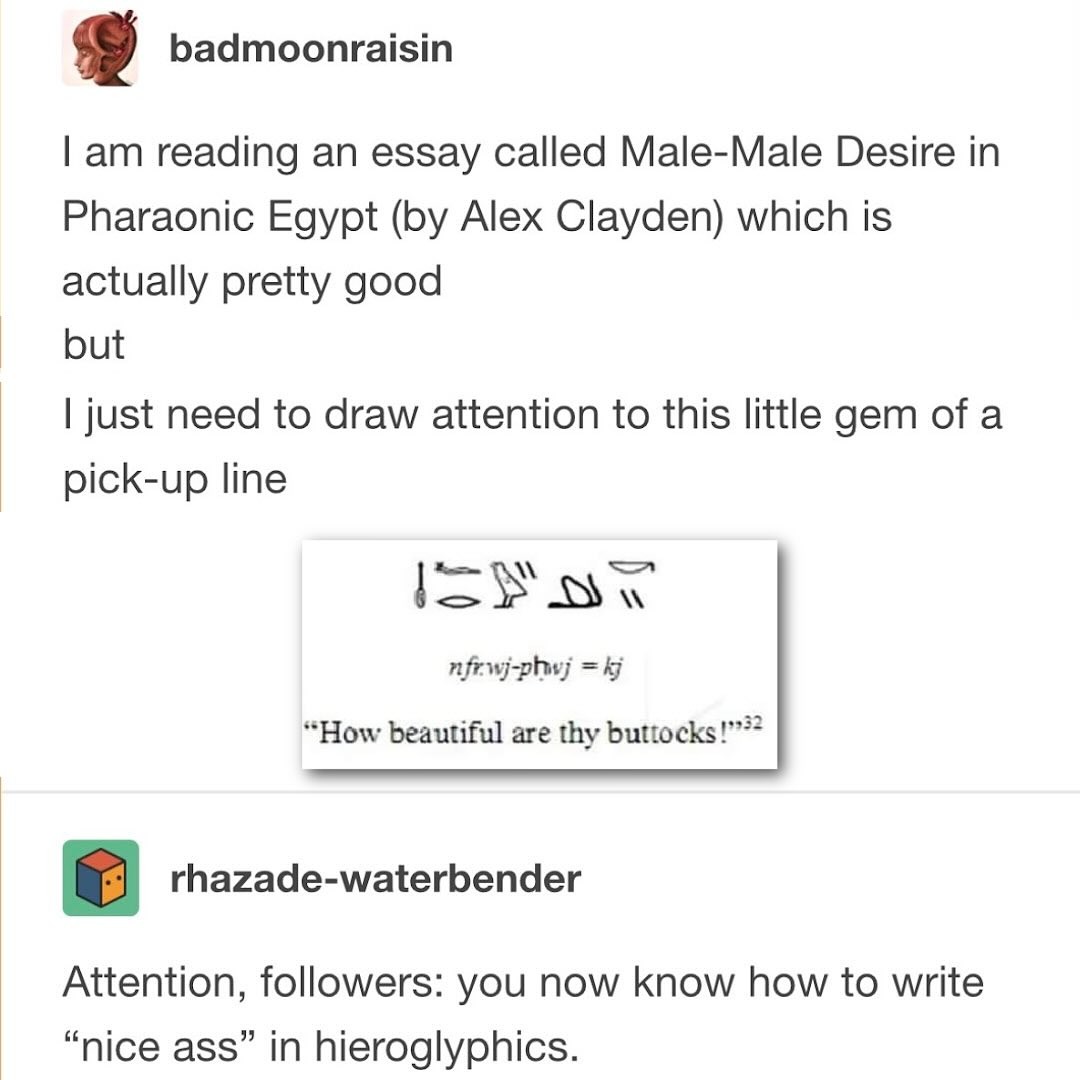
Fun fact. Hieroglyphs can be written left-to-right or right-to-left. You have to distinguish the direction they should be read by the facing of the animal/creature/human used as a character. They will always "look" towards the beginning of the sentence, so in the depicted case, the intended direction is left-to-right.
@PugJesus "𓄤" (U+13124)"𓆑" (U+13191)"𓎡" (U+133A1)"𓅱" (U+13171)"𓄖" (U+13116)"𓂋" (U+1308B)Now. Just need to figure out how to join two symbols and add apostrophes next to and below
The paper is supposedly from 2012. Is it like a standard that academic texts translating ancient languages use the oldest possible form of the destination language or do people just do that to denote that the source is old?
I feel like there's a good argument that the more valid translation is the one that uses modern words and grammar.
Modern English translation: ... Hey babe, nice ass
I believe this is the Unicode:
𓄤𓆑𓂋𓅱𓏭𓄖𓎡𓏭
Unfortunately the joiners don't seem to be supported on most devices.
all 14 comments