all 26 comments

sorted by: hot top controversial new old
[–] 56 points 1 year ago (5 children)

Theorem - All numbers are interesting

Demonstration:

  • 0 is interesting
  • if n is interesting, n+1 is either interesting or not interesting.
    -- If n+1 is not interesting, we take interest in it as it it the smallest non-interesting number.
  • Therefore, n+1 is interesting

By induction, all numbers are interesting

  • source
  • hideshow 5 child comments
  • [–] 8 points 1 year ago*

    My favorite version of this proof:

    Let S be the subset of natural numbers that are not interesting. Suppose by way of contradiction that S is inhabited. Then by the well ordering principle of natural numbers, there is a least such element, s in S. In virtue of being the least non interesting number, s is in fact interesting. Hence s is not in S. Since s is in S and not in S, we have derived a contradiction. Therefore our assumption that S is inhabited must be false. Thus S is empty and there are no non interesting numbers.

  • source
  • parent
  • [–] 2 points 1 year ago (1 child)

    What about 31? That's the smallest non-interesting number so if we take that as the first n, then every n+1 is either interesting or the second-smallest non-interesting number, and the second smallest non-interesting number is still not interesting.

  • source
  • parent
  • hideshow 1 child comment
  • [–] 15 points 1 year ago (5 children)

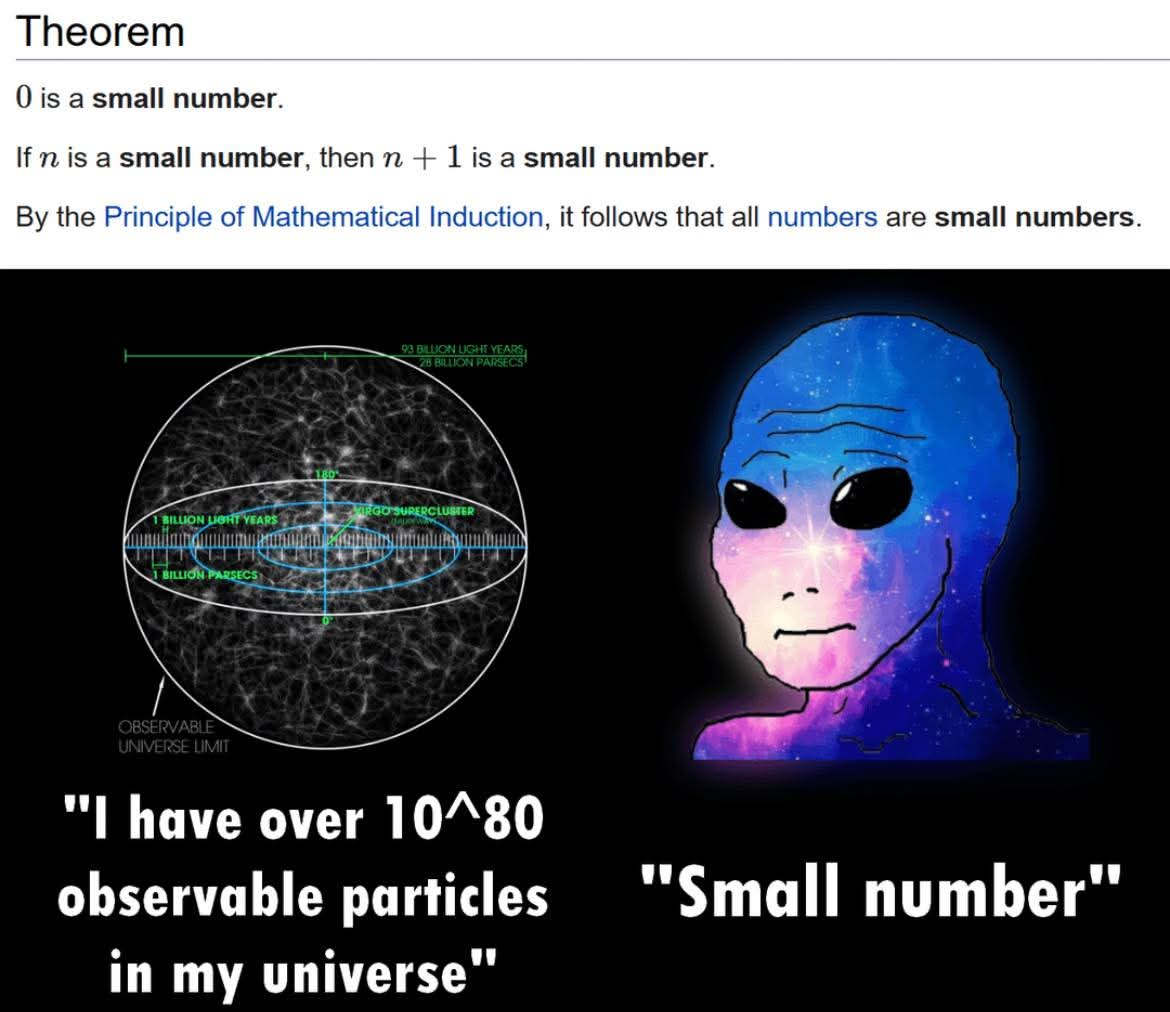
    I mean, yeah. Compared to infinity, the number of particles in the universe is essentially zero.

  • source
  • hideshow 5 child comments
  • [–] 4 points 1 year ago (4 children)

    The number of particles in the observable universe. For all we know, the universe may be infinite.

  • source
  • parent
  • hideshow 4 child comments
  • [–] 3 points 1 year ago (3 children)

    Even if it is infinite, that still pales in comparison to infinity. Infinity is weird.

  • source
  • parent
  • hideshow 3 child comments
  • [–] 1 point 1 year ago (1 child)

    It blew my mind when someone explained to me how some sets of infinity numbers can be infinite yet still technically larger than other sets, like the set of all numbers vs. the set of all odd numbers.

  • source
  • parent
  • hideshow 1 child comment
  • [–] 1 point 1 year ago* (last edited 1 year ago)

    Yes that's right, but I'd like to clarify that if we're talking about whole numbers then my understanding is that the set of all whole numbers is the same "size" as the set of all odd numbers. The quick and dirty way to think about it is you could theoretically make a list of all the odd numbers and all the whole numbers and assign each whole number to an odd number at a 1-1 ratio

    The reason the set of all numbers is "bigger" is because of things like fractions and irrational numbers. Try assigning an odd number to every decimal. You can't even make a list of all the decimals. There is no non-zero interval between which a finite amount of decimals exist.

  • source
  • parent
  • [–] 13 points 1 year ago (2 children)

    I think 6 is a rather big number. It’s more than I can count on one hand.

  • source
  • hideshow 2 child comments
  • [–] 11 points 1 year ago

    I've seen smaller 😏

  • source
  • [–] 9 points 1 year ago (4 children)

    I don't think you can induce all numbers from n+1

  • source
  • hideshow 4 child comments
  • True, You can only induce natural numbers from this.

    However, you could extend it to the positive reals by saying [0,1) is a small number. And building induction on all of those.

    You could cover negative and even complex numbers if “small” is a reference to magnitude of a vector, but that is a slippery slope…

    In a very not rigorous way, you can cover combinations of ordinal numbers and even non-numbers if you treat them as orthogonal “unit vectors” and the composite “number” as a vector in an infinite vector space which again allows you to specify smallness as a reference to magnitude like we did for the complex numbers.

    If you multiply two not really numbers, just count the product as a new dimension for the vector. Same with exponentiation. Same with non math shit like a cow or the color orange. Count all unique things as a unique dimension to a vector then by our little vector magnitude hack, everything is a small number, even things that aren’t numbers. QED.


    This proof is a joke, broken in many ways, but the most interesting is the question of if you can actually have a vector with an uncountably infinite (or higher ordinals) of dimensions and what the hell that even means.

  • source
  • parent
  • [–] 5 points 1 year ago* (2 children)

    Sure you can. Proof:

    0 is a number.

    If n is a number, n+1 is also a number.

    Therefore, by mathematical induction, we can induce all numbers.

  • source
  • parent
  • hideshow 2 child comments
  • [–] 8 points 1 year ago

    But what abut 10⁸⁰ + 1 ??

  • source
  • [–] 3 points 1 year ago

    This is a poor definition, a small number is usually defined by an inequality.

  • source
  • [–] 2 points 1 year ago

    Different variation of the Sorites Paradox.

  • source
  • [–] 2 points 1 year ago