▲ 214 ▼ Those are rookie numbers (fedit.pl) submitted 1 year ago by Kierunkowy74@fedit.pl to c/mathmemes@lemmy.blahaj.zone 26 comments fedilink hide all child comments
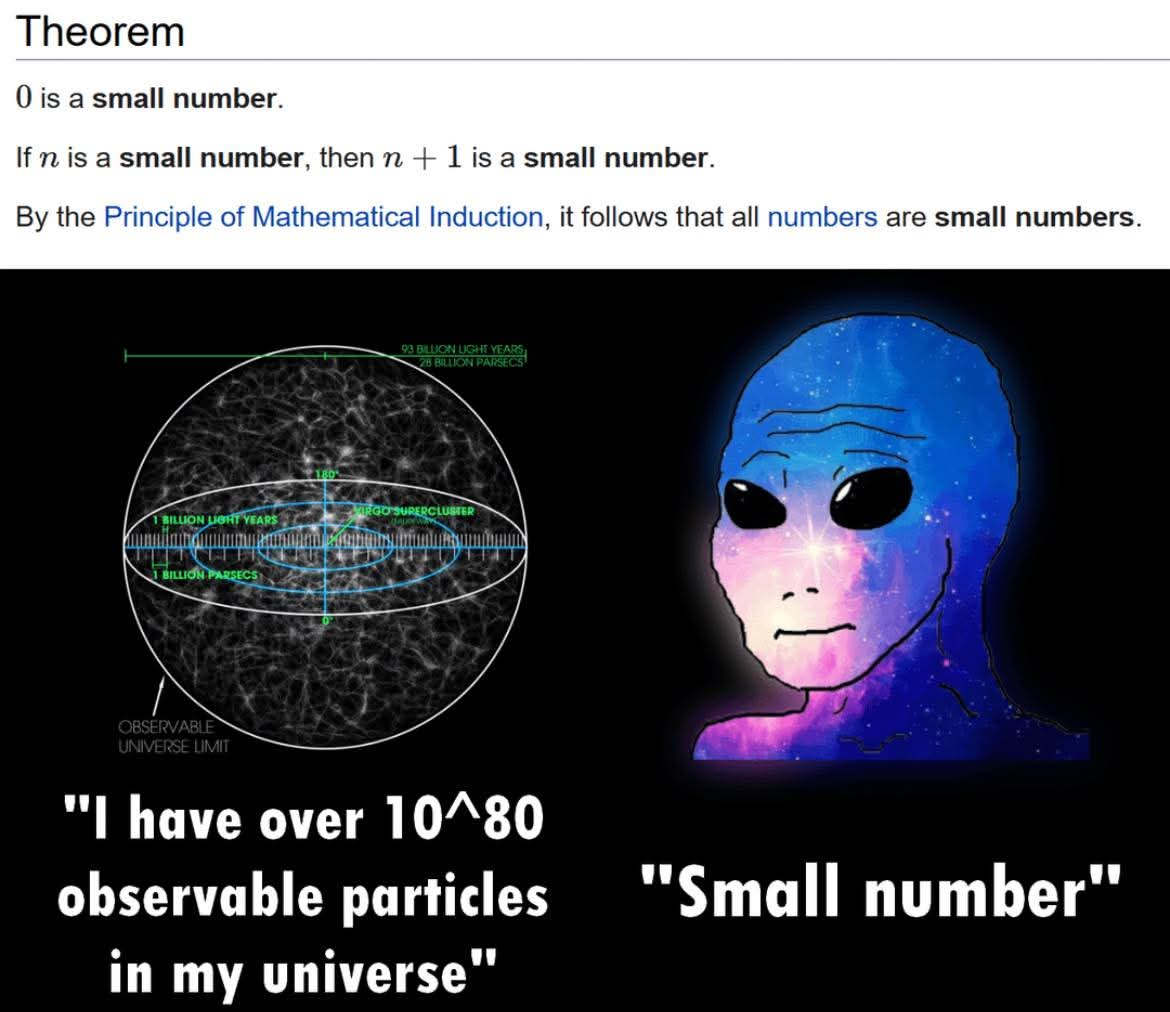
[–] hperrin@lemmy.ca 15 points 1 year ago (5 children) I mean, yeah. Compared to infinity, the number of particles in the universe is essentially zero. permalink fedilink source hideshow 5 child comments replies: [–] very_well_lost@lemmy.world 4 points 1 year ago (4 children) The number of particles in the observable universe. For all we know, the universe may be infinite. permalink fedilink source parent hideshow 4 child comments replies: [–] hperrin@lemmy.ca 3 points 1 year ago (3 children) Even if it is infinite, that still pales in comparison to infinity. Infinity is weird. permalink fedilink source parent hideshow 3 child comments replies: [–] makyo@lemmy.world 1 point 1 year ago (1 child) It blew my mind when someone explained to me how some sets of infinity numbers can be infinite yet still technically larger than other sets, like the set of all numbers vs. the set of all odd numbers. permalink fedilink source parent hideshow 1 child comment replies: [–] Fleur_@aussie.zone 1 point 1 year ago* (last edited 1 year ago) Yes that's right, but I'd like to clarify that if we're talking about whole numbers then my understanding is that the set of all whole numbers is the same "size" as the set of all odd numbers. The quick and dirty way to think about it is you could theoretically make a list of all the odd numbers and all the whole numbers and assign each whole number to an odd number at a 1-1 ratio The reason the set of all numbers is "bigger" is because of things like fractions and irrational numbers. Try assigning an odd number to every decimal. You can't even make a list of all the decimals. There is no non-zero interval between which a finite amount of decimals exist. permalink fedilink source parent [–] very_well_lost@lemmy.world 6 points 1 year ago True. If the universe is infinite, the number of particles would only be a lowly countable Infinity. How pathetic! permalink fedilink source parent
[–] very_well_lost@lemmy.world 4 points 1 year ago (4 children) The number of particles in the observable universe. For all we know, the universe may be infinite. permalink fedilink source parent hideshow 4 child comments replies: [–] hperrin@lemmy.ca 3 points 1 year ago (3 children) Even if it is infinite, that still pales in comparison to infinity. Infinity is weird. permalink fedilink source parent hideshow 3 child comments replies: [–] makyo@lemmy.world 1 point 1 year ago (1 child) It blew my mind when someone explained to me how some sets of infinity numbers can be infinite yet still technically larger than other sets, like the set of all numbers vs. the set of all odd numbers. permalink fedilink source parent hideshow 1 child comment replies: [–] Fleur_@aussie.zone 1 point 1 year ago* (last edited 1 year ago) Yes that's right, but I'd like to clarify that if we're talking about whole numbers then my understanding is that the set of all whole numbers is the same "size" as the set of all odd numbers. The quick and dirty way to think about it is you could theoretically make a list of all the odd numbers and all the whole numbers and assign each whole number to an odd number at a 1-1 ratio The reason the set of all numbers is "bigger" is because of things like fractions and irrational numbers. Try assigning an odd number to every decimal. You can't even make a list of all the decimals. There is no non-zero interval between which a finite amount of decimals exist. permalink fedilink source parent [–] very_well_lost@lemmy.world 6 points 1 year ago True. If the universe is infinite, the number of particles would only be a lowly countable Infinity. How pathetic! permalink fedilink source parent
[–] hperrin@lemmy.ca 3 points 1 year ago (3 children) Even if it is infinite, that still pales in comparison to infinity. Infinity is weird. permalink fedilink source parent hideshow 3 child comments replies: [–] makyo@lemmy.world 1 point 1 year ago (1 child) It blew my mind when someone explained to me how some sets of infinity numbers can be infinite yet still technically larger than other sets, like the set of all numbers vs. the set of all odd numbers. permalink fedilink source parent hideshow 1 child comment replies: [–] Fleur_@aussie.zone 1 point 1 year ago* (last edited 1 year ago) Yes that's right, but I'd like to clarify that if we're talking about whole numbers then my understanding is that the set of all whole numbers is the same "size" as the set of all odd numbers. The quick and dirty way to think about it is you could theoretically make a list of all the odd numbers and all the whole numbers and assign each whole number to an odd number at a 1-1 ratio The reason the set of all numbers is "bigger" is because of things like fractions and irrational numbers. Try assigning an odd number to every decimal. You can't even make a list of all the decimals. There is no non-zero interval between which a finite amount of decimals exist. permalink fedilink source parent [–] very_well_lost@lemmy.world 6 points 1 year ago True. If the universe is infinite, the number of particles would only be a lowly countable Infinity. How pathetic! permalink fedilink source parent
[–] makyo@lemmy.world 1 point 1 year ago (1 child) It blew my mind when someone explained to me how some sets of infinity numbers can be infinite yet still technically larger than other sets, like the set of all numbers vs. the set of all odd numbers. permalink fedilink source parent hideshow 1 child comment replies: [–] Fleur_@aussie.zone 1 point 1 year ago* (last edited 1 year ago) Yes that's right, but I'd like to clarify that if we're talking about whole numbers then my understanding is that the set of all whole numbers is the same "size" as the set of all odd numbers. The quick and dirty way to think about it is you could theoretically make a list of all the odd numbers and all the whole numbers and assign each whole number to an odd number at a 1-1 ratio The reason the set of all numbers is "bigger" is because of things like fractions and irrational numbers. Try assigning an odd number to every decimal. You can't even make a list of all the decimals. There is no non-zero interval between which a finite amount of decimals exist. permalink fedilink source parent
[–] Fleur_@aussie.zone 1 point 1 year ago* (last edited 1 year ago) Yes that's right, but I'd like to clarify that if we're talking about whole numbers then my understanding is that the set of all whole numbers is the same "size" as the set of all odd numbers. The quick and dirty way to think about it is you could theoretically make a list of all the odd numbers and all the whole numbers and assign each whole number to an odd number at a 1-1 ratio The reason the set of all numbers is "bigger" is because of things like fractions and irrational numbers. Try assigning an odd number to every decimal. You can't even make a list of all the decimals. There is no non-zero interval between which a finite amount of decimals exist. permalink fedilink source parent
[–] very_well_lost@lemmy.world 6 points 1 year ago True. If the universe is infinite, the number of particles would only be a lowly countable Infinity. How pathetic! permalink fedilink source parent