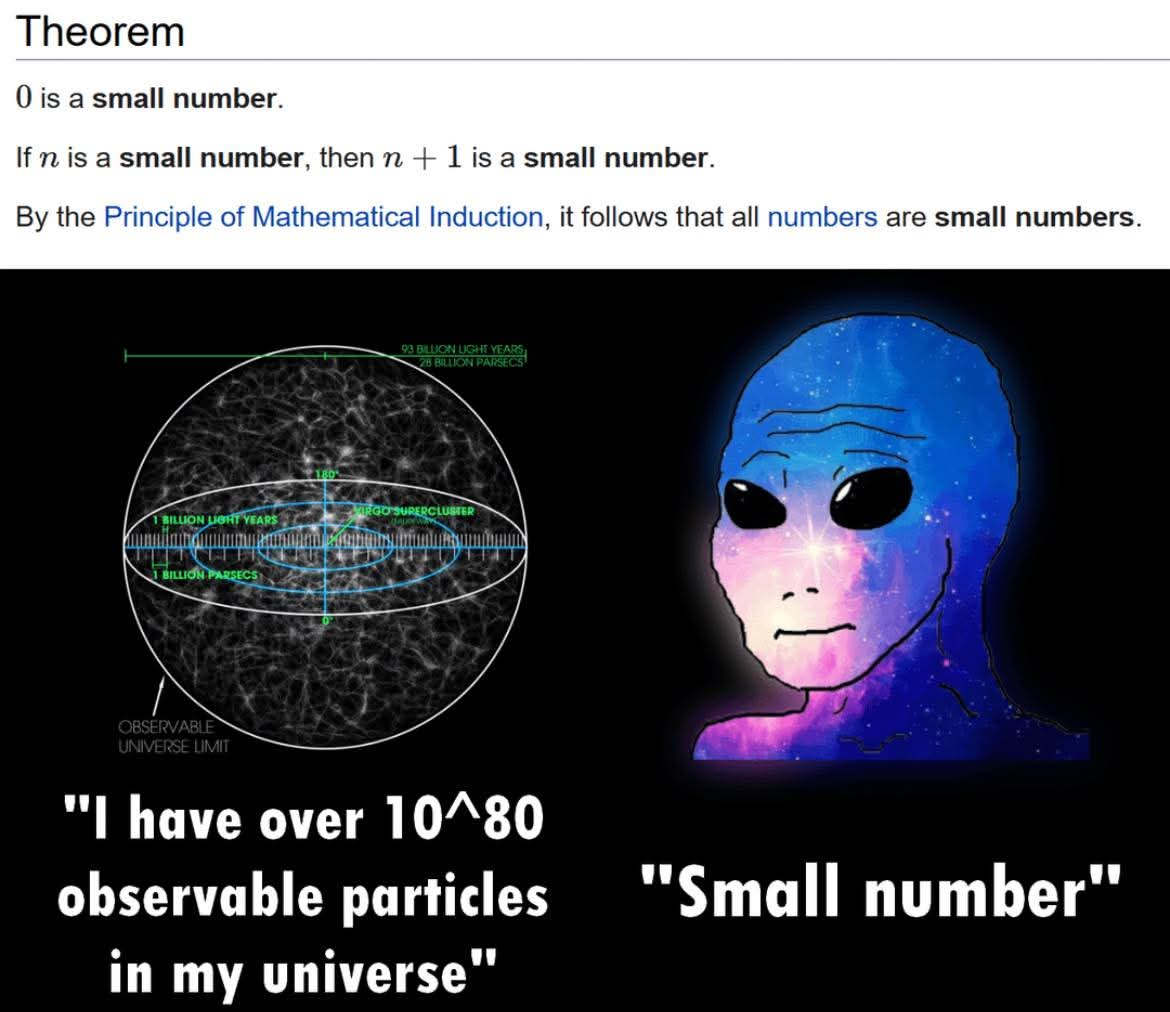
▲ 214 ▼ Those are rookie numbers (fedit.pl) submitted 1 year ago by Kierunkowy74@fedit.pl to c/mathmemes@lemmy.blahaj.zone 26 comments fedilink hide all child comments
[–] 5714@lemmy.dbzer0.com 9 points 1 year ago (4 children) I don't think you can induce all numbers from n+1 permalink fedilink source hideshow 4 child comments replies: [–] AnarchoEngineer@lemmy.dbzer0.com 9 points 1 year ago True, You can only induce natural numbers from this. However, you could extend it to the positive reals by saying [0,1) is a small number. And building induction on all of those. You could cover negative and even complex numbers if “small” is a reference to magnitude of a vector, but that is a slippery slope… In a very not rigorous way, you can cover combinations of ordinal numbers and even non-numbers if you treat them as orthogonal “unit vectors” and the composite “number” as a vector in an infinite vector space which again allows you to specify smallness as a reference to magnitude like we did for the complex numbers. If you multiply two not really numbers, just count the product as a new dimension for the vector. Same with exponentiation. Same with non math shit like a cow or the color orange. Count all unique things as a unique dimension to a vector then by our little vector magnitude hack, everything is a small number, even things that aren’t numbers. QED. This proof is a joke, broken in many ways, but the most interesting is the question of if you can actually have a vector with an uncountably infinite (or higher ordinals) of dimensions and what the hell that even means. permalink fedilink source parent [–] BodilessGaze@sh.itjust.works 5 points 1 year ago* (2 children) Sure you can. Proof: 0 is a number. If n is a number, n+1 is also a number. Therefore, by mathematical induction, we can induce all numbers. permalink fedilink source parent hideshow 2 child comments replies: [–] 5714@lemmy.dbzer0.com 1 point 1 year ago Weird. There are no numbers that can't be added. I wanted that. permalink fedilink source parent [–] BlackRoseAmongThorns@slrpnk.net 5 points 1 year ago ☝🏽🤓 The naturals are hardly all numbers, considering they're only a countably infinite subset of the reals. permalink fedilink source parent
[–] AnarchoEngineer@lemmy.dbzer0.com 9 points 1 year ago True, You can only induce natural numbers from this. However, you could extend it to the positive reals by saying [0,1) is a small number. And building induction on all of those. You could cover negative and even complex numbers if “small” is a reference to magnitude of a vector, but that is a slippery slope… In a very not rigorous way, you can cover combinations of ordinal numbers and even non-numbers if you treat them as orthogonal “unit vectors” and the composite “number” as a vector in an infinite vector space which again allows you to specify smallness as a reference to magnitude like we did for the complex numbers. If you multiply two not really numbers, just count the product as a new dimension for the vector. Same with exponentiation. Same with non math shit like a cow or the color orange. Count all unique things as a unique dimension to a vector then by our little vector magnitude hack, everything is a small number, even things that aren’t numbers. QED. This proof is a joke, broken in many ways, but the most interesting is the question of if you can actually have a vector with an uncountably infinite (or higher ordinals) of dimensions and what the hell that even means. permalink fedilink source parent
[–] BodilessGaze@sh.itjust.works 5 points 1 year ago* (2 children) Sure you can. Proof: 0 is a number. If n is a number, n+1 is also a number. Therefore, by mathematical induction, we can induce all numbers. permalink fedilink source parent hideshow 2 child comments replies: [–] 5714@lemmy.dbzer0.com 1 point 1 year ago Weird. There are no numbers that can't be added. I wanted that. permalink fedilink source parent [–] BlackRoseAmongThorns@slrpnk.net 5 points 1 year ago ☝🏽🤓 The naturals are hardly all numbers, considering they're only a countably infinite subset of the reals. permalink fedilink source parent
[–] 5714@lemmy.dbzer0.com 1 point 1 year ago Weird. There are no numbers that can't be added. I wanted that. permalink fedilink source parent
[–] BlackRoseAmongThorns@slrpnk.net 5 points 1 year ago ☝🏽🤓 The naturals are hardly all numbers, considering they're only a countably infinite subset of the reals. permalink fedilink source parent