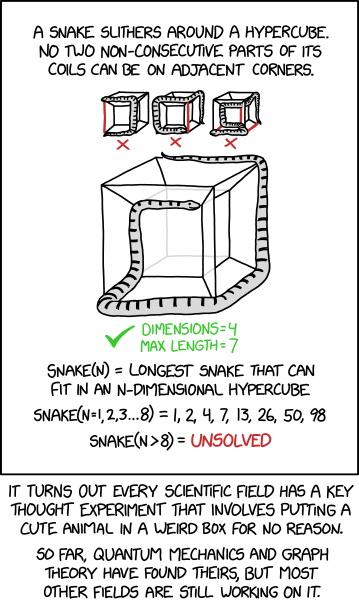
Randall forgot psychology, which has involved a ton of putting animals in boxes...
post
What about goats in circular pens? A goat is tied to the fence of a circular pen. How long does the rope need to be so that the goat can reach exactly half of the pen's area? What sounds like a high school math problem was eventually solved in 2020 via complex analysis.
Here's the answer:

I feel like the answer should be much simpler than that equation salad.
The difficulty is that the goat is tied to the fence.
It would be a lot easier to put a pole in the center of the circle.
The length of the rope would then be 0.5 x sqr(2) x fence radius.
Equation salad? It's elegant. Well, according to my father who was a math professor.
Deriving that monstrosity must be something out of a grad school horror novel.
What's really neat about this problem is that the 3D example, a bird in a cage, was solved sooner and is much simpler
I guess a key thought experiment doesn’t qualify as a reason, and also we are supposed to conveniently forget about putting spherical cows in a vacuum just because.
I'd expect something around ~200 for n=9 and ~400 for n=10, but I imagine this is too big to be brute forced by raw computing
Some lower bounds have been established: https://oeis.org/A099155
I'd think that it's not "too much to be brute forced", but probably no one has thrown enough resources at that recently
Some trivial bounds: F(n-1) + 1 <= F(n) <= F(n-1) * 2 + 1.
Also F(n) <= 2^(n-1)
In biology it’s less of a “thought” experiment

Either I'm misunderstanding the problem or a length of 8 is possible.
Edit: found my mistake, far left edge has two non-consecutive segments on adjacent corners. Leaving this up in case anyone else tries for a better score.

This should do it, or am I missing something?
I'm just nodding along and hoping no one notices i don't know what's happening
Unless your snake is an ouroboros, I don't think folks will count the head and tail as consecutive
Took me a while to follow that too! The three examples of fails at the top each show instances where there are non-consecutive parts of the snake on adjacent corners - it's the lines highlighted in red.
Basically no two parts of the snake that aren't directly joined to each other in the snake are allowed to be on corners which are only a line apart.
I think.
Any two coils that are not directly connected. For example, suppose we number from the head, coil 1, 2, 3, 4. Then pairs that are not directly connected are: (1, 3), (1, 4), (2, 4). The endpoints of these pairs of segments cannot be connected by an edge of the cube.

all 34 comments