There is no alternative for Europe to US Big Tech? Right now, most of EU authorities money goes to the US, but let's look at the future!Last week, two European countries answered that question very differently, setting the course for years to come. Let's look at the tenders!🇬🇷 Greece opened a tender to keep its government cloud on Microsoft Azure.Up to €190M. For 2 more years.🇩🇪 6 German states chose a European school cloud: IONOS, built on @nextcloud Up to €67,5M for 4 years.1/2
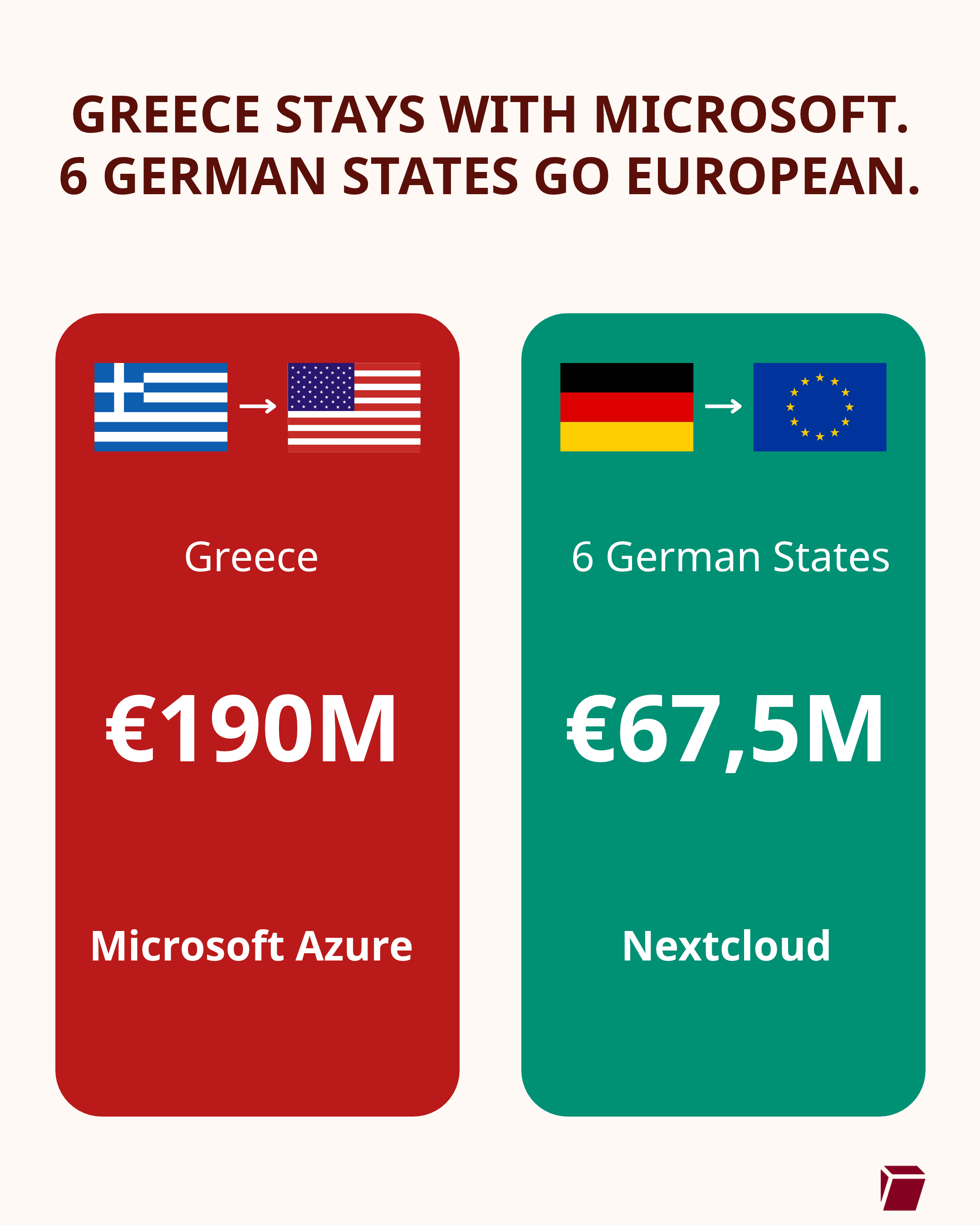
GREECE STAYS WITH MICROSOFT.
6 GERMAN STATES GO EUROPEAN.
Greece: 190M euros to Microsoft Azure

6 German States €67.5M to Nextcloud

all 5 comments

sorted by: hot top controversial new old
[–] 1 point 1 day ago

@Tutanota @nextcloud The contrast is striking — Greece locking in €190M for two more years on Azure, while six German states put €67.5M into a European stack built on Nextcloud. Procurement like this is where digital sovereignty is actually decided, not in speeches. Curious to see part 2 and whether the German model proves replicable elsewhere.

  • source
  • [–] [S] 1 point 1 day ago

    But much more is possible!Organisations in Europe pay €264 billion a year for US software and cloud, according to a French study. That's more than the entire 2025 EU budget of €193 billion!If we want European #sovereignty, we have to start buying it. Every tender is a vote. Let's go, Europe! 🚀 🇪🇺 2/2

  • source
  • [–] 1 point 1 day ago

    @Tutanota @nextcloud Deciding what to do in the public sector has to take into account the bigger picture. The US (and Israel, for that matter) is strategic to Greece's nat. security, and Greece values that enormously, despite how unpopular the US (and Israeli) government may be with the Greek people.So, while I applaud going with #opensource #European solutions, political reality is much more complicated than what's presented here.

  • source
  • @Tutanota@baskin εμεις τα εχουμε και τα σκαμε. Αμ πως.@nextcloud

  • source
  • [–] 1 point 21 hours ago

    @Tutanota @nextcloud It is the only way to go. Microsoft has just invested too much money in the bubble, which is becoming more and more questionable. Remember the recent disastrous outages? They could happen here also.

  • source