you are viewing a single comment's thread
view the rest of the comments
[–] 30 points 1 year ago (12 children)

Electric cars also reduce particulate dust. Because of regenerative braking they need to brake less often and less agressive. There was a study published just kadt week.

  • source
  • hideshow 12 child comments
  • [–] 21 points 1 year ago (2 children)

    Also noise pollution. Under 35 mph, most car noise is engine noise.

  • source
  • parent
  • hideshow 2 child comments
  • [–] 1 point 1 year ago

    eeeh, i don't think this is a particularly noticable benefit.
    The amount of noise given off by cars at those speeds is just an annoyance, the real problem is the tyre noise at high speeds and that's only made worse by electric cars.
    They recently lowered the speed on a through-road near me from 70km/h to 60km/h and it made a pretty huge difference in how tolerable it is to be anywhere near the road, the difference between a combustion and an electric car driving on a residential street is so much smaller that it's not even funny.

  • source
  • parent
  • [–] 4 points 1 year ago (2 children)

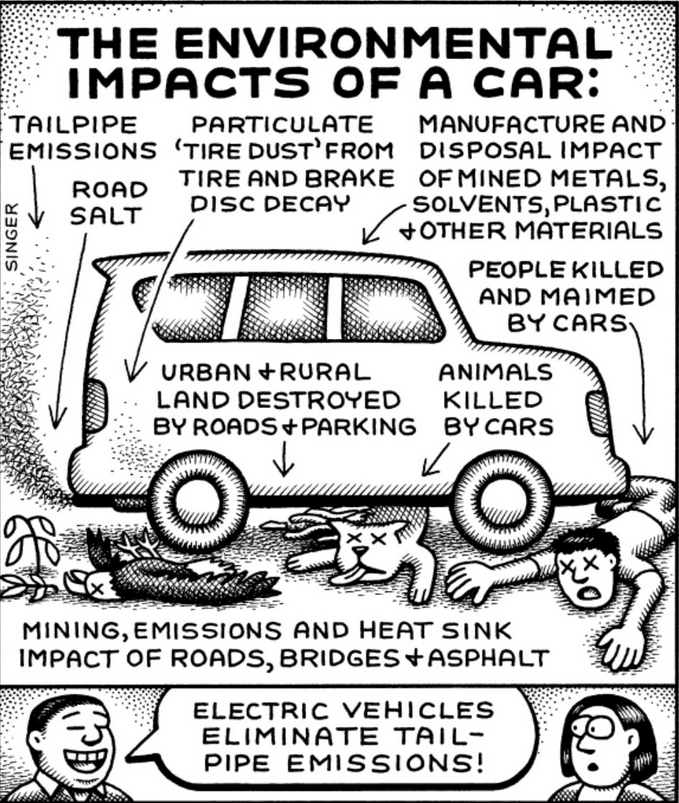
    But they increase particulate tire dust due to being heavier.

  • source
  • parent
  • hideshow 2 child comments
  • [–] 5 points 1 year ago (1 child)

    Yes, but it seems from the study that the increase in tire dust is smaller than the refuction in brake dust

  • source
  • parent
  • hideshow 1 child comment
  • [–] 4 points 1 year ago

    Brakes are iron and copper, the latter is an environmental contaminant. But tires pollute zinc and a hundred other petrochemicals. One is causing big problems with fish - 6PPD, but there are likely others causing yet unseen damage. Between the two brake dust seems more manageable in stormwater.

  • source
  • parent
  • [–] 4 points 1 year ago (5 children)

    Ooh cool, would love to see that paper.

  • source
  • parent
  • hideshow 5 child comments
  • [–] 8 points 1 year ago (1 child)
  • [–] 4 points 1 year ago* (last edited 1 year ago)

    Yay! Thank you! Adding it to the archive. I keep my car in the level 3 regeneration, so mostly "coast" up to the stop. I'm glad to see such significant reduction. Also because I breath a lot of that dust when I'm cycling, less particulates = better.

    Edit: Some key findings from the paper:

    Key finding #3.8: As the level of electrification of a vehicle rises, the dependence on regenerative braking also increases, thus lowering PM emissions from brake wear. Based on recent evidence [30], regenerative braking can reduce, in the worst- case scenario (i.e. highest usage of mechanical brakes or equivalently lowest usage of regenerative braking), brake wear emissions by 10-48% for hybrid electric vehicles (HEVs), 66% for plug-in hybrid electric vehicles (PHEVs), and 83% for battery electric vehicles (BEVs)

    Key finding #3.13: Vehicle weight is directly proportional to tyre wear emissions. For example, a car with a 20% higher mass demonstrated a 20% increase in tyre wear [13]. Electric cars are around 20% heavier than the equivalent conventional cars, so they emit around 20% more tyre wear [40], [42], [43].

  • source
  • parent
  • [–] 8 points 1 year ago (2 children)

    Im curious if the additional weight of EVs causes more tire wear and ends up negating any savings from the brake dust. We also have to consider manufacturing and disposal of both vehicles to be truly fair.

  • source
  • parent
  • hideshow 2 child comments
  • [–] 9 points 1 year ago* (last edited 1 year ago)

    That and the increased road wear which grows exponentially (with the fourth power of axle weight) with the weight of the vehicle. That means a 2 ton car does 16 times more road damage than a 1 ton car. And before someone takes this to mean I prefer to not have EVs on the road, NO, I mean that this is a fact and we have to deal with it somehow while eliminating ICE. For example by making lower range EVs more attractive, since they already are acceptable in practice for a large proportion of road users. Going from ICE cars to ICE trucks, a common trend, is even worse in this regard since it adds significant emissions on top.

  • source
  • parent
  • [–] 5 points 1 year ago

    The additional weight, yes, as posted by @avidamoeba. Tho' those are different things, apples to oranges - brake dust and tire dust are not the same. With the power that some EVs have it's really easy to accelerate rapidly leading to faster tire wear. That is a choice made by the driver. I put my EV in eco mode, and gently accelerate. And try to ride my bike as much as possible, instead of my car. On the bike, I often try to accelerate as fast as possible, for cardiovascular and other health reasons, including just plain having fun!

  • source
  • parent