Tootsie Rolls came out in 1907, and are a very... polarizing... candy, with fans and others who find them loathsome. They sell about 65 million per year, though some of those may be Halloween treats which filter to the bottom of a kid's haul and go stale.
Since 1931, they also sold Tootsie Pops. A 1970+ ad campaign asked, "How many licks does it take to get to the tootsie roll center of a tootsie pop?" (youtube link). Wikipedia alleges this is the longest running ad in US TV history. The matter has also been studied at universities:
In 2014, the Tribology Laboratory at the University of Florida published a study examining the coupled effects of biology, corrosion, and mechanical agitation on the wear of Tootsie Roll Pops. ... The number of licks required to reach the center, based on equatorial cross-section data, was found to be nearly independent of the licking style with the one-sided approach requiring 195±18 licks and the full-surface approach requiring 184±33. Detailed examination of the lollipops indicates that the minimum candy shell thickness is rarely (if ever) located along the equator. Using the global minimum distance resulted in a calculated 130±29 licks to reach the center, independent of licking style.
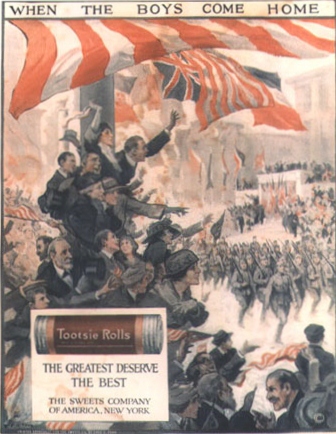
Here is a 1918 ad from near the end of WW-I.
Unknown date ad, possibly 1950s.

