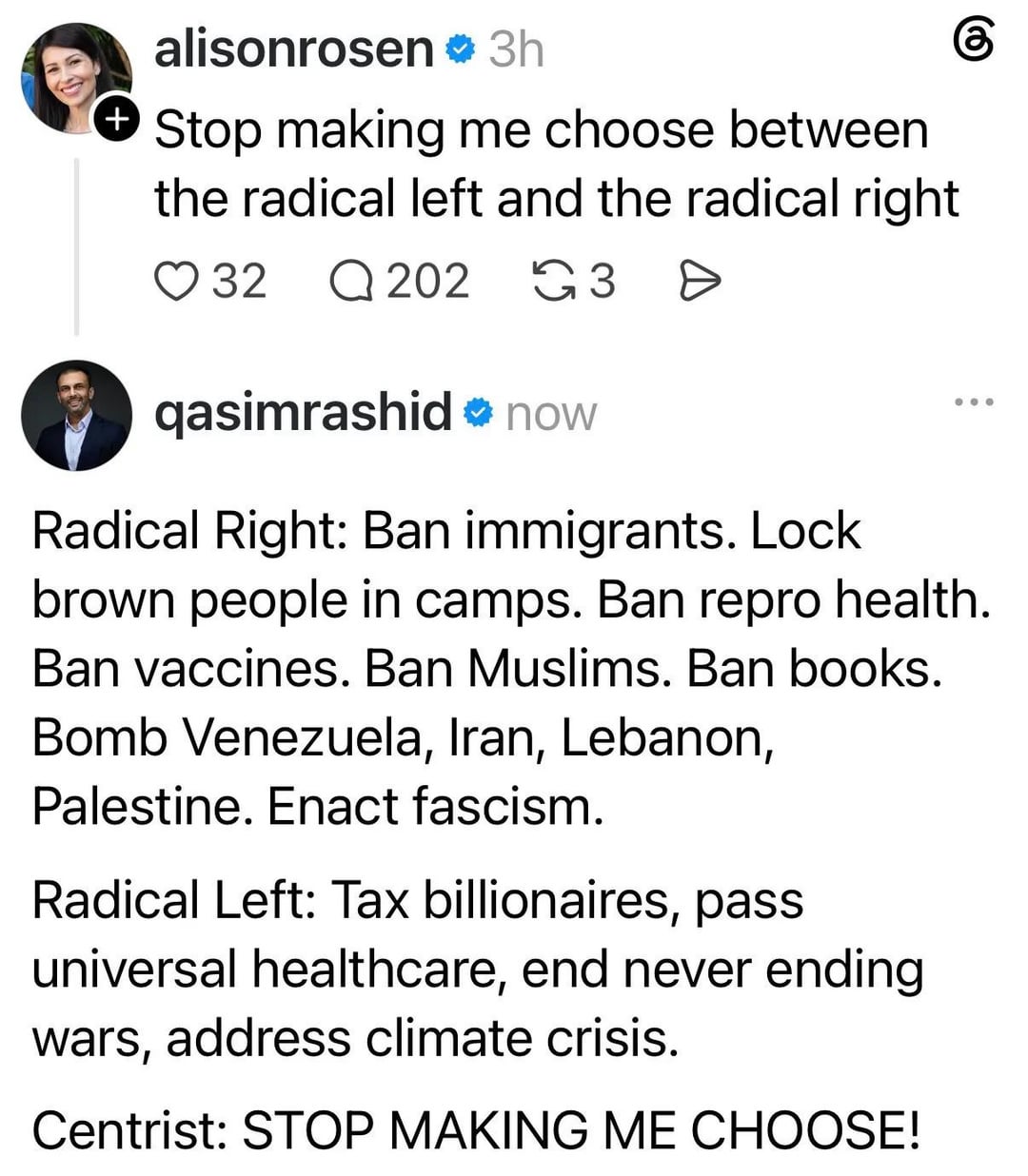
I agree that they're closer to fascists. I've tried explaining that to them but they get all up in arms about how their ideologies differ. I tell them it doesn't matter, because their methodologies are the same, but they just dig in with the strawman, red herring, sea lion combo and claim over and over again that I'm an uneducated idiot who doesn't know the difference between fascism and communism.
(I tend to refer to their beliefs as bolshevism though, because after all that's what ML is. Nothing like Marxism or really any other kind of communism. And their only response to that is to try to glaze the bolsheviks because they can't even deny that that's what they are).
And yes, US politics are overly reductive, but I find that inevitable in a two-party, FPTP system. I've been pointing that out for years, since even before I fully understood it. I've learned a lot in the time since and changed my opinions on various things, but the underlying intuition that something was deeply wrong with a two-party political system at least was correct.
And libertarian is such a loaded term because of its association with right-wing libertarian capitalists. But libertarian and liberal are too distinct concepts, although it could be argued that they're related. Liberal is another loaded term though, and often gets conflated with neoliberal (which is an illiberal and conservative economic policy).
In short though, the libertarian-authoritarian axis on the political matrix is not what most people think of when they hear "libertarian," even though according to that schema, anarcho-syndicalists would fall all the way on the libertarian side of the spectrum.
Oh and for what it's worth, I think we could divide the horizontal spectrum into at least seven segments: (from proximal to lateral) "Centrist," "Center-(L/R)", "Moderate (L/R)", and "Radical (or far-) (L/R)".
Anything beyond radical would be extremist, and falls outside of the political domain so isn't on this spectrum.
The difference between moderate and center- would be that the Moderates in this interpretation would be the meat and potatoes of representing the values and priorities of that side of the spectrum, neither too rash nor overly compromising, whereas the Center-(L/R)s would be the next thing to centrists, only barely distinguishing themselves as falling to one side or the other, and more prone to compromising and appeasement.
The problem with this interpretation though is that many of these terms are already so loaded in the current political environment, it would be difficult to give them technical definitions that don't provoke emotional responses and knee-jerk reactions...