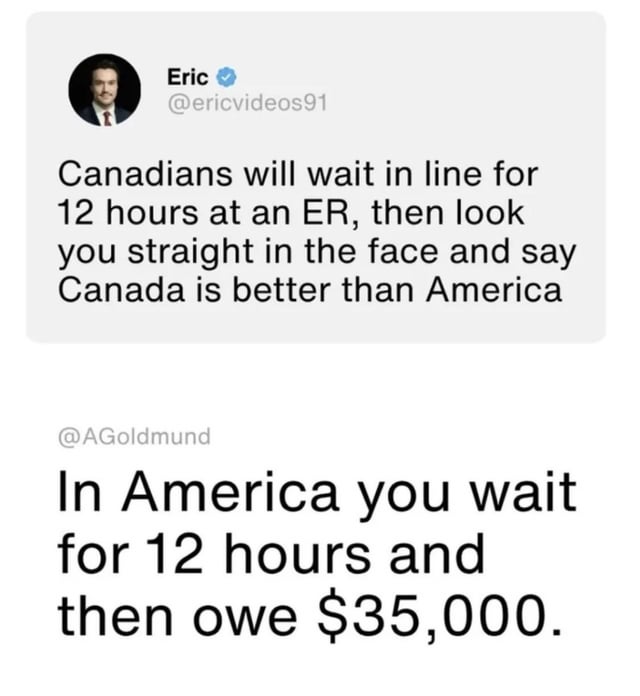
In some sense the US system is more reflective of the "true" cost of healthcare, just in the least humane way possible.
Take a country with "bad" socialized healthcare: Patient pays some percentage of visit cost, government pays the rest.
You break your leg: ambulance with two EMTs is $100/hr, 2 x-rays at $10/per, $30 in assorted bandages and plaster, and $150/hr for a doctor. Total patient cost: some percentage of $300.
The US system charges all those, but also reflects the cost of those things existing and being available as reflected in patient usage. The socialized system sees the ambulance ride as distinct from when the community needs a new ambulance, or the cost of having EMTs available 24/7/365.
Likewise, you get charged not just for the bandaging, but the cost of the person who brought the bandage to the nurse applying them, the cost of the person tracking the inventory, and the cost of the nurse isn't included in the medical care. Your room isn't charged as a room but as the room plus the services of everyone who keeps a hospital room ready to go.
A socialized system just happily says "of course a hospital needs skilled janitors and maintenance people, but only an idiot would call what they do patient care"
No one notices the cost of every hospital janitor and HVAC specialist in an entire country being divided amongst the entire tax base. You do when your share of the salary of all of them at your local hospital gets added to a bill addressed to you.
Our system is the way it is because otherwise no one pays for the pharmacist, and insurance caps things weirdly. Also, you have to multiply everything by 3 because the insurance company will refuse to pay anything above 1/3 of "list" price.
It may be outstandingly cruel, but it is good also terrible at providing cost transparency. Which is worthless to everyone except accountants at work paying for healthcare.
So yeah. That's cheap, and the WTF goes deeper than most people can imagine.