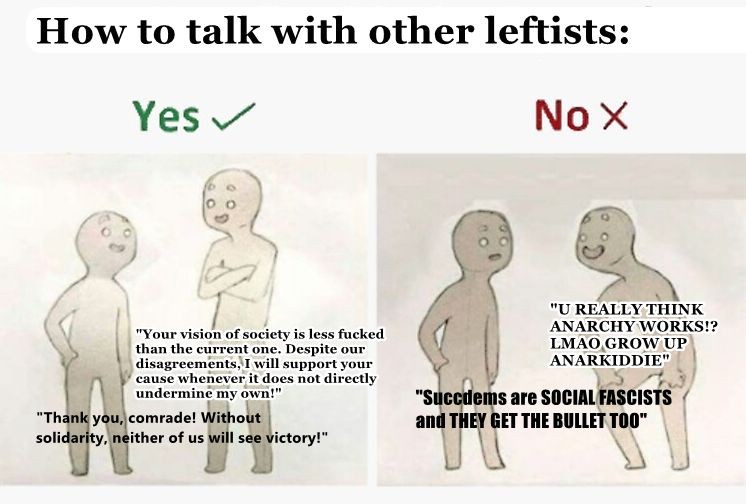
Solidarity is not just with members of your political 'tribe'! Allow a little leftist pluralism - we can support each other!
(media.piefed.social)
In general, it does.
The general basis of anarchist philosophy is a rejection of all hierarchies. These can be explicit hierarchies, like governments or private companies, but also things like white supremacy or transphobia that aren't always formally organized (even if they're often enforced by more formal organization).
Social workers often have to deal with that sort of tension, because their work almost always exists within a hierarchical way of doing things. Even the most well-meaning social workers have to operate under the logic of government. That way, it's unavoidable that they place themselves in a hierarchical relationship with their clients. Anarchists would prefer more cooperative models, primarily based on mutual aid.
As anarchists, we similarly can't avoid those hierarchies. Part of the anarchist critique of governments or capitalism isn't just that they oppress us, but also that they force us to oppress others. Most anarchists have to come to terms with this in order to find a job that they find bearable.